-
-
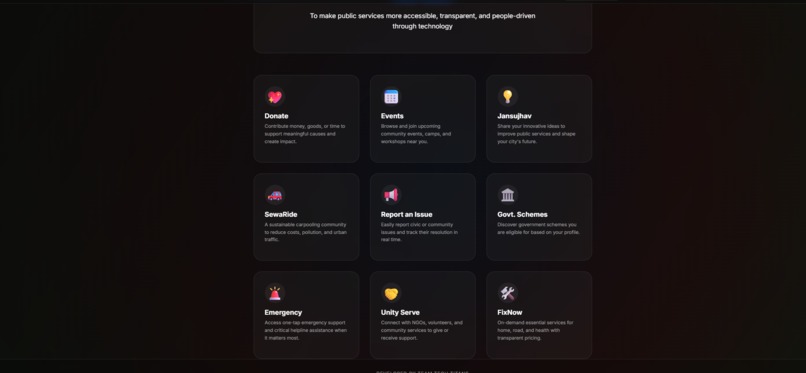
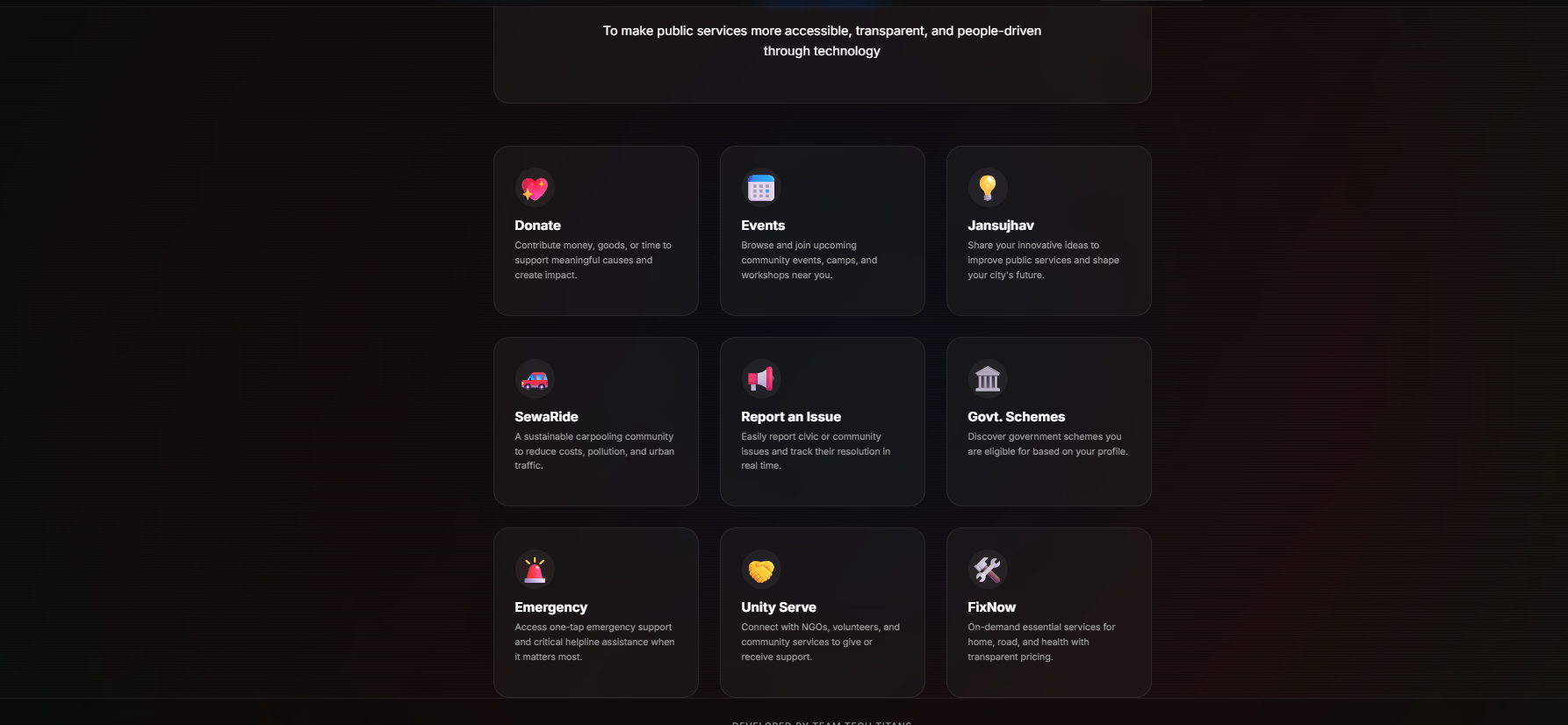
ui for our website
Project Story: SewaSahayak
SewaSahayak was inspired by a simple but powerful observation: citizens often struggle not because services do not exist, but because access to them is fragmented, confusing, and time-consuming. While observing everyday issues such as difficulty in finding the right government scheme, delays in reporting civic problems, or lack of coordination during emergencies, it became clear that there was no single, citizen-centric digital bridge connecting people, communities, and public services. This gap motivated the idea of building one unified platform that puts citizens at the center of governance.
Through this project, I learned that technology alone is not enough; empathy and clarity are just as important. Designing for public services taught me how diverse user needs can be, especially when considering language, accessibility, and trust. I also learned how AI can be applied responsibly to simplify decision-making, such as matching users with eligible schemes or prioritizing reported issues based on urgency. From a technical perspective, I gained hands-on experience with full-stack development, Firebase integration, and structuring modular features that can scale over time.
The project was built as a web-based platform using modern frontend components for a clean, intuitive interface and Firebase for authentication, database, and hosting. Each feature—such as scheme discovery, issue reporting, emergency support, and community services—was designed as an independent yet connected module. AI logic was introduced to personalize recommendations and improve response efficiency. Conceptually, the system works like a unified function: [ \text{Citizen Needs} \xrightarrow{\text{AI + Platform}} \text{Right Service at the Right Time} ] This approach helped keep the architecture simple while ensuring impact across multiple civic use cases.
One of the biggest challenges was balancing ambition with feasibility. Integrating many features without breaking existing functionality required careful planning and debugging. Limited resources and working with free tools also meant optimizing performance and making thoughtful design trade-offs. Another challenge was ensuring the platform remained judge-friendly and realistic, avoiding over-promising while still showcasing innovation. Overcoming these challenges strengthened my problem-solving skills and reinforced the importance of iterative development.
Overall, SewaSahayak represents more than a project—it reflects a learning journey in building inclusive, scalable, and impact-driven technology for public good.

Log in or sign up for Devpost to join the conversation.