-
-
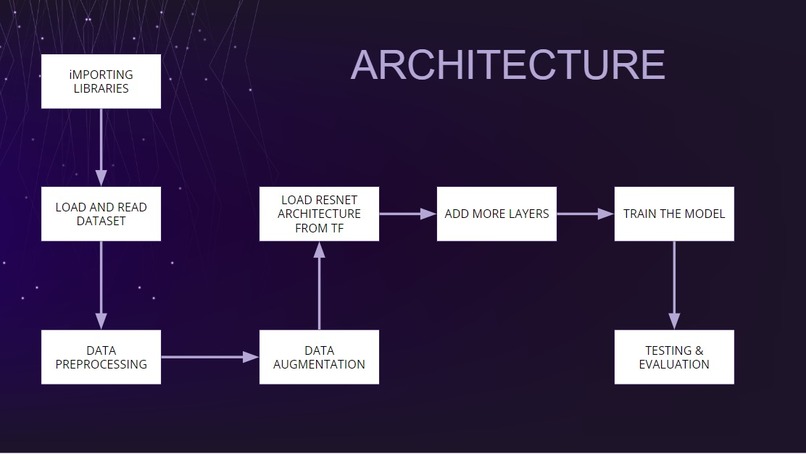
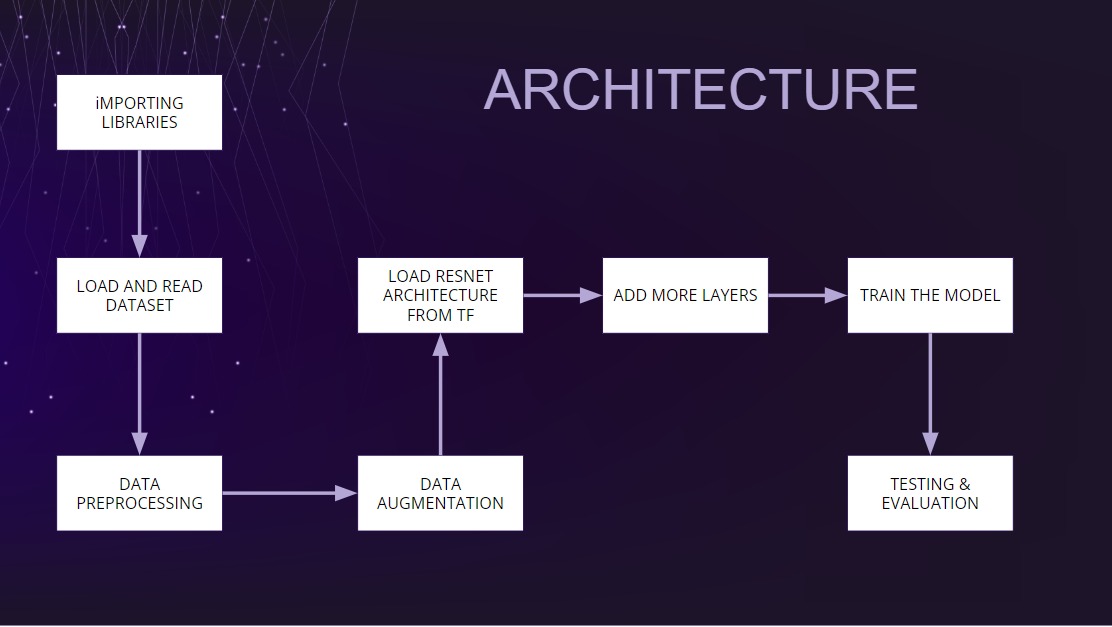
Architecture of the model
-
INSPIRATION:
Our team has a desire to make a difference in the lives of patients with Osteoarthritis (OA) which is a chronic degenerative joint disease that affects millions of people worldwide. Moreover, It causes difficult mobility, worsens in pain & Affects quality of life where there is no definite cure but only treatments to subdue. It is the most prevalent kind of arthritis that affects 7% of the global population, or over 500 million people worldwide. Osteoarthritis cases worldwide have grown by an estimated 132.2% since 1990. In India, 23.46 million in 1990 increased to 62.35 million in 2019. Annual incidence of knee OA is highest between 55 and 64 years old.
Our aim is to create deep learning models that can provide objective and consistent assessments of osteoarthritis severity, reducing the reliance on subjective evaluations by healthcare professionals.
WHAT WE LEARNED?
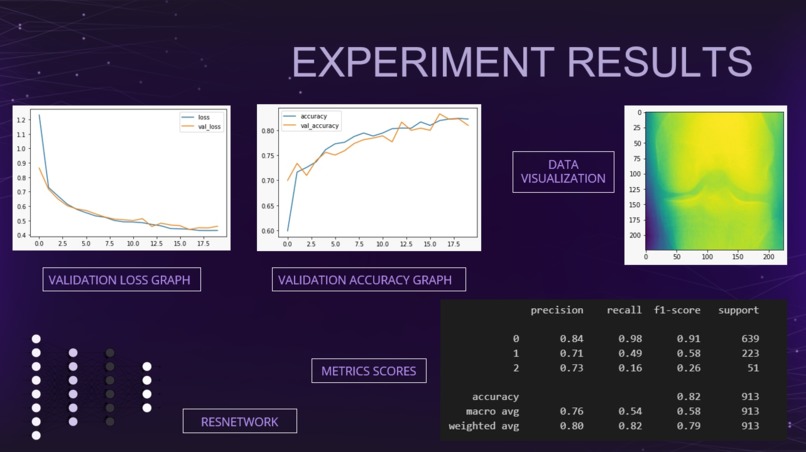
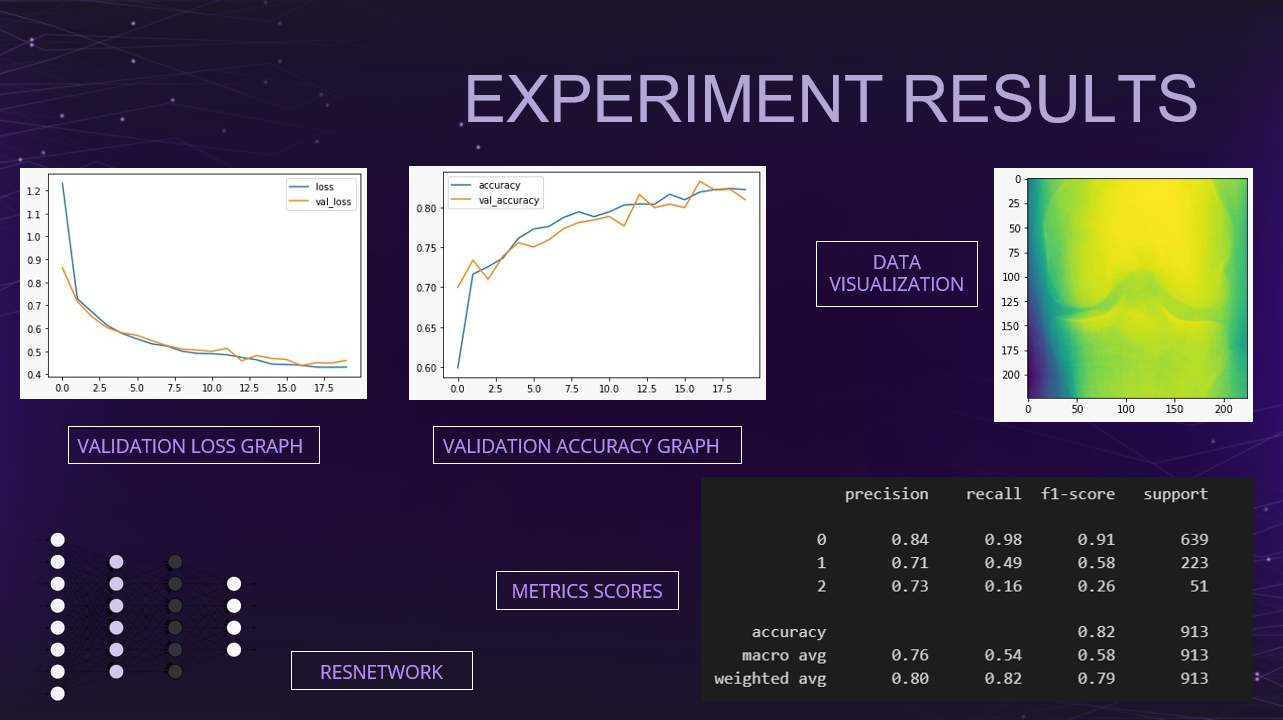
We trained three different models, CNN, Efficient net and RESNET. We learned that RESNET produced a much better accuracy score than CNN since it overcomes the "vanishing gradient" problem, making it possible to construct networks with up to thousands of convolutional layers. This outperforms shallower networks.
HOW WE BUILT?
We downloaded the dataset from Kaggle and preprocessed it. We generated more images using Imagedatagenerator for better results. The final dataset is fed into a resnet architecture base model imported from tensorflow. The huge amount of dataset is trained on both resnet, efficient net and CNN base models. We validate and evaluate the models and obtained the respective accuracy scores of 0.82, 0.69 and 0.56.
CHALLENGES WE FACED:
-> High computation time -> High latency -> Augmenting the dataset
FUTURE SCOPE:
-> Developing deep learning models that can grade the severity of osteoarthritis from multiple imaging -> modalities, such as X-rays, MRIs, and CT scans. -> Developing deep learning models that can be used to predict the progression of osteoarthritis over time. -> Using deep learning to develop personalized treatment plans for patients with osteoarthritis. -> Using deep learning to identify biomarkers of osteoarthritis severity and progression. -> Using deep learning to develop new diagnostic and therapeutic tools for osteoarthritis.


Log in or sign up for Devpost to join the conversation.