Inspiration
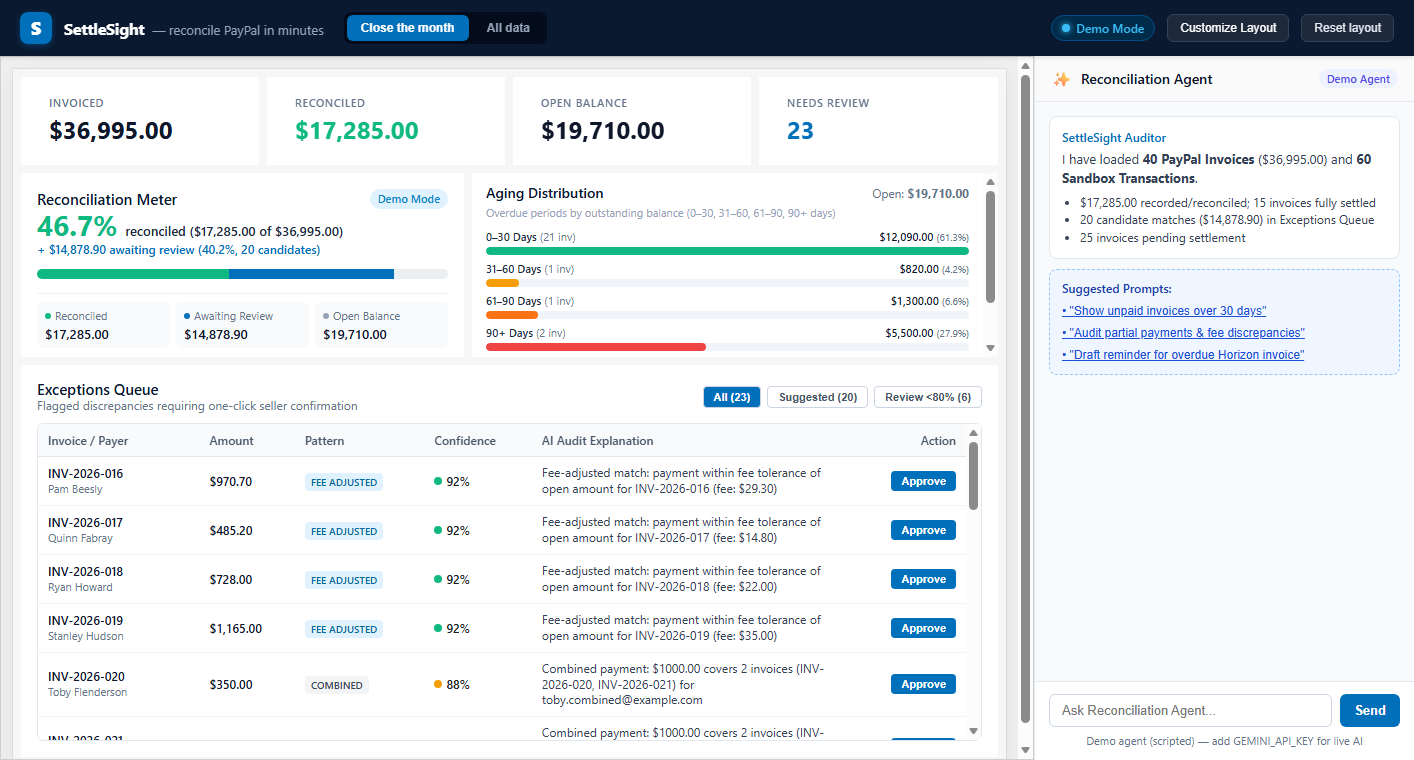
Month-end reconciliation involves more than matching totals. A bookkeeper needs to understand fee deductions, partial payments and conflicting candidates before approving them. SettleSight turns that review into a short conversation with visible evidence and an explicit confirmation step.
What it does
Ask for a month-end summary, review exceptions, explain a flagged invoice, draft a payment reminder, and approve a synthetic match after confirmation. A visible MCP trace shows the arguments and results behind each answer. The reconciliation meter updates after approval. Reminder tools produce drafts only.
The page is labelled Alexa+ (simulated). It is an independent browser experience, not native Alexa integration, an Alexa device skill, or an Amazon partnership. All demo invoices, identities and transactions are synthetic; approvals never write to PayPal.
How we built it
- Existing deterministic SettleSight engine: integer-cent accounting, allocation validation and evidence-based candidate matching.
- Official
@modelcontextprotocol/sdk1.32.1: five tools exposed through stateless Streamable HTTP, with JSON schemas and clear descriptions. - Browser SDK MCP client: initialization, discovery and tool calls; visible call trace.
- Gemini or NVIDIA Nemotron function calling through the existing server-side
LlmClientproxy. Credentials stay on the server. A separately labelled scripted mode supports offline rehearsal and uses the same real MCP tools. - Web Speech API recognition for push-to-talk where supported, a text fallback, and
speechSynthesisfor replies. Recognition may depend on browser/network support and microphone permission. - Vercel Node function handlers plus static builds. No database, AWS account or paid infrastructure is required for this synthetic demonstration.
What was updated after the submission period started
SettleSight existed before this entry as a PayPal reconciliation dashboard and agent. Its existing accounting engine, synthetic datasets, PayPal client and dashboard are reused; they are not claimed as new Alexa+ work.
2026-10-12: Added the mcp/ Streamable HTTP server, five MCP tools, literal confirm=true approval gate, SDK protocol/tool tests and a reproducible validator. Added the alexa-sim/ web experience, browser MCP client, server-side LLM proxy endpoint, function-calling loop, voice input/output, text fallback, explicit scripted rehearsal mode and tool trace. Added Vercel routing, separate simulation build scripts and this Amazon submission material. Existing src/match, src/agent, dashboard behavior and PayPal write-back paths were preserved.
Challenges and limitations
Stateless transport is compatible with serverless deployment, but demo approvals live only in process memory. Hosted cold starts or separate instances may reset or diverge; this is not a durable accounting system. The prototype has no real customer authentication, production storage or native Alexa runtime. Live LLM mode requires an existing eligible provider key and quota; scripted mode is clearly labelled and never presented as live inference. The Devpost entry still needs a deployed URL and an English public video under three minutes.
How to try it
npm ci
npm test
npm run build
npm run mcp
Open http://127.0.0.1:8790/alexa-sim/ in your browser. The MCP endpoint is available at http://127.0.0.1:8790/mcp. Check "Scripted demo (no LLM)" for offline rehearsal, or provide server-side GEMINI_API_KEY or NEBIUS_API_KEY in .env for live function calling. Run npm run mcp:validate to verify all five MCP tools and protocol negotiation, or run npm run video:amazon to generate the automated demo video.
Hosted demo:
Evidence and links
- Source: https://github.com/RyanDev1st/settlesight
- Local usage, deployment handoff and verification: README.md.
- SDK initialization and all tool-call output: protocol-output.txt.
- Local headless Edge screenshots: live Nemotron, scripted rehearsal.
- Actual live function-calling conversation: live-conversation.txt.
- Public deployment URL: pending Vercel import and hosted smoke test.
- Public video URL: pending recording/upload.
Next steps
Deploy and validate the public endpoints, record the review/confirm flow, then submit the Alexa+ track entry by 2026-10-24 02:00 ICT (internal target 2026-10-20). Durable per-user reconciliation and native Alexa integration are future work, not implemented claims.
Built With
- ag-studio
- gemini-api
- javascript
- model-context-protocol
- node.js
- nvidia-nemotron
- react
- typescript
- vercel
- web-speech-api


