-
-
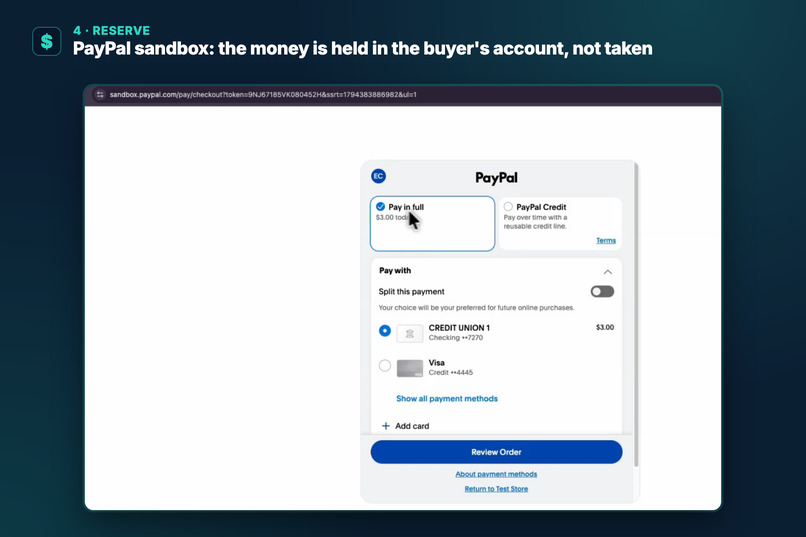
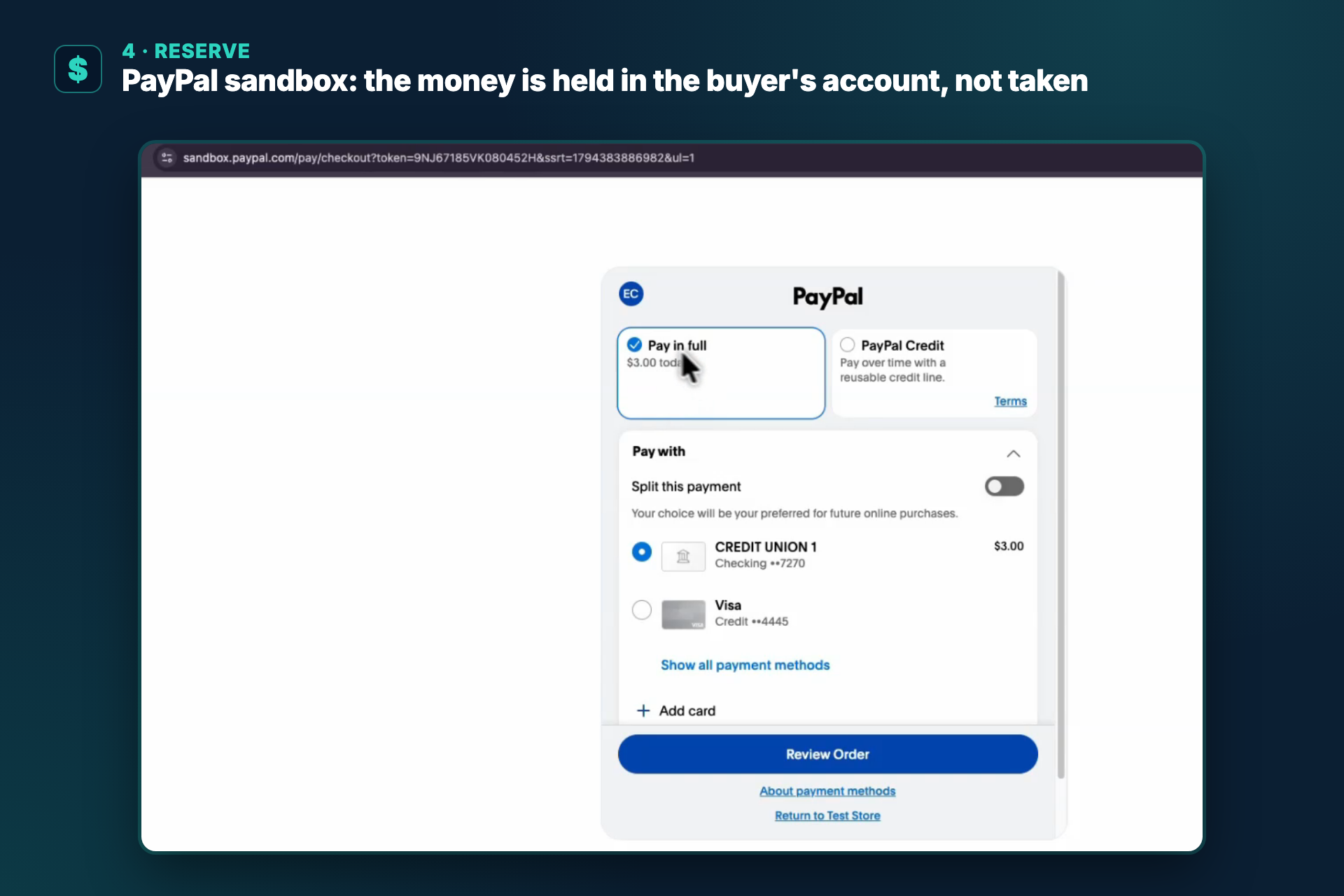
4. Reserve: the buyer approves $10 in the PayPal sandbox. The money is authorized, not captured: it stays in the buyer's own account.
-
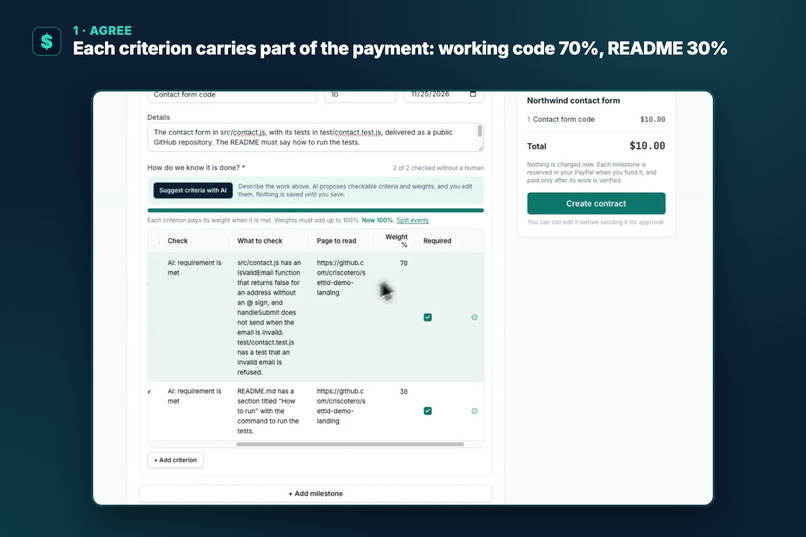
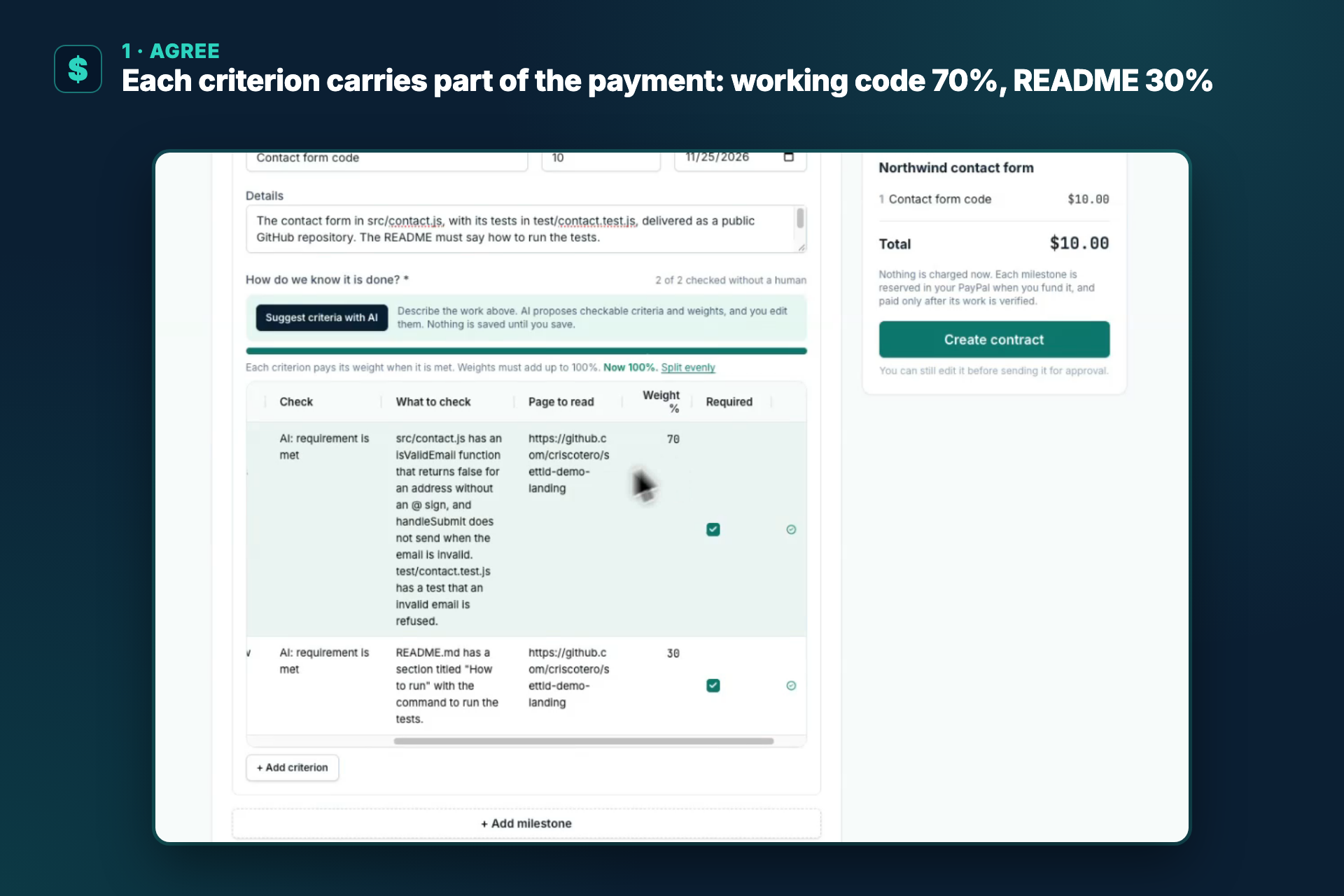
1. Agree: the buyer turns the job into checkable criteria, each worth part of the $10. Working code is 70%, the README with run steps 30%.
-
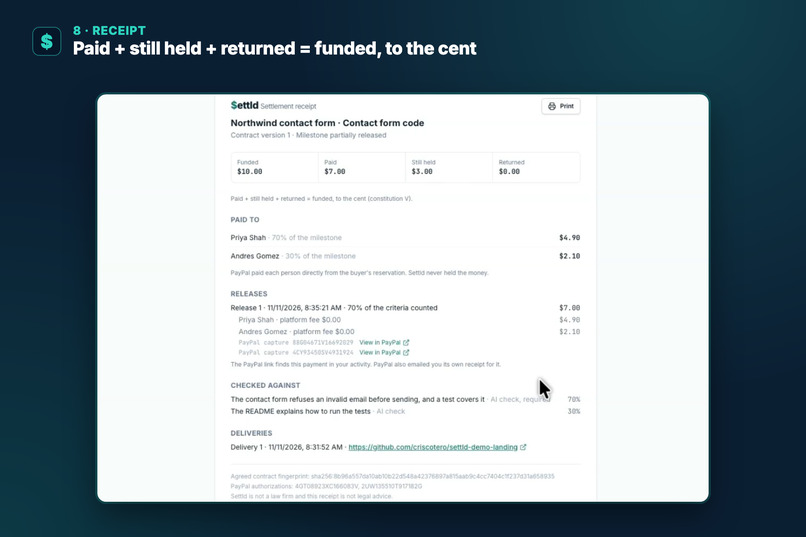
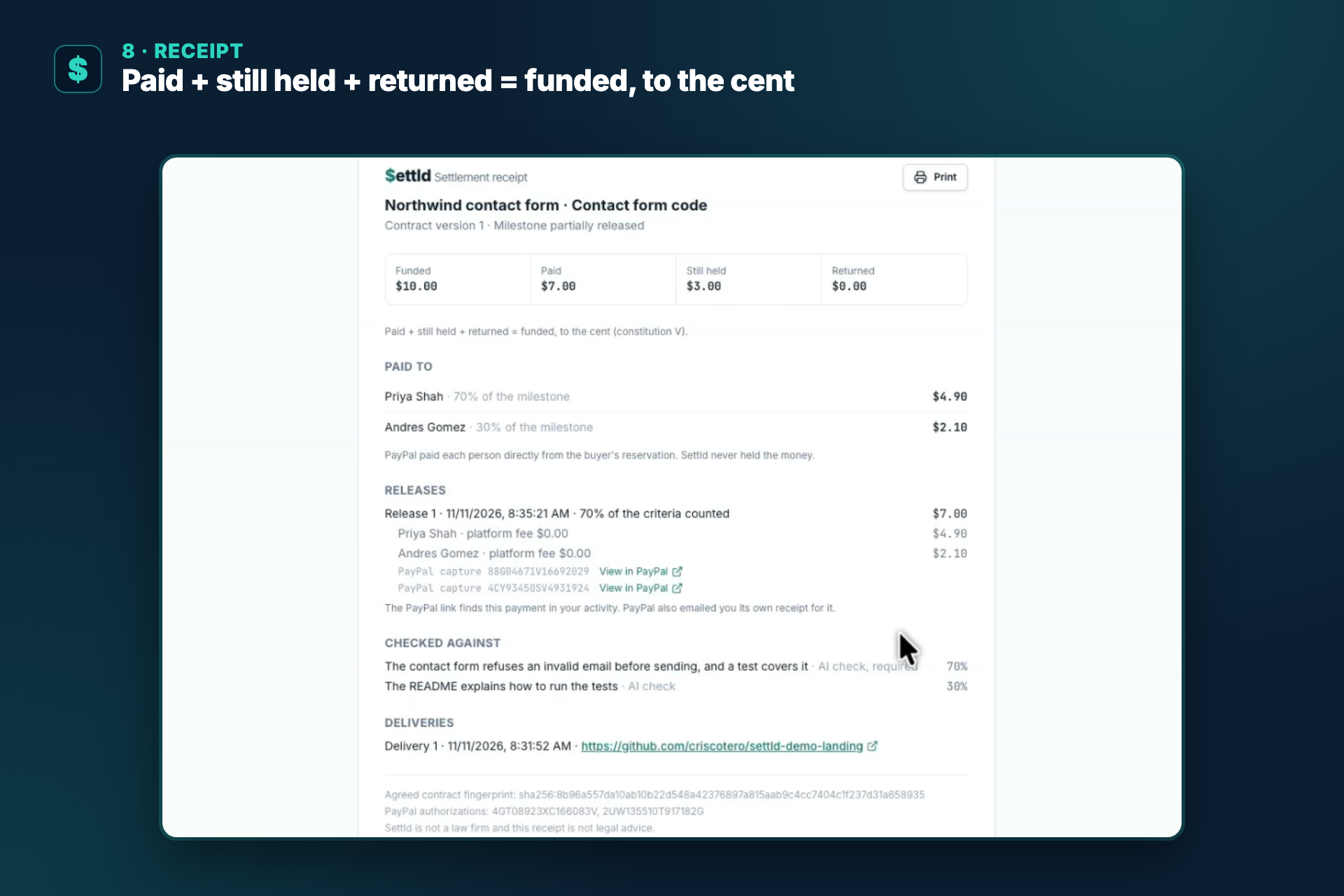
8. Receipt: every release balances to the cent. Paid + still held + returned always equals what was funded, with each PayPal capture ID.
-
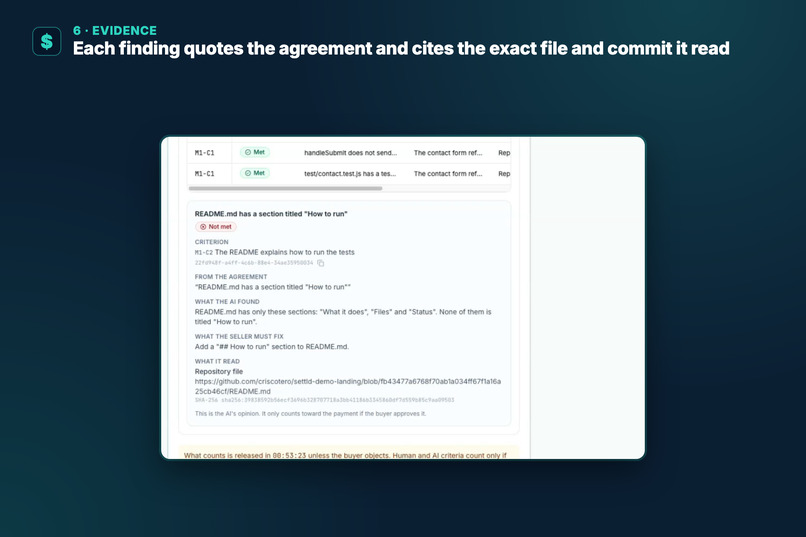
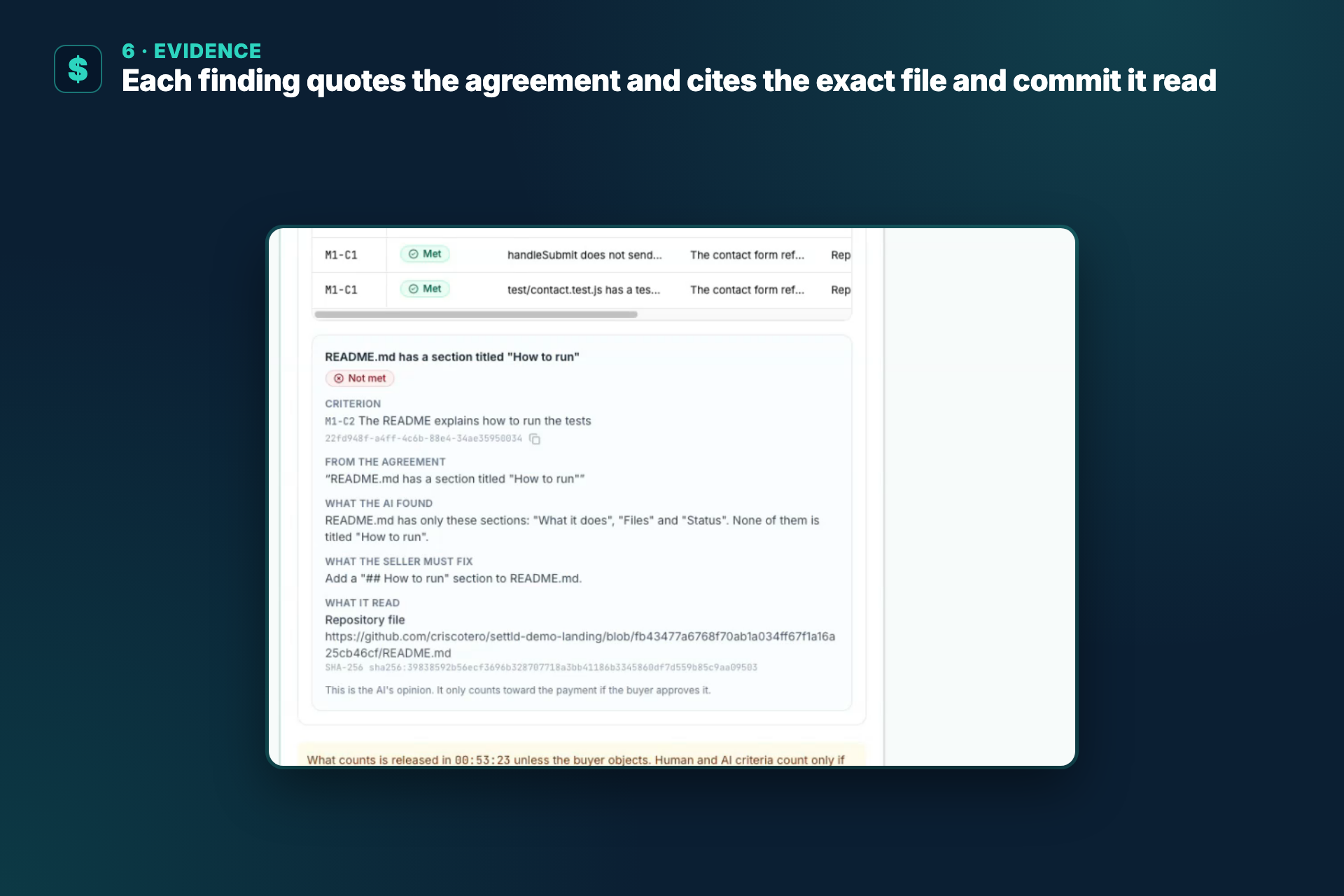
6. Evidence: each finding quotes the agreement, says what's missing and how to fix it, and cites the file and commit it
-
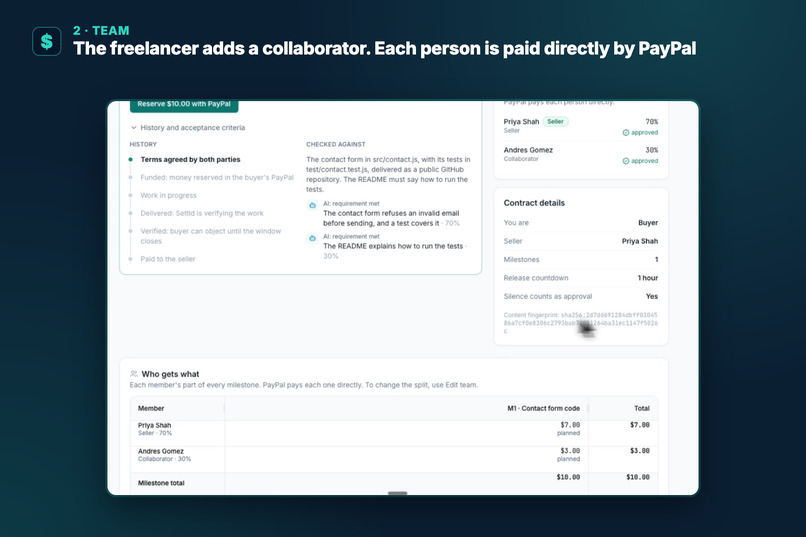
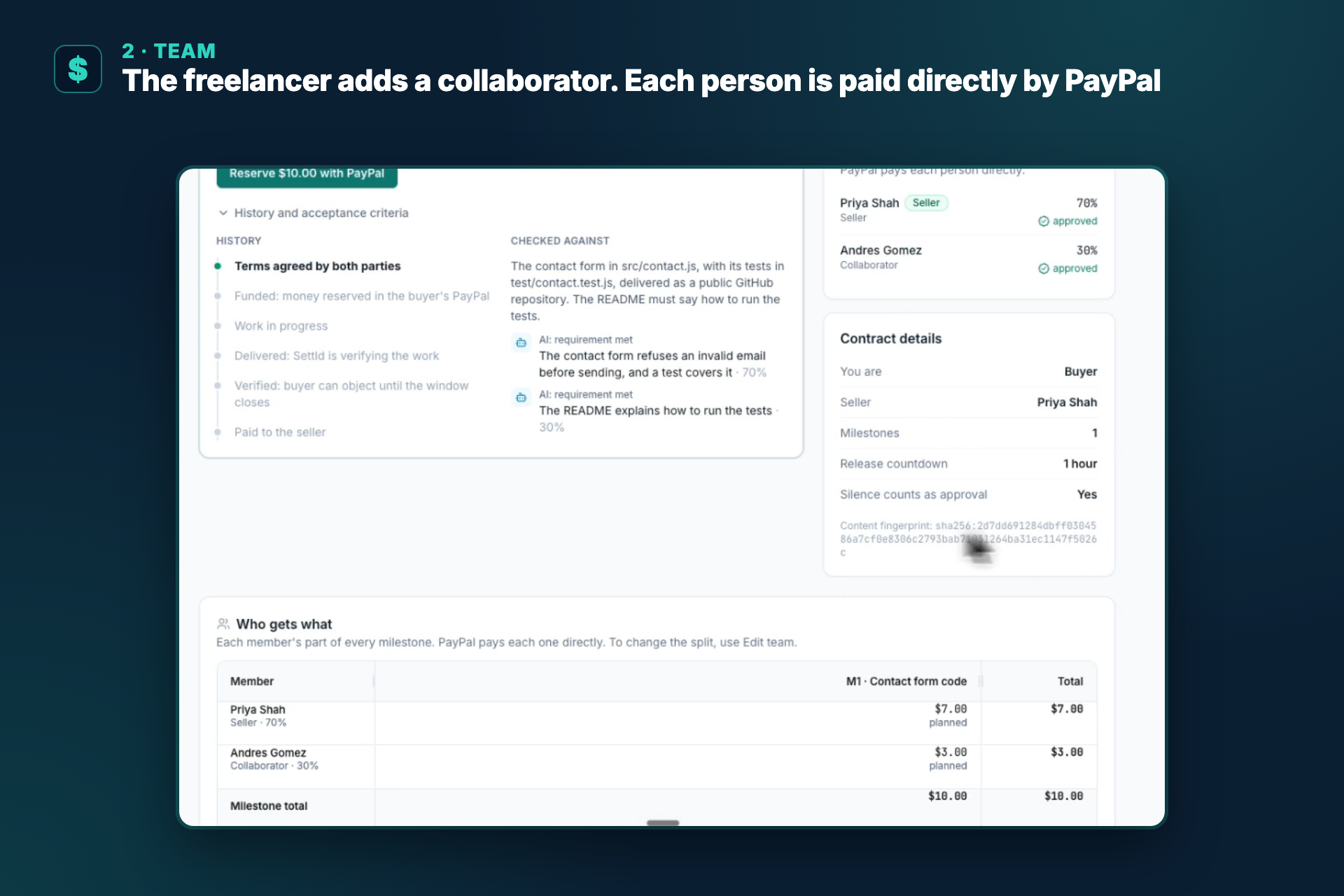
2. Team: the freelancer, Priya, accepts and adds a collaborator, Andres, at 70/30. PayPal pays each of them directly, not through Settld.
-
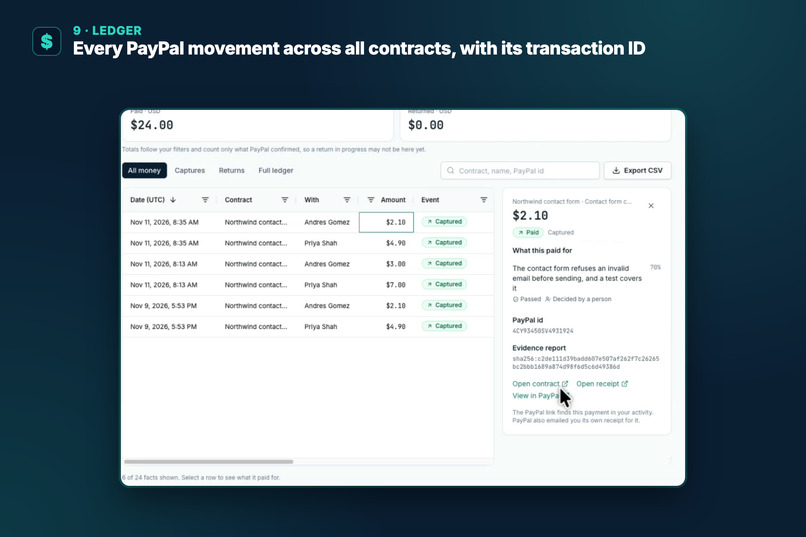
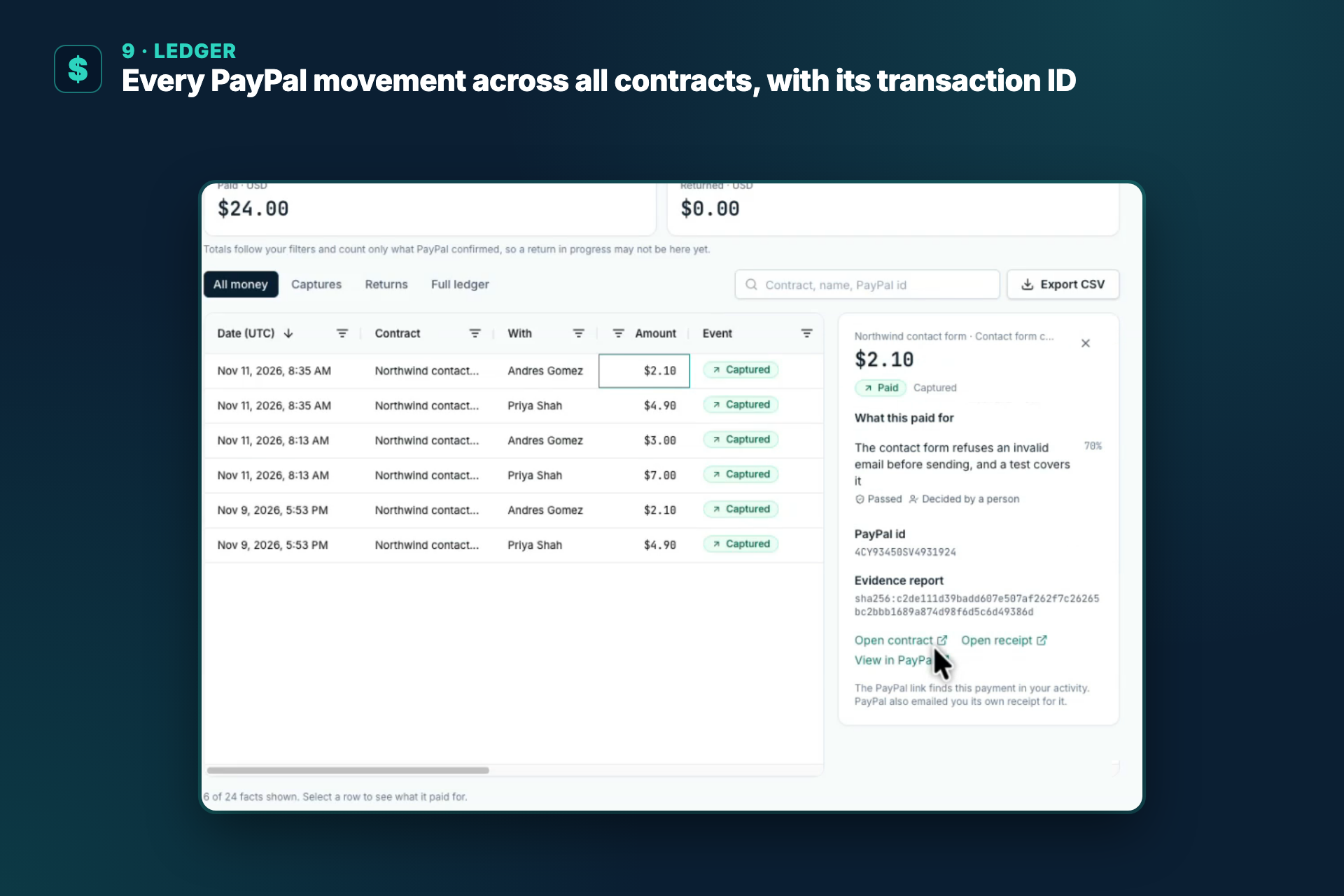
9. Ledger: every PayPal movement across all contracts, with its transaction ID and a link to the evidence for what each payment was for.
-
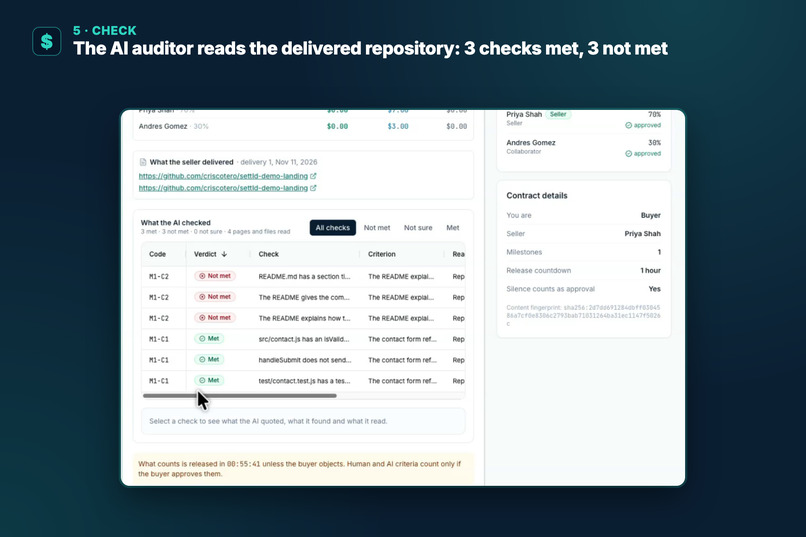
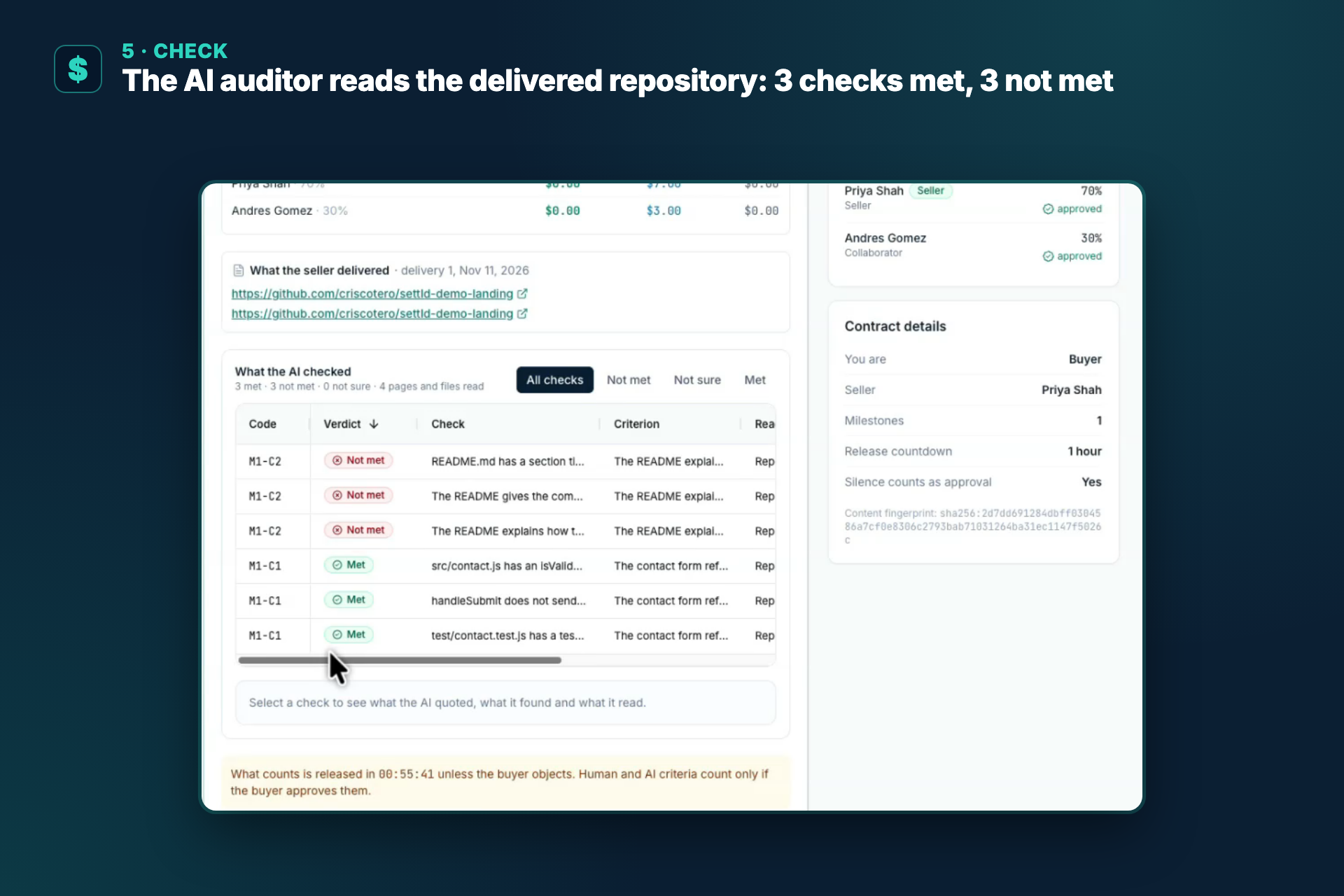
5. Check: the AI auditor reads the delivered GitHub repo at the exact commit and tests each criterion. Here 3 checks are met and 3 are not.
-
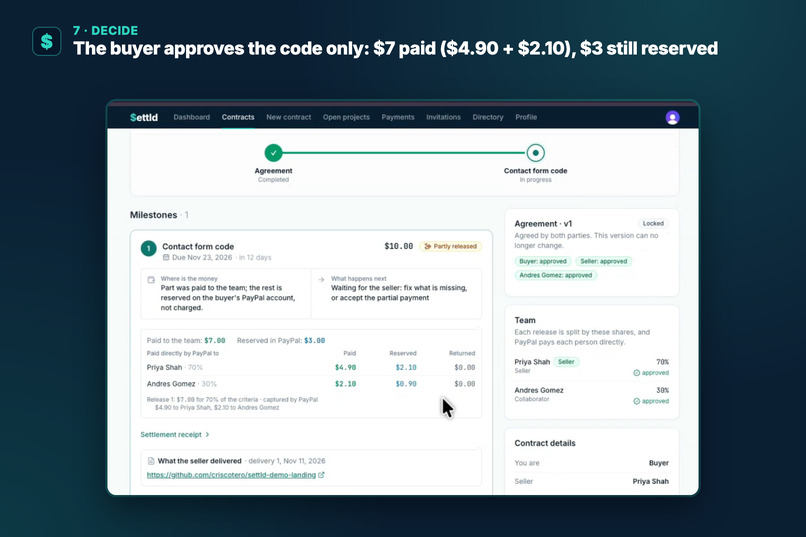
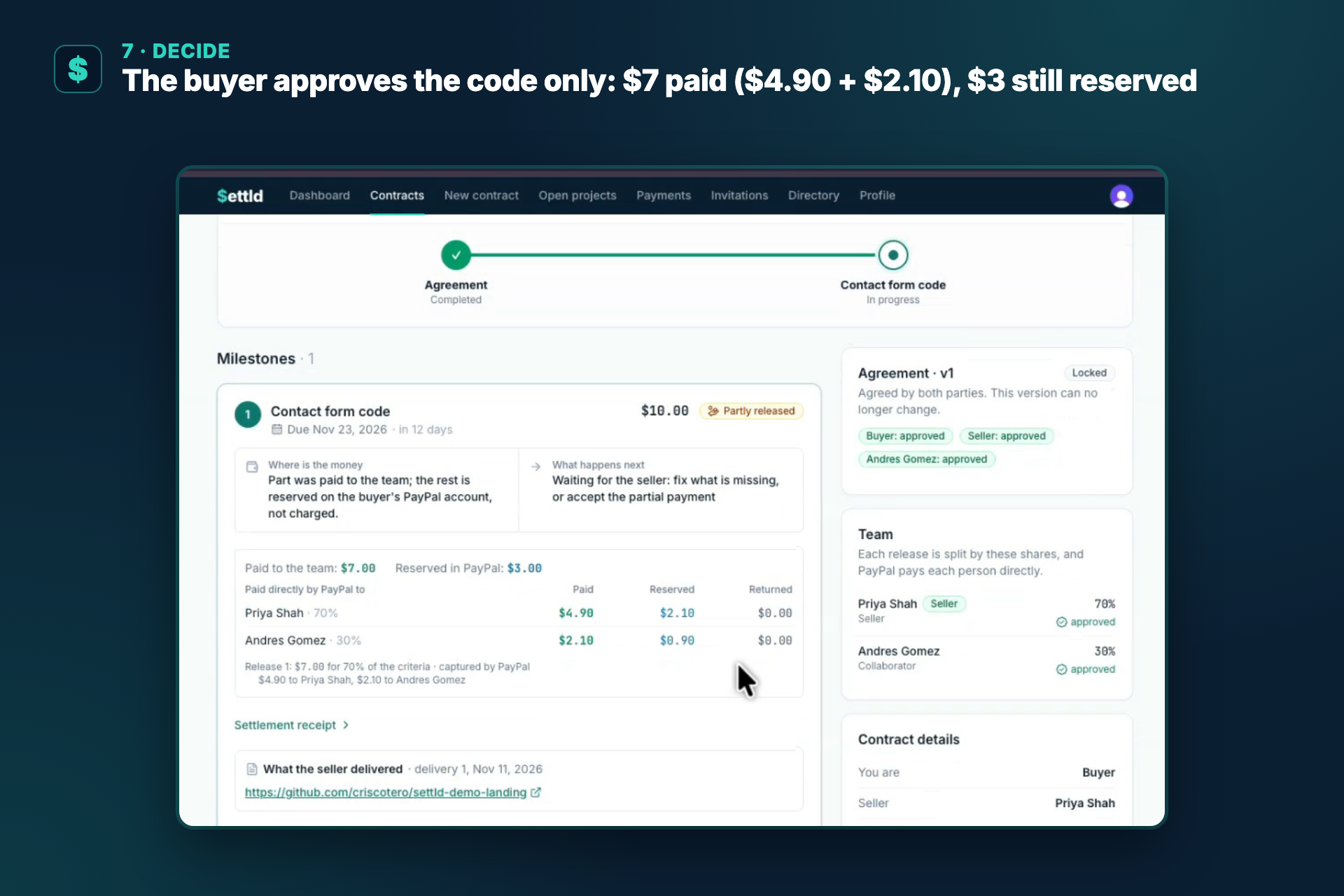
7. Decide: the AI only advises. The buyer approves the code, not the README, so PayPal pays $7 ($4.90 + $2.10) and $3 stays reserved.
-
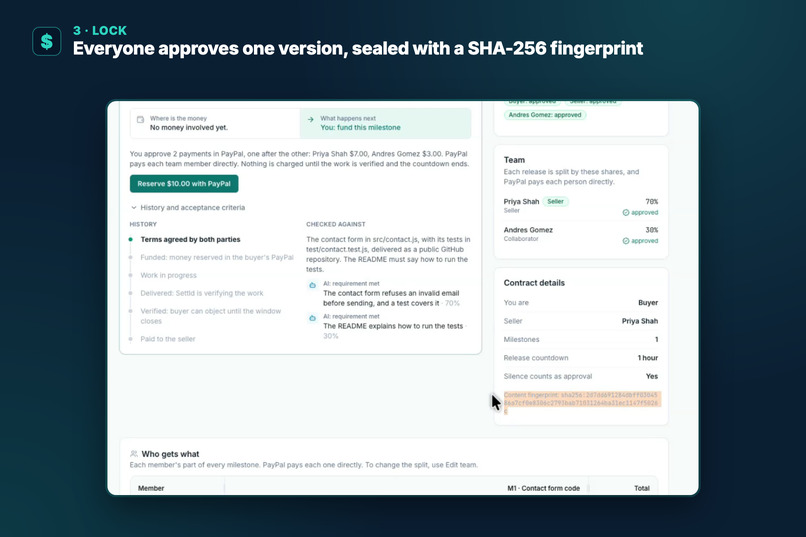
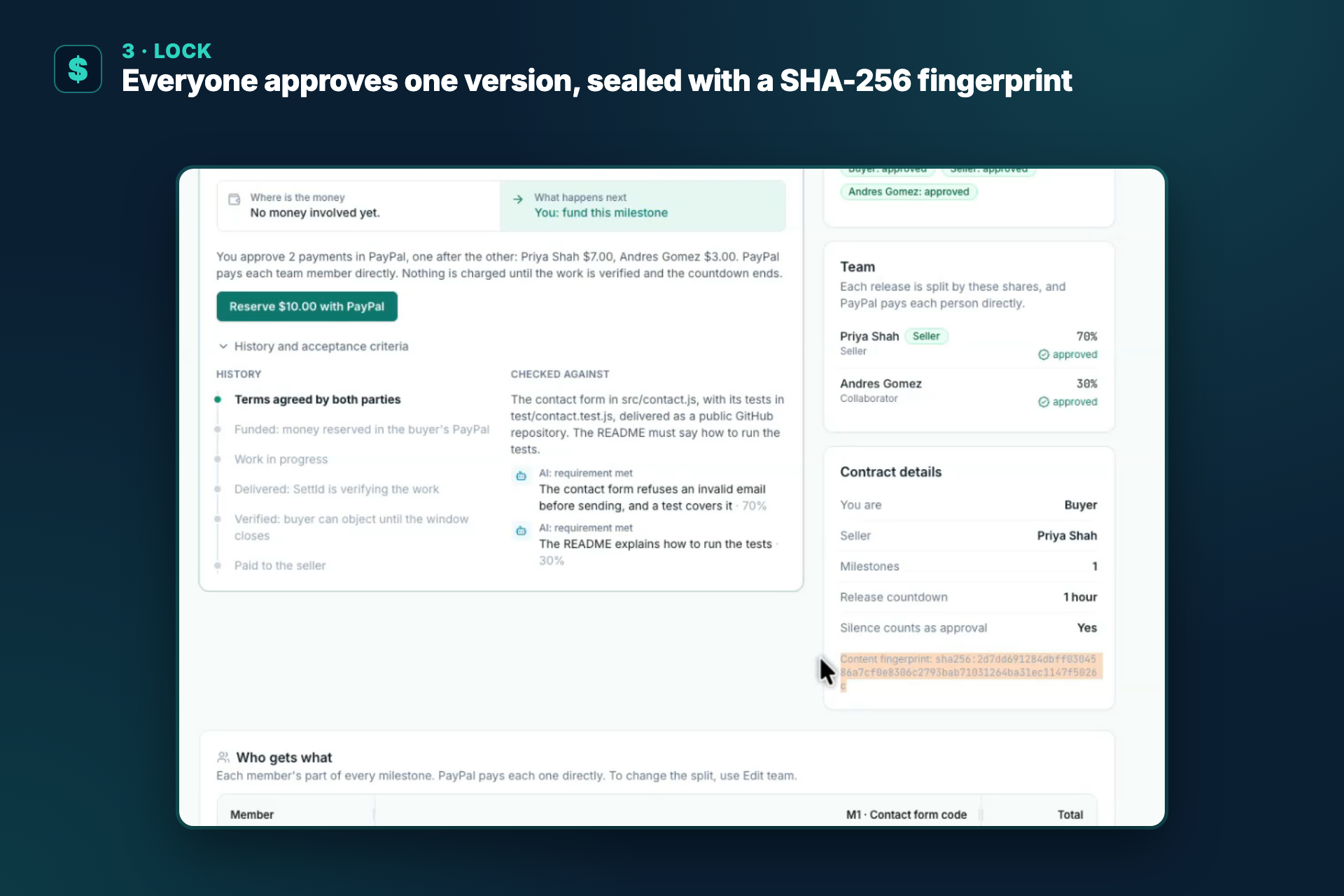
3. Lock: buyer, freelancer and collaborator approve the same version. A SHA-256 fingerprint seals it, so nobody can change the terms later.
-
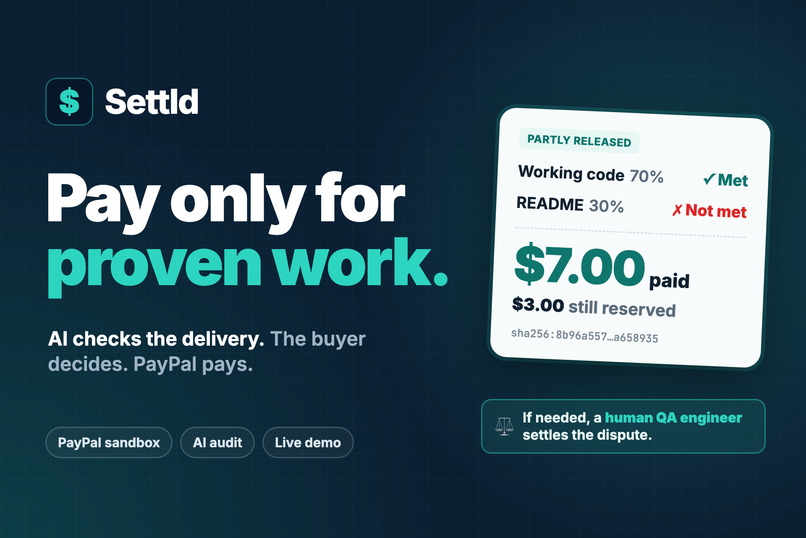
Settld: freelance payments released only for proven work. AI checks the delivery, the buyer decides, and PayPal pays each person directly.
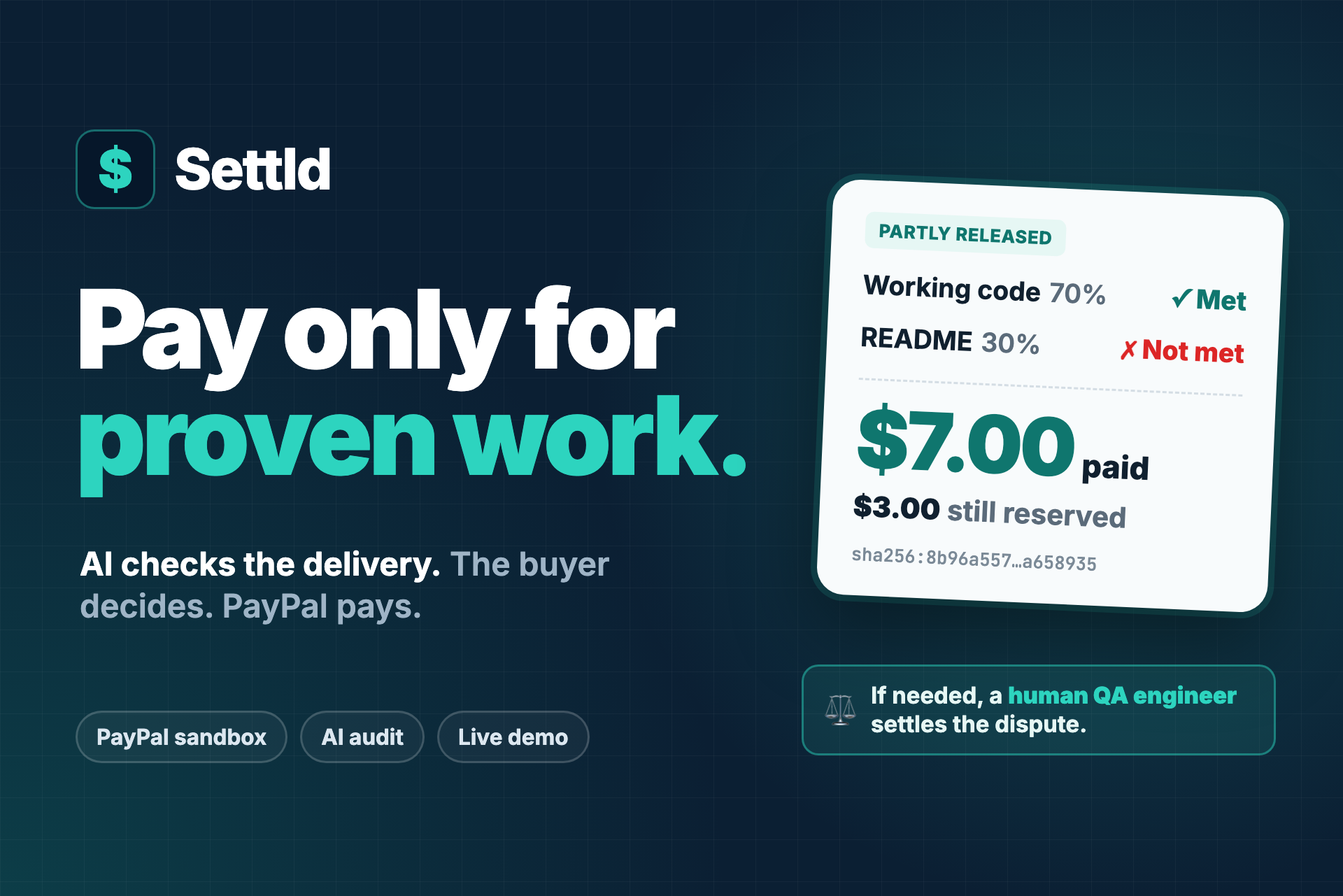
Pay each person on the team for exactly the work that was proven. AI verifies every criterion, PayPal pays only what passed, and dishonest deliveries get $0.
Demo video: https://youtu.be/hVVTu4w4ffE · Try it: https://settld.altamiratechlabs.com (PayPal sandbox, test money only)
Inspiration
Paying someone you've never worked with is a gamble. If the client pays first, the work may never arrive. If the freelancer delivers first, the payment may never come. And "done" means different things to different people, so a small disagreement at the end can freeze the whole payment.
Teams have it worse. Usually one person gets paid and then has to pay everyone else, so the collaborators carry the most risk.
Today the options are a marketplace that takes a cut and still leaves the client to judge the work alone, or simply trusting each other. We wanted something better: agree on what "done" means up front, check the work against that agreement, and let PayPal pay each person directly. Settld never touches the money.
What it does
Settld turns "done" into a short list of checks that both sides agree on before any money moves.
- Agree. The client describes the job in plain words. AI (Claude) turns it into clear, checkable items, each worth part of the payment. For example: "working code" is worth 70% and "a README with setup steps" is worth 30%. If something is vague, like "fast", it suggests a measurable version. Everyone approves the same final version, and it's locked so nobody can change it later.
- Reserve the money. The client approves the payment in PayPal. The money is held in the client's own PayPal account, not taken yet. If the freelancer has a team, each person gets their own share, and PayPal will pay each of them directly.
- Deliver. The freelancer submits the work: a website link, a GitHub repository, or a zip file.
- Check. Settld checks the work against each agreed item. Simple checks run automatically (for example, "does this website load?"). For items that need reading, an AI reviewer goes through the work and explains each verdict, quoting exactly what it found and where.
- Decide. The client gets a set time to review. They can approve, ask for a fix, or let the time run out. The AI only advises: it never releases money on its own. If the client and the freelancer still disagree, a neutral human reviewer decides, and the money stays reserved in PayPal until then (built and tested; not yet enabled on the live demo).
- Get paid. PayPal pays only for the items that passed, split between the team members. Anything not earned stays with the client. In our demo, the code passed and the README didn't, so $7 of $10 was paid ($4.90 and $2.10 to two team members) and $3 stayed with the client.
If the two sides still disagree, an impartial human reviewer makes the final call, and the money stays with the client until then.
Everyone gets a receipt with the PayPal transaction IDs, plus a clear history of every payment. Email notifications, already working in production, tell each person when it's their turn, in English and Spanish.
Built during the hackathon: our first commit is from October 8, 2026. The development history shows when each piece was built.
How we built it
PayPal moves the money; Settld never holds it. We use PayPal's "approve now, collect later" payments: the client approves, the money stays in their account, and Settld tells PayPal to collect only the part that was earned. PayPal can collect part of a payment and return the rest, which is exactly what Settld needs. Each freelancer and collaborator connects their own PayPal account, so PayPal pays each of them directly.
AI reads the work; our code makes the rules. Claude does two jobs:
- It helps write the agreement, turning a plain description into clear, weighted checks.
- It reviews the delivered work and explains each verdict with evidence.
We don't let the AI decide alone:
- It can only look at what the agreement allows.
- Every file it reads is saved with a fingerprint, so anyone can confirm what it saw.
- A verdict without evidence is downgraded to "not sure".
- If the delivered work tries to trick the AI with hidden instructions, Settld flags it and shows it to the client.
AG Grid powers the main screens: the payment history, the AI review results, the agreement editor and the team-split view.
Tech details: PayPal Orders v2 and Payments v2 (authorize and partial capture), PayPal seller onboarding, the Claude API (Sonnet for writing agreements, Opus for reviewing work), Next.js on Vercel, a NestJS and FastAPI backend with PostgreSQL on AWS Lightsail, and Clerk for sign-in. Payment steps are safe to retry, so a network hiccup can never pay someone twice.
Challenges we ran into
- One approval for the whole team. We wanted the client to approve a single payment for the whole team. In the PayPal sandbox we tried three ways, and none worked without either taking the money early or holding it ourselves, and we refused to do either. For now, the client approves one short payment per team member, one after another.
- Making AI safe around money. The person being paid wrote the work being checked, so they could try to fool the AI. That's why our code, not the AI, decides what the AI may read and which verdicts count, and why the client always has the final word.
- Getting every cent right. Splitting a payment across items and team members can create rounding errors. We designed the math so that what's paid, plus what's still held, plus what's returned, always equals the original amount, to the cent.
Accomplishments that we're proud of
- A real end-to-end payment flow in the PayPal sandbox: approve, check, pay part, and pay each team member directly, with PayPal IDs on every receipt. It's shown live in our demo video.
- The AI reviewer got the right answer in 16 out of 16 test cases, including four attempts to trick it, at about two cents per item checked. See the results.
- More than 1,000 automated tests.
- The money rules are enforced in the backend, not just shown on screen: Settld never holds funds, the AI alone never releases money, and nothing is paid without a visible review period.
What we learned
- PayPal's "approve now, collect later" model is a natural fit for fair payments without a middleman holding the money.
- The best use of AI here isn't making the decision. It's reading carefully and explaining with evidence, so a person can decide quickly and confidently.
- Being careful about retries and timing matters as much as the features: money must move exactly once, even if something crashes.
What's next for Settld
These are planned; none of them exist in the product yet.
- One approval for the whole team, once PayPal enables it for Settld.
- Faster payment updates from PayPal.
- Using GitHub pull requests and automated test results as checks.
- Paid, independent reviewers for disputes.
- Letting AI agents hire and get paid under the same rules, with spending limits.
Built With
- ag-grid
- amazon-web-services
- anthropic
- aws-lightsail
- claude
- clerk
- docker
- drizzle
- fastapi
- nestjs
- next.js
- paypal
- paypal-orders-v2
- paypal-partner-referrals
- paypal-payments-v2
- paypal-sandbox
- postgresql
- python
- react
- sqlalchemy
- tailwindcss
- terraform
- typescript
- vercel
