
Devpost submission text — copy/paste into the form
Demo video: https://youtu.be/mJHWBZQGx-Y Code: https://github.com/jebin1727/settl-agent
Project name
SettlAgent
Tagline / one-liner
An autonomous agent that settles marketplace jobs and triages PayPal disputes — real payouts, real risk-assessed decisions, every action explained.
Inspiration
Marketplace and gig platforms have two recurring, manual pain points: paying out providers after a job is done, and triaging the disputes that inevitably follow. Both are usually a human clicking through a dashboard. We wanted to see how far an autonomous agent could go on both — not a chatbot wrapper, but something that actually moves real money and makes real, explainable decisions using PayPal's own APIs.
What it does
SettlAgent is a backend agent + dashboard with two autonomous loops:
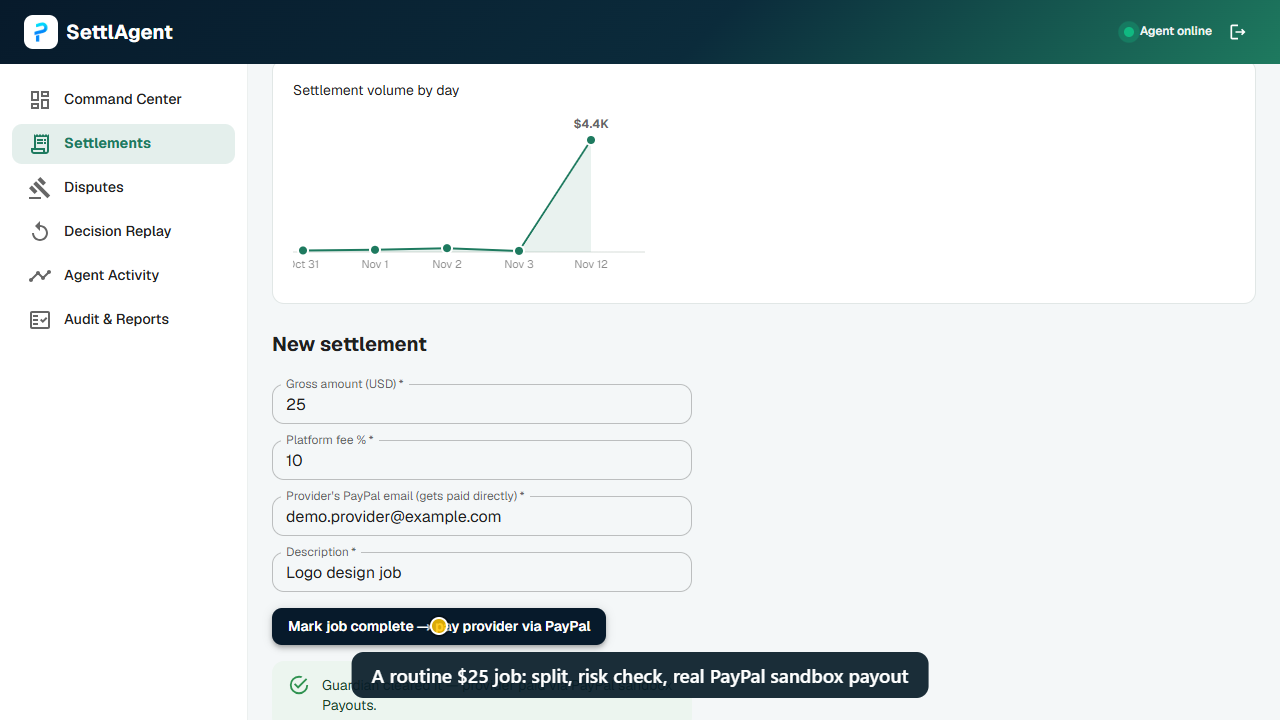
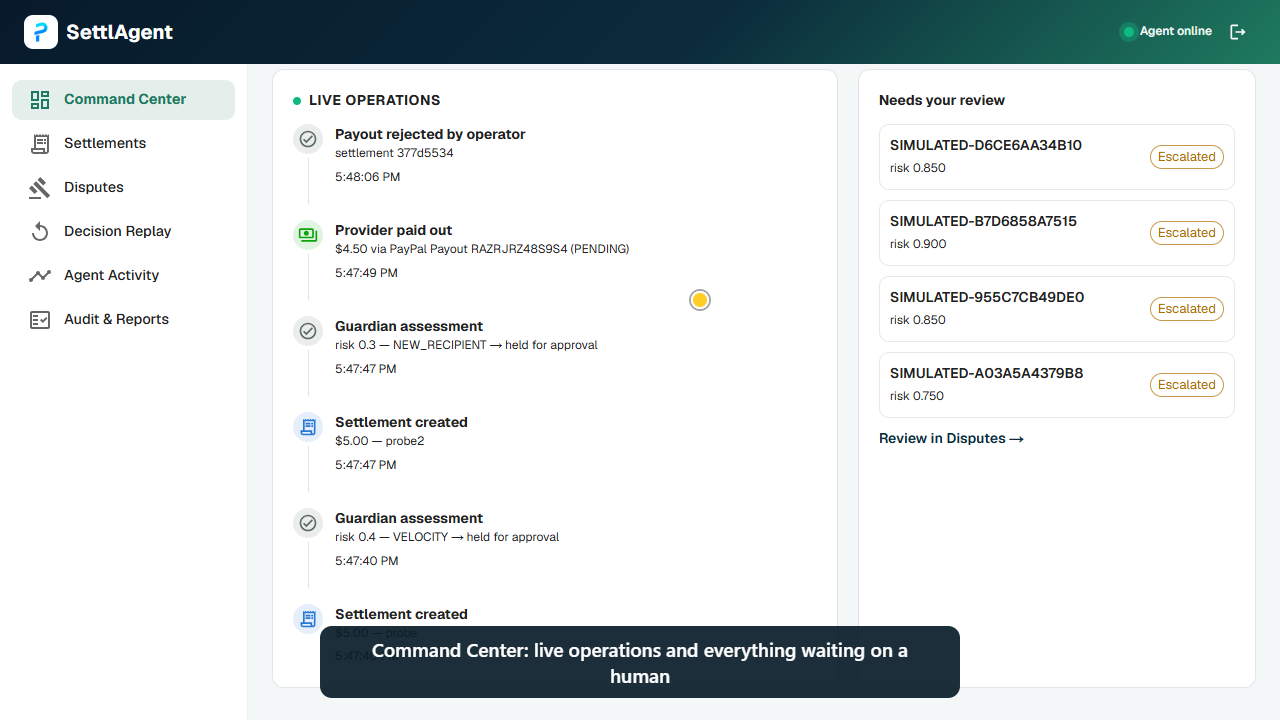
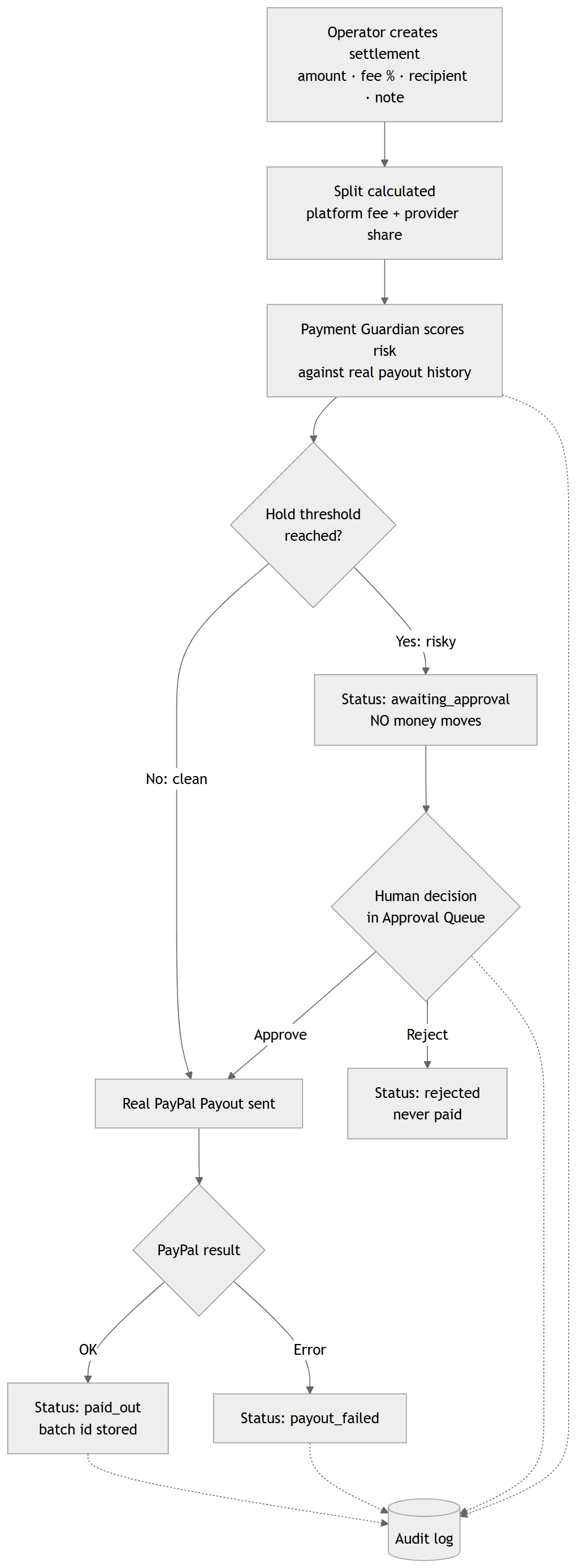
- Settlement → Payout. The moment a job is marked complete, the agent calculates the platform fee split and sends a real PayPal Sandbox Payout directly to the provider — no invoice. Routine payouts need no manual step.
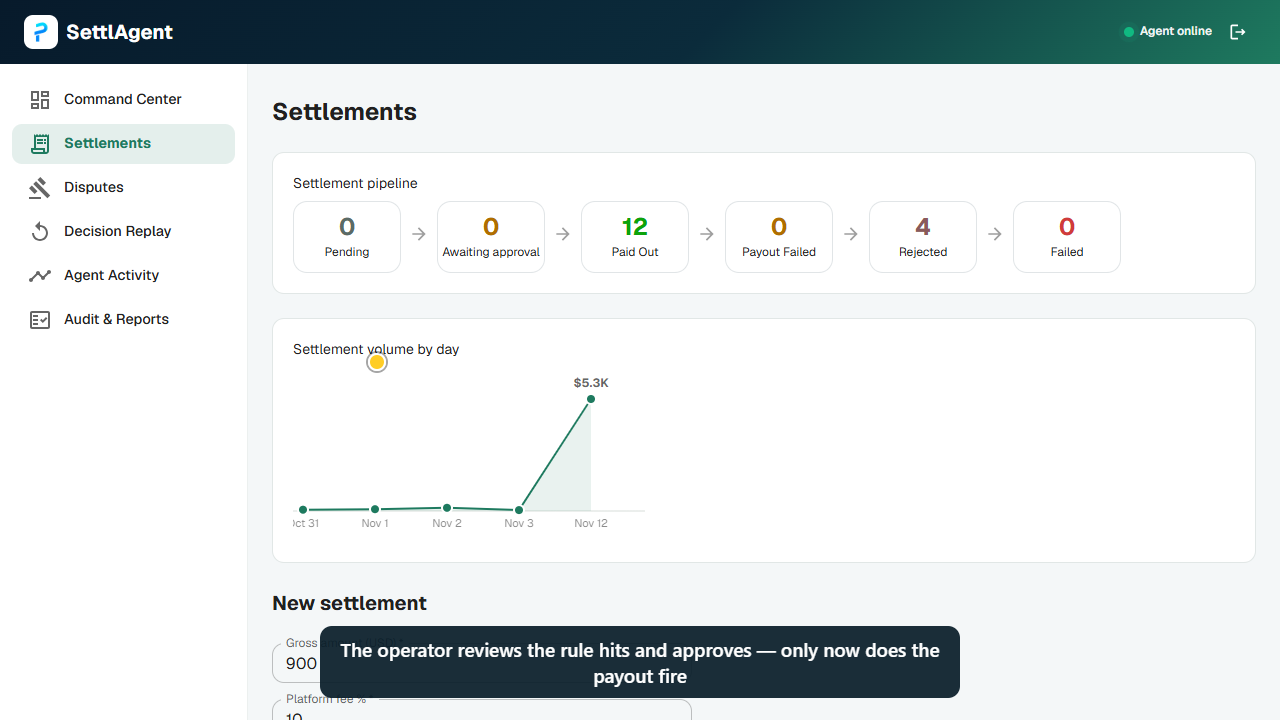
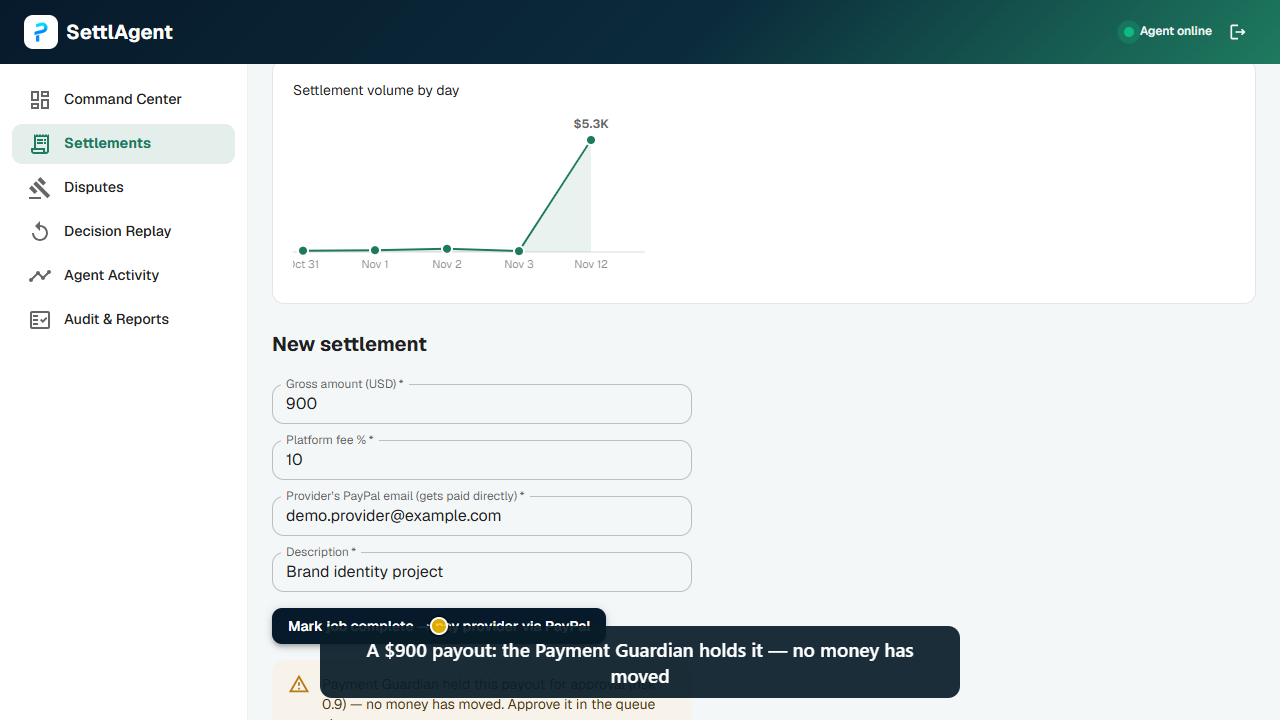
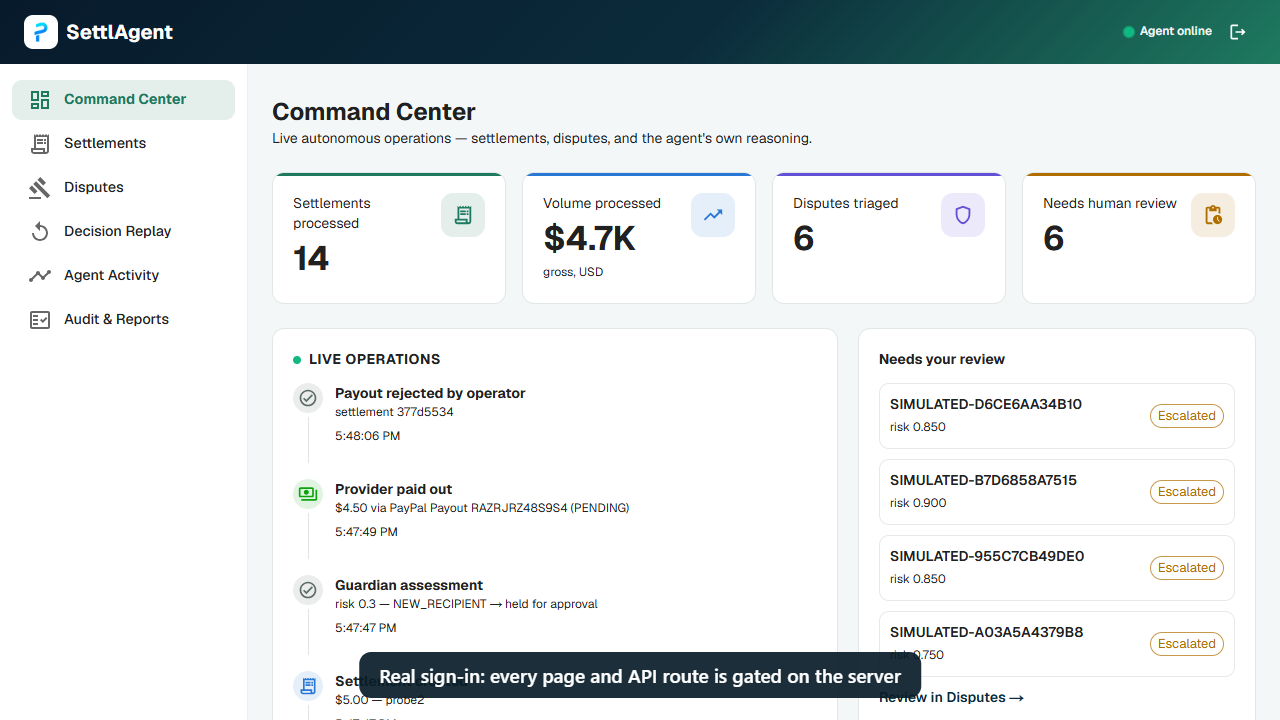
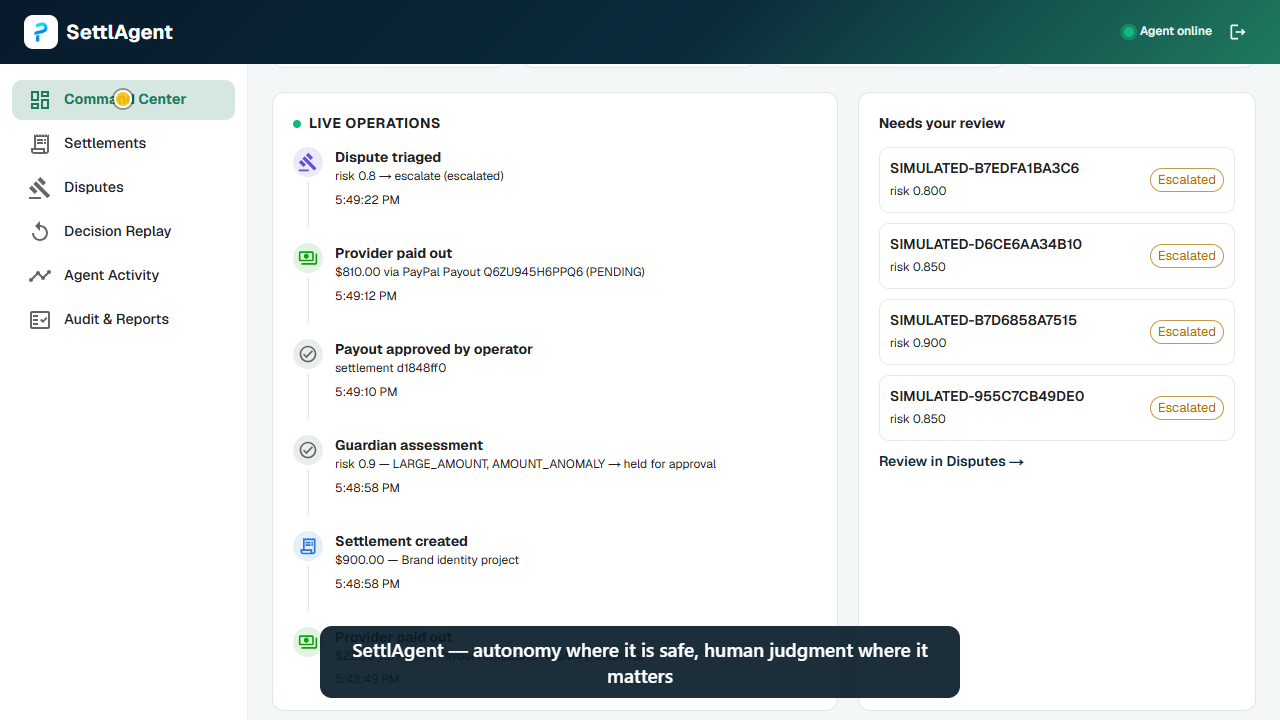
- Payment Guardian (human in the loop). Before any money moves, rule-based risk checks over the real payout history (large amount, amount anomaly, velocity, high fee, new recipient) decide whether to pay or hold. Held payouts wait in an approval queue: approving fires the real payout, rejecting never pays. Money decisions are deliberately not left to an LLM.
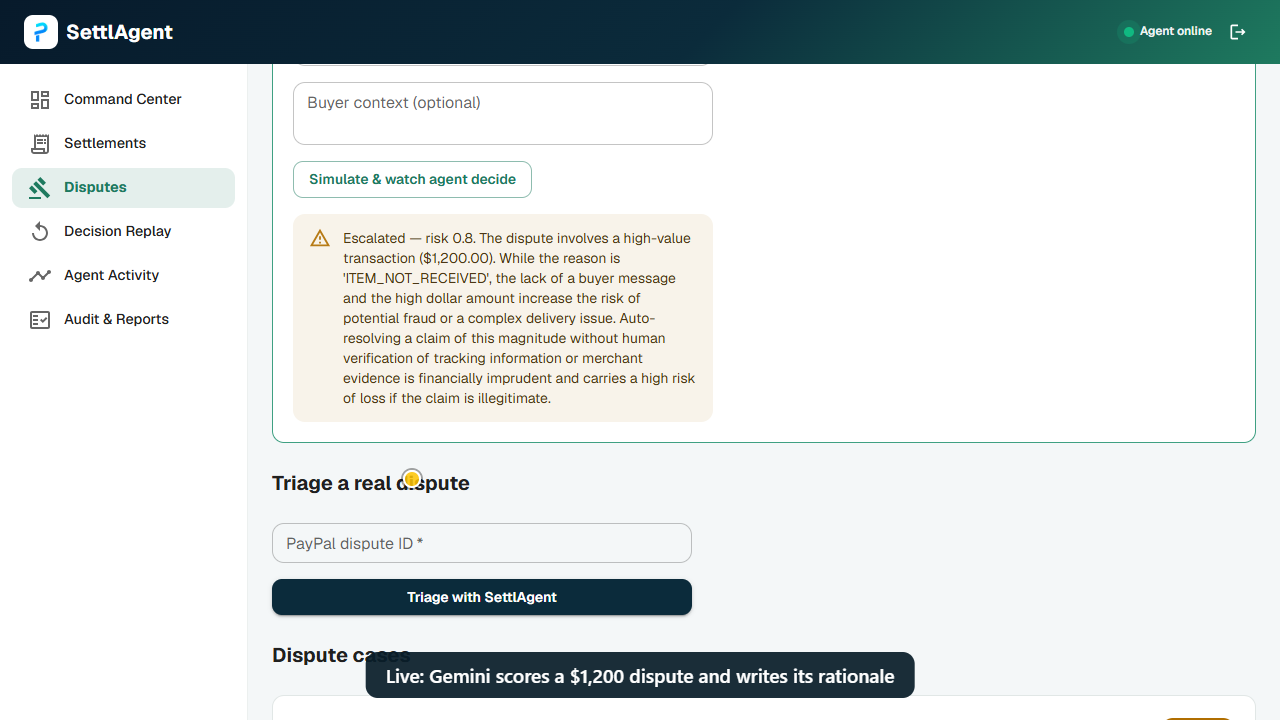
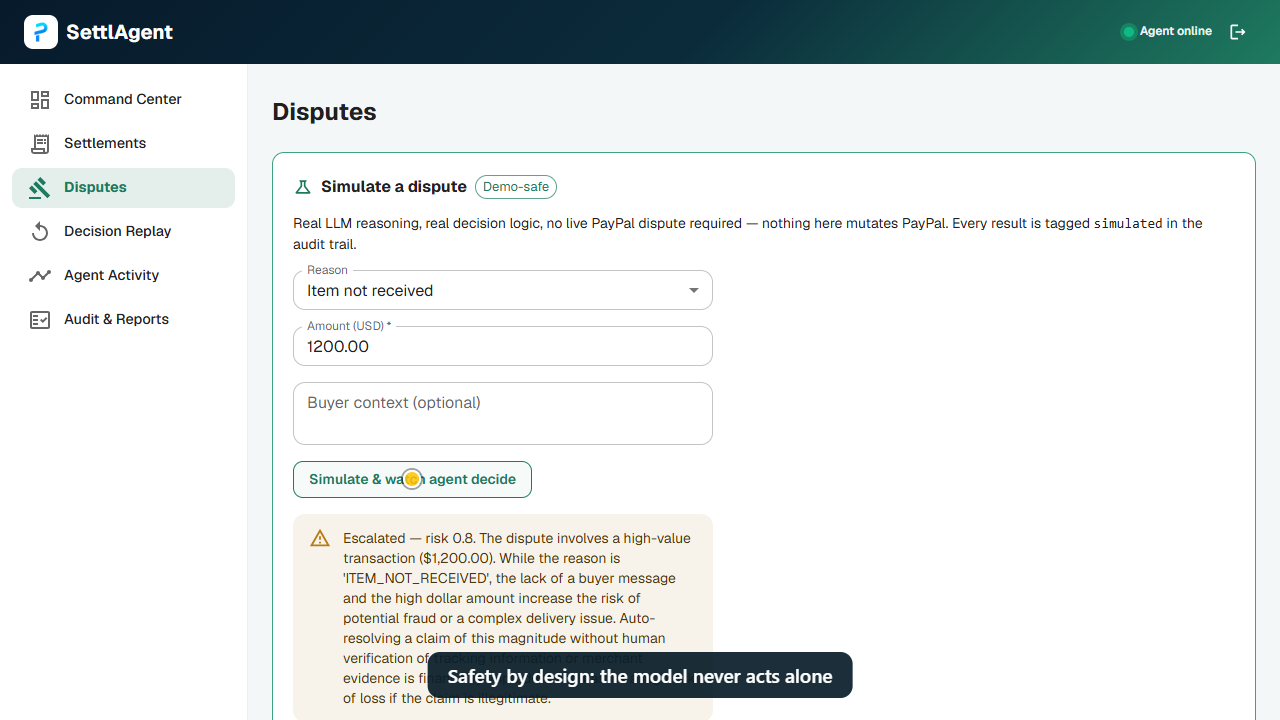
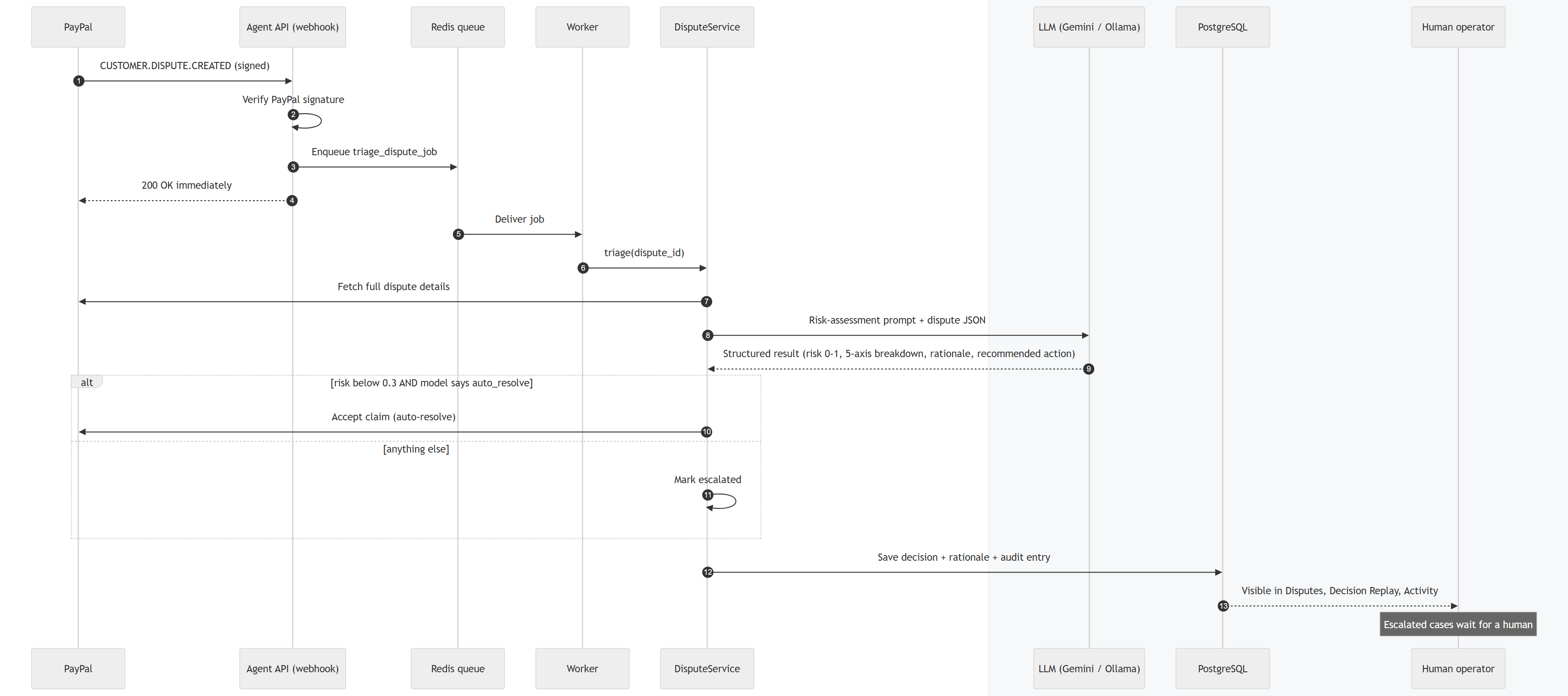
- Dispute → Triage. A PayPal webhook fires when a dispute is created. The agent fetches the dispute, has an LLM assess risk with a visible written rationale, auto-resolves low-risk disputes via PayPal's Disputes API, and escalates everything else — with that same reasoning attached, not just a status badge.
- A "Simulate a dispute" path lets anyone exercise the exact same real
LLM reasoning and decision logic on demand, with zero PayPal mutation —
useful for demos, and tagged
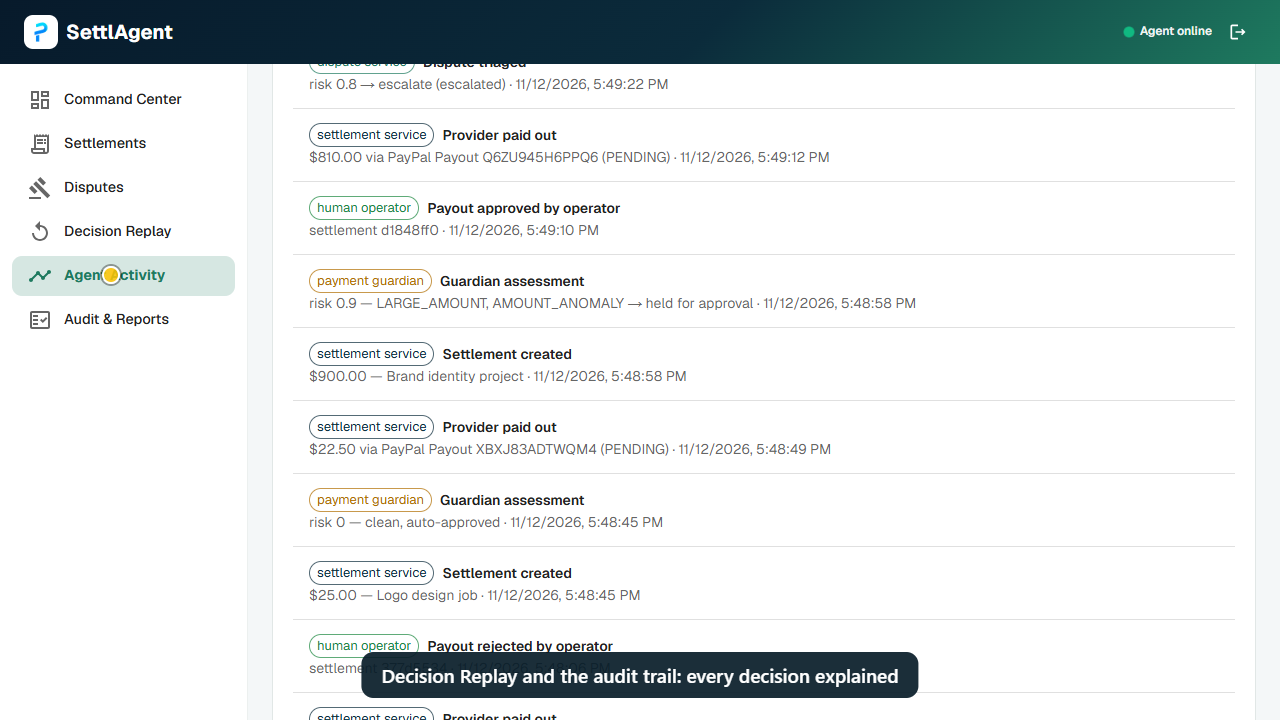
simulatedin the audit trail so it's never confused with a real case. - An authenticated operator console (signed httpOnly session, every page and API route gated) shows all of it live: settlement volume over time, a dispute-risk plot against the agent's own auto-resolve threshold, and a full audit/reasoning log of every decision the agent made and why.
How we built it
- Agent service: FastAPI + LangChain + PayPal's own
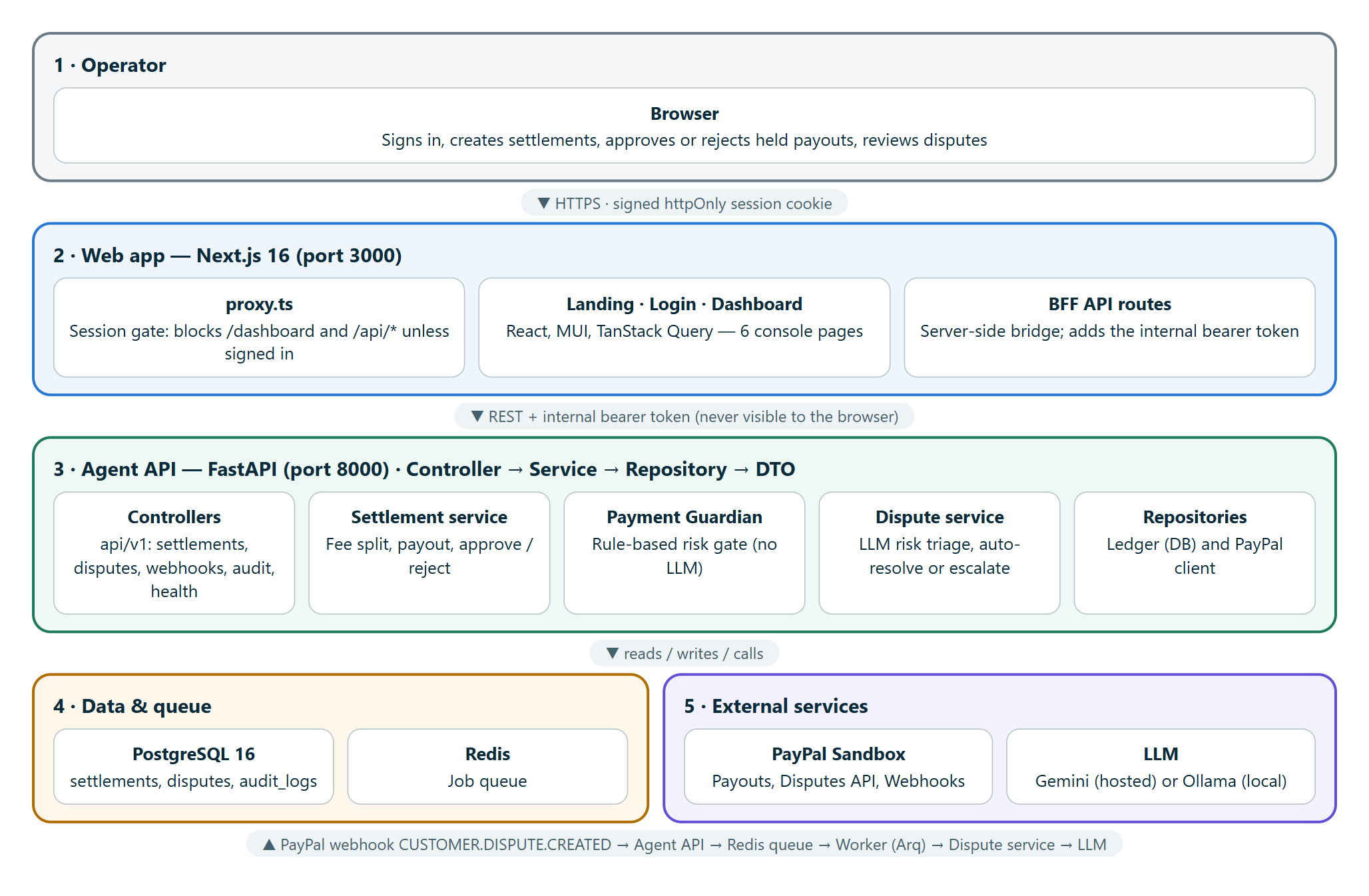
paypal-agent-toolkit, Python. Structured logging, rate limiting (both inbound API and outbound LLM-quota budgeting), Postgres for the audit ledger, Redis + Arq for the webhook-triggered background job queue. - Frontend: Next.js + MUI dashboard, with its own BFF layer so secrets never reach the browser.
- LLM provider swap: the exact same risk-classification call runs on Gemini or a fully local Ollama model — swapping is a one-line config change, proven live both ways.
- Controller → Service → Repository → DTO layering throughout, 65 backend
- 17 frontend tests, Docker Compose for the full stack.
Challenges we ran into
- PayPal Sandbox regional quirks (an India-region sandbox account couldn't send USD or use Payouts) — solved by provisioning a US-region sandbox app.
- A genuinely nasty one: the LLM call was synchronous inside an async
handler, so a slow or rate-limited Gemini call froze the entire server,
not just that one request — found live, fixed, and verified by hitting
/healthzwhile a slow call was in flight. - Gemini's free tier turned out to cap at 20 requests/day (not just per-minute) — a real constraint for a live demo, handled by keeping a local Ollama fallback path with zero code changes needed to switch.
How the AI is used responsibly
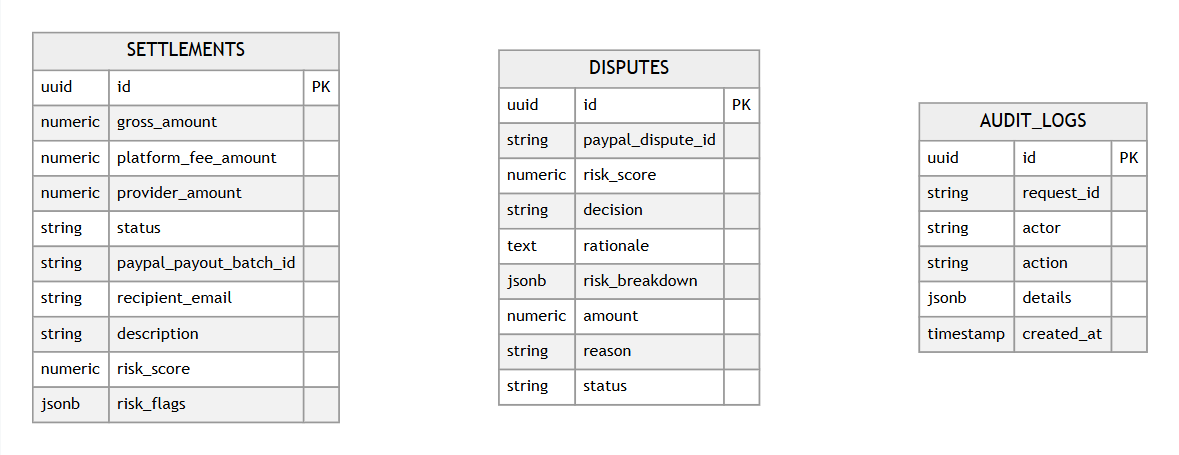
The LLM only does what it is good at — reading messy dispute data and writing a risk assessment with a rationale. A dispute auto-resolves only when the model recommends it and the numeric risk score is under 0.3; either one disagreeing escalates it. Payouts are gated by deterministic rules plus a human, and every decision lands in an audit trail with its actor and reason.
Accomplishments we're proud of
A real agent that moves real (sandbox) money and makes real, auditable decisions — not a mocked demo. Every dispute decision carries its own written rationale, all the way through to the UI.
What we learned
How much of "agentic" reliability is actually unglamorous engineering: async correctness, rate-limit budgeting, and handling a third-party service's real quirks — not just prompt design.
What's next for SettlAgent
Deploying with a registered PayPal webhook for a fully live (not locally-triggered) autonomous loop, and agent-to-agent negotiation between a provider-side and platform-side agent on disputed amounts.
Built during the Submission Period
SettlAgent was created from scratch for this hackathon (first commit November 2026, inside the Oct 1 – Nov 12 window). In the final days we added the Payment Guardian (human-approval gate), an authenticated operator console, a five-axis dispute risk radar, a decision-replay view and the architecture/onboarding documentation.
Sponsor tools
AG Grid powers every data table in the console (settlements ledger, disputes, audit log).
Testing instructions for judges
No hosted deployment is required: everything runs locally with Docker.
- Clone https://github.com/jebin1727/settl-agent and copy
.env.exampleto.env. - Add free PayPal Sandbox Client ID/Secret (developer.paypal.com), a Gemini key (or set
LLM_PROVIDER=ollama), and choose anyADMIN_PASSWORDandSESSION_SECRET. docker compose -f infra/docker-compose.yml up --build, open http://localhost:3000 and sign in asadminwith the password you chose.- Create a settlement under $500 (auto-paid), one over $500 (held → approve/reject), then use
Simulate dispute on the Disputes page. Full walkthrough:
docs/ONBOARDING.md.
Built With
- ag-grid
- arq
- docker
- fastapi
- gemini
- langchain
- mui
- nextjs
- ollama
- paypal-agent-toolkit
- postgresql
- pytest
- python
- react
- redis
- typescript
