-
-
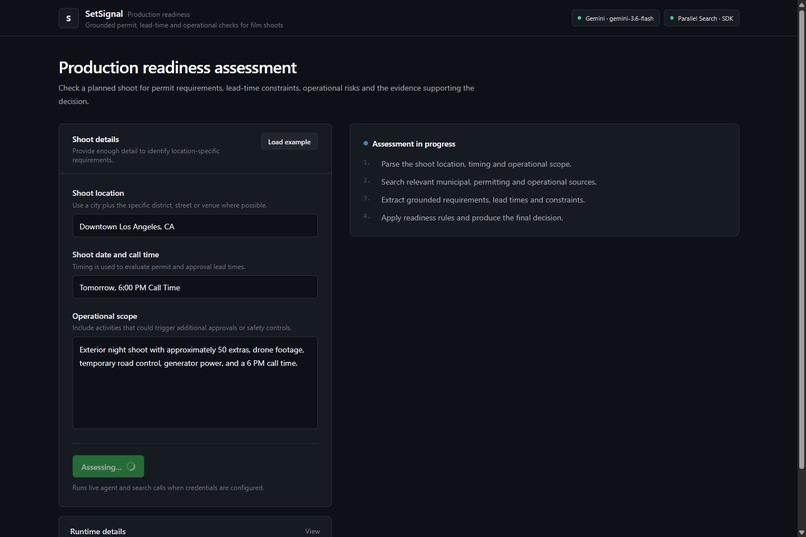
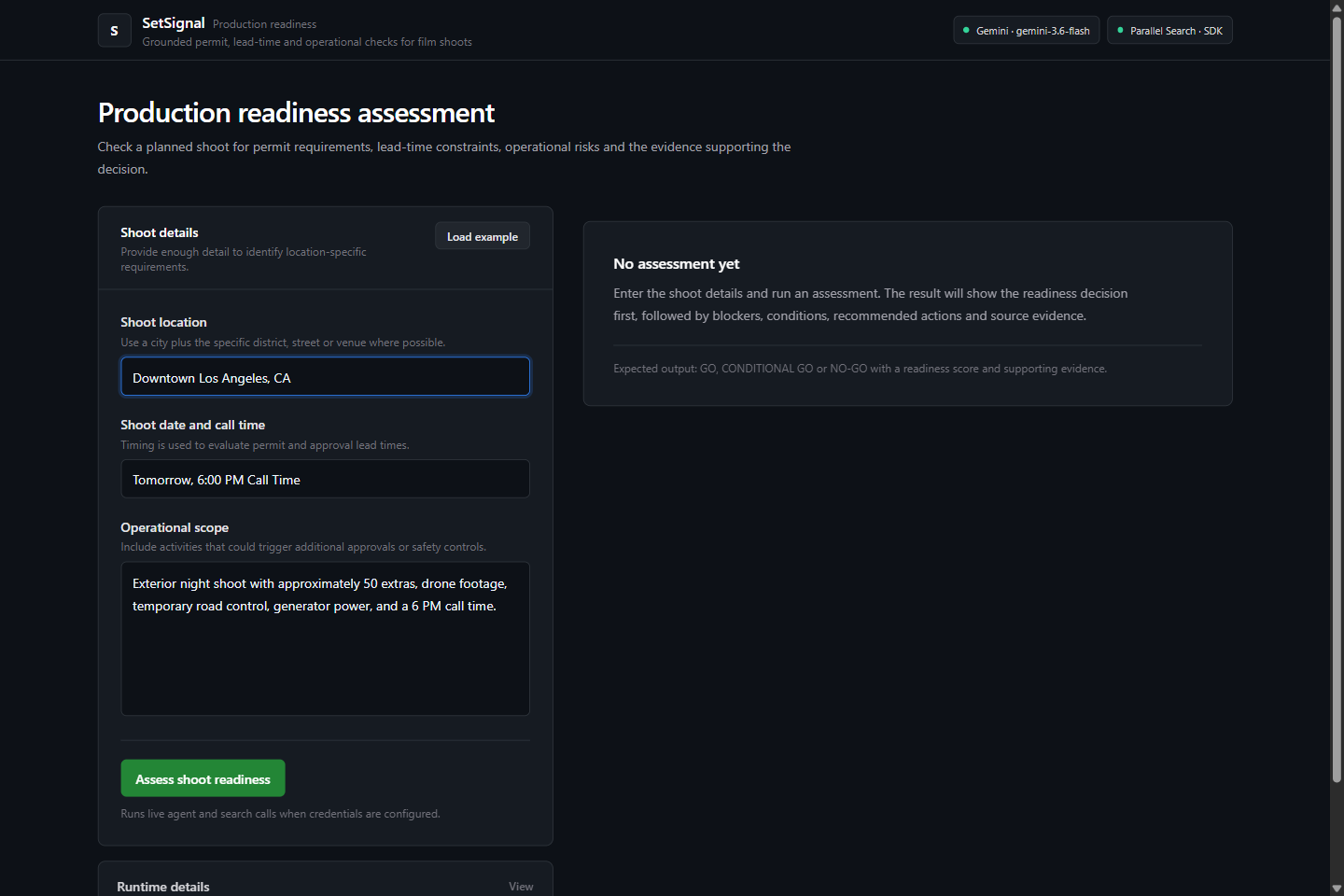
SetSignal mission input: location, call time and shoot scope are captured before the readiness assessment begins.
-
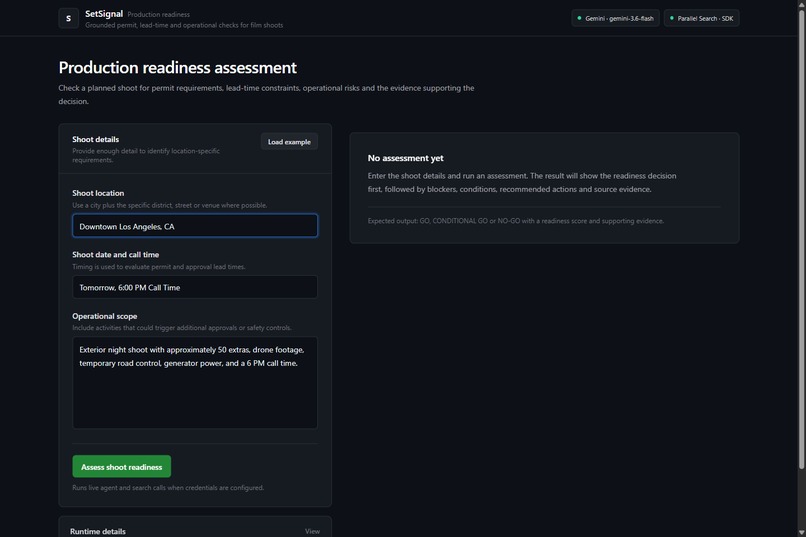
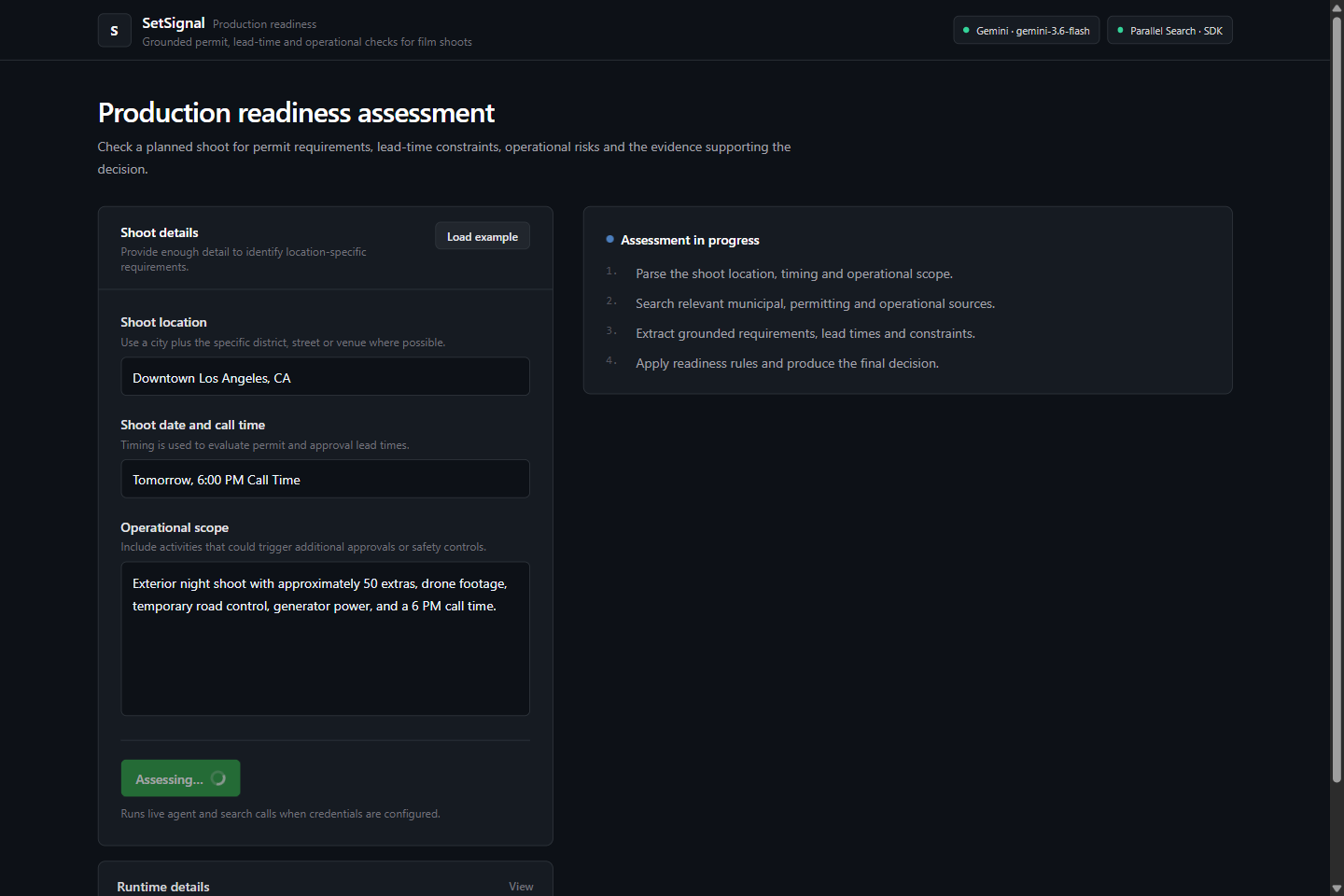
Agentic assessment in progress: Google ADK coordinates Gemini reasoning, Parallel research and readiness evaluation.
-
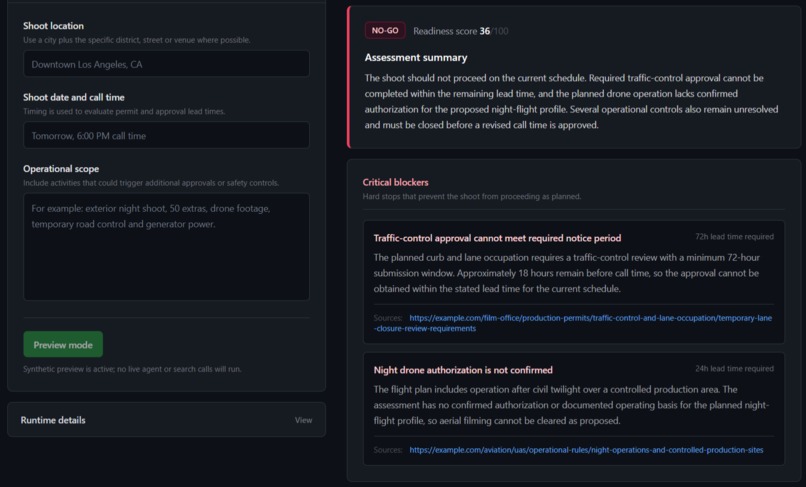
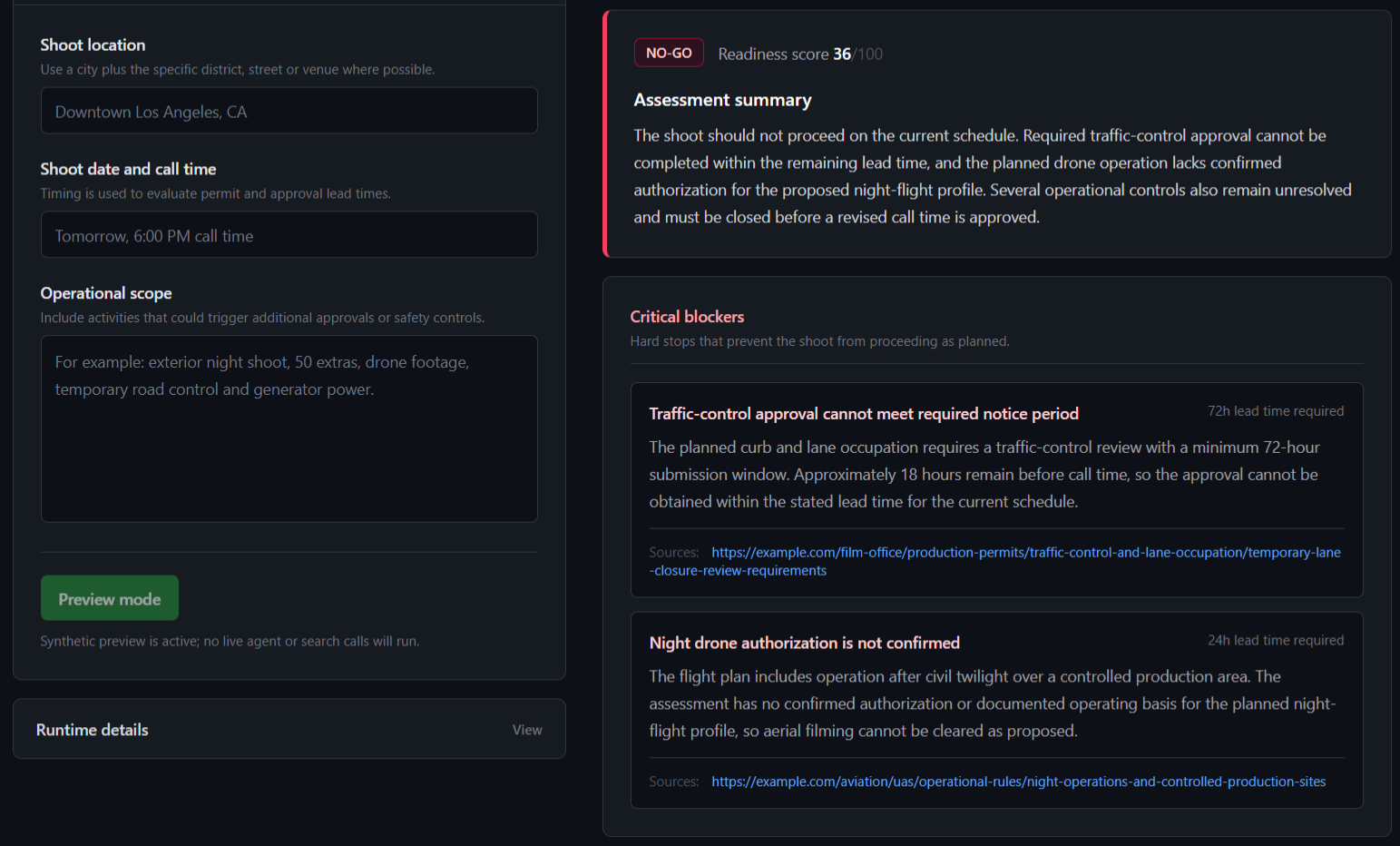
Representative NO-GO output using mock evidence for the published demo; the hosted app uses live Parallel Search at runtime.
-
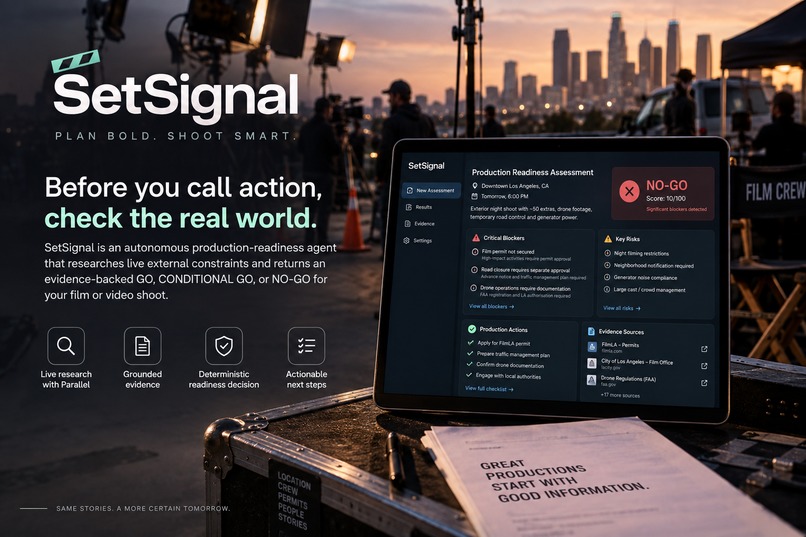
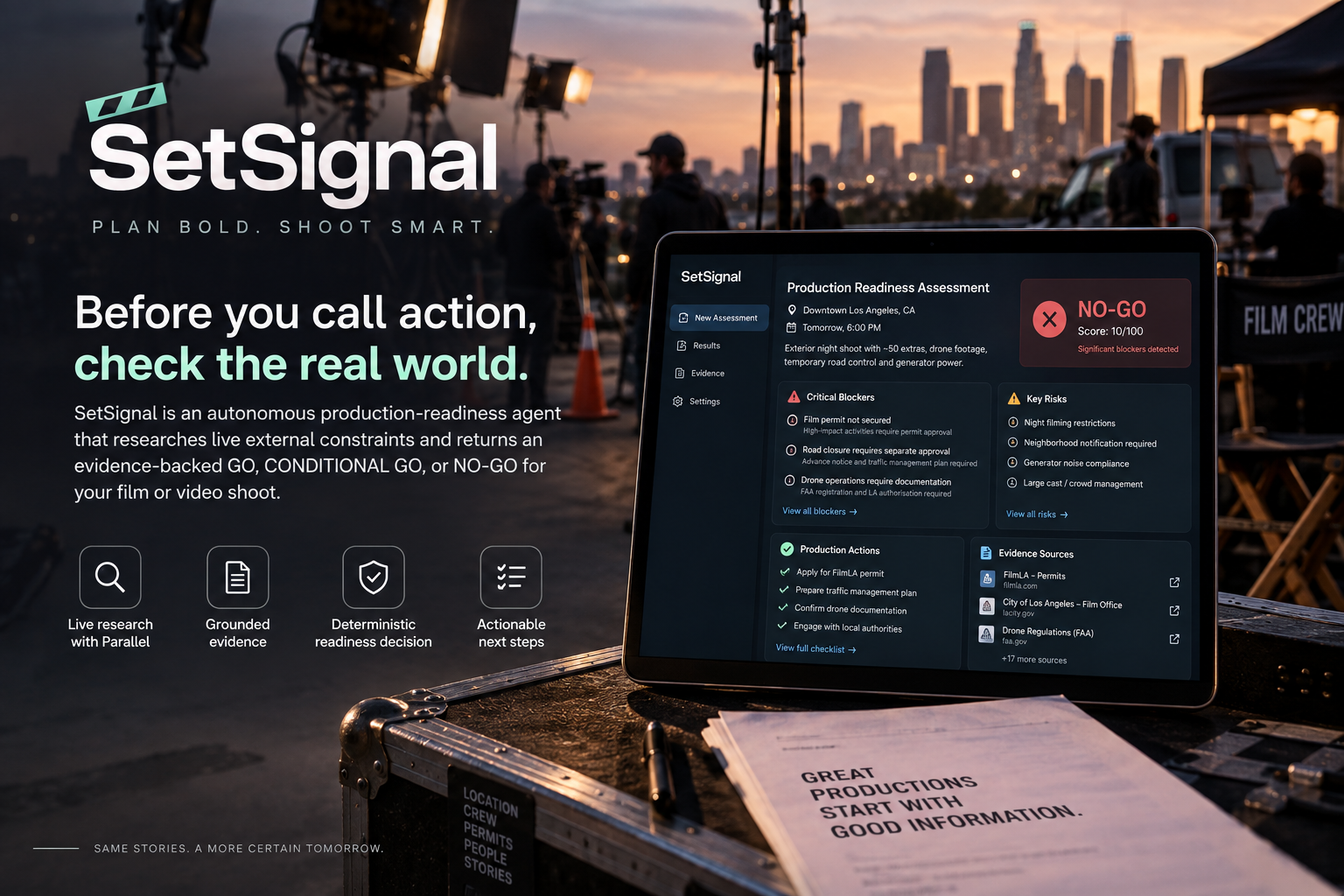
SetSignal: an evidence-backed production-readiness agent for film and video shoots.
Inspiration
Film-production software is good at managing the production plan: schedules, crews, locations, equipment and call sheets.
But a production can still fail when the outside world does not match that plan.
A permit may require more lead time than remains before call. A road-control request may need separate approval. Drone operations may introduce additional documentation requirements. A high-impact shoot may require notification or coordination that has not happened yet.
Discovering those problems on shoot day can mean idle crew, unavailable locations, wasted equipment bookings and an expensive production delay.
SetSignal asks a different question: before a production sends crew, equipment and money to location, is the real world actually ready for the shoot?
What it does
SetSignal is an autonomous production-readiness agent for film and video shoots.
A production team provides:
- shoot location
- date and call time
- operational scope, such as drones, road control, night filming, generators or a large number of extras
SetSignal then investigates current external requirements and operational constraints, gathers evidence from live web sources, interprets that evidence and produces a structured:
GO / CONDITIONAL GO / NO-GO
assessment.
Instead of returning only a conversational answer, the result separates:
- critical blockers
- operational risks
- production actions
- supporting evidence
- source URLs and excerpts
The goal is to give production teams an actionable readiness signal before call time, while keeping the evidence behind that signal visible.
SetSignal is production-readiness decision support, not legal advice.
How we built it
The working prototype uses:
FastAPI → Google Agent Development Kit → Gemini → Parallel Search → deterministic readiness rules → structured assessment → web UI
Google ADK is the runtime orchestration layer. The root agent receives the production mission and coordinates the tools required to investigate it.
Parallel is fundamental to the workflow. Production-readiness decisions depend on information that can change outside the production plan, so the agent performs live external research using the official Parallel Python SDK rather than relying only on model memory.
At runtime, SetSignal calls client.search(...) through the parallel-web SDK. The returned search evidence retains real URLs, excerpts and Parallel search identifiers for traceability.
Gemini interprets the retrieved evidence and converts relevant constraints into structured findings.
The final readiness decision is then evaluated using deterministic rules. This is deliberate: the system does not ask a generative model alone to decide whether a shoot is GO or NO-GO.
The frontend presents the result as a production command-center dashboard designed to make the overall signal, blockers, risks, actions and evidence understandable at a glance.
Demo
Our demo mission is an exterior night shoot in Downtown Los Angeles with approximately 50 extras, drone footage, temporary road control and generator power, with a call time the following evening.
The live workflow:
- sends the mission through the Google ADK agent;
- invokes Parallel Search against the live web;
- retrieves and retains external evidence;
- uses Gemini to interpret relevant production constraints;
- applies the deterministic readiness rules; and
- returns the completed assessment to the browser.
For this mission, the prototype returned:
NO-GO — 10/100
The result identified multiple blockers and operational risks and presented a remediation checklist alongside the supporting evidence.
The successful demonstration retrieved approximately 20 evidence documents, including relevant FilmLA and City of Los Angeles material covering production permitting and high-impact activities.
Challenges
The biggest challenge was preventing a useful research agent from becoming just another confident chatbot.
Real-world production requirements can be jurisdiction-specific, time-sensitive and ambiguous. We therefore needed to separate three responsibilities:
research → interpretation → decision
Parallel supplies current external evidence.
Gemini performs reasoning over that evidence.
The rules engine applies explicit decision logic to the structured findings.
We also preserved source provenance so that judges and users can inspect the evidence instead of being asked to trust an unsupported AI conclusion.
What we learned
The most important lesson was that agentic systems become more useful when different parts of the workflow are given different levels of authority.
Generative reasoning is valuable for investigating and understanding messy real-world information. Deterministic logic is valuable when the application needs to produce a consistent operational signal.
Combining those approaches made SetSignal more useful than either a conventional rules engine with stale data or a general-purpose research chatbot without a controlled final decision.
What we're proud of
The core workflow is genuinely live rather than mocked.
Google ADK invokes Gemini, the ADK agent invokes the registered Parallel Search tool, Parallel performs a real external search, evidence is returned with source provenance, Gemini interprets the findings, and the deterministic rules engine produces the final readiness assessment.
SetSignal demonstrates a production-control layer that complements existing production-management tools:
production software knows the plan; SetSignal investigates whether the outside world is ready for that plan.
Built With
- adk
- fastapi
- gemini
- html
- javascript
- parallel
- python


Log in or sign up for Devpost to join the conversation.