Inspiration
SetRadar started from a problem I have personally experienced as someone who makes videos. Finding the right location can take a surprising amount of time. I might know some places in my own city, but I definitely do not know every interesting location, and the problem becomes much bigger when creating something in another city or country.
Sometimes I know exactly what I want visually, but there is no simple keyword for it. I might be looking for a building that feels like socialist architecture in Split, but actually be somewhere in Italy. Or I might need a location in Rome for a vintage car commercial without wanting the obvious tourist locations.
The information exists, but it is scattered across maps, websites, articles, social media, photography platforms, weather services, and other sources. I wanted to build something that could understand the creative idea behind a scene, research real places, and bring the useful information together.
I also had a personal reason for approaching the project this way. I am not particularly interested in AI replacing the creative process or generating the video itself. I still believe the idea, creative decisions, and story should come from the person making the project. But AI can be extremely useful for the work around creativity - research, discovery, verification, comparison, and organization.
That became the idea behind SetRadar: use AI to help with the research behind a production, while keeping the creative decisions human.
What it does
SetRadar is an AI-powered location scouting, research, and production planning platform for creators.
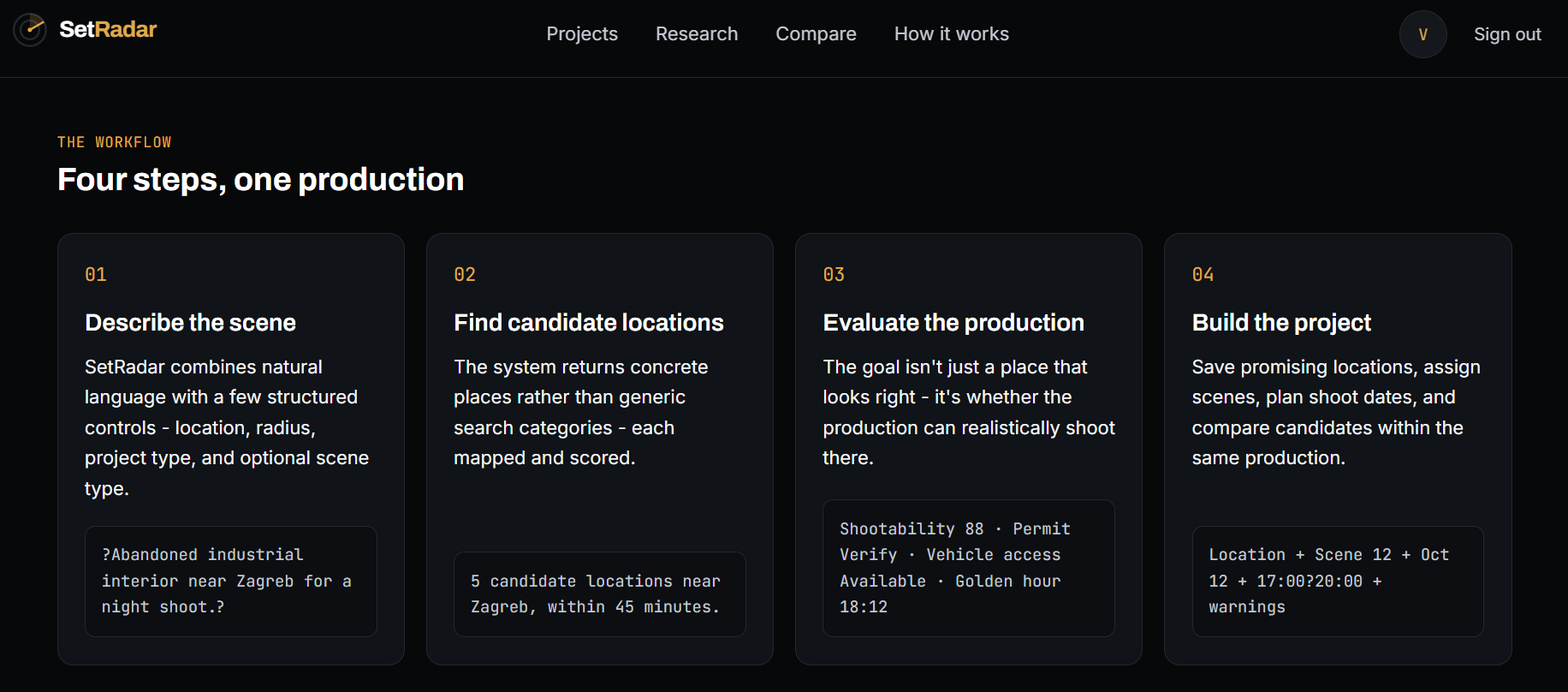
The main feature is Location Scout. Instead of choosing from rigid categories, I can describe the scene I am looking for in natural language. I can specify a city or area, search radius, production type, and scene requirements, while the AI focuses on understanding the actual visual and contextual idea behind the request.
For example, I can search for an abandoned industrial warehouse near New York, a brutalist civic building with dramatic stairs and deep shadows, or a quiet waterfront street with weathered warehouses.
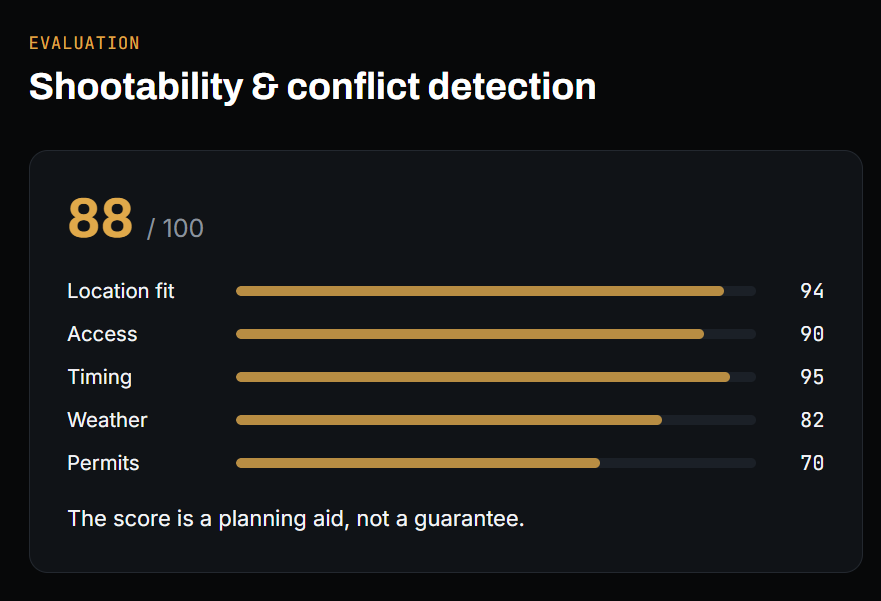
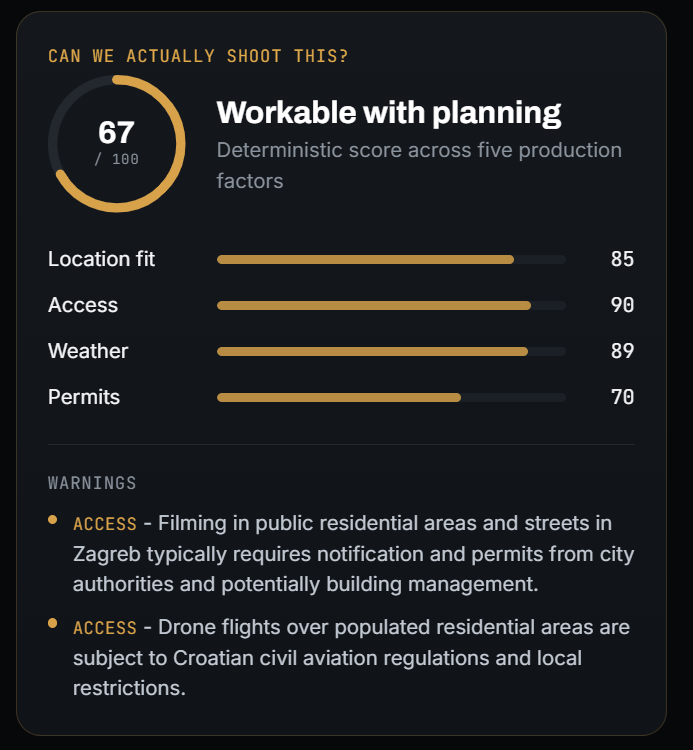
SetRadar then creates a research plan and uses AI agents and web research to find real locations. The results are not just generated places. Each candidate can include its name, address, coordinates, images, sources, description, explanation of why it matches, a shootability evaluation, warnings, and practical production information.
The system also researches images for discovered locations, filters unsuitable results, removes duplicates, and connects visual references with the correct location.
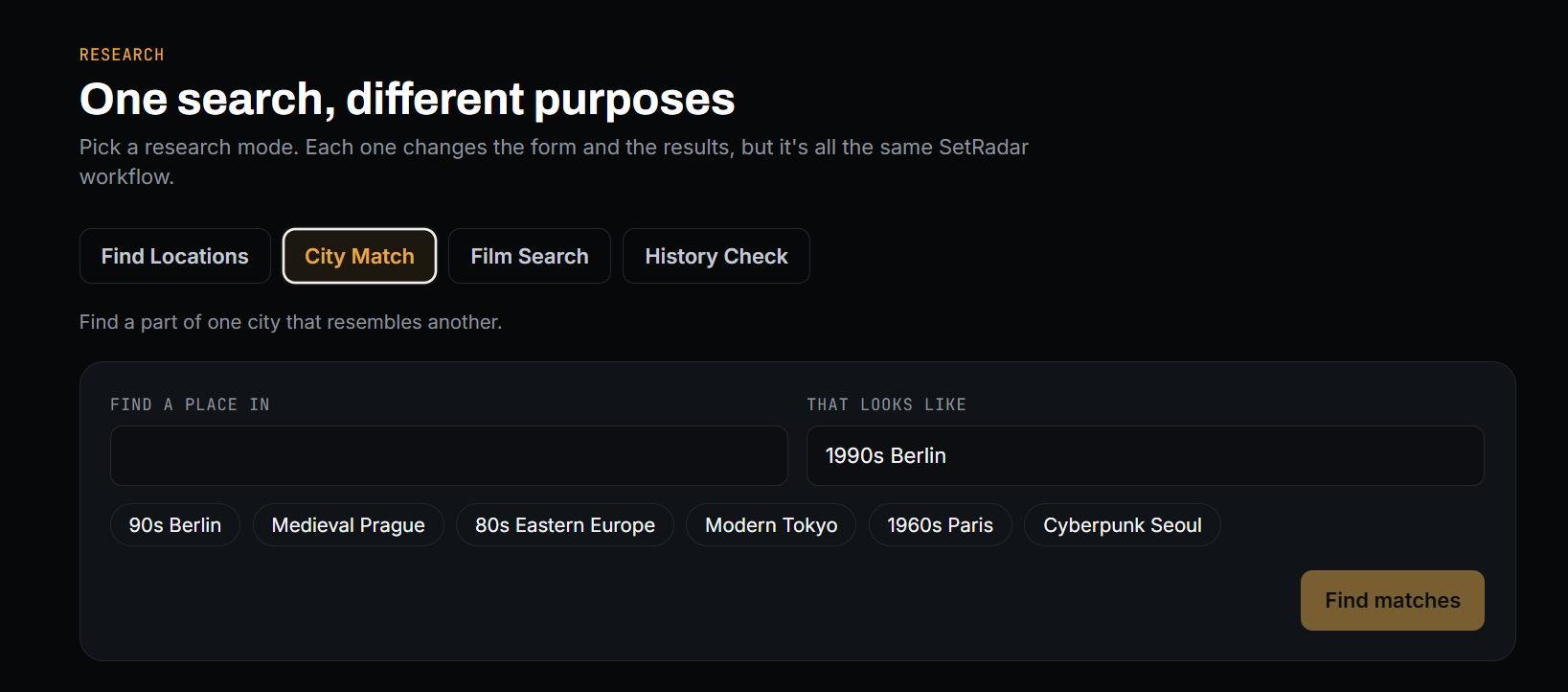
Another search mode is City Lookalike. It helps find places that visually resemble a reference city or environment. This is useful when a production needs the feeling of one city but has to film somewhere else because of budget, access, permits, travel, or scheduling.
Films in a City provides another way to discover locations and inspiration. I can research films associated with a particular city and find information about productions and filming locations connected to it.
SetRadar also includes a Historical Location Check. When a story takes place in a particular period, it can investigate whether a building, street, location, or visual environment actually fits that time.
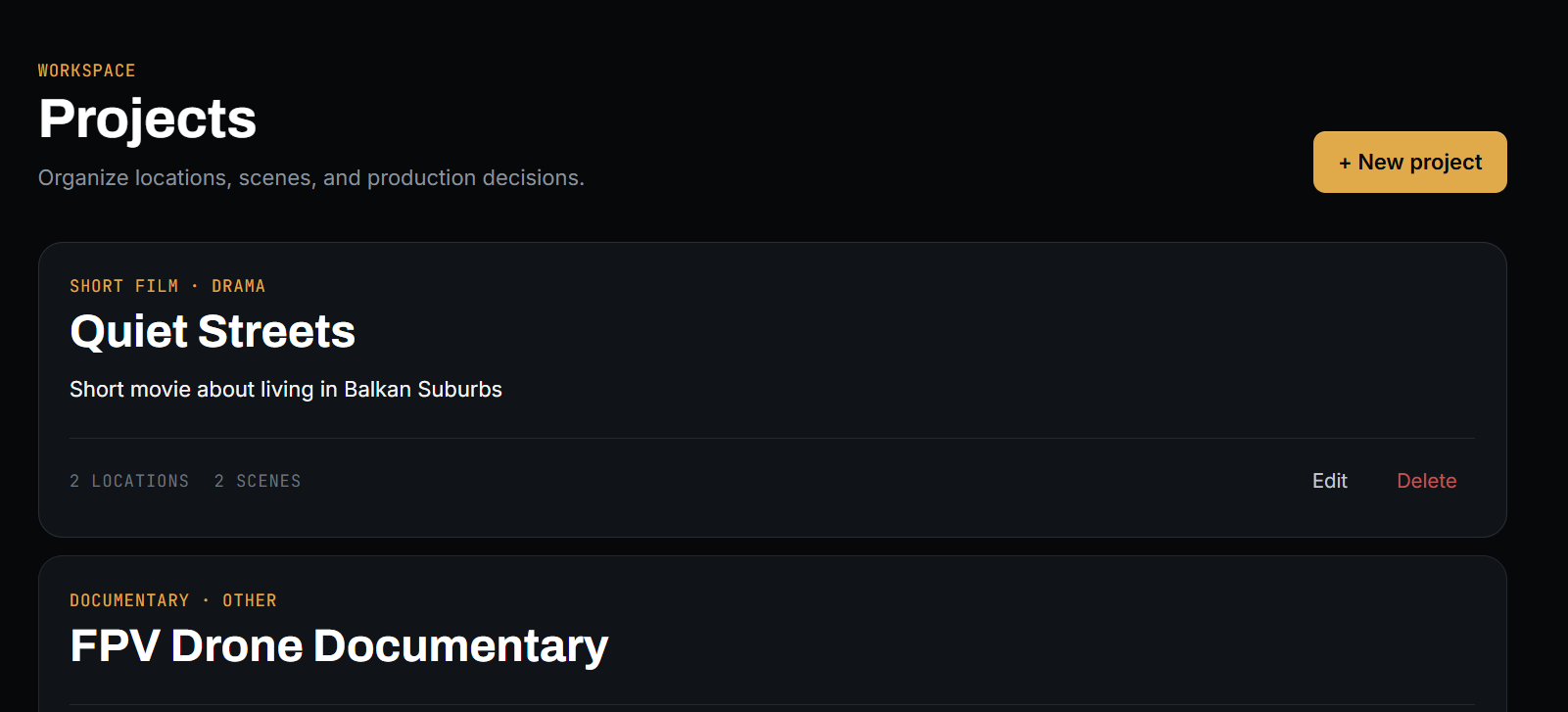
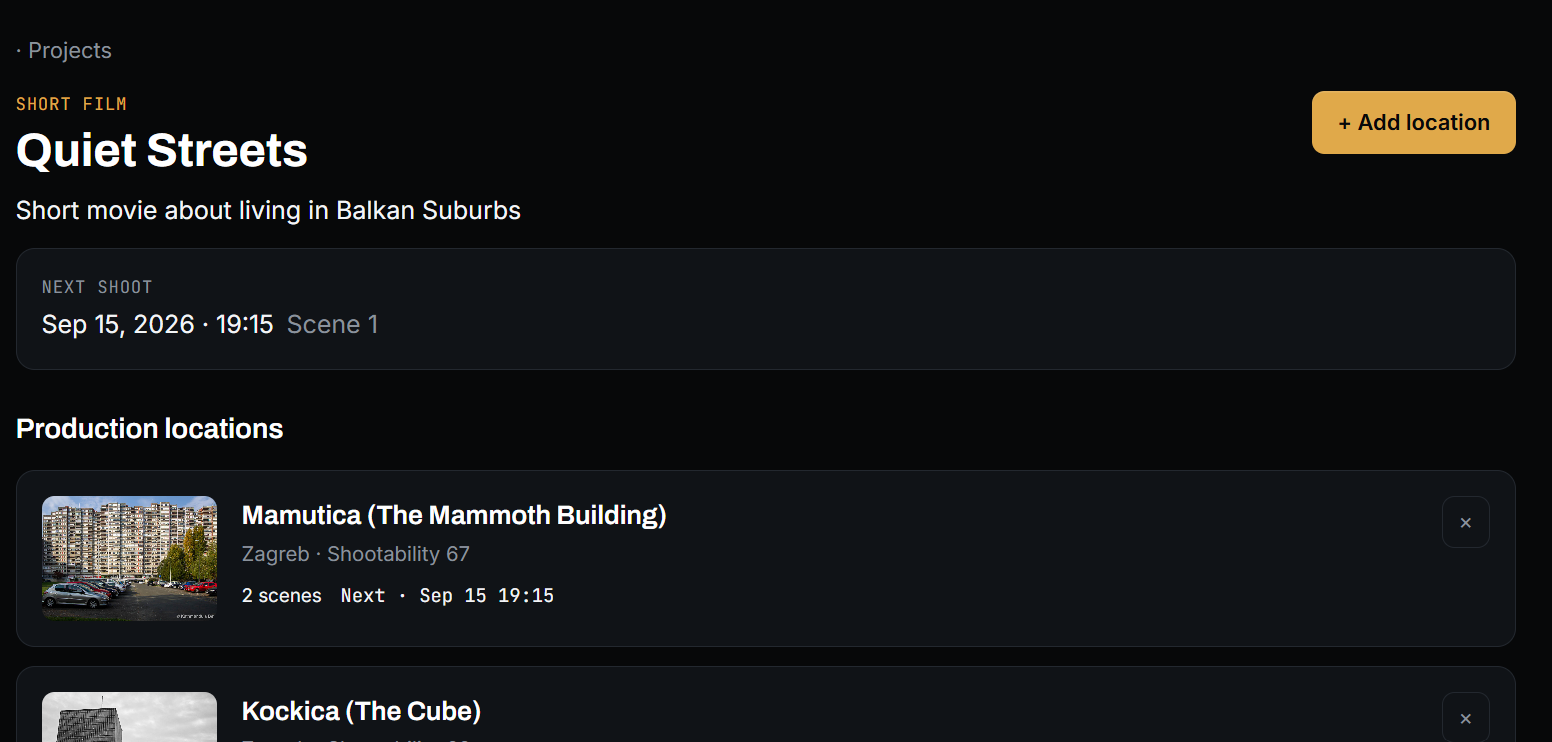
Once I find interesting locations, I can save them to my personal location library or add them to a project. Projects let me organize multiple locations and scenes in one place, instead of losing useful research after a search is finished.
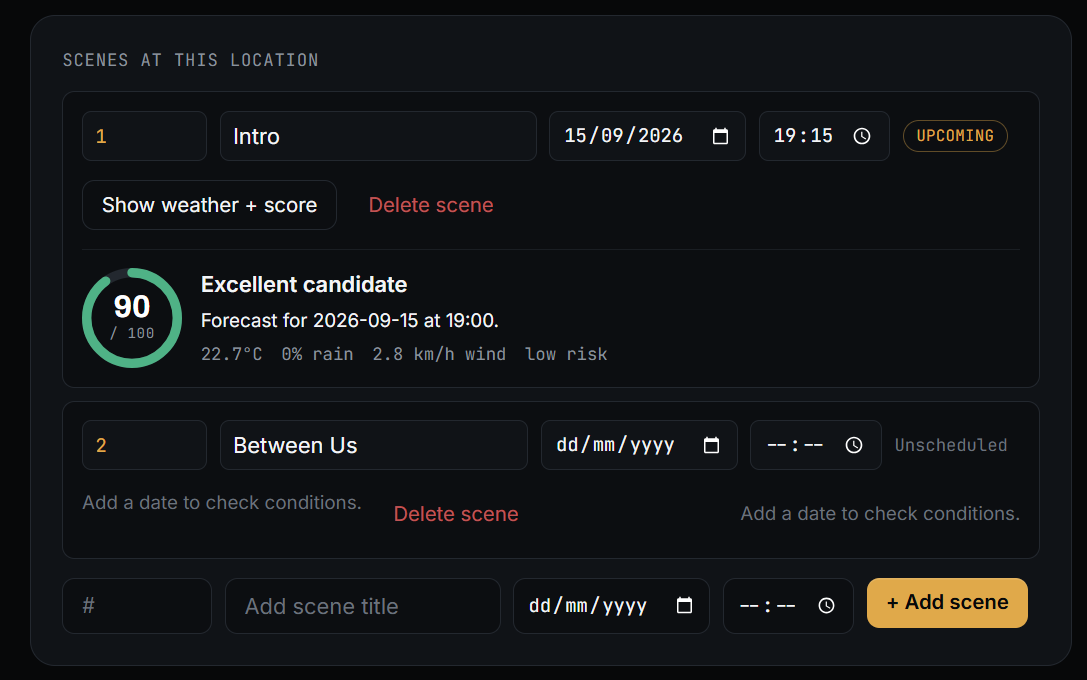
Each project can contain multiple locations and scenes with scene numbers, titles, shoot dates, start and end times, and production notes. I can attach notes to specific locations for things like permit questions, access instructions, parking, contacts, equipment limitations, or follow-up tasks.
SetRadar also provides comparison and decision support. Locations can be compared using factors such as visual match, shootability, access, restrictions, weather, distance, travel time, image references, and scene compatibility.
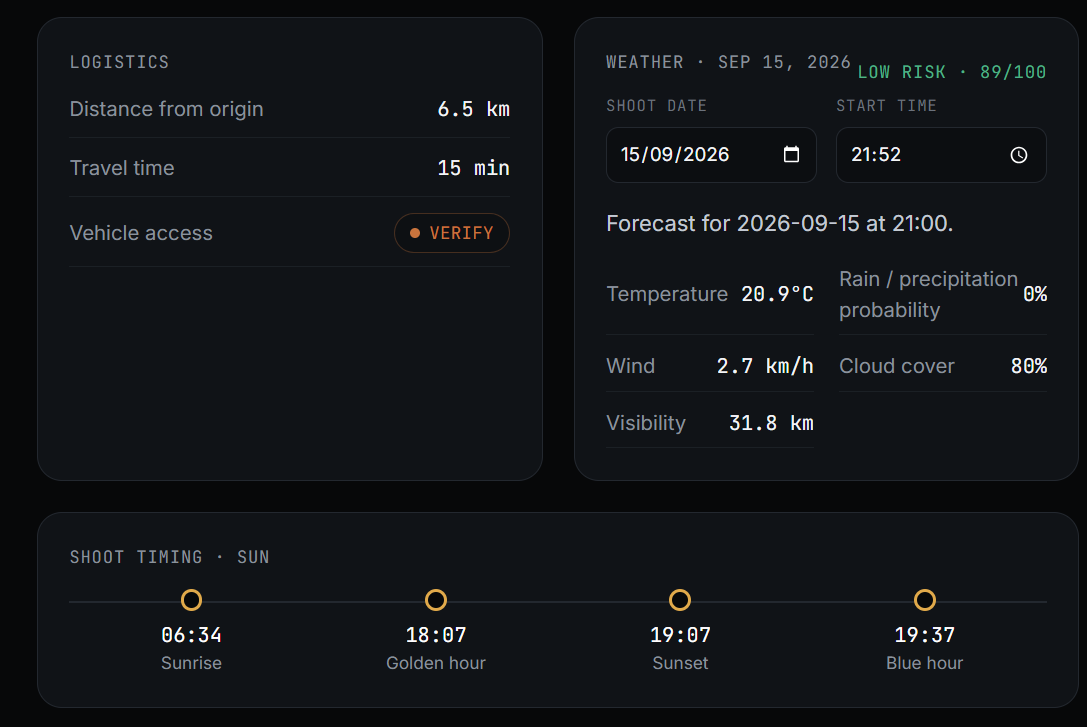
Weather and timing are integrated into the production workflow as well. For a planned date and time, SetRadar can provide temperature, rain probability, wind, cloud cover, visibility, sunrise, sunset, golden hour, and blue hour information. It can also warn me when a planned date is in the past, too far in the future, or potentially unsuitable for the requested scene conditions.
The result is not just a list of places. It is a workflow that takes a creative idea, turns it into researched real-world options, and helps organize those options into an actual production plan.
How I built it
I built SetRadar as a full web application with a React and TypeScript frontend and an Express and Node.js backend connected to MongoDB.
The AI workflow combines Google Gemini, Google ADK, and Parallel. Gemini is used for understanding creative requests, research planning, candidate synthesis, production analysis, and historical verification. Google ADK is used for the agent and tool orchestration, allowing different research responsibilities to work together as an agent-based workflow.
Parallel handles live web research and information gathering from relevant sources. The system can research location context, architecture, accessibility, permits, practical production details, historical information, and other evidence needed to evaluate a candidate.
I also integrated Open-Meteo for weather and environmental information, together with geographic and contextual sources for location data.
The application has persistent authentication and user data through MongoDB. Users can create accounts, save locations, create projects, manage scenes, and keep production notes. Private data is protected through authenticated API routes and ownership checks.
One of the important architectural decisions was making SetRadar behave more like a research system than a simple AI chat interface. The workflow can be broken into several specialized responsibilities, including research, image discovery, location analysis, and historical verification. An orchestrator then combines those results into a consistent response.
I also built the image discovery workflow so that the application does not simply display the first image matching a location keyword. It attempts to find useful visual references, filter unsuitable results, remove duplicates, and associate them with the correct location.
The application is structured for deployment through Vercel while keeping the frontend and backend architecture separate.
Challenges I ran into
One of the biggest challenges was making the AI useful without making it feel generic.
Early versions could find obvious locations, but they struggled with less-known places and more specific creative descriptions. A creator does not always know the exact name or category of a place. Sometimes they are describing an atmosphere, architectural style, era, visual reference, or feeling.
I had to improve the research workflow so that the system could interpret these descriptions instead of simply matching keywords.
Another challenge was discovering genuinely useful locations rather than repeatedly returning the most famous or obvious results. For location scouting, a result can be technically relevant but still be useless if everyone already knows it or if it does not actually fit the visual idea.
Image discovery was another difficult part. A location recommendation becomes much more useful when I can immediately see what the place actually looks like, but web image results can easily return something visually similar while representing a completely different place. Connecting the correct visual information to the correct location required additional filtering and validation.
I also had to deal with the complexity of combining multiple types of information. Location data, weather, historical information, images, permits, accessibility, and research sources all have different requirements and different levels of reliability.
The challenge was not simply getting AI to generate an answer. It was making the entire workflow reliable enough that a creator could actually use the information to make production decisions.
Accomplishments I am proud of
I am most proud that SetRadar grew from a simple location search idea into something closer to a complete research and planning workflow.
A creator can start with a vague creative idea, discover real locations, research them, see visual references, compare candidates, save the interesting ones, organize them into a project, assign them to scenes, add production notes, and check practical, weather, and historical information.
I am also proud of the focus on less obvious locations. The value of a location scouting tool is not only finding the places everyone already knows. I want SetRadar to help uncover places that a creator might never have found through a normal search.
Another accomplishment I am proud of is combining creative AI with real-world research. Instead of treating AI as the final answer, SetRadar uses AI agents to understand the request, coordinate research, evaluate evidence, and connect information from different sources.
I am also proud of building the project around an actual production workflow rather than stopping at the search result. Saving locations, creating projects, managing scenes, comparing candidates, adding notes, and checking weather and historical details all build on the same idea.
Most importantly, I am proud that the product reflects how I think about AI as a creator. I do not want AI to decide what my story should be or replace the creative process. I want it to remove some of the tedious research around the process so I can spend more time making creative decisions myself.
What I learned
I learned that location scouting is much more contextual than I initially thought.
A good location is rarely just a place that matches a keyword. It can depend on architecture, time period, atmosphere, geography, cultural context, accessibility, weather, production requirements, and the story that is being told there.
I also learned that building an AI product around real-world information is very different from building a normal chatbot. The system has to deal with information that can be incomplete, outdated, duplicated, or simply wrong. Research, verification, and source quality become just as important as the AI reasoning itself.
I learned that different AI tasks work better when they have clear responsibilities. Researching a location, finding images, analyzing production suitability, and checking historical accuracy are different problems. Separating these responsibilities and coordinating them made the overall workflow much more useful.
I also learned that AI does not need to replace creativity to have a meaningful role in the creative industry. It can be incredibly valuable as a research partner while leaving the actual creative direction to the person.
What's next for SetRadar
The next major step is making SetRadar understand an entire production, not just a single location request.
I want creators to be able to upload or paste an entire screenplay, script, treatment, storyboard, or other production format. SetRadar could then understand the different scenes, identify what each scene requires, and help find suitable locations for the entire project.
Instead of searching for one location at a time, a creator could give SetRadar the complete story and receive a production-oriented breakdown of the locations needed for each scene.
History Check could also become much more powerful in this workflow. Instead of manually entering one historical scenario, a creator could give SetRadar an entire period film script and have it identify potentially inaccurate details throughout the story - from brands and clothing to technology, architecture, transportation, cultural references, and other historical details.
I also want to improve the location scouting system so that SetRadar becomes less dependent on locations that are already well documented online.
One direction is allowing users to contribute locations that are difficult to discover through normal search. Photographers, filmmakers, location scouts, local creators, and people who simply know interesting places could add their own discoveries to SetRadar.
This could eventually create a community-powered location database focused specifically on interesting and production-relevant places, including locations that are almost completely unknown outside their local area.
I also see an opportunity for people who own or manage interesting private locations. They could create location profiles and make their spaces discoverable to creators looking for specific environments. Instead of only searching for locations that already exist online, SetRadar could connect creators directly with people who have exactly the kind of space they need.
Another feature I want to build is a map showing locations and the productions associated with them. A creator could explore a city geographically, discover interesting locations, and see which films, music videos, commercials, or other productions have used them.
That could eventually create a visual history of locations - not just "this is a place," but "these are the productions that happened here."
I also want to develop a stronger partner ecosystem around SetRadar. This could include production companies, location agencies, property owners, film commissions, tourism organizations, equipment companies, and other businesses that are already part of the production process.
Over time, I see SetRadar becoming a platform where creators can discover locations, location owners can make their spaces available, production teams can organize their projects, and partners can participate in the wider production ecosystem.
The long-term goal is for SetRadar to become more than a location search engine. I want it to become a research and discovery layer for the entire location-based production process - from the first creative idea, through finding and verifying locations, to organizing the final production plan.
The core idea would stay the same: AI helps with the research and connects the information, while the creative vision and the story remain with the person creating them.
Built With
- express.js
- gemini
- google-adk
- mongodb
- open-meteo-forecast
- parallel
- react

Log in or sign up for Devpost to join the conversation.