Inspiration
Every year, thousands of people go missing, leaving families in uncertainty and distress. Existing systems are often slow, fragmented, and unable to adapt as time passes. We were inspired to create a solution that not only tracks missing individuals but actively helps reconnect them with their families—even after years. SETHU was born from the idea of using AI as a bridge of hope.
What it does
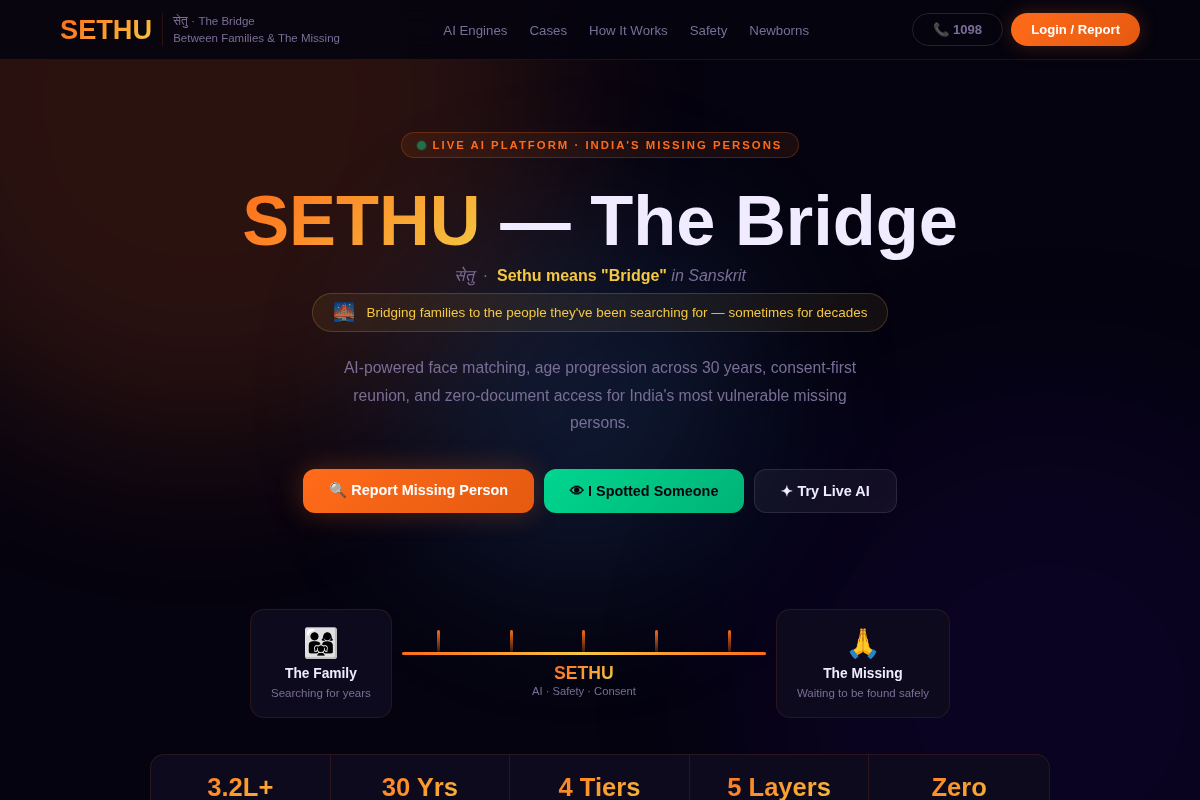
SETHU is an AI-powered platform designed to help locate and reconnect missing persons with their families. It uses:
- Facial recognition to identify individuals from images or reports
- Age progression to predict how a person might look over time
- Predictive analytics to estimate possible locations or movement patterns
- Real-time alerts when potential matches are detected
It transforms missing person recovery from a passive process into an active, intelligent system.
How we built it
We designed SETHU as a modular, scalable system powered by AI (ASI-1):
- Collected and structured missing person data inputs
- Planned facial recognition and image analysis workflows
- Integrated age progression and predictive modeling concepts
- Designed system architecture including database, processing layer, and alert mechanisms
- Used ASI-1 extensively for ideation, feature design, and system planning
- Created mockups and conceptual flows to demonstrate functionality
Challenges we ran into
- Ensuring privacy and ethical handling of sensitive personal data
- Designing accurate age progression models conceptually
- Balancing system complexity with usability
- Structuring unorganized data into meaningful formats
- Clearly integrating ASI-1 into multiple parts of the system
Accomplishments that we're proud of
- Built a meaningful solution addressing a real-world social issue
- Successfully integrated AI (ASI-1) across multiple core features
- Designed a scalable and impactful system architecture
- Created a clear vision for real-world deployment
- Combined technology with empathy to solve a human problem
What we learned
- AI can be used not just for automation, but for solving emotional and societal challenges
- The importance of ethical AI, privacy, and consent
- How to design systems with real-world scalability
- The value of structured documentation and AI-assisted development
- How to transform an idea into a complete, presentable solution
What's next for SETHU — AI Bridge for Missing Persons
- Develop a working prototype with real-time facial recognition
- Integrate with law enforcement and missing persons databases
- Build a mobile app for public reporting and alerts
- Enhance prediction models for better accuracy
- Expand to a nationwide and eventually global platform
- Collaborate with NGOs and government agencies for real-world deployment
SETHU doesn’t just find people — it restores families.


Log in or sign up for Devpost to join the conversation.