Inspiration
We wanted to build a robot that felt less like a machine and more like a small companion. Most beginner robotics projects focus mainly on movement, but we wanted Sesame to have personality too. The idea of giving a robot expressive eyes, simple emotions, and playful movements made the project much more exciting. We were also inspired by the growing open-source robotics community and wanted to create something that other students, makers, and beginners could build and experiment with.
What it does
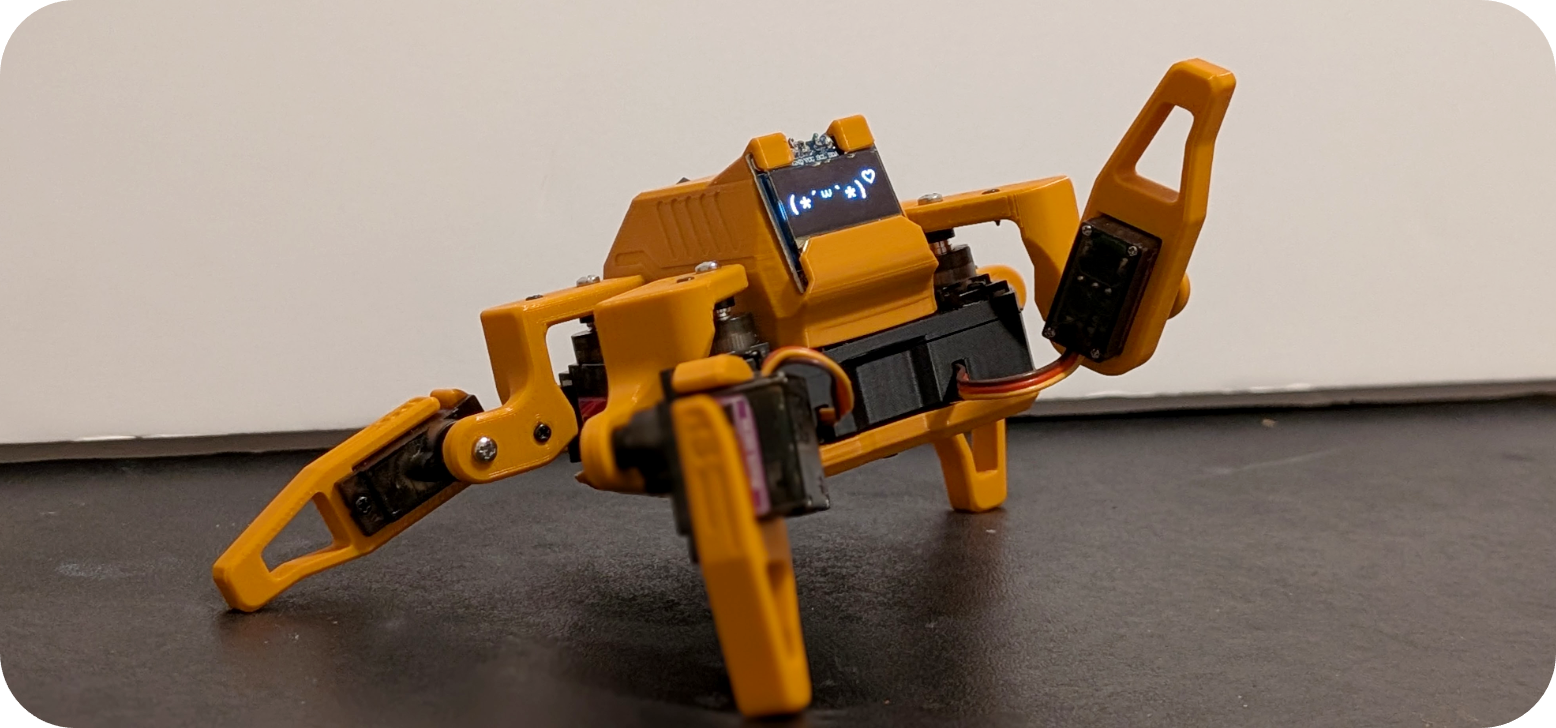
Sesame is an 8-servo quadruped robot powered by an ESP32. It can walk, wave, dance, point, rest, and perform other pre-programmed movements. Its 128×64 OLED acts as an expressive face, allowing it to react with different emotions and expressions.
The robot can connect to Wi-Fi and be controlled through a web interface, serial commands, or a JSON API. We also developed tools such as Sesame Studio to create custom animations without having to manually write every servo movement.
How we built it
The robot was designed to be completely 3D-printable using PLA, keeping the mechanical structure affordable and accessible. We used eight MG90-style servo motors, an ESP32-based controller, an OLED display, and a regulated 5V power source.
On the software side, the firmware was developed in C++ using the Arduino ecosystem. We combined servo control, basic quadruped movement, OLED animations, Wi-Fi connectivity, and API-based control into one system. Sesame Studio was created to make animation development easier by allowing us to visually define poses and sequences.
Challenges we ran into
Getting eight servos to move together smoothly was one of the biggest challenges. Small differences in servo positioning, mechanical assembly, and calibration could make the robot unstable or cause uneven walking.
Power management was another important challenge. Multiple servos can draw significant current, especially during movement, so we had to pay close attention to the power supply and wiring.
We also had to balance movement with expression. A robot can technically move correctly, but making those movements look natural and coordinated with its face required a lot of testing and adjustment.
Accomplishments that we're proud of
We are proud that Sesame became more than just a walking robot. It combines mechanical design, embedded programming, electronics, animation, networking, and human interaction in a single open-source platform.
We also created the project with accessibility in mind. Someone with a basic understanding of Arduino, access to a 3D printer, and affordable components can build their own Sesame and then modify it however they like.
Most importantly, we built a foundation that others can extend rather than a closed, one-purpose robot.
What we learned
This project taught us that robotics is rarely about getting one component working in isolation. Mechanical design, electronics, software, power, calibration, and user experience all have to work together.
We also learned how important iteration is. Many of Sesame's best movements and expressions came from repeatedly testing, adjusting, breaking things, and trying again.
Perhaps the biggest lesson was that personality can completely change how people interact with a robot. Even a simple OLED face and a small movement can make a machine feel surprisingly alive.
What's next for sesame-robot
We want Sesame to become a broader robotics platform rather than just one robot design. Future work could include better walking algorithms and inverse kinematics, additional sensors, improved obstacle detection, smarter balance control, and more advanced interaction capabilities.
We also want to explore AI-powered voice and vision features, allowing Sesame to understand simple commands, respond conversationally, and react to its surroundings.
The long-term goal is simple: keep Sesame open, affordable, hackable, and fun so that anyone can build it, modify it, and turn it into their own robot companion.
Built With
- 3dprinting
- arduino
- c++
- cad
- embeddedsystems
- esp32
- iot
- motors
- oled
- open-source
- python
- restapi
- robotics
- servo
- wifi


Log in or sign up for Devpost to join the conversation.