-
-
SERVEXA
Inspiration
SERVEXA started with a real communication failure I experienced while working with a real estate company.
I had brought a client into the company and was involved in helping her with her property. After I left the company, her property was eventually revoked because the company said they had been trying to reach her and were unable to get a response.
But when I spoke with the client, she told me a very different story. She said she had not received an email, phone call, or any other communication telling her that there was an issue with her property. She also had not been informed that I had left the company or that another staff member could take over the relationship and help her regularize the situation.
What stood out to me was not simply that there had been a missed call or an unanswered email.
There was no reliable follow-through.
The company believed they had attempted to communicate. The customer believed nobody had contacted her. Somewhere between those two sides, an important customer relationship was lost.
That experience made me think about how many businesses have the same problem. They send reminders, emails, messages, or make occasional calls, but once something is missed, someone still has to follow up, understand what happened, and make sure the next action actually happens.
That became the idea behind SERVEXA.
What it does
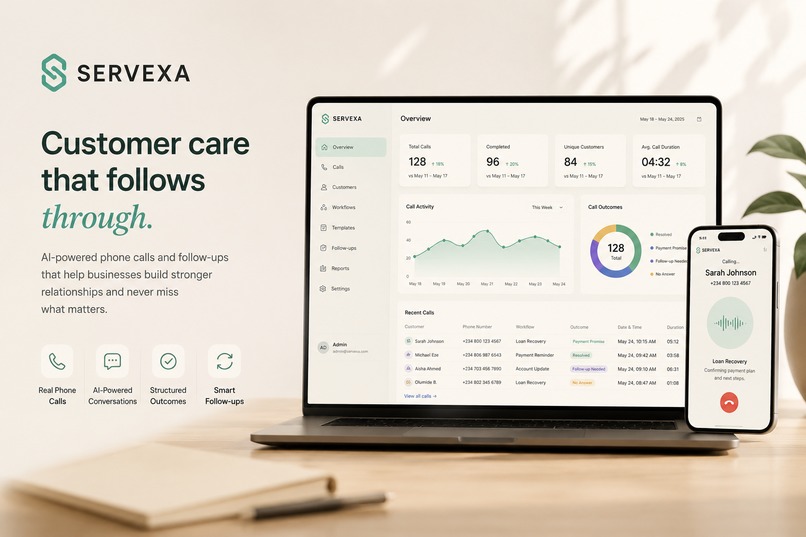
SERVEXA is an AI-powered customer-care workforce designed to handle routine customer conversations by phone and follow through on what happens next.
Instead of relying only on emails or notifications, SERVEXA can use CALL-E to make a real phone call, understand the customer's response, record the outcome, and determine the next action.
The system is designed around a simple principle:
Call → Understand → Record → Follow Through
A company can use a standard customer-care workflow or provide a human-directed instruction for a specific conversation. For example, a staff member could tell the agent to naturally ask whether a customer can make a partial payment this week.
The goal is not to replace human customer-care teams.
The goal is to make sure important customer conversations do not disappear between departments, inboxes, spreadsheets, and missed calls.
How we built it
SERVEXA uses CALL-E as the phone conversation layer.
The application sends a customer-care task from the SERVEXA interface to a Supabase Edge Function, which securely initiates the CALL-E call. CALL-E conducts the live conversation and returns the call information and structured result.
SERVEXA then persists the result in Supabase so the organization can see what happened and what should happen next.
The workflow is:
Customer data → Call workflow → CALL-E phone call → Customer response → Structured outcome → Follow-up
I also built two conversation modes: standard workflows and human-directed calls. This allows an organization to maintain a consistent customer-care process while still giving staff control when a particular customer needs a specific question or follow-up.
Challenges we ran into
The hardest part was not simply getting an AI agent to talk.
It was designing the system around what happens after the conversation.
A useful customer-care call needs a clear purpose. The agent needs to understand the customer's situation, avoid inventing information, respond with empathy, recognize when a human should take over, and leave behind a useful record.
That led me to treat the call as one part of a larger workflow rather than the entire product.
Accomplishments that we're proud of
The accomplishment I am most proud of is turning a real communication problem I personally experienced into a working product.
SERVEXA is not just a concept or a mockup. I built a functioning customer-care workflow that can initiate real phone conversations through CALL-E, allow a human to direct what the conversation should accomplish, and turn the conversation into a structured customer-care outcome.
I am especially proud of the human-directed call workflow. A staff member can give the agent a specific instruction for a customer instead of relying on a generic script. The agent can then incorporate that instruction naturally into the conversation while maintaining the broader customer-care objective.
I am also proud that I built the product around what happens after the call. The goal is not simply to have an AI talk to someone. The conversation needs to produce an outcome that can support a follow-up action.
Most importantly, SERVEXA came from a problem I actually experienced. I saw how a communication gap between a company and a customer could have a real consequence, and I built something intended to prevent that kind of gap from happening again.
What we learned
Building SERVEX changed how I think about voice AI.
A convincing conversation is not enough.
For customer care, the real value comes from turning that conversation into something actionable.
A customer can say, "I need more time."
The important question is what happens after that.
Is the situation recorded? Is there a follow-up date? Does someone know what happened? Does the organization have a reliable record of the conversation?
That is the gap SERVEX is designed to address.
The experience that inspired the project showed me that communication is not just about sending a message. It is about making sure the message reaches the customer, understanding their response, and following through.
That is why the idea behind SERVEX is simple:
Customer care that follows through.
What's next for SERVEXA
The next step for SERVEXA is to move from a working prototype into a production-ready customer-care platform for organizations that manage large numbers of customer relationships.
I want SERVEXA to become the layer that makes sure important customer conversations are not forgotten.
That means expanding the workflow beyond individual calls into persistent customer follow-up: scheduled callbacks, escalation to human staff, richer reporting, customer-history context, and integrations with the systems companies already use to manage their customers.
I also want to expand the intelligence around call outcomes. Instead of treating every conversation as an isolated event, SERVEXA should help organizations identify recurring problems, customers who need attention, unresolved cases, and patterns in why customers are not completing important actions.
The long-term vision is simple:
Customer data → Intelligent outreach → Real conversation → Understanding → Action → Follow-through
SERVEXA should help organizations know not only that they contacted a customer, but what happened, what the customer needs, and what should happen next.
The ultimate goal is to make reliable follow-through a standard part of customer care.
Built With
- call-e
- expo.io
- react
- restapi
- superbase
- typescript
- vercel

Log in or sign up for Devpost to join the conversation.