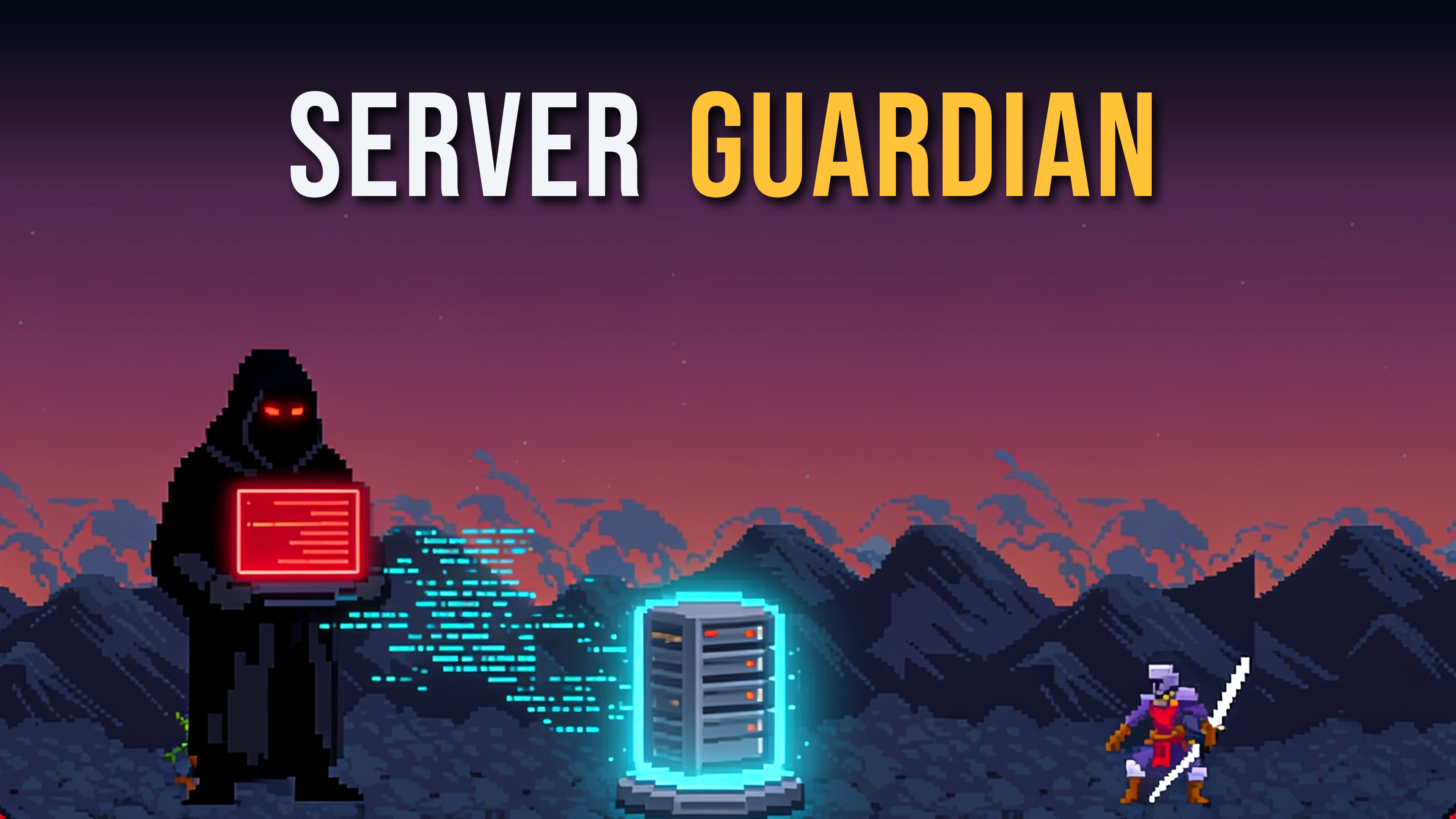
   ## Inspiration

   Running my own home server is a hobby — it's a small, personal part of my daily
   life. But that also means it's constantly poked at by automated intruders. Raw
   security logs are hostile, unreadable, and worst of all they *leak the very
   infrastructure they describe*. I didn't want a SOC console. I wanted to glance
   at my own server the way I'd check on a base in a game — and actually enjoy
   defending something that's mine.

   ## What it does

   Server Guardian Warboard turns privacy-filtered signals from a read-only decoy
   on my server into five synchronized, watchable views:

   - an **RPG village** where each monster is a redacted bot,
   - a **strategic map**,
   - a **NORAD-style threat board**,
   - **cinematic battles**, and
   - a **first-person mode**.

   ## How I built it

   The dashboard core, RPG/battle engine, sprite pipeline, map/NORAD views, audio,
   and FPS mode existed before Build Week. During the Submission Period I used
   **Codex and GPT-5.6** to turn a personal toy into a judge-ready, privacy-safe
   app:

   - a hardened redaction boundary with a **final display-layer aliasing pass**, so
     no raw address/host/account can reach the UI even if a backend step fails,
   - full **English/Korean** coverage of every judge-facing string,
   - **deterministic demo scenes** (`?demo=skirmish|dq|srw|fps|fpss|fpsm`) for
     repeatable judging,
   - a **six-mode automated QA gate**, and
   - the public repo, licensing/notices, submission guide page, and the 2:55 demo
     video pipeline.

   Product direction, safety and privacy boundaries, visual language, and final
   acceptance stayed my decisions.

   ## Challenges I ran into

   The hardest guarantee was privacy that never fails open. A single redaction
   choke point isn't enough, so I enforce it in layers and finish with a display-
   layer alias pass — hostile input can never surface verbatim. Keeping the whole
   thing deterministic enough for reliable judging (six QA modes, reproducible
   scenes) was the other real lift.

   ## What I learned

   Privacy has to be enforced in layers, not at one point. And framing matters: the
   moment defending my server felt like a game, an ignored log stream became
   something I *want* to look at every day.

   ## What's next

   Broader signal sources, configurable redaction policies, and shareable
   read-only war rooms so other homelab hobbyists can watch over their own servers
   safely.
Server Guardian Warboard
Someone kept attacking my personal server, so I turned every intrusion into an RPG, map, NORAD, and first-person war room — a privacy-safe, read-only security viewer built with Codex and GPT-5.6.


Updates

Leave feedback in the comments!
Log in or sign up for Devpost to join the conversation.