-
-
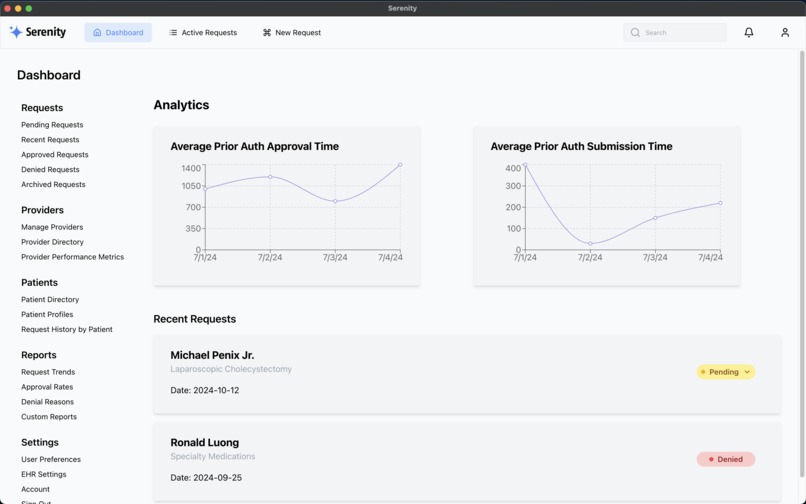
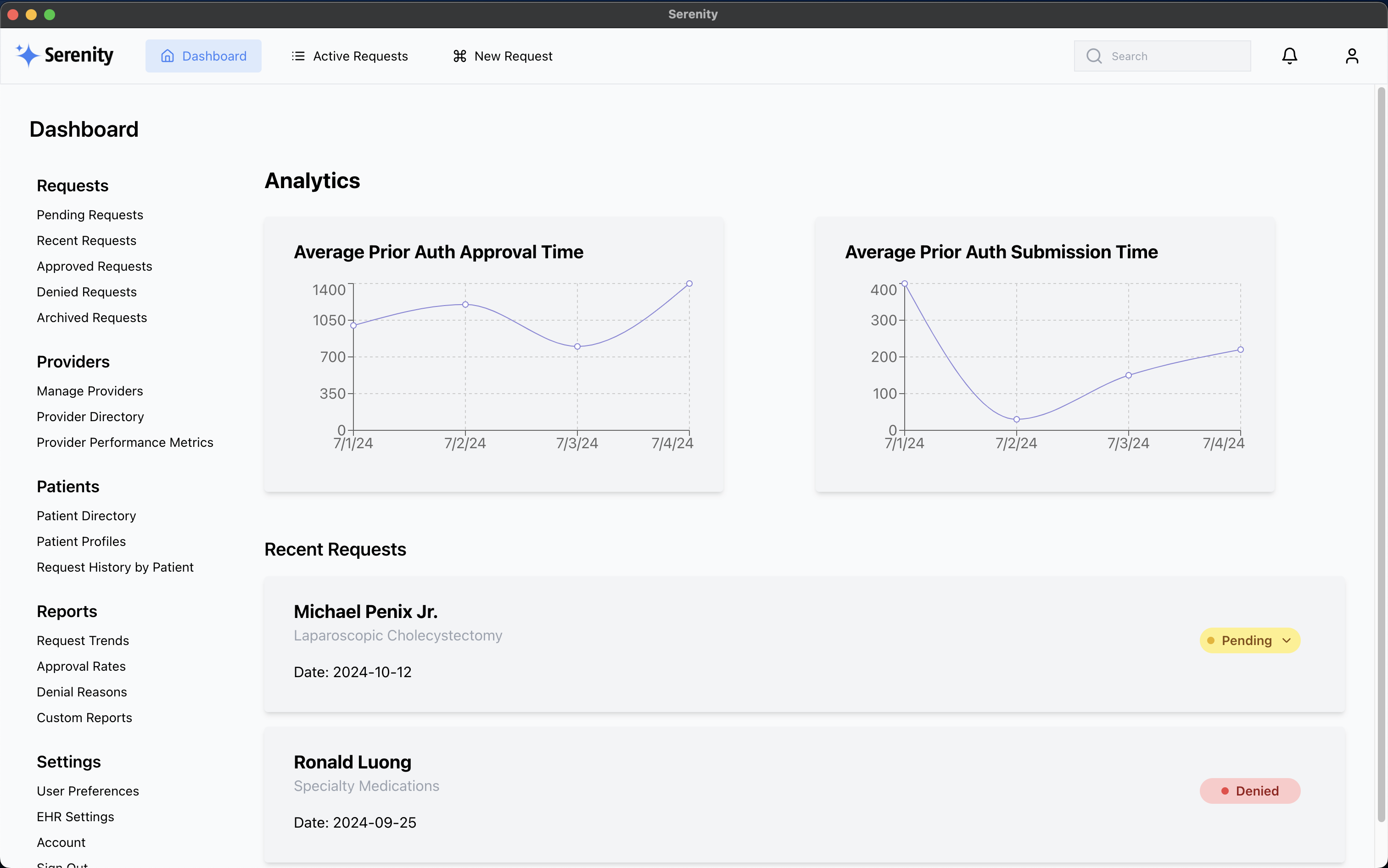
Dashboard
-
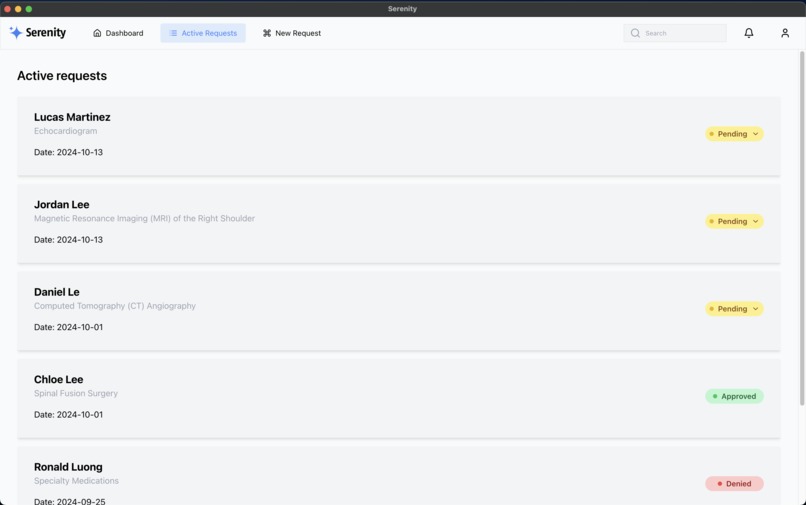
Active Requests
-
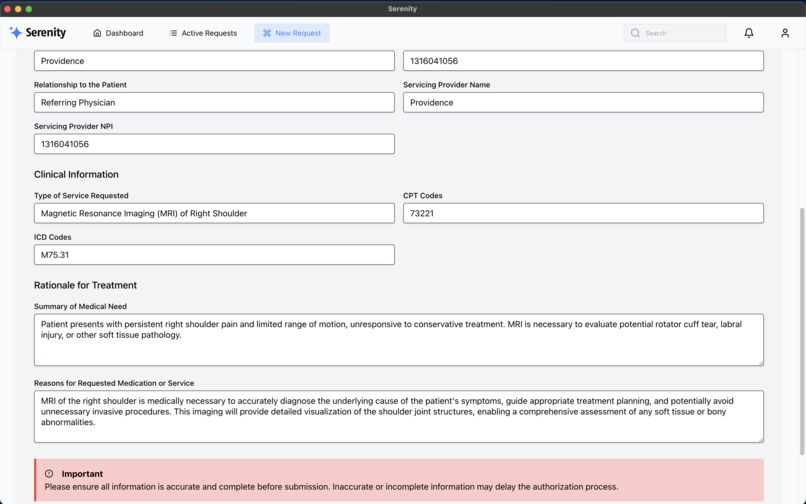
Generated Prior Authorization Form
Inspiration
In 2008, the doctors told my father that he had a subtle heart murmur. It took an entire 16 days for the echocardiogram to be approved by insurance and when it was finally processed, it revealed a severe aortic aneurysm that would have been fatal, had it been left unseen for even two more days.
This process — where healthcare providers must get their claim approved by an insurance provider before distributing care — is called prior authorization.
Delays in the prior authorization process have been long affecting patients who are not able to receive the necessary care fast enough and end up suffering as a result. The constant back-and-forth between healthcare providers and insurance providers, the outdated practice of faxing untraceable prior authorization claims, and the predatory nature of insurance firms all contribute to a massive overhead in terms of money and time for caregivers.
With Serenity, we hope to reduce that overhead by providing a streamlined solution to generating and managing successful prior authorization requests; we wish to reduce the time spent on insurance so that we can increase the time spent on those in need.
What it does
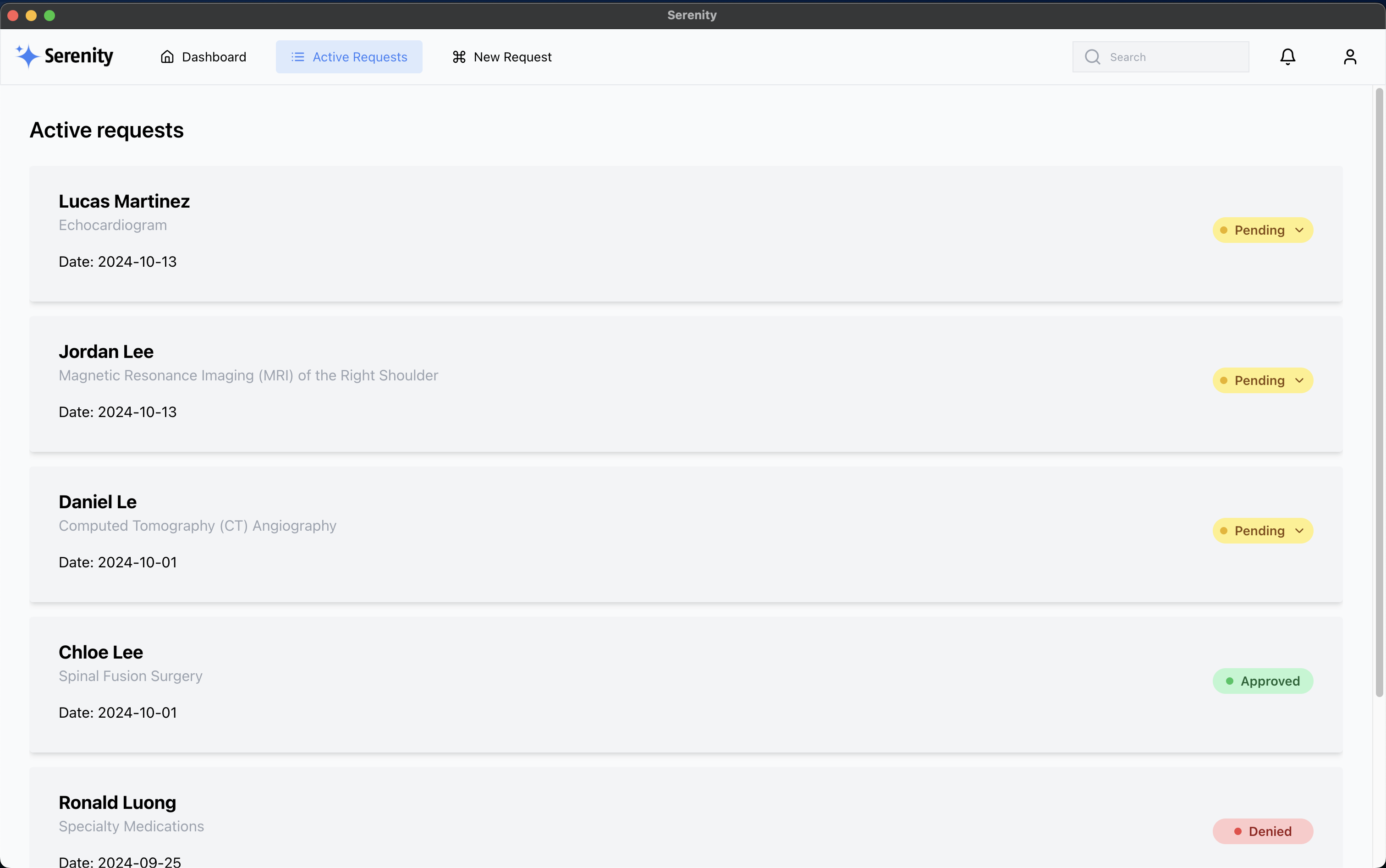
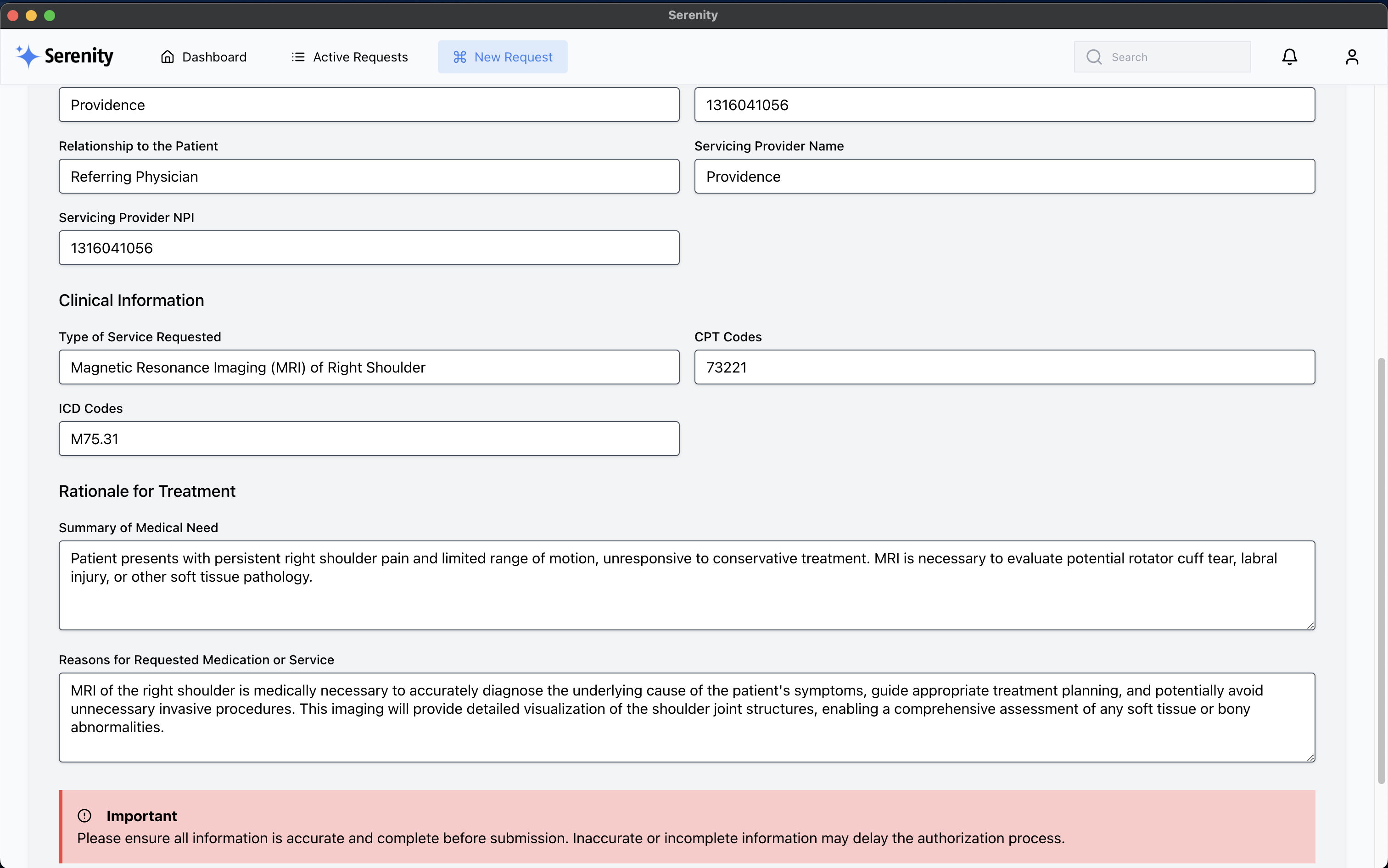
Serenity is an end-to-end management platform that automates the prior authorization process for healthcare providers. We integrate patient data from popular EHR systems (Epic, etc.) combined with an LLM that pulls the most accurate and relevant clinical justification to create a tailored prior authorization request for each patient and their unique needs. Serenity offers features like prior authorization generation, easily-traceable request management, one-click follow-ups with insurance providers, and performance analytics to allow for a much smoother, and hopefully faster, experience.
Essentially, we help healthcare providers create and manage fast and accurate prior authorization insurance claims.
How we built it
We built Serenity on AWS Bedrock, leveraging its scalable infrastructure and integrated AI services to streamline the process of generation. With Bedrock’s support, we were able to create a RAG pipeline that combined Anthropic’s Sonnet-3.5 with AWS’s data vectorization tools to search through relevant clinical guidelines, insurance policies, and medical necessity documents to prompt highly-relevant results.
Challenges we ran into
The most significant issue we ran into was building a healthcare tool that leveraged AI in a way that was accurate, safe, and trustworthy to use. Short answer — it’s not possible. Figuring out how to create the most accurate responses while ensuring that a human was always in the product loop was the most important challenge in building Serenity.
Accomplishments that we're proud of
We’re very proud of implementing a functional MVP and being able to present the programmed features of our idea in a working application. Getting the different components down and working together in the short amount of time was definitely a stressful task, but seeing how it turned out and being able to envision healthcare providers using our tool to aid more and more patients is something we take pride in.
We liked the idea of solving a very consumer-oriented problem without making a consumer-facing product — in this case, it’s simply an impossible issue for a patient to solve. That’s why attacking the issue at its roots with large-scale technologies like generative AI and AWS bedrock is becoming an extremely valuable concept.
What we learned
Planning and ideating is very important, but so is the notion that you “should always be building”. Iterating and redoing over and over again led us to create functionality that we would have never thought of had we just been sitting there thinking about it.
What's next for Serenity
Continued development and hopefully support in one of the local incubator tracks!


Log in or sign up for Devpost to join the conversation.