-
-
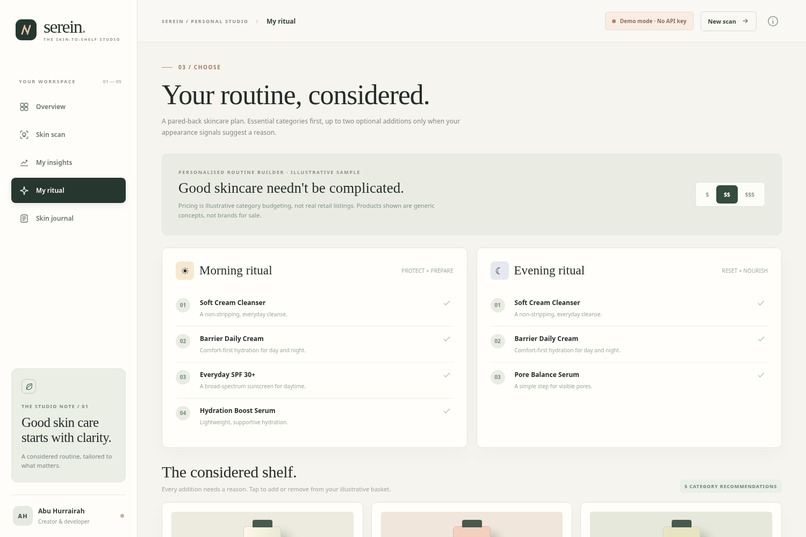
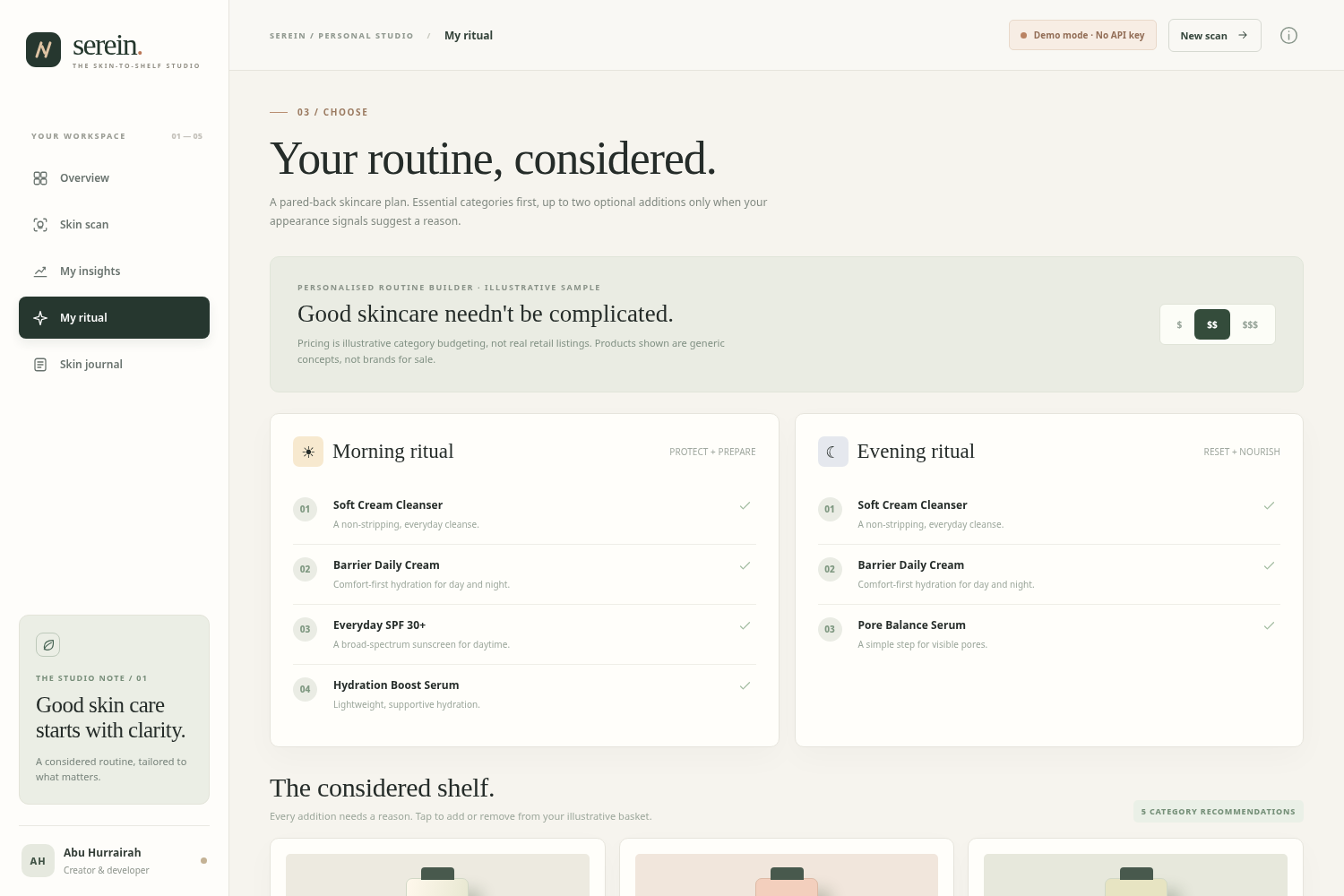
A personalised routine builder that turns skin priorities into practical morning and evening care and thoughtful product categories.
-
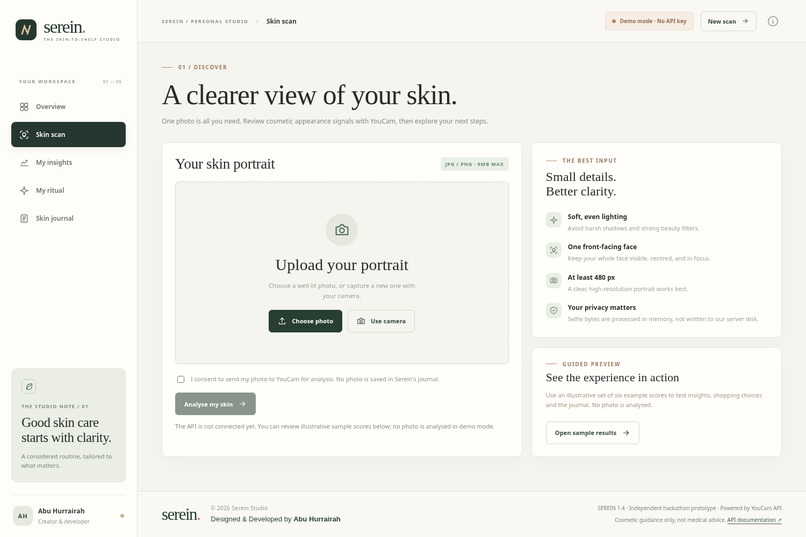
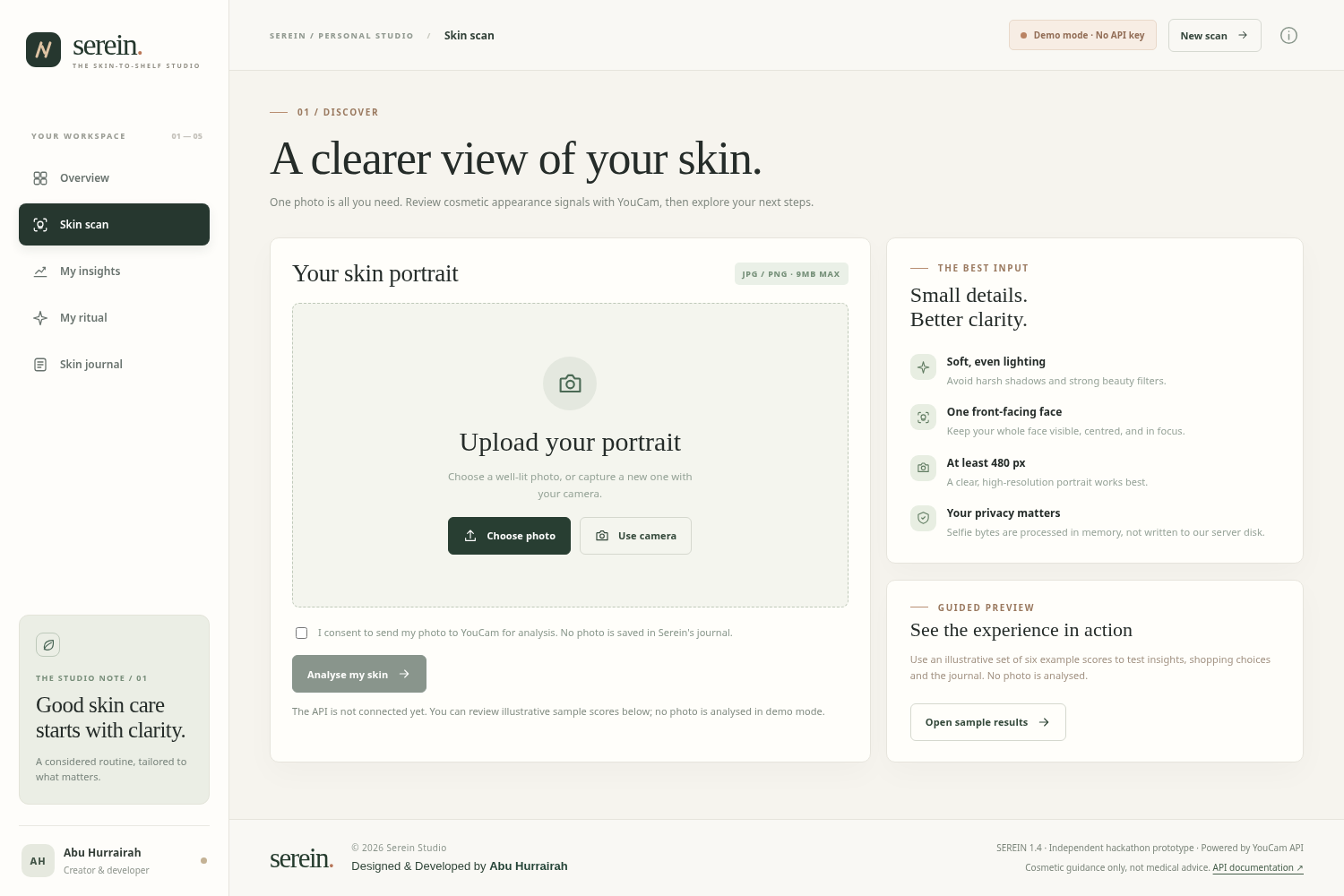
The starting point of the Serein experience. Users can upload a photo or use their camera to begin a cosmetic skin analysis.
-
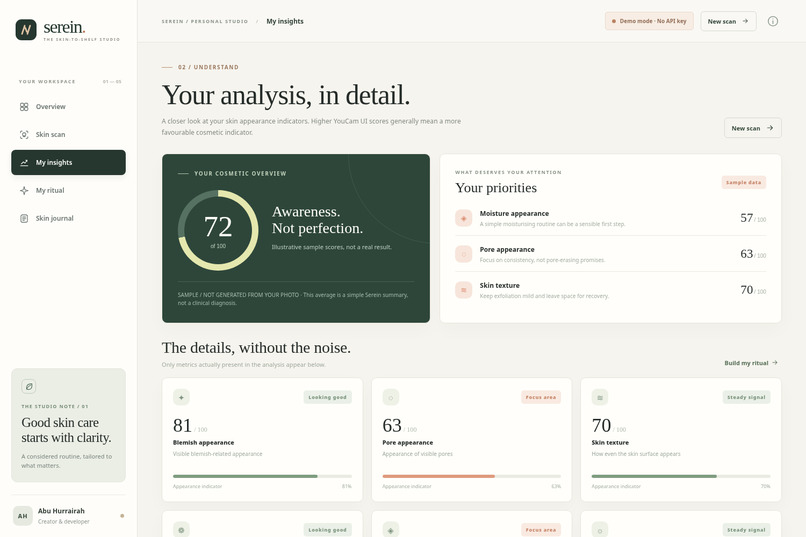
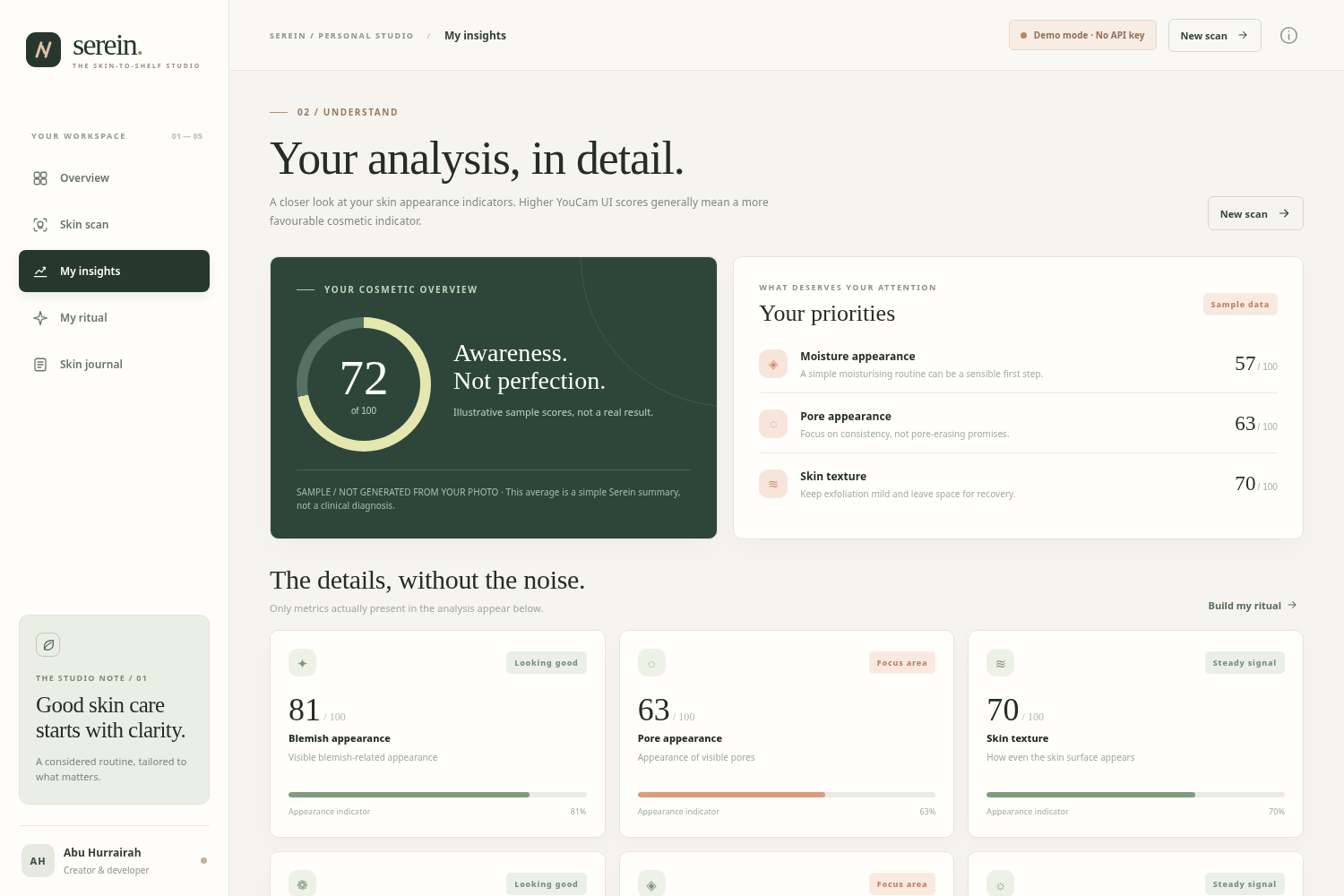
A clear visual breakdown of cosmetic skin appearance signals users understand their priorities. This screenshot demonstrates the experience.
-
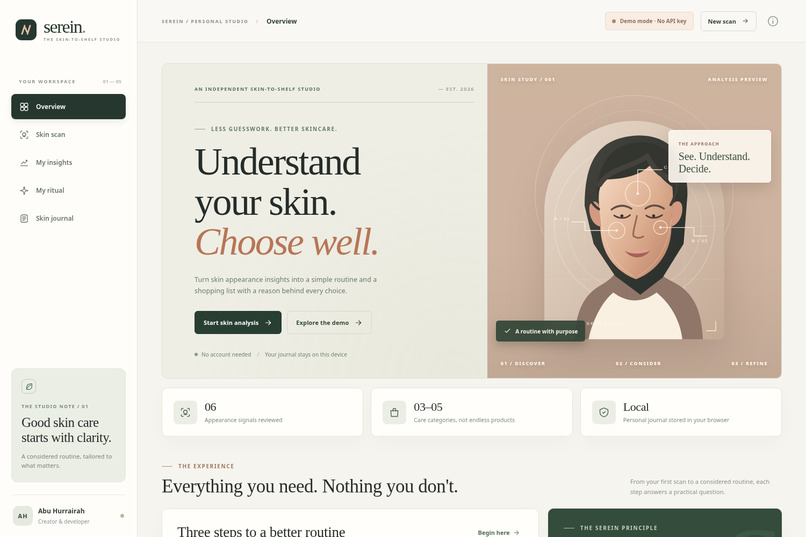
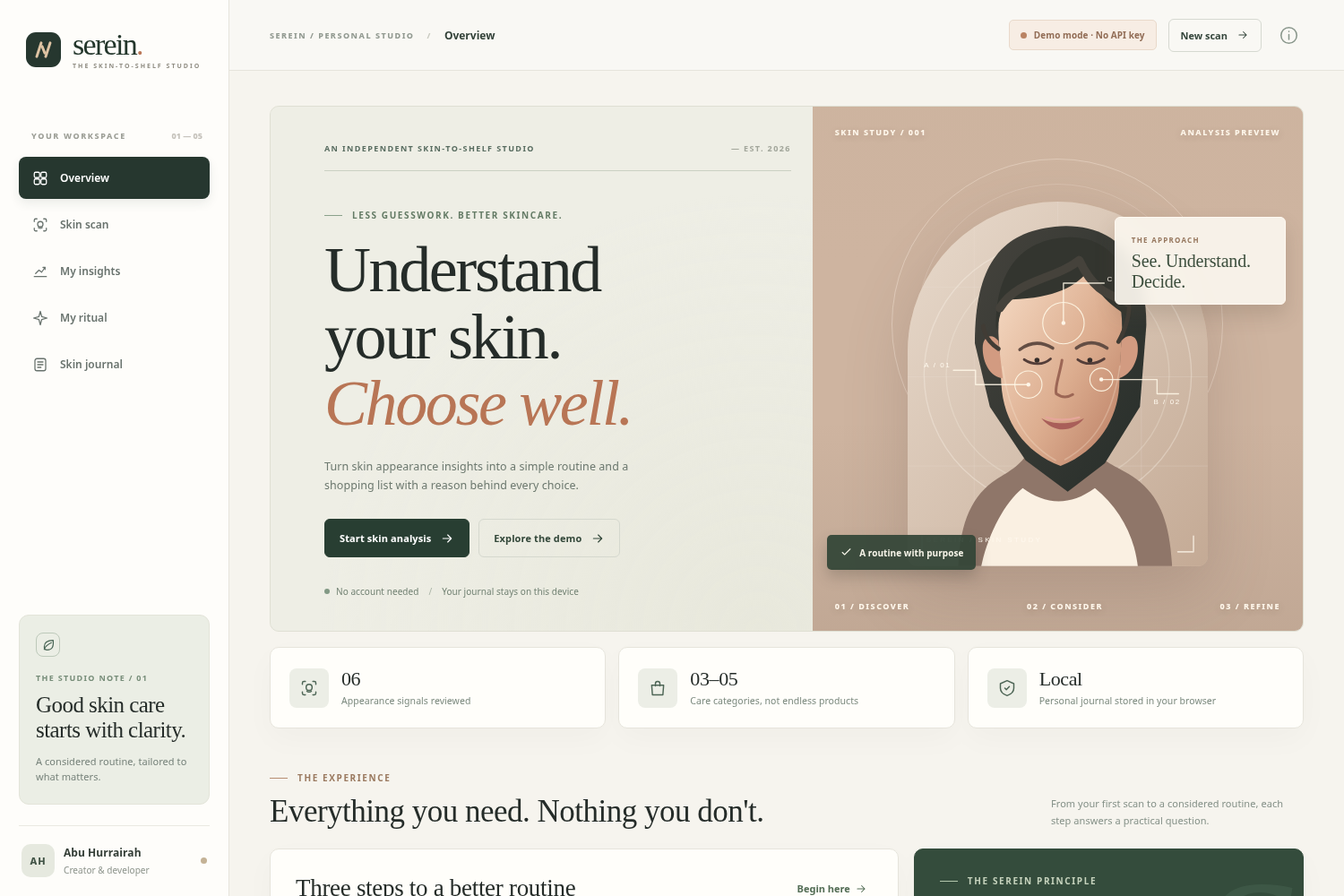
A thoughtfully designed skincare studio that brings skin insights, personalised routines, and smarter shopping decisions.
Serein — Skin-to-Shelf Studio
Your skin, your signals, your smarter shopping list.
Inspiration
Shopping for skincare should be simple, but it rarely feels that way. One product promises clearer skin, another promises better hydration, and social media has a new recommendation almost every day.
I wanted to approach this problem from a different direction. Instead of starting with products, what if we started with understanding the person shopping for them?
That question became Serein — a skincare decision studio designed to connect AI-powered skin insights with practical, thoughtful shopping choices.
The idea is simple: understand first, buy second.
What it does
Serein takes users through a five-part experience:
1. Skin Scan
Users can upload a portrait or take a photo using their camera. With an API key configured and user consent provided, Serein sends the image through the YouCam Skin Analysis API integration to request cosmetic skin analysis.
2. My Insights
The application presents the available appearance scores in a readable format, helping users understand which areas may deserve attention.
Instead of overwhelming people with technical measurements, Serein organises the information into clear priorities.
3. My Ritual
Based on those priorities, Serein creates a practical morning and evening skincare routine.
The routine starts with three essentials: cleansing, moisturising and sun protection. It can then suggest up to two additional care categories, with explanations of why they might be useful.
4. Smarter Shopping
Serein encourages intentional purchases instead of building an unnecessarily large shopping basket. Users can explore illustrative budget tiers, review suggested categories and remove optional items they do not want.
The goal is not to sell the most products. It is to help people make better decisions.
5. Skin Journal
Users can save appearance scores and personal reflections, review previous check-ins and export their journal as a CSV file. Journal information stays in the browser's local storage, and portrait photographs are not saved in the journal.
A clearly labelled sample experience is also included so the interface can be explored without consuming API credits. Sample results are illustrative and are never presented as genuine YouCam analysis.
How I built it
I developed Serein as a responsive web application using Python, FastAPI, HTML, CSS and JavaScript.
The backend integrates Perfect Corp's YouCam Skin Analysis API v2.1 using HTTPX. The integration involves requesting a file-upload destination, uploading the processed image, creating a skin-analysis task and checking the task status until a result becomes available.
Pillow processes uploaded portraits, including normalising image orientation and removing embedded metadata during JPEG re-encoding.
On the frontend, I built a custom editorial-style interface with responsive navigation, interactive insights, a rule-based routine builder and a personal journal.
One important design decision was to keep the recommendation logic understandable. Instead of using another opaque model to recommend products, Serein applies simple rules to cosmetic appearance scores and explains the suggested categories.
The API key stays on the server rather than being exposed in browser code.
The project also includes automated tests covering application routes, the user interface and a mocked YouCam API workflow. The live API integration still requires validation with actual credentials.
Challenges
One of the biggest challenges was turning technical skin-analysis output into something meaningful for an everyday shopper.
A numerical score alone does not tell someone what to do next. I needed to connect those measurements to useful decisions without making medical claims or suggesting that every visible concern requires another product.
Another challenge was the asynchronous YouCam workflow. Uploading an image, starting an analysis and retrieving the final result are separate operations, so the application needed to handle that process reliably.
I also wanted the interface to feel like a considered consumer product rather than a technical API demonstration. That influenced the typography, navigation, content structure and overall visual direction.
What I learned
Building Serein reinforced the difference between integrating an AI service and designing an actual product around it.
The API provides the underlying analysis capabilities, but the user experience depends on what happens afterward: how results are explained, which actions are suggested, and how much control the user retains.
I also gained practical experience with asynchronous API workflows, image validation, privacy-conscious application design and responsive frontend development.
What's next
There are several directions I would like to explore:
- Real retailer catalog integrations with transparent ingredient and pricing information.
- Better comparisons between visits while accounting for lighting and photo conditions.
- More personalised routines based on user preferences and budgets.
- Multilingual support and accessibility improvements.
- Production-level authentication, API usage limits and additional privacy controls.
The long-term vision is to turn Serein into a shopping companion that helps consumers feel more informed and less pressured.
Built by
Abu Hurrairah
Designed and developed for the YouCam API Skin AI & eCommerce VTO Hackathon.
Powered by Perfect Corp's YouCam Skin Analysis API integration. Serein is an independent prototype, not a medical diagnosis tool or an official Perfect Corp product.
Built With
- api
- css3
- fastapi
- html5
- httpx
- javascript
- pillow
- pytest
- python
- rest
- youcam
