Inspiration:
The inspiration for SERA came from a simple, yet deeply human need: the right to ask personal questions without fear or shame. Around the world, sexual health remains a taboo topic—especially for young people, LGBTQ+ individuals, and those in conservative or underserved communities. We wanted to create a space where anyone could feel safe asking the questions they were too afraid to voice elsewhere.
We saw the potential of AI not just as a tool, but as a bridge—one that connects curiosity to knowledge, and silence to support. With SERA, our goal was to combine empathetic AI with accessible technology to make sexual health education inclusive, respectful, and always available.
What it does:
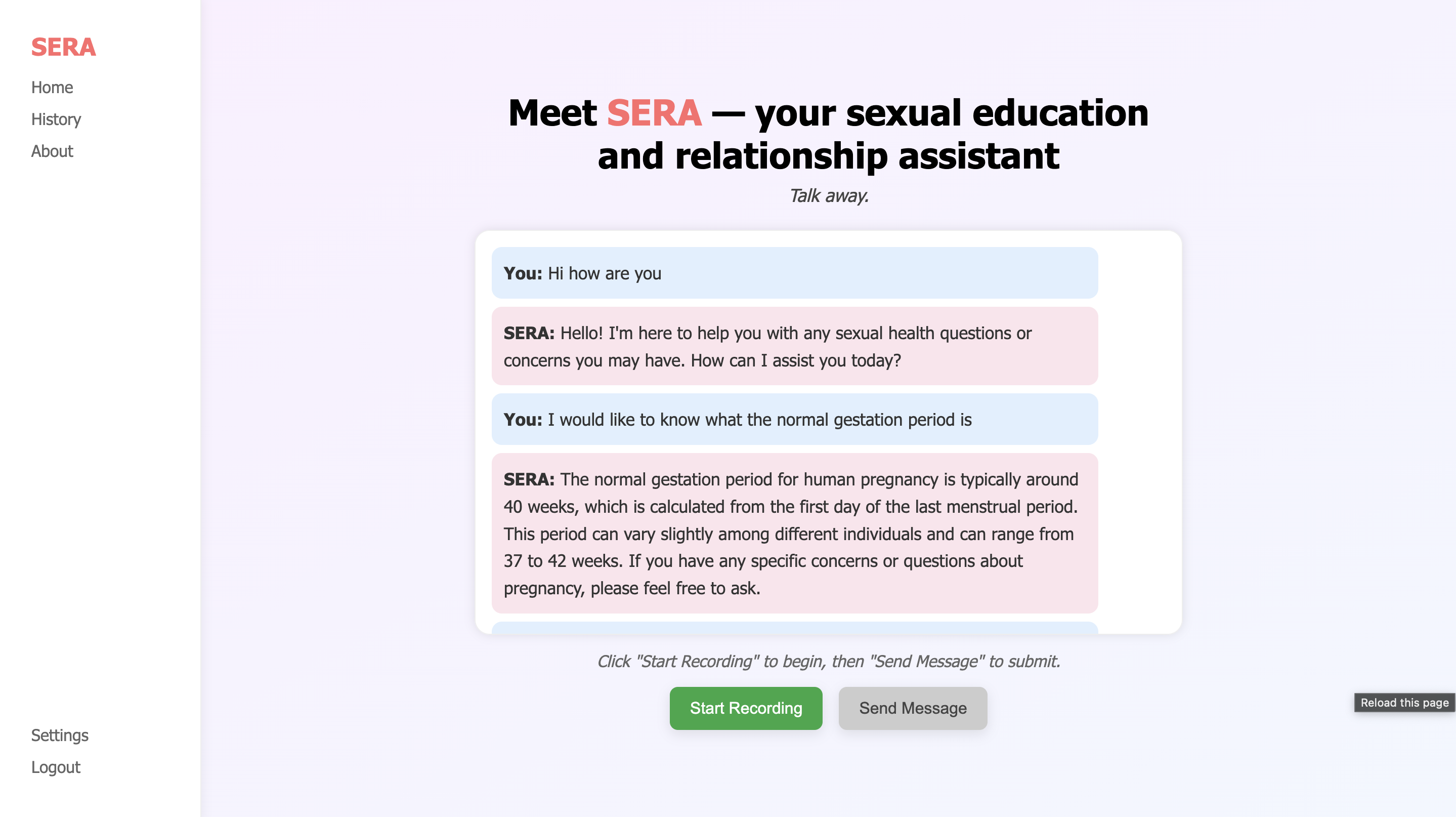
SERA is an AI-powered chatbot that provides real-time, confidential support for sexual health and relationship education. Users can speak or type their questions—ranging from topics like consent, STIs, birth control, relationships, and emotional well-being—and receive thoughtful, accurate responses generated by OpenAI’s GPT-4. The platform supports voice input through speech recognition, making it accessible to users with different literacy levels or visual impairments. It also stores chat history and transcripts securely (without storing any personal data) using MongoDB. With a modern, calming interface and a retractable sidebar for navigation, SERA creates a safe space for users to ask sensitive questions freely, learn through natural conversation, and feel heard, respected, and informed.
How we built it:
We built SERA as a full-stack web application using React and Tailwind CSS on the frontend for a clean, responsive interface with a retractable sidebar and central chat console. On the backend, we used Node.js with Express.js to handle API requests, integrate with the OpenAI GPT- 3.5 - Turbo model API for generating responses, and manage user data with MongoDB Atlas. For speech input, we leveraged the Web Speech API in the browser and also experimented with Whisper for more accurate transcription. The frontend sends both audio metadata and text to the backend via fetch, where responses are generated and stored. We deployed the full project on Vercel using a monorepo structure to keep the frontend and backend in sync, ensuring seamless real-time conversation and secure data flow.
Challenges we ran into:
One of the biggest challenges was balancing helpfulness with responsibility. Since sexual health is a sensitive domain, we had to ensure SERA offered informative answers without stepping into the role of a medical professional. Crafting GPT prompts that kept the tone compassionate and accurate—without making risky claims—took multiple iterations. We also faced technical hurdles with speech-to-text integration, especially ensuring that voice inputs were consistently accurate across different environments and accents. Finally, deploying a monorepo on Vercel with both frontend and backend posed initial issues with route handling and API integration, but we were able to overcome them with careful refactoring.
Accomplishments that we're proud of:
We’re incredibly proud of creating a tool that addresses a real-world, underserved need with empathy and accessibility. From the smooth voice-enabled chat experience to the safe, stigma-free language used in GPT replies, every aspect of SERA was designed with the user in mind. We successfully built a responsive, modern UI that feels calm and welcoming, integrated OpenAI for conversational intelligence, and set up a secure backend with MongoDB to handle chat history—without ever storing PII. Knowing that this project could truly make a difference in someone’s life is our biggest win.
What we learned:
We learned that human-centered design matters just as much as technical execution—especially for sensitive topics. This meant paying attention not only to code, but to tone, accessibility, and emotional impact. We gained hands-on experience with prompt engineering, React UI/UX design, and integrating AI and voice tech into real-time web apps. Working as a team, we also learned the importance of iteration, feedback, and creating ethical safeguards when deploying AI for public use.
What's next for SERA - Sexual Education & Relationship Assistant:
There’s so much more we envision for SERA. Next, we plan to add multi-language support to reach more communities, and incorporate sentiment detection to recognize when a user may be in distress and gently guide them to professional resources. We also want to create gamified learning modules on topics like consent, healthy relationships, and safe sex to encourage proactive learning. Long-term, we hope to partner with NGOs, schools, and telehealth providers to bring SERA to areas where it’s needed most. Our dream? To make SERA a global companion for compassionate, accessible sexual health education—one conversation at a time.


Log in or sign up for Devpost to join the conversation.