Inspiration
SeqCraft began when I kept facing a problem while using DNA tools.
I could ask an AI about a plasmid cloning strategy, primers or restriction sites. Get a helpful answer.. When I wanted the AI to work with the actual sequence I had to copy data between the chat and various biology tools again.
The AI could think about biology. It had no real link to the workspace where the biology was happening.
WebMCP made me rethink that. Of giving an agent generic UI controls I wanted SeqCraft to reveal the real molecular biology operations of the app.
What it does
SeqCraft is a browser-based DNA engineering workspace where the user and the agent share the biological state.
It supports:
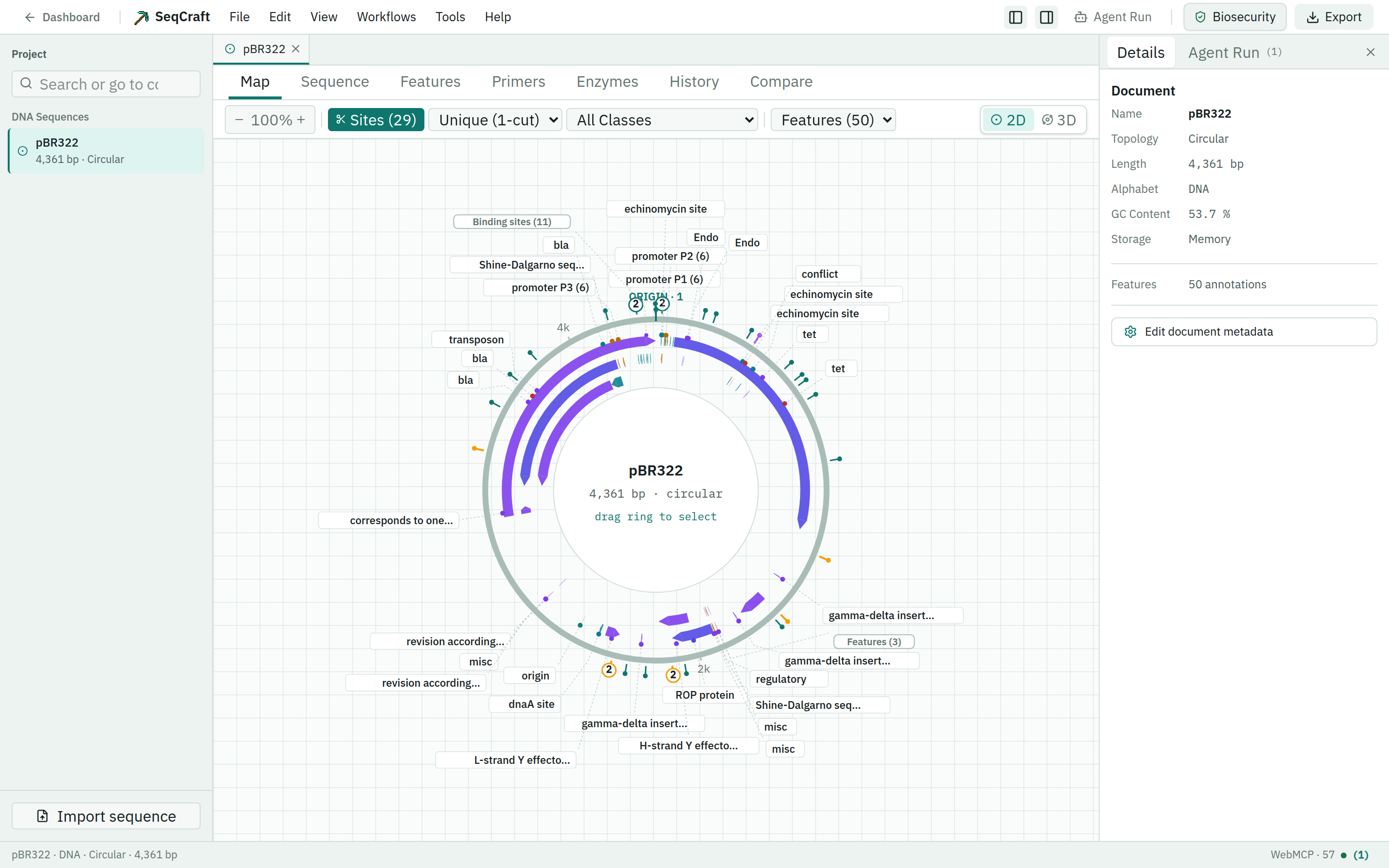
linear and circular DNA views
annotations and feature navigation
GenBank and FASTA import/export
direct sequence import from NCBI, ENA. Supported Addgene records
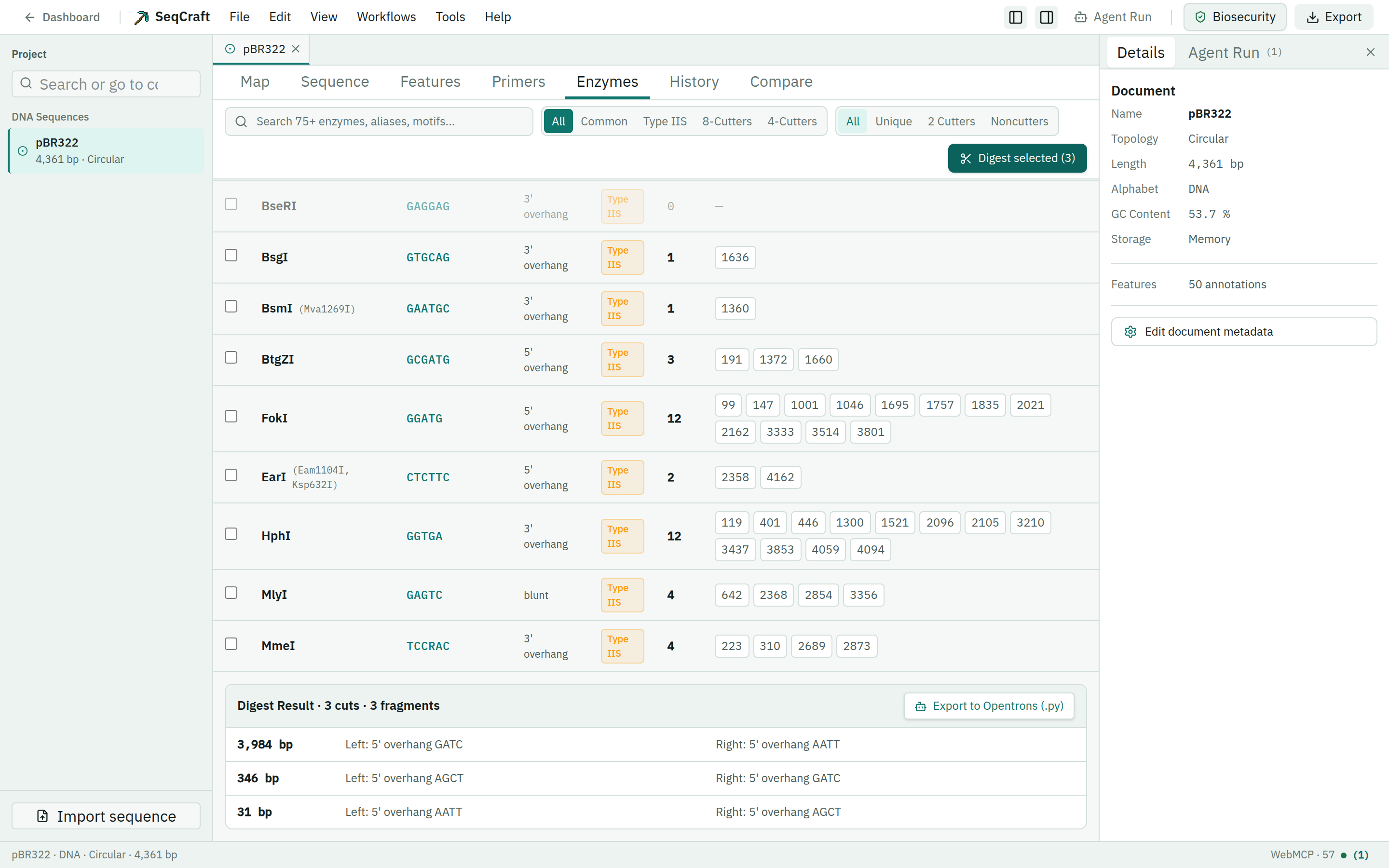
restriction analysis and digest simulation
Golden Gate workflows and sequence domestication
primer analysis and PCR simulation
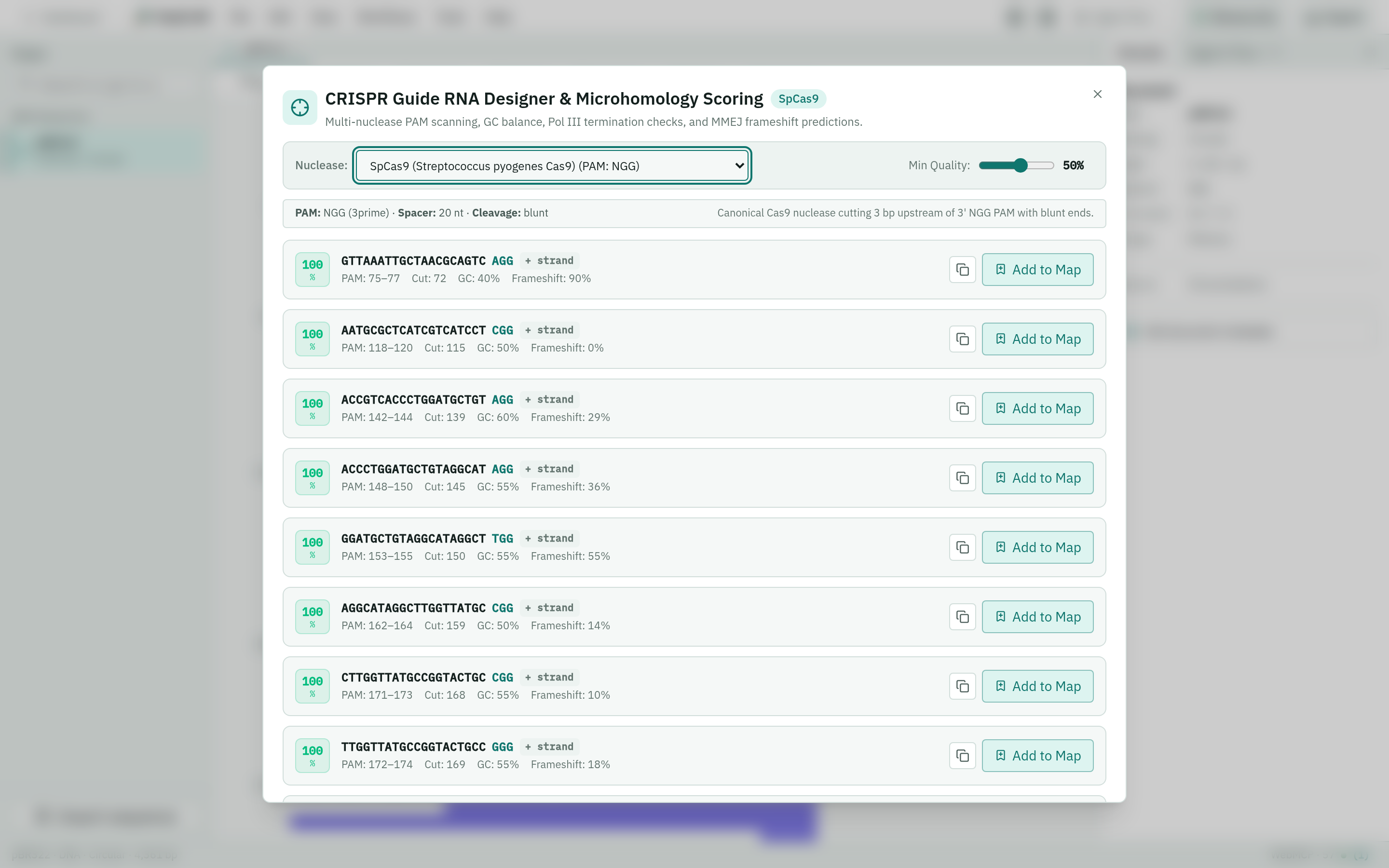
CRISPR target analysis
document comparison and history
Opentrons protocol generation
SeqCraft exposes these capabilities through WebMCP as domain-level tools.
So an agent can import pBR322 from NCBI go to beta‑lactamase find a cloning conflict stage a mutation check the resulting sequence design a PCR assay or work across many DNA documents.
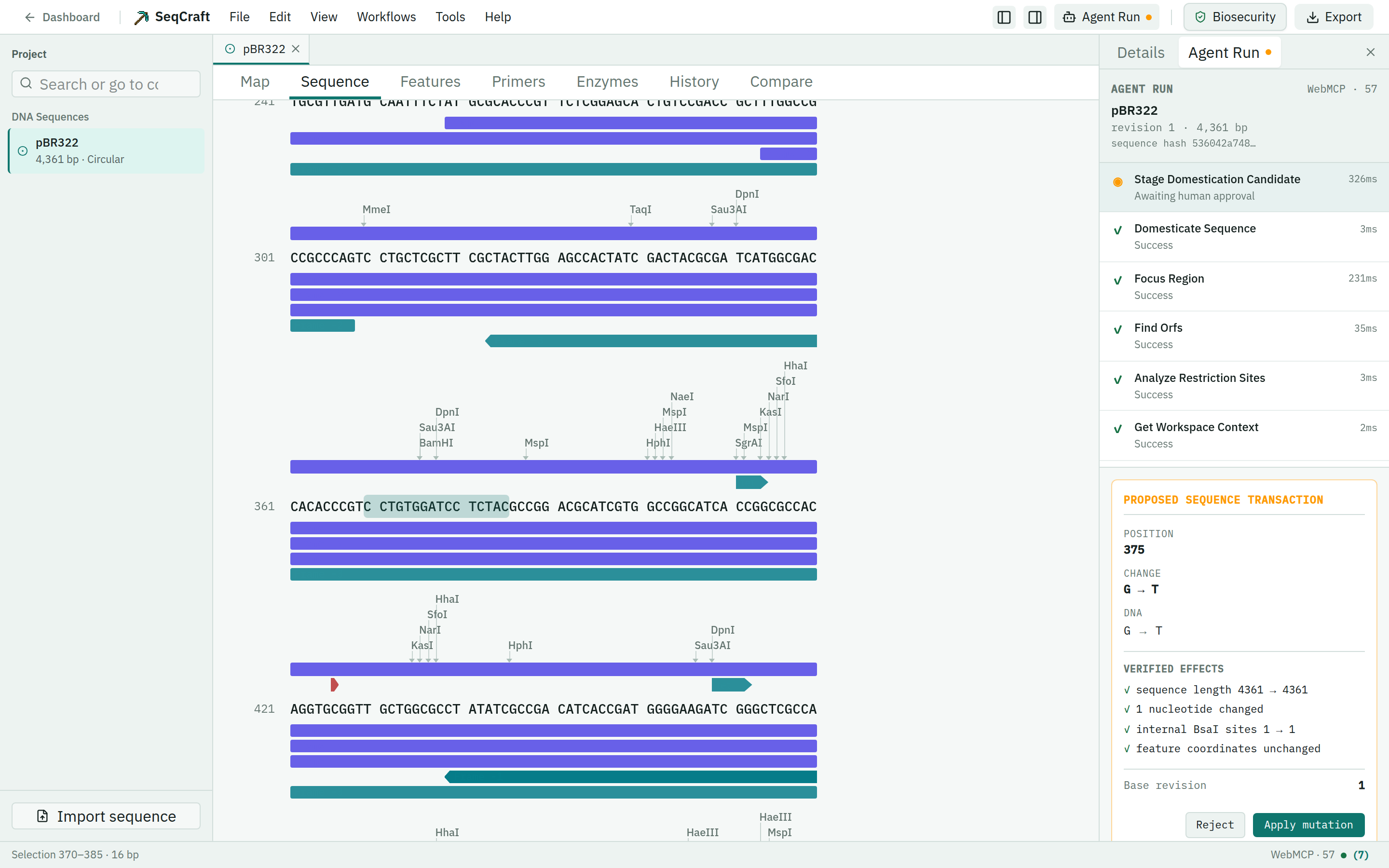
For sequence‑changing operations the agent does not edit the DNA quietly. SeqCraft stages the mutation against the document revision and sequence hash shows the biological consequences and waits for human approval.
How we built it
SeqCraft is written in TypeScript. Runs in the browser.
The UI and WebMCP tools use the underlying domain logic so the agent works with the same documents, annotations, revisions and history as the user.
Scientific operations are exposed as WebMCP tools instead of generic browser actions. For example the agent can ask SeqCraft to analyse restriction sites show a feature compare documents or stage a sequence edit directly.
External sequence records from NCBI, ENA and supported Addgene sources go through the import pipeline as uploaded GenBank and FASTA files, preserving topology, annotations and provenance.
The workspace also tracks sequence revisions and hashes so analysis results and mutation proposals stay tied to the state they were calculated from.
Challenges we ran into
The part was not registering WebMCP tools. It was making a stateful scientific application reliable enough for an external agent to operate.
Some of the problems we ran into were:
document state after mutations
circular DNA coordinate edge cases
reverse‑strand handling
imported GenBank annotations behaving differently from built‑in demo data
keeping UI state and WebMCP state synchronized
inconsistent restriction‑enzyme behaviour across different workflows
making mutation proposals safe across document revisions
returning useful errors so an agent can recover instead of getting stuck
Testing with real NCBI sequences exposed several bugs that would have been easy to miss with only hand‑made examples.
Accomplishments that we're proud of
The part I'm most proud of is that SeqCraft can handle a complete workflow without the user specifying which tools to call.
In one test I gave the agent pBR322 and eGFP with a goal and a few constraints.
The agent:
evaluated cloning strategies
rejected BsaI because it conflicted with the ampicillin‑resistance gene
selected a BamHI–SalI strategy
preserved the replication origin and ampicillin resistance
disrupted tetracycline resistance for screening
built and annotated the recombinant construct
designed a colony‑PCR assay
generated an Opentrons PCR protocol
exported the final GenBank file
and pointed out that fluorescence should not be assumed because the insert did not include a dedicated bacterial promoter or RBS
Another part I am proud of is the human‑review boundary. The agent can. Prepare a sequence mutation but SeqCraft keeps the final sequence‑changing action under explicit human control.
What we learned
The biggest thing we learned is that WebMCP becomes more useful when an application exposes its domain instead of mirroring its interface.
For SeqCraft the useful operations are not:
“click this button”
or
“open this panel”
They are:
“analyse this sequence”
“show this feature”
“compare these constructs”
“stage this mutation”
Once the application exposes those primitives the agent can choose and combine them based on the user’s goal.
We also learned that real external data matters. Testing with GenBank records from NCBI revealed edge cases that clean demo sequences never exposed.
What's next for SeqCraft
The next step is making SeqCraft beyond the hackathon workflow.
I want to improve:
larger and more complex construct handling
annotation and feature libraries
more cloning and assembly strategies
stronger primer and CRISPR analysis
better interoperability, with existing biology formats and tools
more lab‑automation workflows
collaboration and reproducible project sharing
I also want to keep improving the WebMCP surface so agents can handle longer scientific workflows while staying grounded in the exact document state they are operating on.
The long‑term goal is simple: make SeqCraft a browser‑native molecular biology workspace that both humans and agents can use together.


Log in or sign up for Devpost to join the conversation.