-
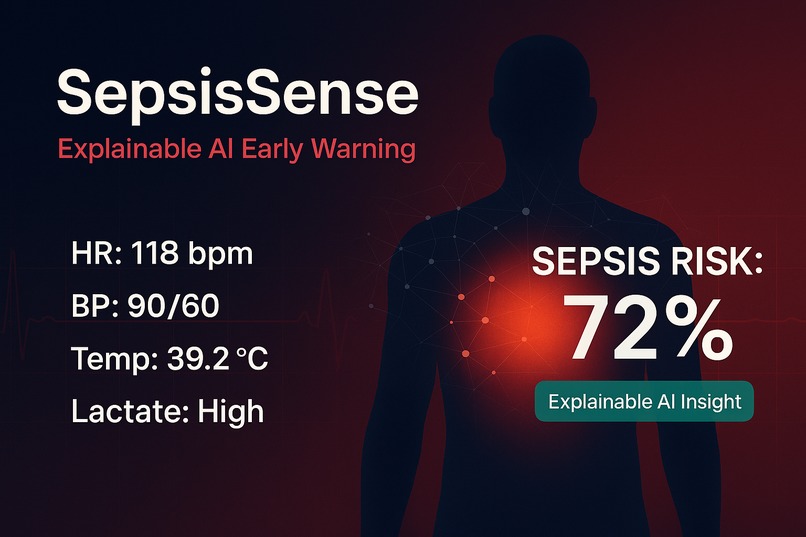
SepsisSense: Explainable AI Sepsis Early Warning Tool
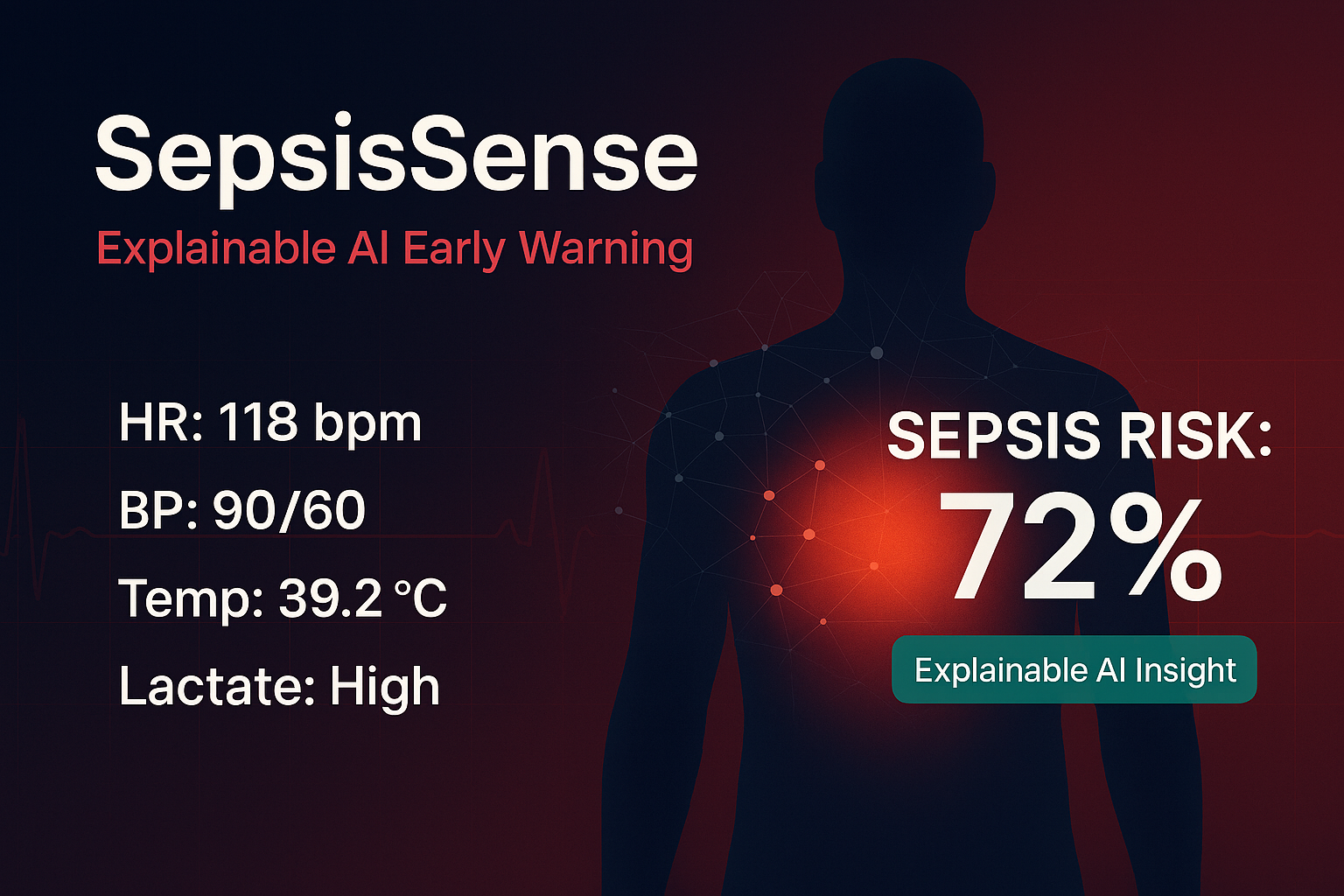
🧠 SepsisSense: Explainable AI Sepsis Early Warning Tool
Inspiration
Sepsis remains one of the leading causes of preventable hospital mortality worldwide. In high-pressure emergency departments, clinicians must interpret multiple vital signs and laboratory markers simultaneously, often under severe time constraints. Early sepsis symptoms are subtle, non-specific, and easy to miss until deterioration becomes critical.
SepsisSense was inspired by the need to transform routine clinical data into early, actionable intelligence. Rather than replacing clinicians, we envisioned an AI system that augments clinical judgment with transparent risk insights — enabling faster intervention and improved patient outcomes.
What it does
SepsisSense is an explainable AI-powered clinical decision-support tool designed for emergency departments.
It:
- Analyzes key patient vitals and lab markers such as heart rate, blood pressure, temperature, respiratory rate, oxygen saturation, white blood cell count, and lactate levels.
- Generates a dynamic sepsis risk probability score in real time.
- Provides explainable outputs highlighting which clinical parameters most influence the prediction.
- Supports early awareness and triage prioritization.
SepsisSense does not diagnose sepsis. It is designed to support clinician decision-making and risk stratification in emergency settings.
How we built it
SepsisSense was developed as a scalable prototype using:
- Python for backend development
- Scikit-learn for machine learning modeling
- Random Forest classifier for risk prediction
- SHAP (SHapley Additive Explanations) for model interpretability
- Streamlit for an interactive, lightweight clinical dashboard
The model was trained using publicly available and simulated datasets reflecting sepsis-related parameters. Users input patient vitals through a simple interface and receive an immediate risk score along with a visual explanation of contributing factors.
The system architecture was intentionally designed to allow future integration with electronic health record (EHR) systems.
Challenges we ran into
One key challenge was balancing predictive capability with transparency. In healthcare, explainability is essential to build clinician trust.
Another challenge was responsible positioning. AI in medicine must avoid overclaiming. We carefully defined SepsisSense as a decision-support tool rather than a diagnostic system.
Data generalizability was also a consideration. Since the prototype relies on public and simulated data, real-world clinical validation would be required before deployment.
Accomplishments that we're proud of
- Building a functional explainable AI prototype within a limited timeframe.
- Integrating transparent model explanations instead of a black-box system.
- Designing the solution with GDPR and EU MDR regulatory awareness.
- Creating a clinically relevant and ethically framed AI tool.
- Demonstrating how AI can responsibly augment emergency care workflows.
What we learned
This project reinforced that healthcare innovation requires more than technical accuracy — it demands transparency, trust, and feasibility.
We gained deeper understanding of:
- The importance of explainable AI in clinical environments.
- Regulatory considerations for medical software.
- Ethical framing and risk disclosure in AI systems.
- Translating machine learning concepts into practical healthcare tools.
Above all, we learned that impactful health technology must prioritize patient safety and clinician empowerment.
What's next for SepsisSense
The next phase focuses on validation, refinement, and scalability.
Future steps include:
- Conducting retrospective clinical validation studies.
- Expanding datasets to improve robustness and reduce bias.
- Enhancing real-time monitoring capabilities.
- Performing clinician usability testing.
- Exploring regulatory pathways under the EU Medical Device Regulation (MDR).
Long term, SepsisSense aims to become a GDPR-compliant, scalable clinical decision-support platform that improves early sepsis detection and ultimately saves lives.
Built With
- matplotlib
- numpy
- pandas
- python
- random-forest
- scikit-learn
- shap
- streamlit

Log in or sign up for Devpost to join the conversation.