-
-
SepsisSense AI
SepsisSense AI
Inspiration
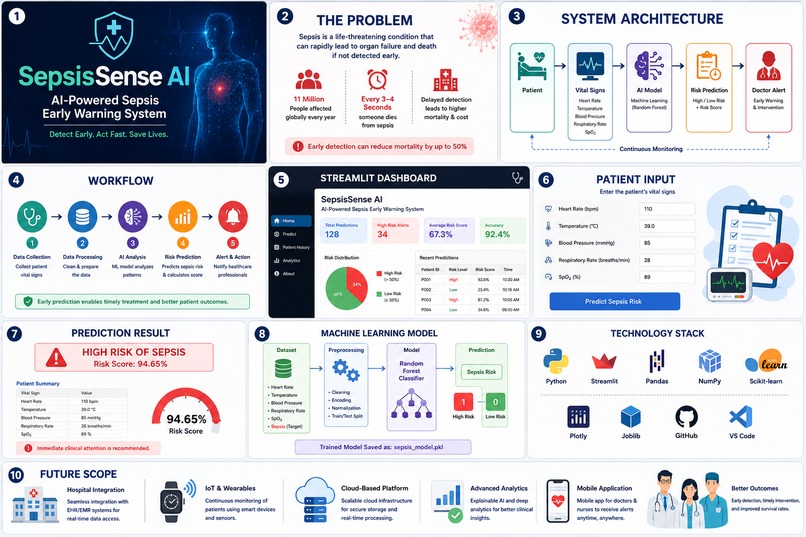
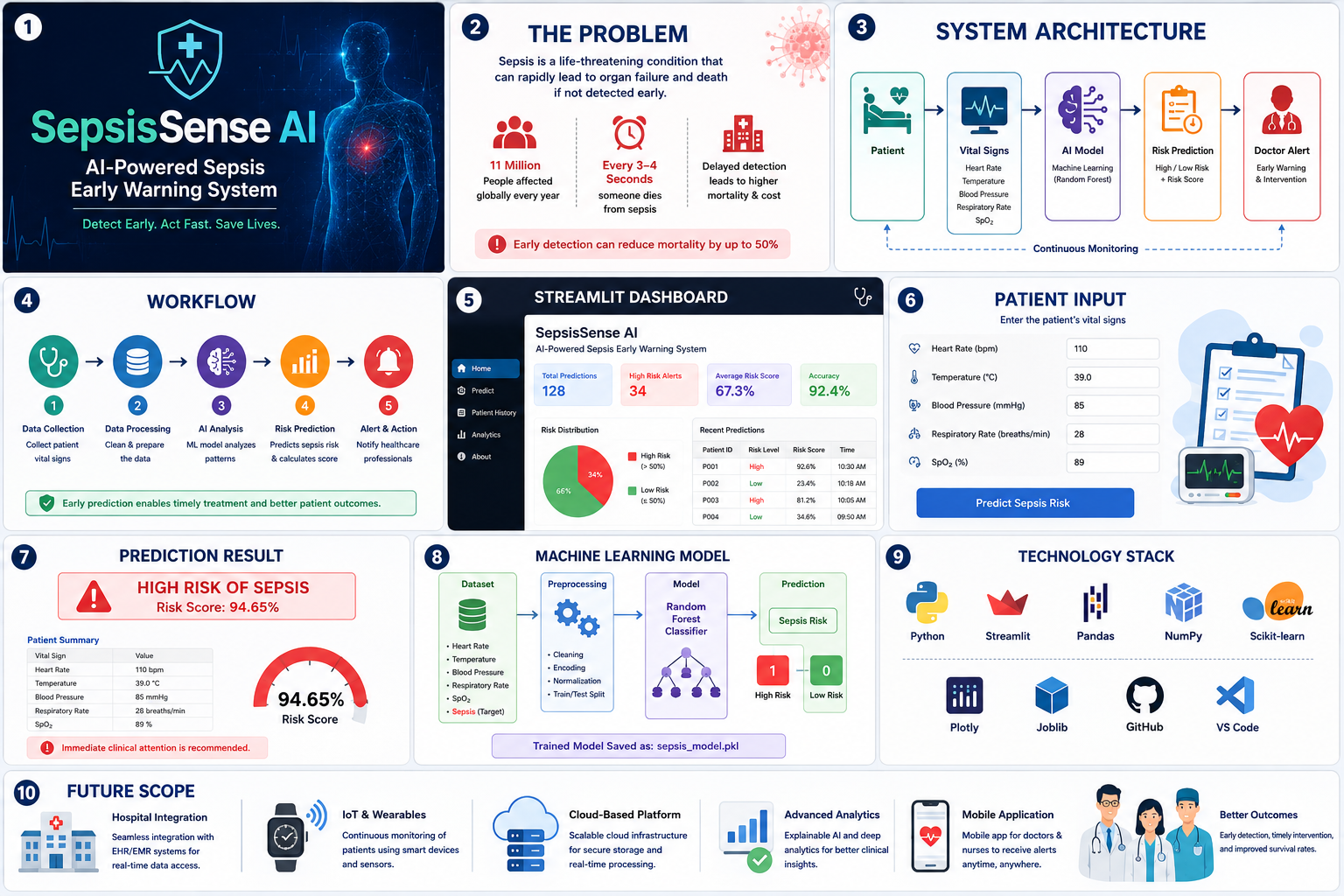
Sepsis is a life-threatening medical emergency that can rapidly lead to organ failure if not detected early. Many patients show subtle changes in their vital signs before their condition worsens. We wanted to build a solution that uses clinical data and artificial intelligence to identify these early warning signs, helping healthcare professionals make faster and more informed decisions.
What it does
SepsisSense AI is an AI-powered early warning system that analyzes patient vital signs such as heart rate, body temperature, blood pressure, respiratory rate, and oxygen saturation. Using machine learning, it predicts the likelihood of sepsis and displays a risk score on an easy-to-use dashboard. When a high-risk patient is identified, the system generates an alert so clinicians can intervene sooner.
How we built it
The project was developed using Python for data processing and machine learning, Pandas and NumPy for data analysis, Scikit-learn for predictive modeling, and Streamlit to create an interactive web dashboard. Clinical datasets were cleaned, analyzed, and used to train the prediction model. The application visualizes patient data and provides real-time risk predictions in a simple interface.
Challenges we faced
One of the biggest challenges was handling incomplete and imbalanced healthcare datasets while maintaining reliable predictions. We also focused on selecting meaningful clinical features and presenting AI results in a way that is easy for healthcare professionals to understand.
What we learned
Through this project, we gained practical experience in healthcare data analytics, machine learning, data preprocessing, model evaluation, and dashboard development. More importantly, we learned how AI can support clinical decision-making and improve patient outcomes when combined with medical knowledge.
Future improvements
Future versions of SepsisSense AI could integrate with hospital Electronic Health Record (EHR) systems, support continuous monitoring from wearable devices, provide explainable AI recommendations, and notify healthcare teams through mobile or web alerts for faster emergency response.


Log in or sign up for Devpost to join the conversation.