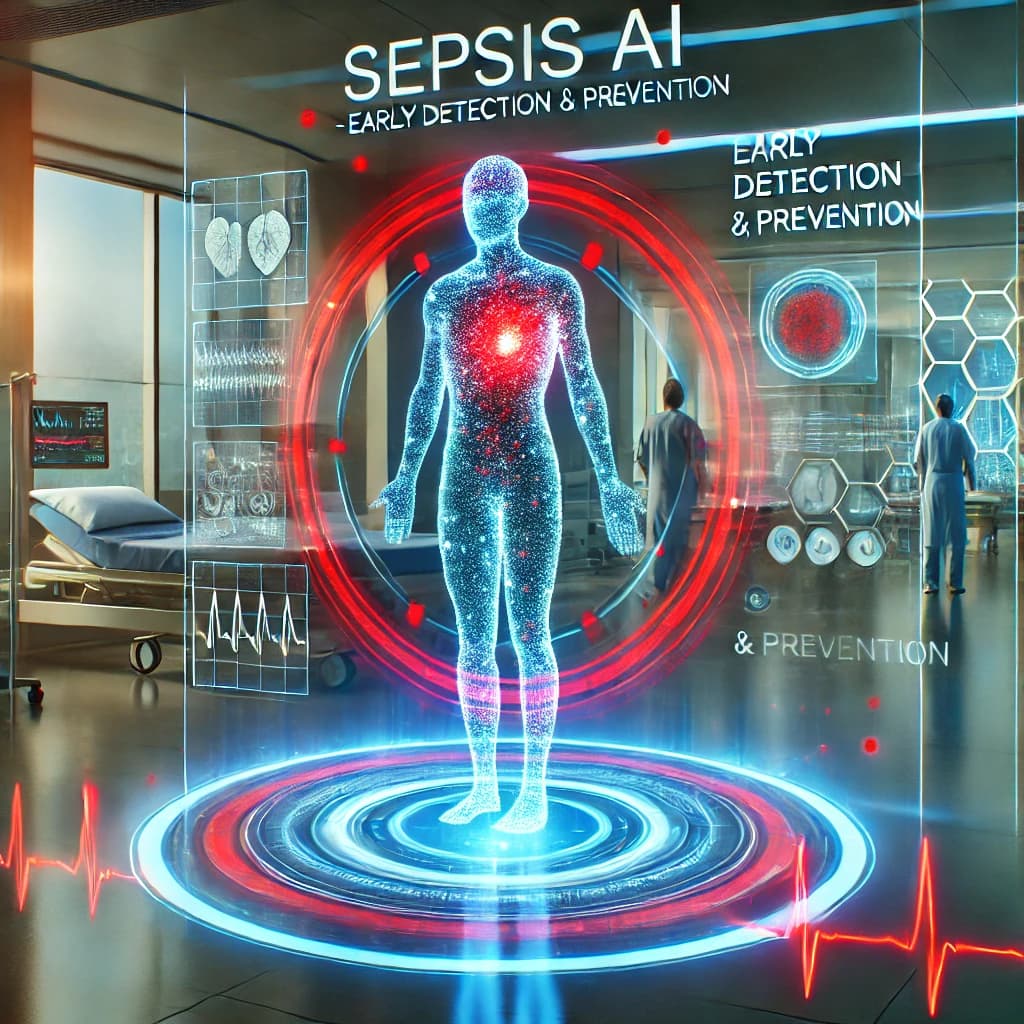
Sepsis Detection AI: Early Prediction, Faster Treatment, Better Outcomes
Inspiration
Sepsis is one of the leading causes of mortality worldwide, responsible for millions of deaths each year. Early detection is critical because every hour of delay increases the risk of death by nearly 8%. Despite advancements in medicine, sepsis detection remains a major challenge, especially in resource-limited hospitals where real-time monitoring is unavailable.
We were inspired by:
- The urgent need for faster and more accurate sepsis detection.
- The potential of AI in healthcare to analyze vast amounts of patient data in real time.
- Studies showing that machine learning can predict sepsis hours before clinical diagnosis, enabling life-saving early interventions.
What It Does
Sepsis Detection AI is a predictive tool that analyzes patient vitals, lab results, and medical history to detect early signs of sepsis. It:
- Monitors real-time ICU patient data for sepsis indicators.
- Uses machine learning models to predict sepsis onset before clinical symptoms appear.
- Provides a sepsis risk score to help doctors make informed decisions.
- Generates alerts when a patient's condition worsens, prompting immediate intervention.
How We Built It
Data Collection & Processing
- Used public datasets (MIMIC-III, PhysioNet Sepsis Challenge) and real ICU patient records.
- Cleaned data by handling missing values and standardizing medical measurements.
- Used public datasets (MIMIC-III, PhysioNet Sepsis Challenge) and real ICU patient records.
Feature Engineering & Model Training
- Extracted key features like heart rate, blood pressure trends, oxygen saturation, and inflammation markers.
- Trained models including XGBoost, Random Forest, and LSTMs for time-series predictions.
- Extracted key features like heart rate, blood pressure trends, oxygen saturation, and inflammation markers.
Evaluation & Optimization
- Assessed performance using AUC-ROC, precision-recall, and F1-score to ensure accuracy.
- Used oversampling (SMOTE) and class-weighted loss to handle data imbalance.
- Assessed performance using AUC-ROC, precision-recall, and F1-score to ensure accuracy.
Deployment & Real-Time Integration
- Developed a Flask/FastAPI web app where doctors can input patient data and receive sepsis risk predictions.
- Designed a dashboard for ICU monitoring with live alerts and patient risk visualization.
- Developed a Flask/FastAPI web app where doctors can input patient data and receive sepsis risk predictions.
Challenges We Ran Into
- Data imbalance – Sepsis cases were significantly fewer than non-sepsis cases, requiring advanced resampling techniques.
- Feature selection – Identifying the most critical features without overfitting was complex.
- Real-time processing – Ensuring low-latency AI predictions for ICU monitoring was a major challenge.
- Interpretability – Medical professionals require explainable AI (SHAP, LIME) to trust predictions.
Accomplishments That We’re Proud Of
- Developed an AI model that detects sepsis hours before clinical diagnosis.
- Achieved high accuracy and recall, reducing false negatives in life-threatening cases.
- Built a real-time dashboard that integrates seamlessly with ICU monitoring systems.
- Implemented explainable AI, allowing doctors to understand why the model predicts sepsis.
What We Learned
- AI in healthcare is powerful but requires explainability – Medical professionals need transparent models.
- Time-series modeling (LSTMs, GRUs) is key – Patient vitals change dynamically, making sequential analysis crucial.
- Ethical and regulatory considerations matter – AI in healthcare requires compliance with HIPAA, GDPR, and clinical validation.
What's Next for Sepsis Detection AI
- Integration with wearables – Continuous monitoring using smartwatches and IoT sensors.
- Federated learning for privacy – Training AI models across hospitals without sharing patient data.
- Personalized risk scores – Adapting predictions based on genetic and microbiome factors.
- Expansion to rural healthcare – Bringing AI-driven early detection to low-resource hospitals.
Built With
- fastapi-**frontend**:-react.js
- fastapi-for-the-backend-react.js
- gdpr
- google-cloud-ai-**apis-&-integration**:-fhir-(fast-healthcare-interoperability-resources)
- google-cloud-ai-fhir
- grus-**database**:-postgresql
- grus-for-time-series-modeling-postgresql
- hl7-**security-&-compliance**:-hipaa
- hl7-for-healthcare-data-integration-hipaa
- lambda)
- mongodb-**backend**:-flask
- mongodb-flask
- mqtt-**cloud-services**:-aws-(ec2
- mqtt-for-real-time-data-streaming-aws-(ec2
- numpy
- oauth
- plotly-**real-time-data-streaming**:-apache-kafka
- plotly-for-visualization-apache-kafka
- python
- pytorch
- s3
- scikit-learn
- scipy-**time-series-modeling**:-lstms
- scipy-lstms
- seaborn
- tailwind-css-**visualization**:-matplotlib
- tailwind-css-for-the-frontend-matplotlib
- xgboost-**data-processing**:-pandas
- xgboost-pandas

Log in or sign up for Devpost to join the conversation.