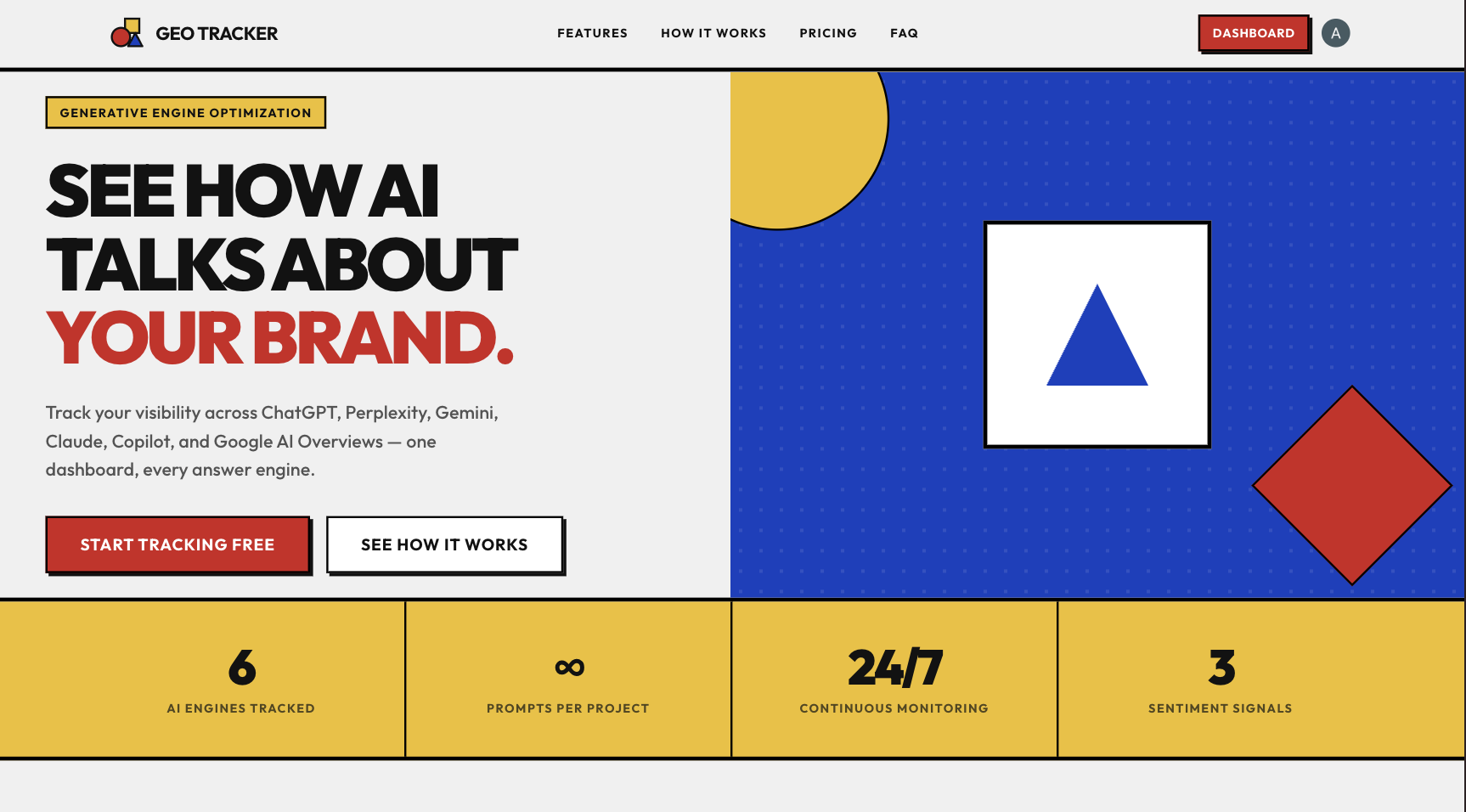
As AI search becomes a major way people discover products, companies, and services, traditional SEO alone is no longer enough. A brand can rank well on Google but still be invisible when someone asks ChatGPT, Gemini, Perplexity, Claude, Copilot, or Google AI Overviews about it.
That led us to build an SEO + GEO (Generative Engine Optimization) Tracker to answer a simple question:
"What does AI say about my brand, and how visible is my brand across AI search engines?"
What We Built
The platform provides a single dashboard to monitor how AI models understand and represent a brand.
Users can track:
- AI visibility across multiple answer engines
- Brand mentions and recommendations
- Competitor visibility
- Search/query performance
- AI-generated responses about their brand
- Visibility trends over time
- Opportunities to improve their content and GEO strategy
The goal is to move beyond simply tracking where a website ranks and start measuring whether a brand appears in AI-generated answers.
How We Built It
We built the application as a modern web platform with a focus on automation, analytics, and an easy-to-understand dashboard.
The system:
- Collects predefined or custom brand-related queries.
- Sends those queries to supported AI/answer engines.
- Captures and analyzes the generated responses.
- Identifies brand and competitor mentions.
- Calculates visibility and positioning metrics.
- Presents the results through a centralized analytics dashboard.
- Tracks changes over time so users can measure the impact of their SEO and GEO efforts.
The architecture was designed to make it easy to add additional AI models and answer engines as the AI-search ecosystem evolves.
What We Learned
One of the biggest lessons was that AI visibility is fundamentally different from traditional search visibility.
Search engines primarily return ranked pages, while generative engines synthesize information from multiple sources and produce an answer. A brand may therefore be technically present online but still not be mentioned, recommended, or considered authoritative by an AI model.
We also learned that measuring GEO requires looking at more than simple keyword rankings. Factors such as brand mentions, competitor comparisons, answer consistency, source visibility, and model-specific behavior can all influence how a brand is represented.
Challenges We Faced
The biggest challenge was building a consistent measurement system across different AI models.
Different models can produce different answers for the same query. Responses can also change over time, making it difficult to treat AI visibility like a traditional static ranking.
Other challenges included:
- Designing meaningful GEO visibility metrics
- Comparing responses across different AI platforms
- Detecting brand and competitor mentions reliably
- Handling changing AI-generated responses
- Building an intuitive dashboard for complex AI data
- Making the system scalable as more answer engines are added
These challenges shaped the product into more than a simple rank tracker — it became a way to observe, measure, and understand how AI represents a brand.
What's Next
We want to continue expanding the platform with deeper competitor analysis, automated GEO recommendations, historical visibility trends, citation/source analysis, and actionable insights that help brands improve their presence across AI-powered search.
The future of search is moving from "Where do I rank?" to "Does AI recommend me?"
This project is built to help brands measure that transition.
Built With
- clerk
- nextjs
- tailwindcss
- typescript

Log in or sign up for Devpost to join the conversation.