-
-
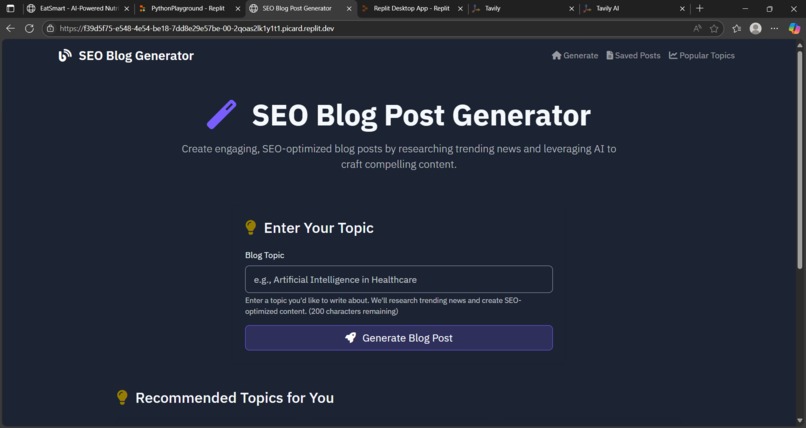
AI-powered app that turns trending news into SEO blog posts in seconds. Enter a topic and get fresh, high-quality content instantly!seo.page
-
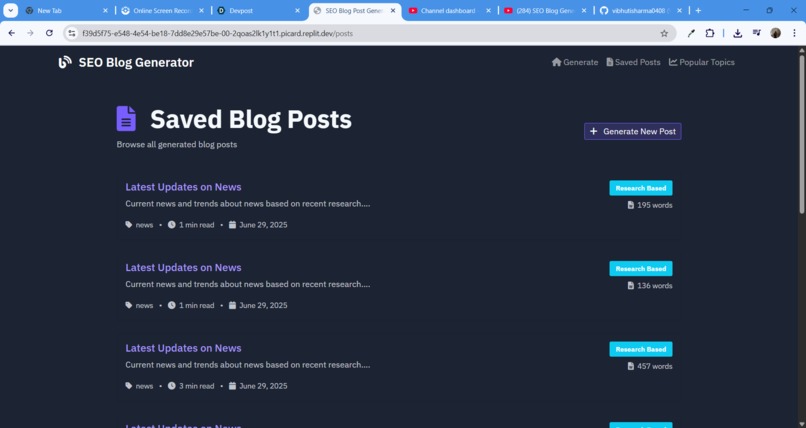
Easily view, manage, and revisit all your saved AI-generated blog posts here.
-
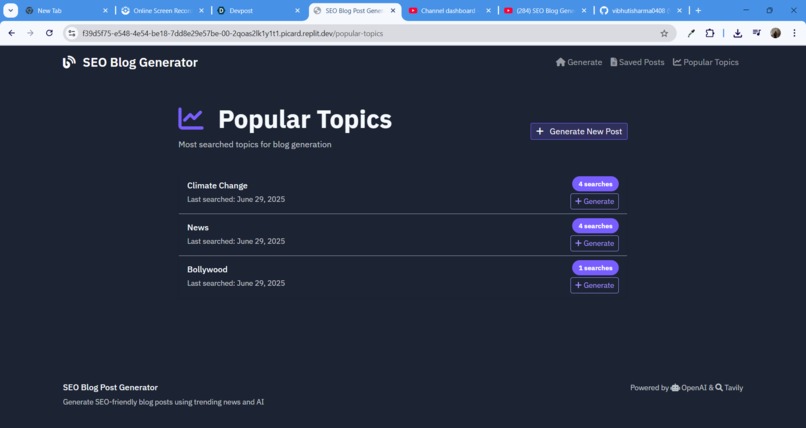
Discover trending topics and generate blog posts on what’s popular right now.


Inspiration
As content creators and businesses strive to stay relevant, producing timely, SEO-optimized blog posts is more important than ever. I was inspired by the challenge of automating this process—leveraging the latest news and AI to help anyone create high-quality, up-to-date content in seconds. The 100 Agents competition, with its focus on agentic workflows and real-world impact, was the perfect opportunity to bring this idea to life.
What it does
The SEO Blog Post Generator is an AI-powered web application that helps users create engaging, SEO-optimized blog posts in seconds. Here’s how it works: User Enters a Topic: The user types in any topic they want to write about (e.g., “AI technology,” “climate change,” “Bollywood”). Fetches Trending News: The app uses the Tavily API to search for the latest and most relevant news articles about the chosen topic. Generates a Blog Post with AI: The app sends the news summaries to OpenAI’s GPT model, which crafts a detailed, SEO-friendly blog post—including an introduction, main content, and conclusion. Displays the Result: The generated blog post is shown instantly in a clean, readable format. Users can also explore trending and recommended topics for inspiration.
How we built it
Ideation: I started by outlining the user journey: enter a topic → fetch trending news → generate a blog post → display results. Tech Stack: Backend: Python (Flask) for simplicity and fast deployment on Replit. Frontend: HTML/CSS/JS for a modern, user-friendly interface. APIs: Tavily: To fetch real-time, trending news for any topic. OpenAI: To generate engaging, SEO-optimized blog posts from the news. Agentic Orchestration: The app acts as an orchestrator, first using Tavily as a “research agent,” then passing the results to OpenAI as a “writing agent.” Deployment: I chose Replit for its ease of use, instant web hosting, and shareable live links—perfect for hackathons and demos. Polish: Added recommended topics, loading states, and clear instructions to enhance the user experience.
Challenges we ran into
API Key Management: Ensuring secure handling of API keys in a cloud IDE environment. Rate Limits: Working within the free tier limits of Tavily and OpenAI while ensuring a smooth user experience. Deployment: Navigating Replit’s new “App” interface and understanding the difference between free “Run” mode and paid deployments. UX/UI: Making the interface both powerful and simple, so anyone can generate great content with zero learning curve.
Accomplishments that we're proud of
Built a fully functional AI-powered blog assistant in just a few hours. Seamlessly integrated two powerful APIs (Tavily and OpenAI) to automate research and content creation. Designed a clean, intuitive web interface that makes advanced AI accessible to everyone. Implemented agentic orchestration—chaining research and writing agents for a real business use case. Deployed the app live on Replit, making it instantly shareable and easy for anyone to try. Added trending and recommended topics to inspire users and showcase the app’s versatility. Overcame technical challenges with API limits, deployment, and user experience to deliver a polished product. Created a tool that can help bloggers, marketers, and businesses save time and stay ahead with up-to-date, SEO-optimized content. Learned new skills in rapid prototyping, API integration, and user-centric design. Received positive feedback from early testers for both the quality of generated content and the ease of use
What we learned
Agentic Workflows: I deepened my understanding of chaining multiple AI agents (news search + content generation) to solve a real business problem. API Integration: I learned how to integrate and orchestrate multiple APIs (Tavily for news, OpenAI for content) in a seamless workflow. Rapid Prototyping: Using platforms like Replit, I discovered how quickly you can go from idea to live demo, making it easy to iterate and share. User Experience: I gained experience designing a clean, intuitive interface that makes advanced AI accessible to everyone.
What's next for SEO Blog Generator
Looking ahead, there are many exciting directions for the SEO Blog Generator. We plan to introduce user accounts, allowing people to save, revisit, and edit their favorite blog posts. Customization will be a key focus, with options for users to select the tone, length, and even add images to their generated content. Expanding to multi-language support will help us reach a global audience, while integrating advanced SEO analysis and keyword suggestions will further optimize every post. We also aim to enable one-click publishing to popular blogging platforms like WordPress and Medium, and provide an analytics dashboard so users can track trending topics and post performance. Team collaboration features and a mobile-friendly experience are on the roadmap, making the tool even more versatile and accessible. Finally, we’re excited to experiment with enhanced agentic workflows, such as memory layers and LLM monitoring, to make the assistant smarter and more autonomous. These improvements will ensure the SEO Blog Generator continues to empower users to create high-quality, relevant content with ease.
Built With
- css
- flask
- html
- javascript
- openaiapi
- python
- replit
- tavilyapi


Log in or sign up for Devpost to join the conversation.