-
-
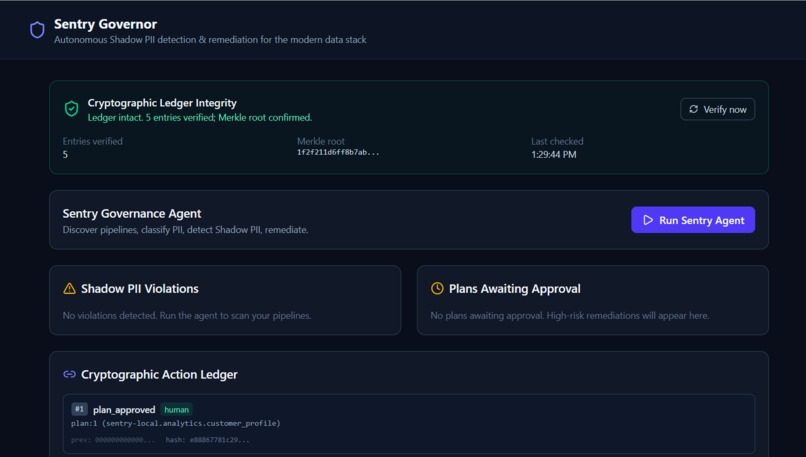
The "Prove-It" Moment: Sentry Governor's live dashboard verifying the cryptographic integrity of the agent's actions via a Merkle root.
-
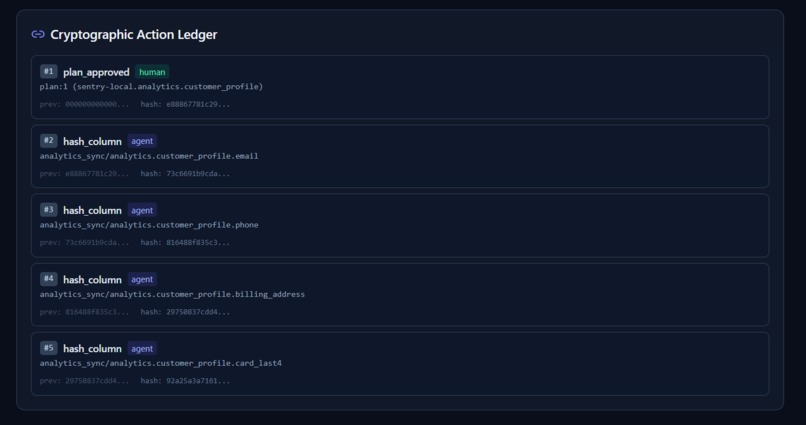
The Tamper-Evident Ledger: Every autonomous remediation executed via Fivetran MCP is hashed and chained, ensuring zero-trust compliance.
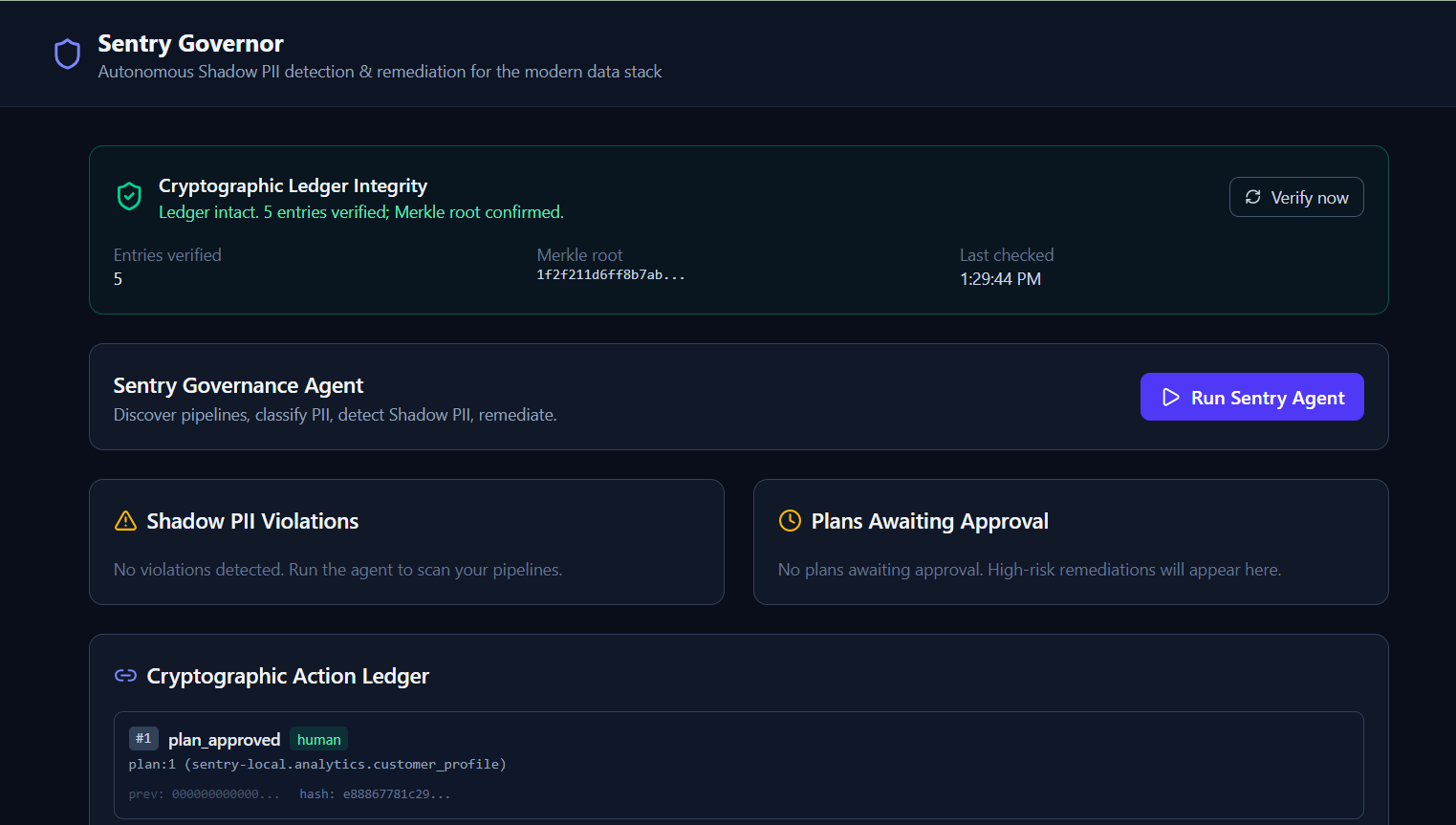
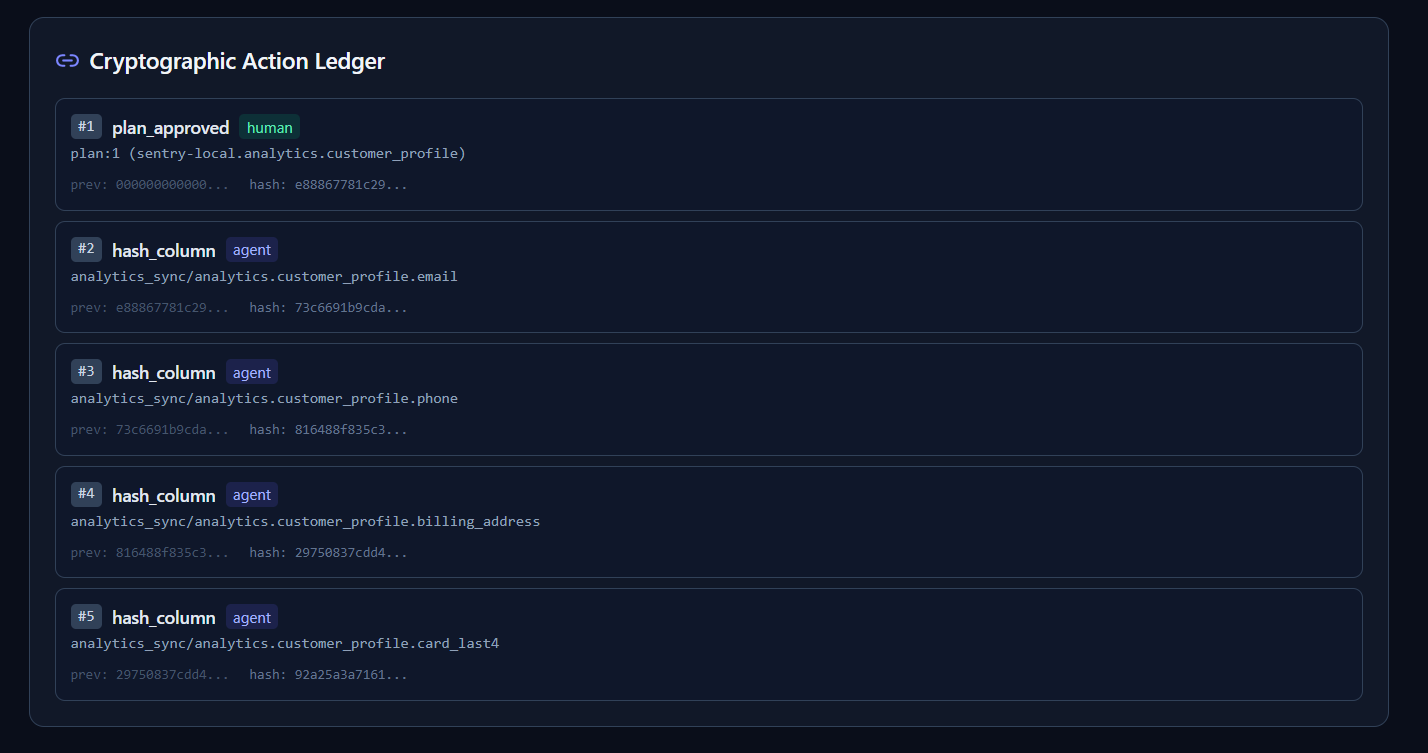
Data compliance fines reach billions annually, largely due to "Shadow PII"—sensitive data that silently slips into fast-moving data pipelines. Sentry Governor uses Fivetran’s MCP and Google Gemini to autonomously detect, quarantine, and cryptographically ledger these violations before they become liabilities.
Inspiration
Modern enterprises use Fivetran to build robust, high-volume data pipelines into BigQuery. However, data governance remains a manual bottleneck. When untracked PII enters a source database, it immediately propagates downstream. We need autonomous agents that can act faster than data engineers, but AI agents have a trust problem. How do you trust an AI to modify your enterprise pipelines without it going rogue? We were inspired to build a system that not only fixes the problem but mathematically proves its own integrity.
What it does
Sentry Governor is a zero-trust, autonomous data-governance agent built for the modern data stack.
- Discovers: Continuously scans tables synced to BigQuery.
- Classifies: Uses Google Cloud AI (Gemini) to intelligently evaluate column data against strict, predefined "Data Contracts."
- Remediates: Acts autonomously via the Fivetran MCP Server to instantly mask columns or halt non-compliant pipelines.
- The "Prove-It" Ledger: Every single action the agent takes is hashed and stored in a cryptographically tamper-evident Merkle tree.
How we built it
We bypassed the "weekend script" approach and built a staff-engineer-level microservices architecture:
- Frontend: React + Vite (hosted on Vercel) featuring a dark-mode, Series-B enterprise UX.
- Backend: Python + FastAPI (hosted on Render) with robust CORS policies.
- Database: PostgreSQL for persistent Data Contracts and Ledger storage.
- AI & Partner Integrations: We used Google Gemini 1.5 Flash for its structured JSON outputs to accurately categorize ambiguous data. We used the Fivetran MCP Server as our Control Plane to programmatically execute pipeline halts.
Challenges we ran into
Achieving real-time communication between the Vercel frontend, Render backend, and the Fivetran MCP required strict environment and CORS management. More importantly, designing a lightweight Merkle tree for the cryptographic ledger that updates in real-time without blocking the FastAPI asynchronous event loop required careful architectural planning.
Accomplishments that we're proud of
Successfully wiring the Fivetran MCP to an autonomous agent. But most importantly, creating the "Prove-It" moment: a UI that live-verifies the cryptographic integrity of the agent's actions, proving to human operators that the AI is acting securely. We built an agent that enterprises can actually trust.
What we learned
We learned how to design a zero-trust architecture for AI agents. Giving an AI the power to halt an enterprise data pipeline is dangerous; learning how to mathematically ledger those actions using cryptographic hashing was a massive step forward in building safe, enterprise-ready AI.
What's next for Sentry Governor
Expanding the MCP integrations beyond Fivetran, introducing "Human-in-the-loop" (HITL) approval notifications via Slack for high-risk pipeline pauses, and containerizing the deployment for Google Kubernetes Engine (GKE) for true enterprise scalability.
Built With
- bigquery
- fastapi
- fivetran
- gemini
- google-cloud
- postgresql
- python
- react
- render
- vercel
- vite


Log in or sign up for Devpost to join the conversation.