-
-
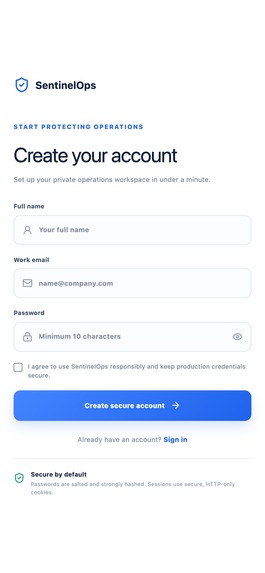
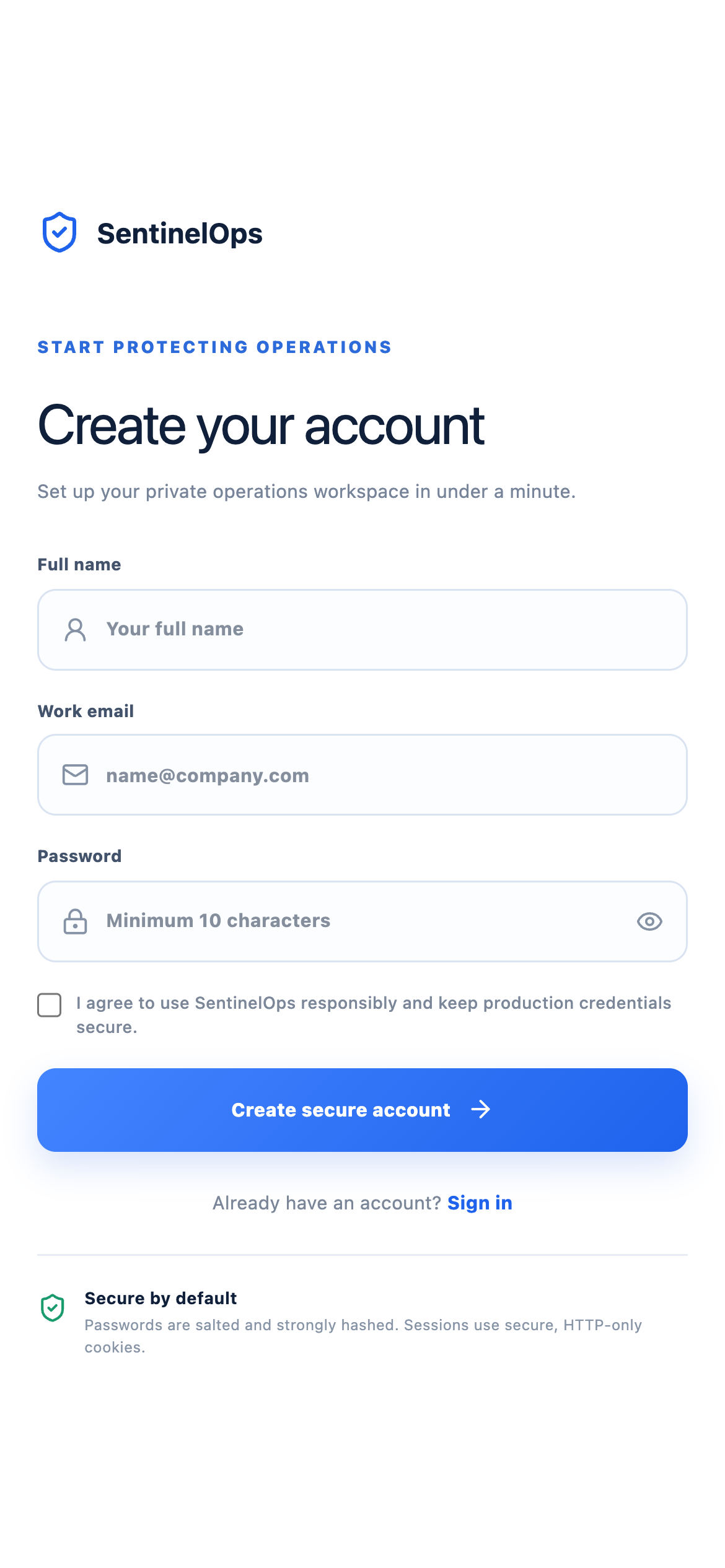
MOBILE VIEW
-
-
Inspiration: The 2 AM Nightmare
It was 2 AM, the day before we were scheduled to present our startup prototype—a complex, quantum-inspired LLM—to our project guide. We were doing our final, "perfect" run-throughs when our entire infrastructure just vanished.
We faced a severe, cascading crash. Instead of polishing our pitch or getting some sleep, we spent the next six hours frantically digging through raw logs, jumping between dashboards, and trying to trace a single memory leak.
If the state space of our quantum-inspired model was $O(2^n)$, our manual debugging time felt like it was scaling factorially: $O(n!)$.
We survived the presentation, but the panic of that night sparked a realization. In traditional DevOps, Mean Time to Resolution (MTTR) is defined as:
$$ \text{MTTR} = t_{\text{identify}} + t_{\text{diagnose}} + t_{\text{remediate}} $$
As system complexity grows, the time spent diagnosing ($t_{\text{diagnose}}$) approaches infinity. We realized engineers shouldn't be manually hunting for root causes while the clock is ticking. We needed a system where $\lim_{x \to \infty} t_{\text{diagnose}} \approx 0$. That’s why we built SentinelOps.
What it does
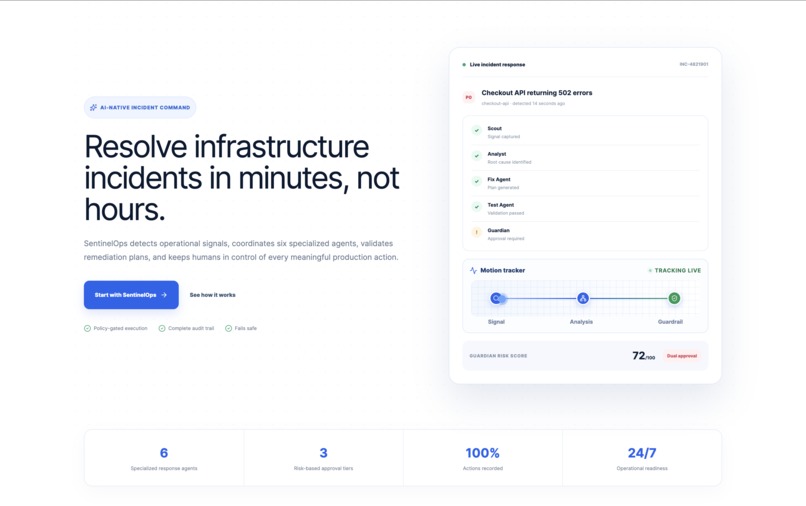
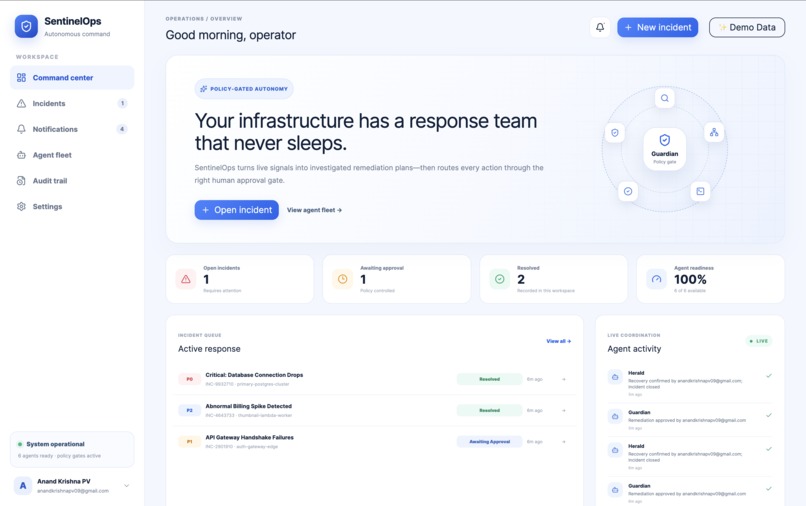
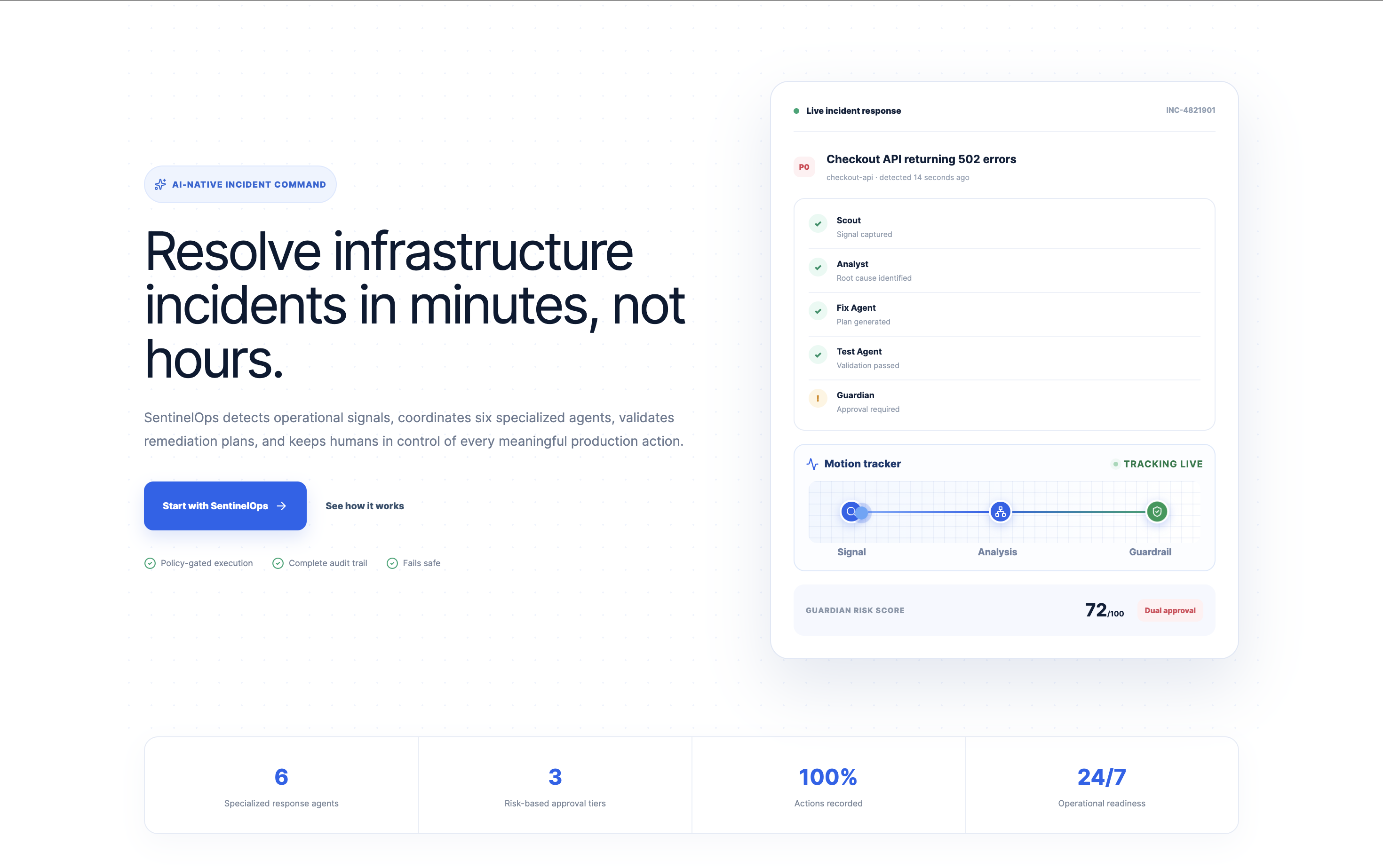
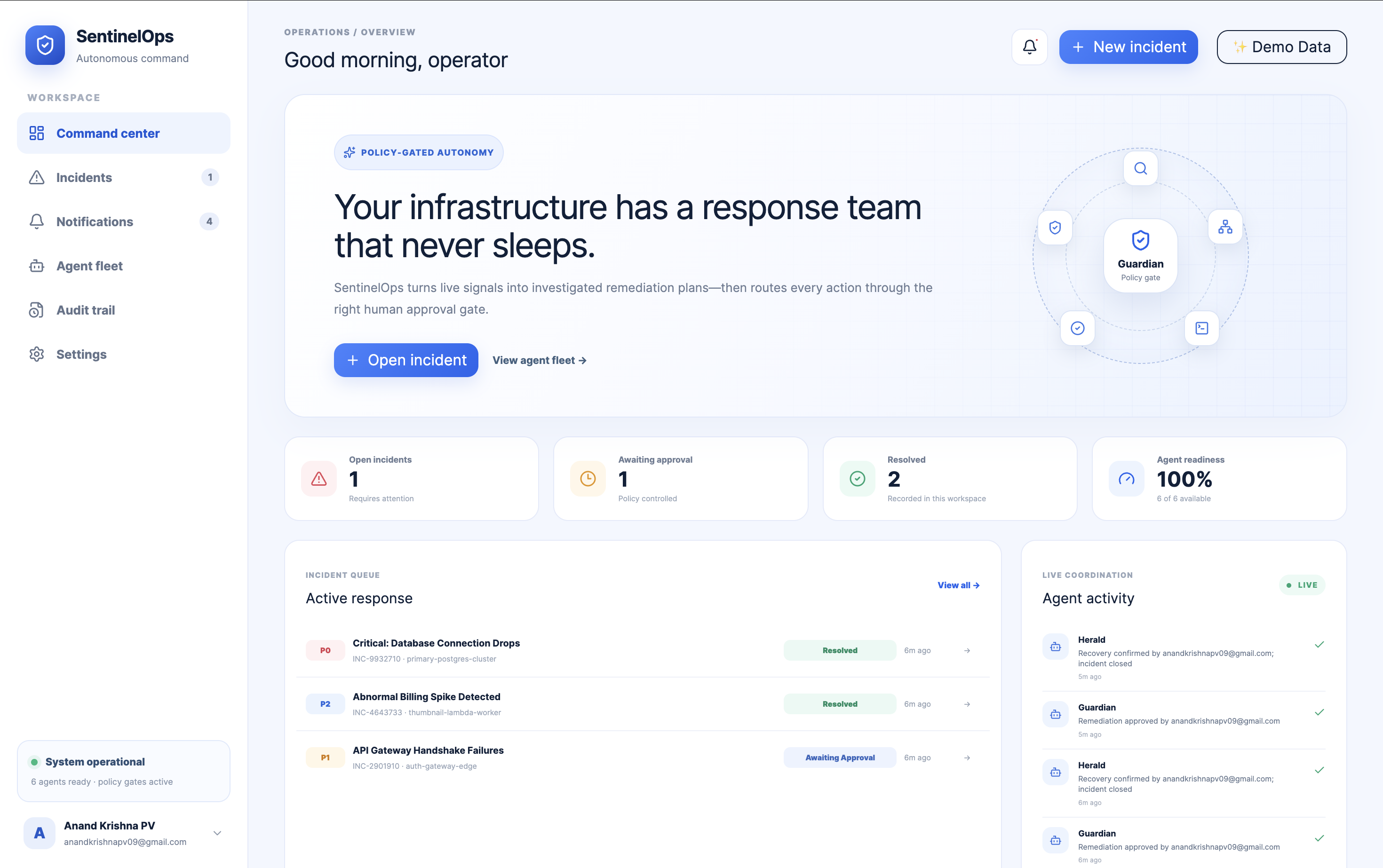
SentinelOps is an autonomous, policy-gated incident command center. When your infrastructure breaks, you don't just get a basic alert. Instead, our system of AI agents instantly investigates the crash, identifies the root cause, and generates a bounded, safe remediation plan.
Crucially, AI recommends, but humans control the impact. The AI stages the exact fix, assigns it a calculated risk score, and queues it up. Your engineers simply review the plan and click "Approve" to execute it, effectively eliminating $t_{\text{diagnose}}$ from the incident lifecycle.
How we built it
We built the platform with absolute speed and reliability in mind.
- Frontend: We designed a dark, mission-control style split-screen UI using Next.js and Tailwind CSS, optimizing for cognitive readability during high-stress incidents.
- Backend: The application logic runs on Next.js serverless API routes for minimal cold-start latency.
- Database: We utilized Vercel Postgres integrated via Drizzle ORM for heavily structured, type-safe data storage. This handles everything from user sessions to immutable audit logs of every action the AI or a human takes.
- Agent Architecture: We orchestrated specific AI personas (Scout, Analyst, Fix Agent, and Guardian) to break down the problem in parallel, ensuring the diagnostic output is deterministic rather than a generalized hallucination.
Challenges we ran into
Our biggest challenge was balancing AI autonomy with operational safety.
It is terrifying to give an AI direct access to execute commands on production infrastructure. We realized early on that a fully autonomous system is a liability. We had to architect a "Policy-Gated" system. We spent a lot of time engineering the "Guardian" agent, which evaluates the proposed fix against this strict condition:
$$ P(\text{execution}) = \begin{cases} 1, & \text{if Risk Score } < \theta_{\text{auto}} \ 0, & \text{otherwise (Requires Human Auth)} \end{cases} $$
We also faced a major technical hurdle migrating our database schema late in the game. We originally prototyped using an edge-based SQLite setup, but to support the relational complexity of our audit logs, we had to refactor our entire ORM and API layer to run on Vercel Postgres perfectly without breaking our UI just hours before submission.
Accomplishments that we're proud of
We are incredibly proud of the user experience. Incident response is inherently stressful, and we successfully built an interface that feels calm, secure, and authoritative. We're also proud that we didn't just build a generic AI wrapper for server logs—we built a strict, deterministic pipeline of agents that actually produces verifiable, safe infrastructure patches.
What we learned
We learned that the true value of AI in DevOps isn't replacing the engineer; it's replacing the boilerplate debugging. Humans have great judgment but are fundamentally slow at parsing millions of log strings. AI is mathematically exceptional at pattern recognition but lacks business judgment. SentinelOps is the perfect marriage of both capabilities.
What's next for SentinelOps
We want to integrate directly with Datadog and AWS EventBridge to pull in live telemetry automatically. We're also planning a mobile companion app so on-call engineers can review and approve staged fixes securely from their phone with biometric authentication, completely untethering incident response from the laptop.
Built With
- data
- database
- javascript
- react
- web


Log in or sign up for Devpost to join the conversation.