SentinelMesh – Verifiable Security for AI-Powered Payment Workflows
Inspiration
AI agents are becoming capable of performing increasingly important tasks, including interacting with APIs, accessing sensitive information, and initiating financial workflows. But giving an AI agent the ability to act also introduces a critical question: How can we ensure that an AI agent's actions are safe, authorized, and auditable?
This question inspired us to build SentinelMesh — a Zero-Trust security gateway designed to bring accountability and control to AI-agent actions, with a focus on AI-powered payment workflows.
Our goal is to explore how risky actions can be evaluated before execution, how human approval can be introduced when necessary, and how security decisions can be supported by tamper-evident evidence.
What We Built
SentinelMesh acts as a governance layer between an AI agent and the actions it wants to perform. Instead of automatically trusting every request, it evaluates each action against security policies and returns one of three decisions:
- ALLOW: The requested action satisfies the configured security policies.
- BLOCK: The action violates a security rule or is considered unsafe.
- REQUIRE_APPROVAL: The action needs human authorization before proceeding.
The platform is designed around several core capabilities:
- Zero-Trust Action Evaluation: Evaluate agent requests before they are permitted to proceed.
- Policy-Based Governance: Apply security rules to control sensitive operations.
- Human-in-the-Loop Approval: Introduce an approval step for actions requiring additional authorization.
- Cryptographic Evidence: Canonicalize structured evidence using RFC 8785 and generate SHA-256 hashes.
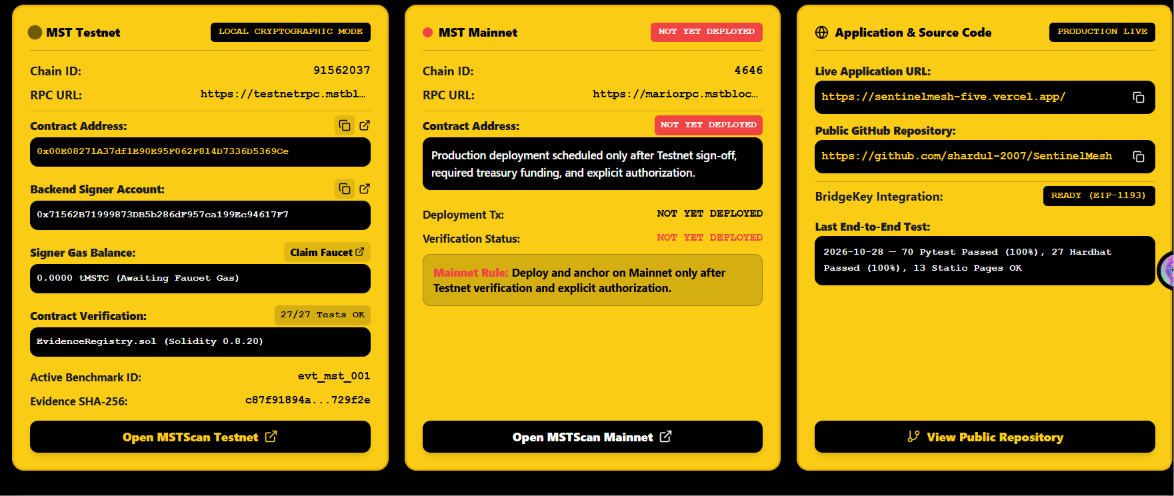
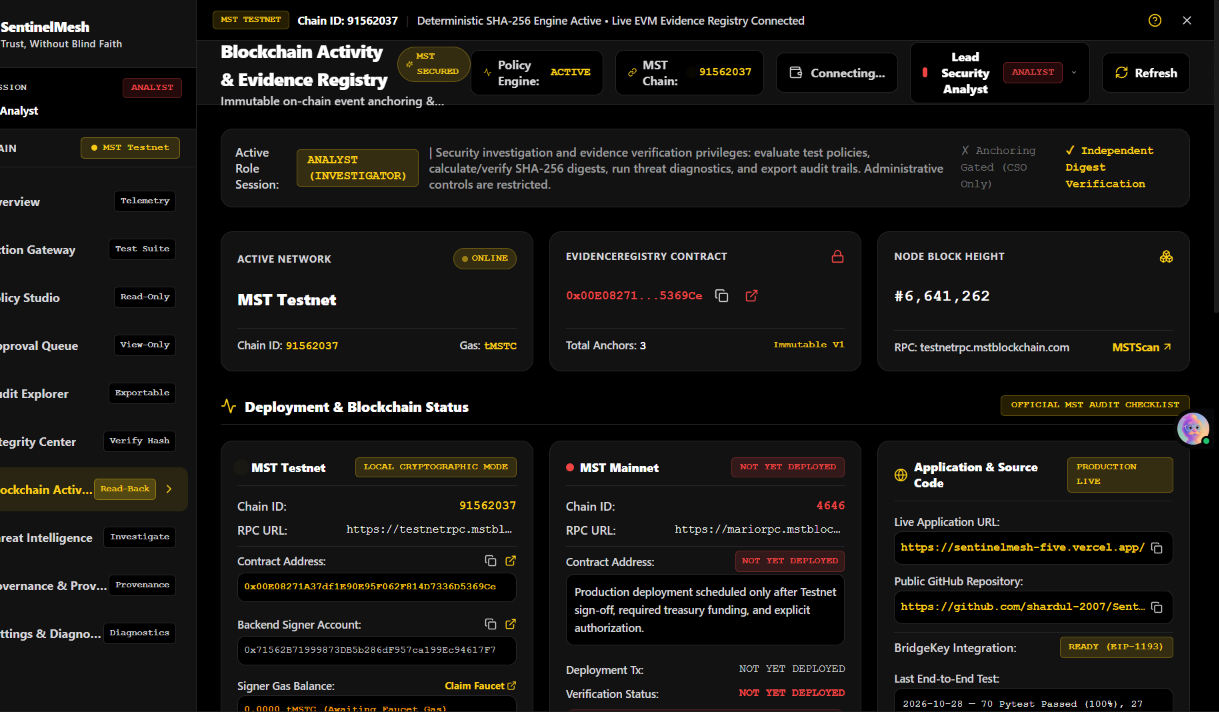
- Blockchain Evidence Registry: Designed to anchor evidence hashes on the MST Blockchain Testnet, enabling independent verification of recorded commitments.
- Auditability: Provide a traceable record of security decisions and their supporting evidence.
For AI-powered payment scenarios, SentinelMesh is designed to provide an additional governance layer before sensitive payment-related actions are authorized. It does not claim to process payments or provide a completed PayPal API integration.
How We Built It
We approached the project by separating action evaluation, policy enforcement, evidence generation, and blockchain verification into distinct components.
The workflow follows this structure:
- An AI agent or client submits an action request.
- SentinelMesh evaluates the request against configured security policies.
- The gateway returns an
ALLOW,BLOCK, orREQUIRE_APPROVALdecision. - A structured evidence record is generated for the decision.
- The evidence is canonicalized using RFC 8785 and hashed using SHA-256.
- The evidence hash can be submitted to the MST Blockchain Testnet for recording and later verification.
The project includes a web-based interface, an interactive simulator, backend functionality, and blockchain-related verification components.
Challenges We Faced
One of our biggest challenges was moving beyond a simple demonstration of security decisions and building a system with a clear, verifiable architecture.
We had to think carefully about the difference between generating a transaction-like record and proving that a transaction actually exists on a blockchain. We also worked on separating real backend responses from simulated behavior, improving the user experience, and making the project's purpose easier to understand.
Another challenge was designing a practical approval workflow for sensitive AI-agent actions while maintaining a clear audit trail.
These challenges helped us understand that security products must demonstrate not just an impressive interface, but reliable functionality, transparent system status, and verifiable results.
What We Learned
Building SentinelMesh strengthened our understanding of Zero-Trust architecture, AI-agent security, backend system design, cryptographic hashing, blockchain integration, and human-in-the-loop governance.
Most importantly, we learned that trust in autonomous systems should be earned through verification, not assumed by default.
What's Next
Our next steps include strengthening real-world payment workflow integrations, expanding policy controls, improving approval and audit workflows, and validating the complete evidence-anchoring process.
Our long-term vision is to make SentinelMesh a practical security and accountability layer for AI agents operating in sensitive environments, especially financial workflows.
SentinelMesh — Let AI Act. Keep Every Action Accountable.
Built With
- ai-agents
- artificial-intelligence
- blockchain
- cryptography
- cybersecurity
- human-in-the-loop
- mst
- next.js
- node.js
- python
- react
- sha-256
- smart-contracts
- typescript
- web3
- zero-trust

Log in or sign up for Devpost to join the conversation.