-
-
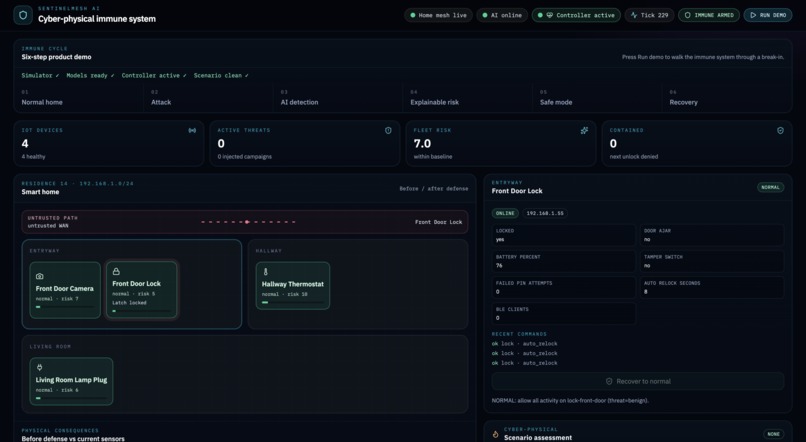
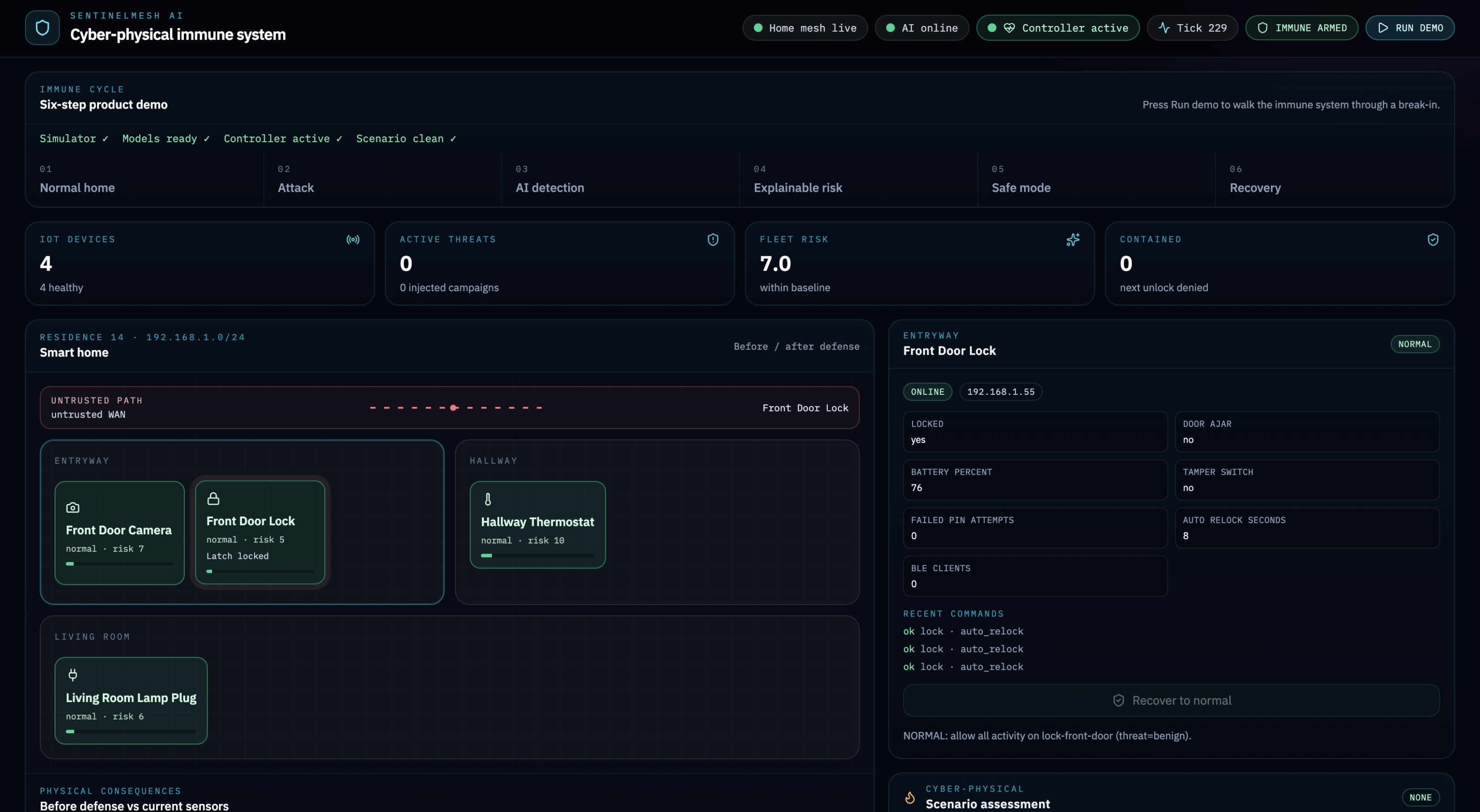
SentinelMesh AI Dashboard
Inspiration
Technology is becoming increasingly intelligent and connected. From smart homes to automated systems, billions of devices now interact with the physical world. However, as these systems become more autonomous, they also become more difficult for humans to monitor and protect.
I have always been fascinated by intelligent technology and the possibilities of connected systems. At the same time, I became increasingly concerned by how quickly technology was advancing compared to our ability to understand and control it. I often came across examples of compromised IoT devices, abnormal device behavior, and security incidents that showed a clear problem:
Connected systems are becoming smarter, but they still need an intelligent layer that can understand when something is wrong and respond appropriately.
This inspired us to build SentinelMesh AI — an autonomous AI guardian that helps connected environments understand their own behavior, detect anomalies, and adapt to unexpected situations.
What I Built
SentinelMesh AI is a cyber-physical AI system that uses machine learning to model normal behavior patterns of connected devices and identify abnormal activity.
Instead of relying only on predefined rules, SentinelMesh learns behavioral patterns from device telemetry:
- network activity;
- command patterns;
- energy consumption;
- sensor information;
- device-specific behavior.
When the system detects unusual behavior, it analyzes the situation, estimates risk, explains the reasoning behind its decision, and applies an appropriate response.
The AI pipeline follows:
Observation → Behavior Learning → Anomaly Detection → Risk Assessment → Adaptive Response
The goal was to move beyond traditional alert systems and explore how AI can become an active decision-making layer for intelligent environments.
How I Built It
Because physical IoT hardware was not available during development, I created a simulated smart environment containing different connected devices:
- smart cameras;
- smart plugs;
- smart locks;
- smart thermostats.
Each simulated device generates realistic telemetry, including:
- communication patterns;
- device commands;
- power usage;
- sensor states;
- behavioral history.
The AI/ML system consists of several components:
1. Behavioral Profiling
Each device develops its own baseline behavior instead of using one universal rule set.
For example, a smart camera and a smart plug have completely different normal patterns, so they are analyzed separately.
2. Anomaly Detection
I use machine learning approaches to identify unusual behavior compared with previous observations.
The system combines:
- statistical analysis;
- anomaly detection models;
- behavioral comparison.
3. Risk Assessment
Detected anomalies are transformed into understandable risk scores by combining multiple signals.
Example: Unknown connection + Unusual traffic increase +
Abnormal command pattern
High-risk behavior
4. Adaptive Response
Instead of only generating alerts, SentinelMesh can simulate different response levels:
- monitoring;
- restricted operation;
- quarantine;
- recovery.
This creates a complete AI decision loop:
Detect→Understand→Act→Verify
I used Cursor as an AI-assisted development tool to accelerate implementation, debugging, and code organization. The architecture, project direction, ML approach, security logic, and system design were developed and evaluated by me. I reviewed, tested, and modified generated code to integrate it into SentinelMesh AI.
What I Learned
Building SentinelMesh AI taught me that creating intelligent systems is not only about developing accurate models.
A useful AI system must also:
- understand context;
- explain its decisions;
- handle uncertainty;
- take safe actions;
- recover from mistakes.
One of my biggest lessons was that detection alone is not enough. A system that can recognize a problem but cannot respond safely still leaves humans with the hardest decision.
The future of AI systems requires a balance between autonomy and human control.
Challenges Faced
The biggest challenge was creating a realistic AI environment without access to real IoT devices.
I needed to simulate:
- realistic device behavior;
- normal variations;
- attack scenarios;
- physical consequences.
Another challenge was avoiding a simple rule-based approach. I wanted SentinelMesh to demonstrate genuine machine learning concepts rather than manually labeling every situation as "safe" or "dangerous."
I focused on building a complete AI pipeline where models identify patterns, the system evaluates risk, and responses are generated based on evidence.
Future Improvements
In the future, SentinelMesh AI could be extended with:
- real IoT device integrations;
- larger behavioral datasets;
- stronger autonomous AI agents;
- computer vision-based environmental understanding;
- personalized security recommendations.
My vision is to create intelligent systems that do not just connect the world, but help make it safer.
Built With
- ai
- data-science
- fast-api
- iot
- machine-learning
- predictive-analytics
- python
- react
- scikit-learn
- typescript


Log in or sign up for Devpost to join the conversation.