-
-
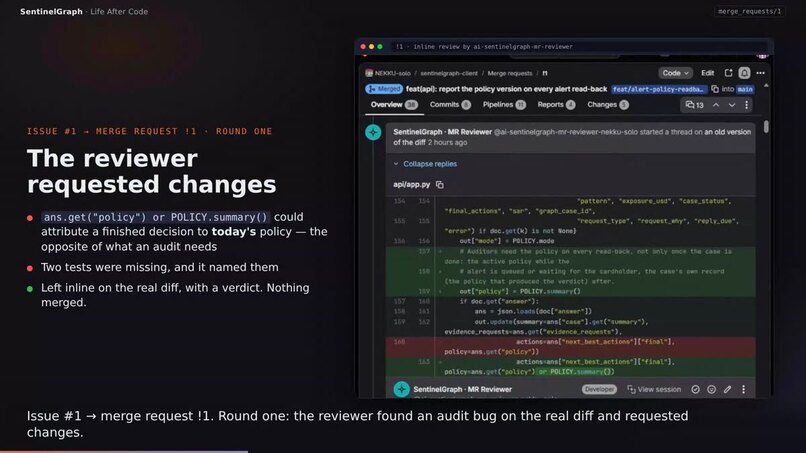
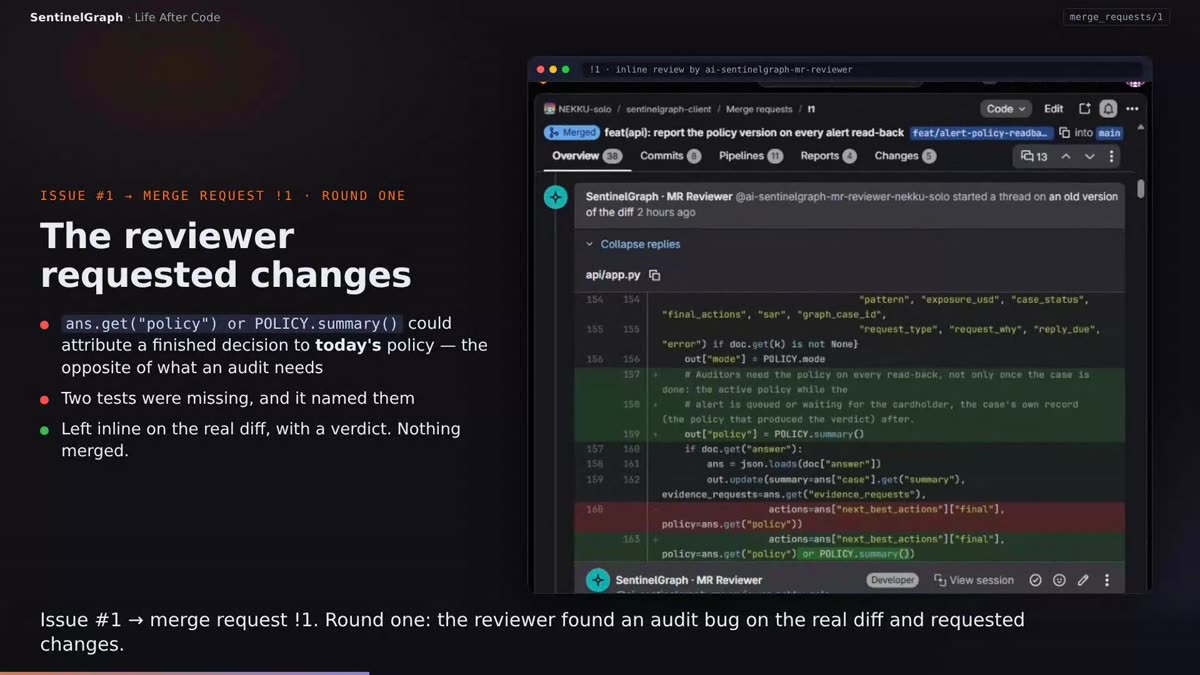
MR !1, round one: the MR Reviewer flow found an audit bug on the real diff and requested changes.
-
The pipeline on main: tests, benchmark, image, four scanners, release, staging deploy, manual production gate.
Path B (Bring Your Own) · Supervised autonomy · 9 of 9 lifecycle stages
- GitLab project: https://gitlab.com/nekku-solo/sentinelgraph-client
- Original MIT project: https://github.com/nirmaljosephukken/sentinelgraph-client
- Pipeline history: https://gitlab.com/nekku-solo/sentinelgraph-client/-/pipelines
- Agent sessions: https://gitlab.com/nekku-solo/sentinelgraph-client/-/automate/agent-sessions
- Live demo of the agents at work: issue #1 and merge request !1
- Staging (deployed by the pipeline): https://sentinelgraph-staging-539369061797.asia-south1.run.app · API docs: https://sentinelgraph-staging-api-539369061797.asia-south1.run.app/docs
- Video: https://youtu.be/DIg0ib6bDI0
Inspiration
SentinelGraph is an agentic fraud investigator for card issuers: a deterministic evidence engine over a TigerGraph of 590,000 transactions, a Gemini agent on Google ADK that explains and chooses tools but never decides, policy-as-code with L1/L2 approval routes, and an audit trail a regulator can read. It already had tests, a Dockerfile, a Cloud Run deploy script and a monitoring pack. What it did not have was anyone to run the lifecycle after a commit: review, triage, scanning, release notes, deploys, rollback, incidents. A solo founder did all of that by hand, when there was time, which is to say rarely.
The thesis of this entry: in a regulated domain the post-code lifecycle is the part that should be agentic, as long as the agents are given the same hard rules the product gives Gemini — explain and act on the mechanics, never decide the things humans must own.
What it does
Push code or open an issue; agents take it from there. The only human actions left are approve the merge request
and click deploy-production.
| Stage | Before (GitHub Actions, by hand) | After (GitLab CI/CD + GitLab Duo) |
|---|---|---|
| plan | triage by hand | Issue Triage flow — labels type/severity, checks duplicates, writes acceptance criteria and an implementation sketch after reading the code |
| create | manual review | MR Reviewer flow — enforces the trust boundary (Gemini never decides) and golden-benchmark integrity, leaves inline findings, submits a verdict, labels the MR; foundational Duo Code Review and Duo Developer alongside |
| verify | lint + fast tests | ruff as Code Quality, fast + slow pytest (20 benchmark alerts must reproduce exactly), coverage and JUnit in the MR; Pipeline Medic flow reads failed job logs and pushes the fix — and refuses to touch the golden file |
| package | image built, discarded | image in the Container Registry; console, worker and intake API started from it and health-checked |
| secure | a regex for keys | SAST, secret detection, dependency scanning, container scanning; Security Gate flow triages findings for what matters in a bank, opens issues, blocks/clears the MR |
| release | none | keyless semantic releases: the job tags and publishes with its own CI_JOB_TOKEN, version from Conventional Commits; Release Scribe flow writes the changelog on approval, including policy version/approver and any decision change |
| configure | deploy.ps1 from a laptop |
staging deploy of three Cloud Run services via keyless OIDC (Workload Identity Federation); production behind one approval |
| monitor | Cloud Monitoring alerts (kept) | smoke tests after every deploy with automatic traffic rollback; hourly health probe |
| govern | branch protection | CODEOWNERS on decisions/policy/deploy, approval rule, DCO and license gates in CI; Incident Responder flow opens an Incident work item with evidence, suspected commit and rollback status |
What was added during the submission period (Path B)
SentinelGraph itself (the fraud engine, the Gemini/ADK agent, the console, the intake API, the TigerGraph schema) predates this hackathon and is the MIT project linked above. Everything below was created on or after 5 October 2026, for this hackathon, and is visible in the GitLab project history:
- the import to GitLab and the whole
.gitlab-ci.ymlpipeline (19 jobs: verify, package, secure, release, deploy-staging, verify-staging, deploy-production, monitor); - the six custom GitLab Duo flows in
.gitlab/duo/flows/, their triggers, andAGENTS.md; CODEOWNERS, the approval rule, DCO and license gates, MR and issue templates,CHANGELOG.md;- the keyless Google Cloud deployment: Workload Identity Federation setup scripts (
deploy/gitlab-wif-setup.*), the Artifact Registry copy, the threesentinelgraph-staging*Cloud Run services, smoke tests with rollback, and the hourly health-probe schedule; - the keyless release job (
.gitlab/scripts/release.sh) and releasev1.1.0; - the feature in MR !1 (
policy/policy_sourceon the alert read-back), reviewed, fixed and merged with the agents.
How we built it
- Six custom flows (
.gitlab/duo/flows/), each a singleAgentComponent(MR Reviewer adds aOneOffComponentlabeler), API-only (coding_environment: none), with GitLab's own tools:list_merge_request_diffs,submit_mr_review,get_job_logs,create_commit,list_security_findings,create_work_item… - Triggers on real events: work item created, merge request created / approved, pipeline passed / failed, mention.
AGENTS.mdgives every agent the two rules that matter here: Gemini explains, the engine decides and never regeneratetests/golden/benchmark.json— a changed fraud decision is a policy event for a human.- A 19-job pipeline with the four scanner templates, a three-service container health check, keyless Cloud Run
deploys (
id_tokens→ WIF → deploy service account, no JSON keys anywhere) and rollback. - No long-lived credential anywhere: deploys use OIDC federation, releases use the job token, agents use GitLab's own service accounts. There is nothing in this project a leaked CI variable could give away.
- Governance as code: CODEOWNERS, DCO sign-off check, copyleft license gate, approval rule, protected
main.
What the agents actually did (watch issue #1 and !1)
- Issue Triage read
api/app.pybefore answering and corrected the issue's premise: the endpoint already returned the policy once a case was done; the real gap was the provisional state. It labelledtype::feature / severity::low. - MR Reviewer requested changes on our own MR: the fallback
ans.get("policy") or POLICY.summary()could attribute a finished decision to the currently active policy — the opposite of what an audit needs — and it named the two missing tests. We fixed it and asked for a re-review. - The second review found three more real problems in the fix: the guard keyed on the wrong field, a test that
patched a frozen dataclass (so it could never catch the regression it was named for), and tests that depended on
run order. It suggested the exact remedies (
dataclasses.replace, state-based attribution, self-contained fixtures). While that was being fixed the MR pipeline went red, and Pipeline Medic read the failed job log and pushed the guard fix to the branch on its own (
f8116ca1), without touching the golden benchmark. The human commit that followed built on it.On approval, Release Scribe read the final diff and wrote the Keep-a-Changelog entry for !1 into
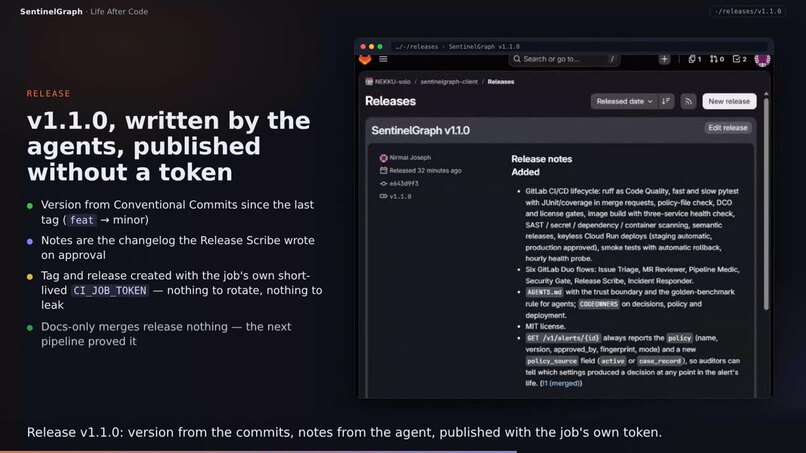
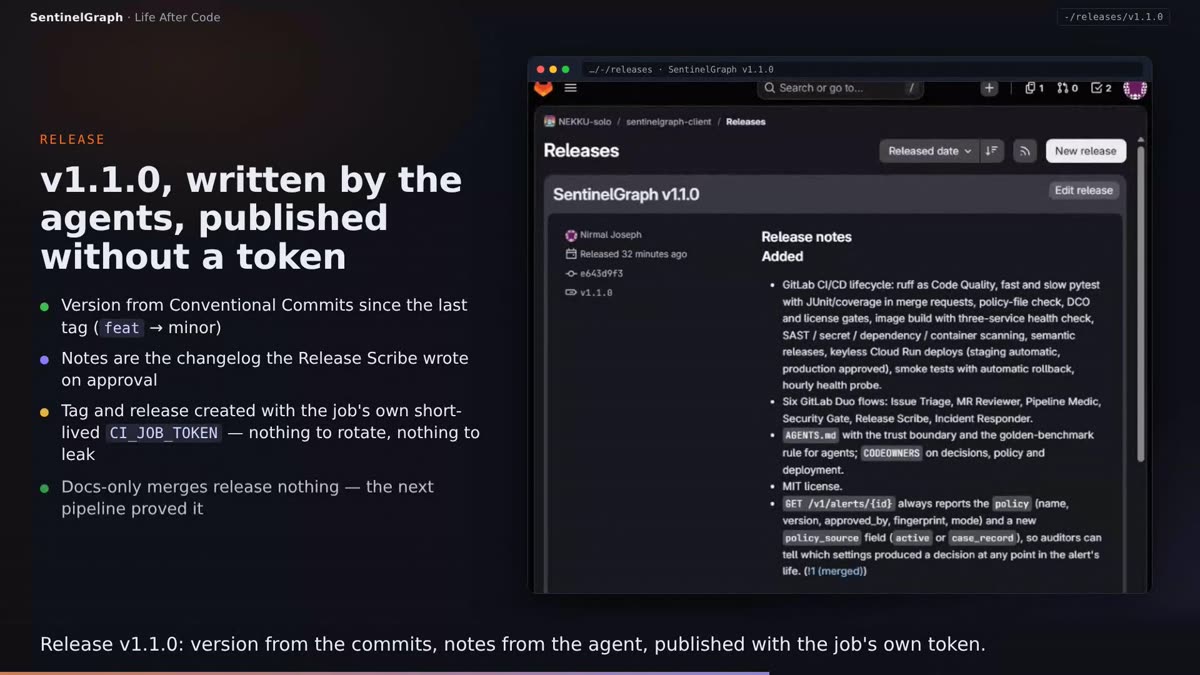
CHANGELOG.mditself; on merge, the release job turned that entry into thev1.1.0GitLab Release and the post-merge pipeline rolled the image onto staging without anyone touching a cloud console.
That is the Supervised model working: agents found real defects and fixed the mechanical one themselves; a human decided what the audit semantics should be; nothing merged on its own.
Challenges
- Flows run in CI as a
workloadjob that downloads the Duo CLI withcurl; anagent-config.ymlpointing atpython:3.11-slim(no curl) silently killed the first runs. Lesson: the flow image must carrycurl. - Getting the dependency between
deploy-productionand the staging smoke test right needed explicit stages (deploy-staging → verify-staging → deploy-production), becauseneeds:cannot look forward. - A pure SPDX allowlist for licenses is whack-a-mole; a copyleft denylist is what a bank actually wants.
- Release Scribe's first changelog commit carried a skip-CI marker, which the "pipeline must succeed" merge rule
correctly refused. The governance caught the agent; the fix went into the flow and into
AGENTS.md. - GitLab's shared runners sit on another continent from Mumbai, so a 1.5 s p95 smoke budget failed on pure
round-trip time. The budget is now explicit (
SMOKE_P95_SECONDS) rather than a magic number.
Known limits (so you don't have to find them)
- Container scanning reports HIGH CVEs in the Debian base of
python:3.11-slimwith no upstream fix yet; the Security Gate flow tracks them and does not block on them. We rebuild on every base-image refresh. - This is a solo project, so the approval rule necessarily allows the author to approve; CODEOWNERS, the DCO and
license gates, protected
mainand the audit trail of agent sessions are what keep that honest. - Staging runs the offline mode (local graph mirror, no model calls) so it can be public and cost nothing; production is the full stack and sits behind the manual gate.
Accomplishments
Nine lifecycle stages covered by a mix of CI and six agents; a review conversation between an agent and a human that improved real code; zero secrets in the repo or the pipeline; the benchmark decisions still reproduce exactly.
What we learned
Agents are at their best when the codebase tells them what they must not do. The AGENTS.md rules were the
difference between a reviewer that nitpicks and one that catches an audit bug.
What's next
Run the Incident Responder against a real Cloud Run outage; give Pipeline Medic a coding_environment: full so it
can run the suite before committing; let Release Scribe open the production deploy for approval.
Built With
- artifact-registry
- docker
- fastapi
- gemini
- gitlab
- gitlab-ci
- gitlab-duo
- google-adk
- google-cloud-run
- pytest
- python
- tigergraph
- workload-identity-federation

Log in or sign up for Devpost to join the conversation.