-
-
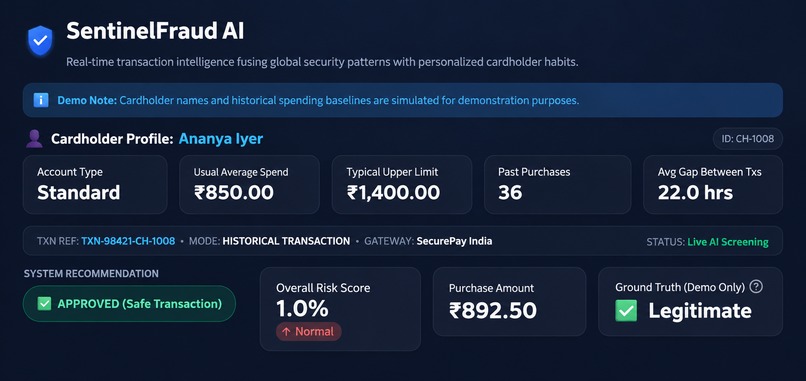
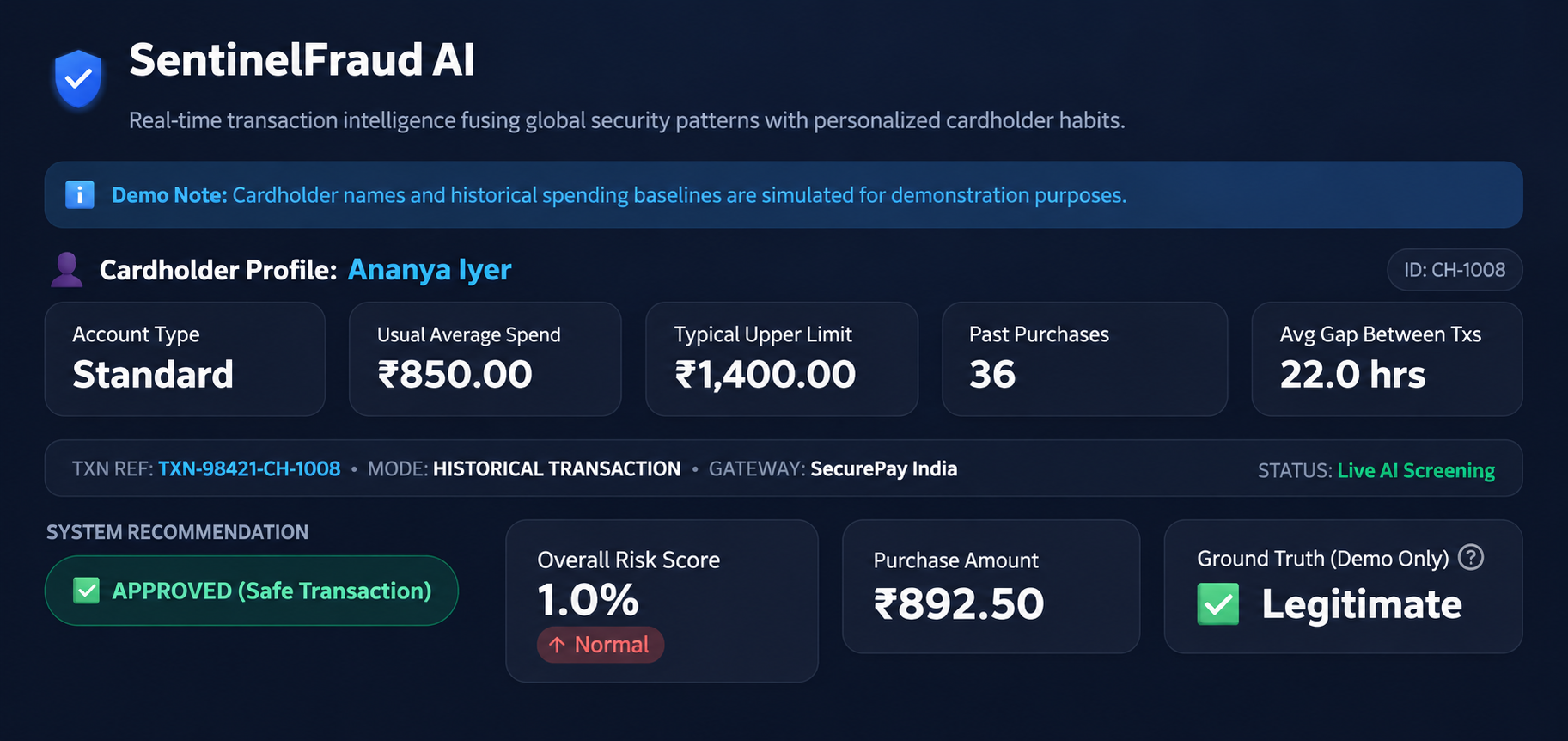
Contextual Baseline: Instant 0.9% Risk Approval for VIP Spender with Zero False-Positive Friction
-
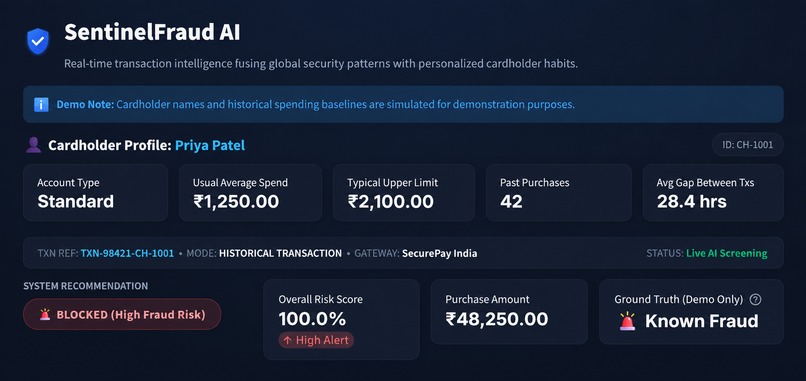
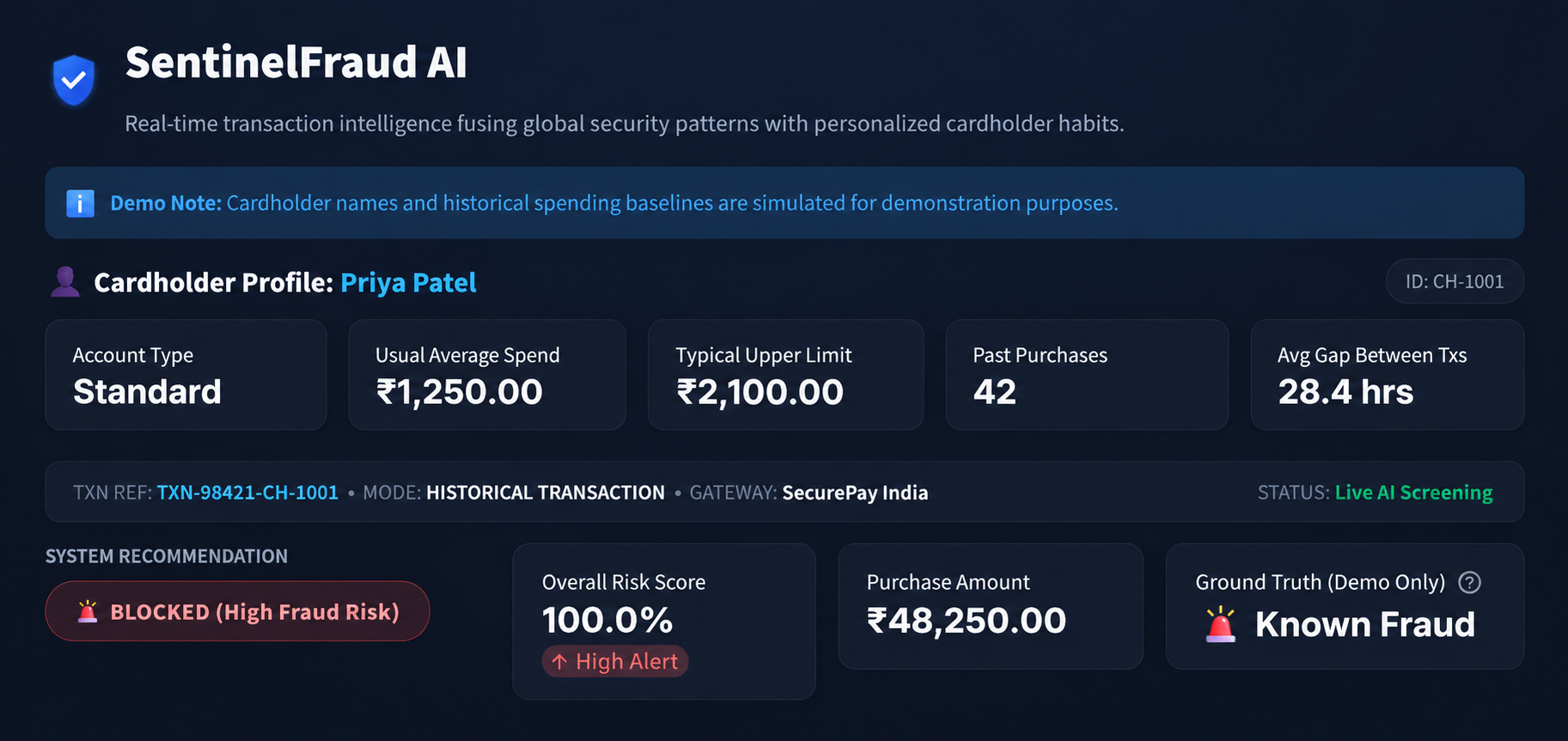
High-Risk Detection: 100% Risk Score & Plain-English SHAP Root Cause Breakdown for Account Takeover
Inspiration
Traditional banking fraud detection systems are notoriously opaque "black boxes." When a transaction is declined, the customer is left frustrated and the bank's fraud analyst has no clear explanation for why it was flagged. Furthermore, static models often fail on two extremes: they miss sophisticated stealth account takeovers, or they embarrass high-value VIP customers by declining legitimate large purchases.
We built SentinelFraud AI to solve this exact bottleneck: an explainable, dual-layer decision-support cockpit for card-issuing banks that provides real-time, plain-English root causes for every flagged transaction using game-theoretic Explainable AI (XAI).
What It Does
SentinelFraud AI is an enterprise decision engine that evaluates transactions through three integrated layers:
- Universal Fraud Pattern Detection: Employs a cost-sensitive XGBoost classifier trained on 284,000+ transactions to identify signature fraud patterns (device mismatches, token tampering, bot velocity).
- Contextual Cardholder Behavioral Profiler: Maintains dynamic spending baselines (mean, standard deviation, purchase intervals, spending tiers). A ₹40,000 transaction is recognized as routine for a VIP spender, but flagged as a critical anomaly for a student account.
- Game-Theoretic SHAP Explainability (XAI): Decomposes complex feature vectors into plain-English root causes (e.g., "Why Flagged: Authorization Anomaly + Velocity Burst").
- Actionable 3-Tier Decision Workflow:
- Approve (<35% Risk): Instant frictionless clearance.
- ** Escalate (35%–70% Risk):** Triggers dynamic Step-Up 2FA/biometric authentication or analyst review.
- ** Block (>70% Risk):** Immediate card freeze to prevent theft.
How We Built It
- Machine Learning Core: Trained a cost-weighted XGBoost model (
scale_pos_weight = 577.3) withRobustScalerpreprocessing to handle extreme class imbalance (0.173% fraud rate). - Explainability Layer: Integrated SHAP TreeExplainer to compute feature contribution waterfalls in real time.
- Cardholder Profiling Engine: Built a statistical profiling module that models individual Z-scores and purchase velocity gaps.
- Frontend Cockpit: Developed a responsive Streamlit dashboard styled with a Purrweb-inspired dark fintech design system (
#0B1220navy palette, SVG shield branding, Plotly risk gauges, and live parameter simulation).
Challenges We Ran Into
- Extreme Class Imbalance: Normalizing accuracy metrics can be deceiving when 99.8% of data is non-fraud. We optimized specifically for PR-AUC (0.8301) and Fraud Recall (86.73%).
- SHAP Computation Latency: Calculating full Shapley values inline can be computationally heavy. We structured the architecture to compute explainability factors conditionally for analyst review without choking transaction pipelines.
- Translating PCA Math to Human Insights: Translating anonymized PCA dimensions into actionable business reasons required mapping mathematical variance to standard banking security signals.
Accomplishments That We're Proud Of
- Achieved 86.73% Fraud Recall on 56,962 unseen out-of-sample test transactions with sub-15ms inference latency.
- Implemented an intuitive, multi-persona demo spectrum spanning 9 distinct cardholders across all risk tiers.
- Delivered an interactive live simulator allowing risk officers to manipulate amounts, intervals, and security signals to see real-time score updates.
What We Learned
- Why hybrid intelligence (combining universal ML signatures with individualized cardholder baselines) is crucial to solving the false-positive dilemma in fintech.
- How Explainable AI directly fulfills regulatory governance mandates (RBI Digital Security Controls, GDPR Article 22, EU AI Act).
What's Next for SentinelFraud AI
- Graph Neural Network (GNN) Integration: Incorporating graph databases (e.g., Neo4j) to detect organized multi-card money mule rings.
- Real-Time Kafka Streaming: Packaging the inference engine into high-throughput microservices capable of handling 50,000+ TPS.
- Automated Behavioral Adaptation: Using sliding-window continuous learning to adapt baseline metrics during seasonal spending (holidays, travel).
Built With
- datascience
- explainableai
- fintech
- machine-learning
- numpy
- pandas
- plotly
- python
- streamlit
- xgboost

Log in or sign up for Devpost to join the conversation.