-
-
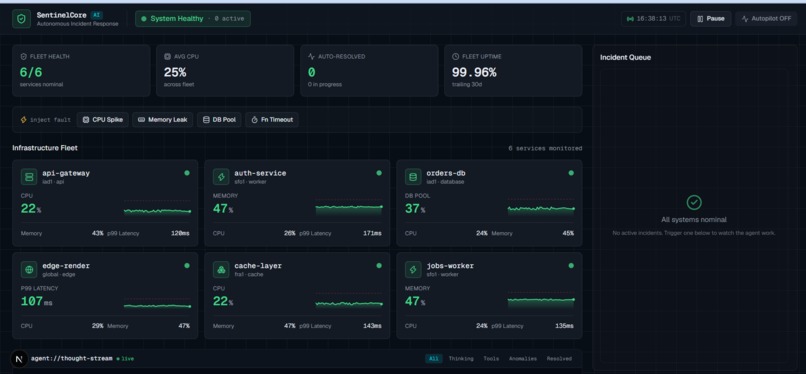
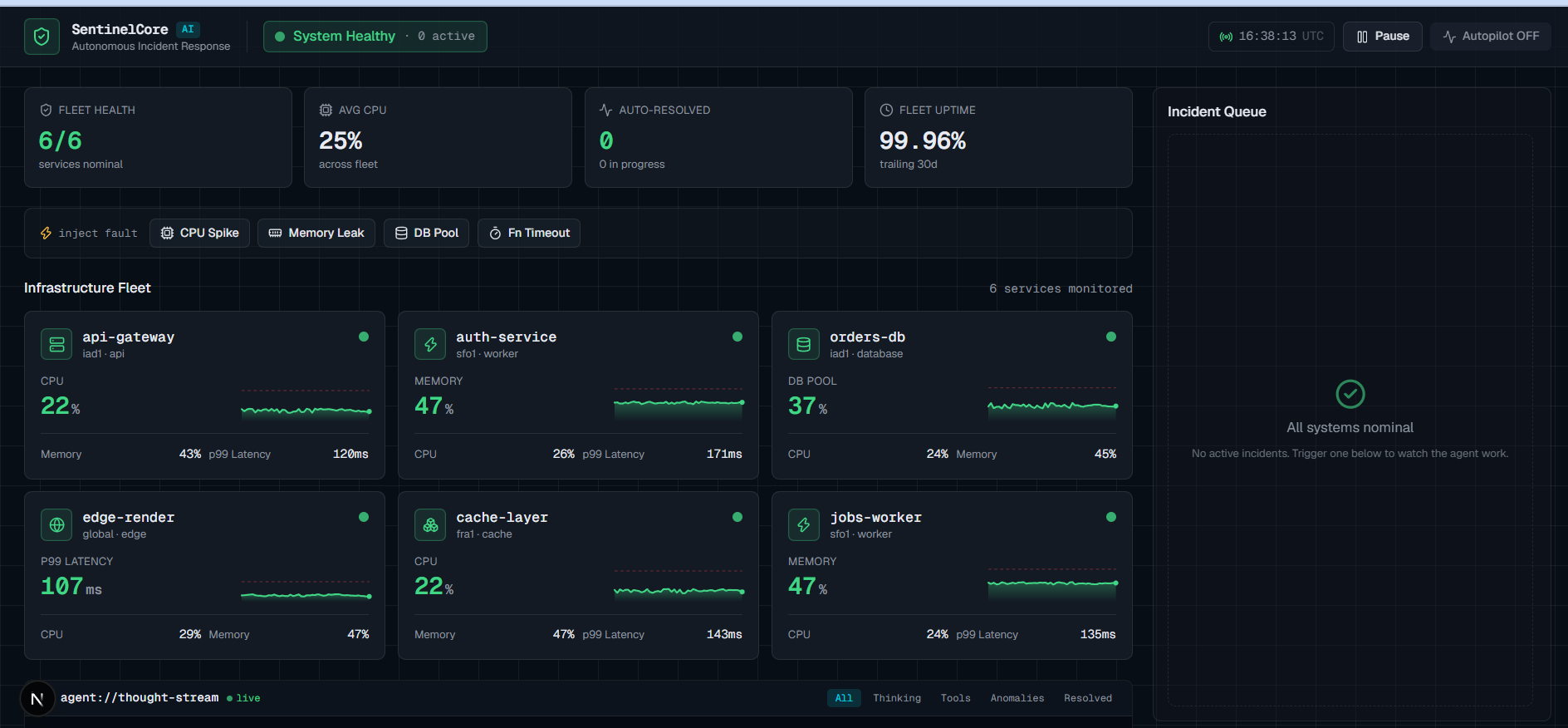
Real-Time Fleet Telemetry and Fault Control Dashboard
-
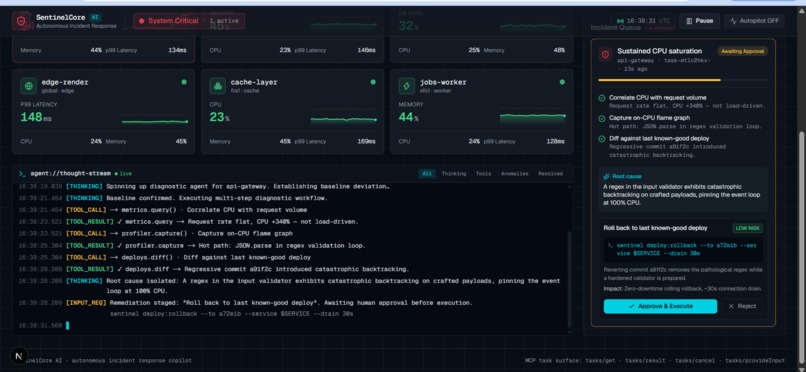
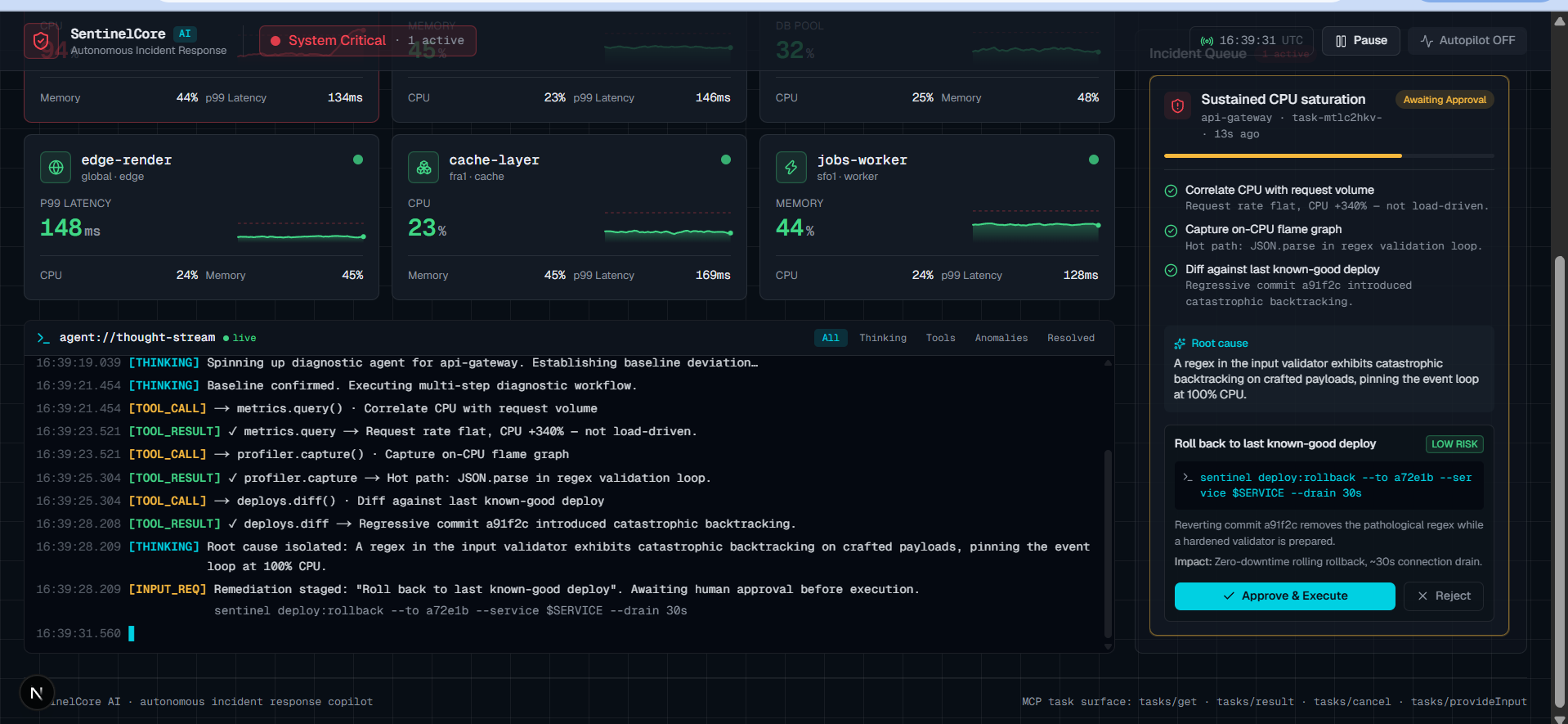
Live Agentic Thought Stream and Incident Triage Queue
Inspiration I was inspired to build SentinelCore AI after witnessing firsthand how much engineering time and mental bandwidth are wasted on alert fatigue, manual log scouring, and repetitive incident firefighting. When critical microservices experience cascading failures, traditional monitoring tools flood developers with noise rather than clarity. I wanted to design an intelligent SRE copilot that cuts through the chaos, automates multi-step diagnostics using transparent thought streams, and handles incident remediation with absolute safety and human-in-the-loop control.
What it does SentinelCore AI is an autonomous DevOps incident response platform and SRE copilot. It monitors a live infrastructure fleet across multiple critical services, tracks real-time telemetry metrics like CPU utilization and memory thresholds, and features a built-in fault injection engine to stress-test systems on demand. When anomalies or faults—such as CPU spikes, memory leaks, database pool exhaustions, or function timeouts—occur, the platform instantly populates an incident queue, triggers a live agentic thought stream to isolate root causes, and stages verified remediation scripts requiring one-click operator approval.
How I built it I built SentinelCore AI using React, Next.js, and Tailwind CSS to create a fast, highly responsive, and self-contained in-browser interface. The architecture models an advanced Model Context Protocol (MCP) task runtime, allowing secure diagnostic tool calls like profiler.capture() and deploys.diff() to execute seamlessly. I designed the UI with a professional dark-mode terminal aesthetic, incorporating real-time sparklines, telemetry status cards, interactive fault injection controls, and granular authorization toggles like Autopilot and Pause mode.
Challenges I ran into One of the main challenges was orchestrating a realistic, fluid multi-step diagnostic simulation that felt completely authentic without relying on an external backend or fragile API keys. I had to carefully engineer the state management for the live thought-stream terminal and incident queues so that injecting a fault dynamically cascades through fleet status updates, automated tool invocations, and staged rollbacks in real time while maintaining strict human-in-the-loop safety boundaries.
Accomplishments that I'm proud of I am incredibly proud of successfully building a fully functional, production-grade DevOps dashboard that bridges autonomous AI execution with strict human oversight. Achieving a seamless layout that integrates real-time telemetry sparklines, an interactive fault injection suite, and a transparent agentic thought stream—all packed into a clean, cohesive developer-first interface—was a massive milestone.
What I learned Working on SentinelCore AI deepened my understanding of SRE workflows, automated root-cause analysis, and human-in-the-loop system design. I gained valuable experience in structuring complex Next.js applications, optimizing real-time telemetry rendering with Tailwind CSS, and modeling agentic task runtimes that prioritize safety, auditability, and zero-downtime recovery.
What's next for SentinelCore AI Moving forward, I plan to scale SentinelCore AI by integrating it with real LLM gateways, live cloud telemetry providers like Prometheus and Datadog, and enterprise-grade Kubernetes clusters. Future enhancements will include advanced role-based access control (RBAC), immutable audit logging for post-mortems, and expanded multi-region orchestration to handle enterprise-level microservice ecosystems.
Built With
- mcp
- next.js
- react
- tailwind-css
- typescript


Log in or sign up for Devpost to join the conversation.