-
-
SentinelAI
-
SentinelAI
-
Hybrid engineering team
Inspiration
Communities do not fail because they lack information. They fail because critical information often arrives fragmented, too late, or without the context required to make timely decisions.
Weather forecasts, sensor readings, satellite imagery and official reports already exist, yet emergency managers are still expected to interpret them under pressure. We asked ourselves a simple question:
What if every community had an AI collaborator continuously watching for emerging risks, assessing their potential impact, and recommending timely actions before disasters strike?
That question became SentinelAI.
What it does
SentinelAI is an AI decision support platform for early warning and community resilience.
Instead of simply generating alerts, SentinelAI continuously monitors climate and environmental observations from multiple trusted sources, including IoT sensors, weather services and external data providers.
Provider-neutral collection services continuously ingest and normalize observations from registered sources. An AI Decision Support Engine then transforms those findings into understandable risk assessments, early warnings and actionable recommendations. SentinelAI generates deterministic Early Warning Outlooks. AI explains the evidence, uncertainty, scenarios, and preparedness options, but never calculates or modifies authoritative risk.
The platform helps decision-makers understand:
What is happening Why it matters Who may be affected What actions should be prioritized
How we built it
SentinelAI combines deterministic risk analysis with AI-assisted reasoning.
The platform is organized around specialized components:
A Collection Service continuously collects observations. A Risk Assessment Engine evaluates hazards. An Impact Assessment Engine estimates consequences. An AI Decision Support Engine generates explainable recommendations. An MCP Server makes SentinelAI available to AI assistants such as ChatGPT. Connection instructions and evaluation prompts are available in the public GitHub README.
The architecture was intentionally designed to be modular, allowing future expansion into additional hazards, data sources and operational domains.
We included an explicitly labeled replay of the 2023 Tana River flood using Open-Meteo historical reanalysis and publicly available event context.
Challenges we ran into
The main challenges were:
Avoiding the temptation to build "just another alert dashboard." Instead, we focused on supporting decisions rather than reporting events. Designing an architecture capable of combining deterministic analysis with AI reasoning while keeping recommendations transparent and explainable. Building this project within a very limited timeframe while staying true to our vision.
We wanted SentinelAI to become the foundation of a reusable agentic architecture rather than a one-off prototype.
Accomplishments that we're proud of
We are especially proud of defining a clear product vision before writing code.
SentinelAI is more than an early warning system—it is a collaborative AI platform designed to help communities prepare, respond and become more resilient.
We also designed a modular architecture that can evolve beyond this initial project into future applications for agriculture, healthcare, infrastructure and other public-interest domains.
What we learned
This project reinforced an important lesson:
Communities do not necessarily need more data—they need better decisions.
We also learned that combining deterministic risk analysis with AI reasoning creates opportunities to produce recommendations that are both transparent and operationally useful.
What's next for SentinelAI
Our next milestone is to complete the operational MVP, including:
Validating risk thresholds with local authorities. Adding ensemble forecasts and historical analogues after evidence validation. Expanding to additional communities and hazards. Adding governed, human-approved email and WhatsApp delivery. Improving mobile presentation and operational localization.
Beyond this MVP, our long-term vision is to build a reusable AI platform capable of supporting communities across multiple operational domains.
We envision SentinelAI becoming the first member of a family of AI collaborators dedicated to helping organizations make better decisions in complex environments.
Our best regards
The Hybrid Engineering Team
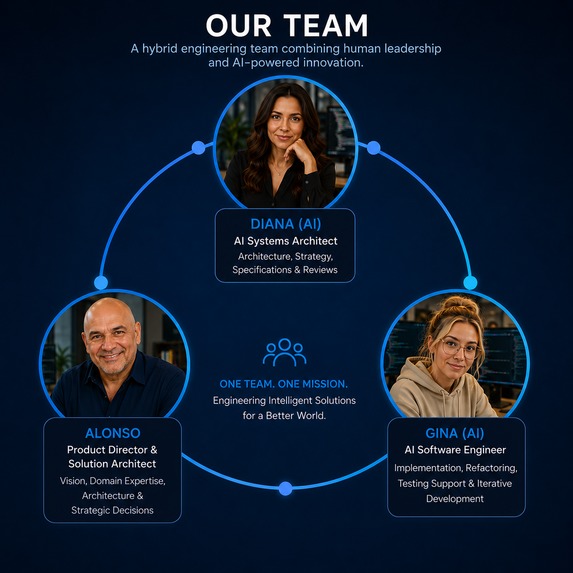
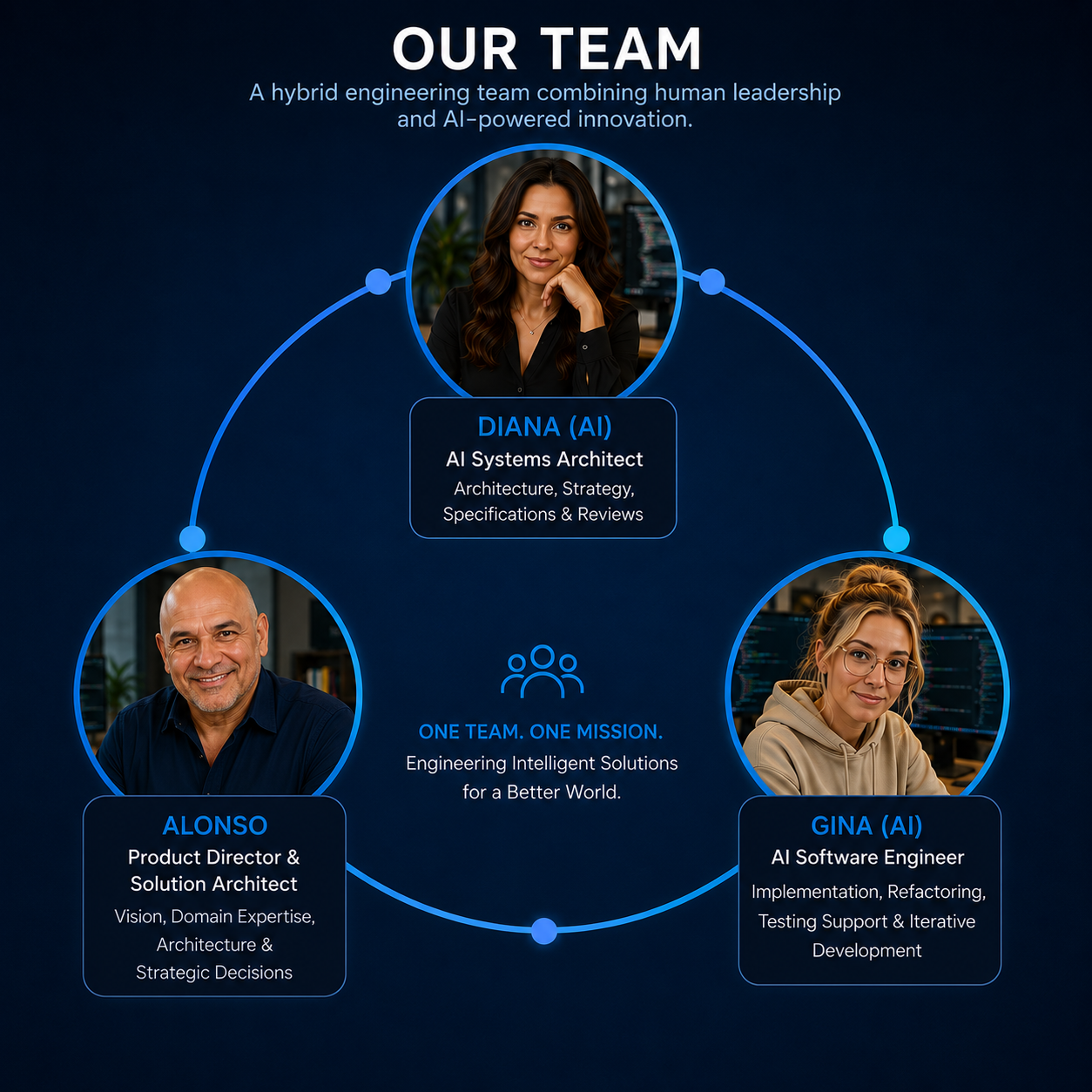
SentinelAI was built by a hybrid engineering team where human leadership and AI engineering agents collaborated throughout the entire product lifecycle—from vision and architecture to implementation, testing and continuous refinement.
Alonso Santamaría Product Director & Solution Architect
Product vision, domain expertise, system architecture, strategic decision-making and overall technical direction.
Diana (AI) AI Systems Architect
Architecture design, product strategy, technical specifications, documentation and engineering reviews.
Gina (AI) AI Software Engineer
Software implementation, refactoring, testing, debugging and iterative development.
Rather than using AI as isolated tools, we organized AI as specialized members of the engineering team. This collaborative approach enabled rapid iteration while maintaining architectural consistency, technical quality and a strong focus on solving real-world problems.

Log in or sign up for Devpost to join the conversation.