-
-
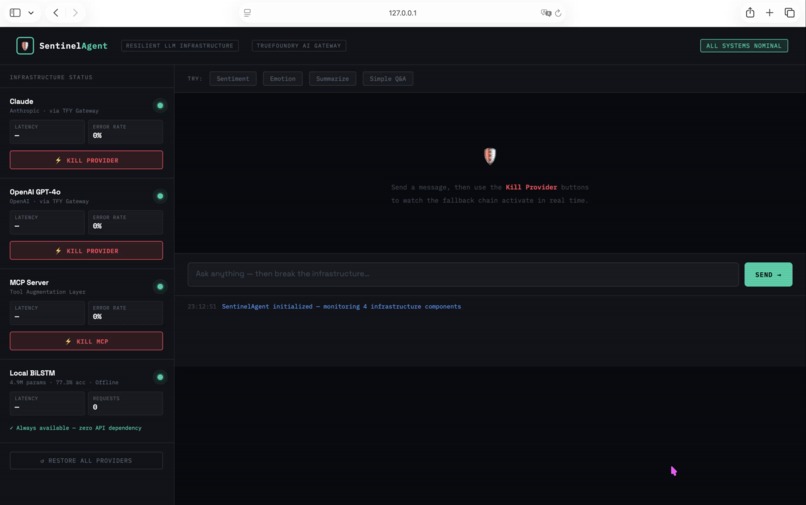
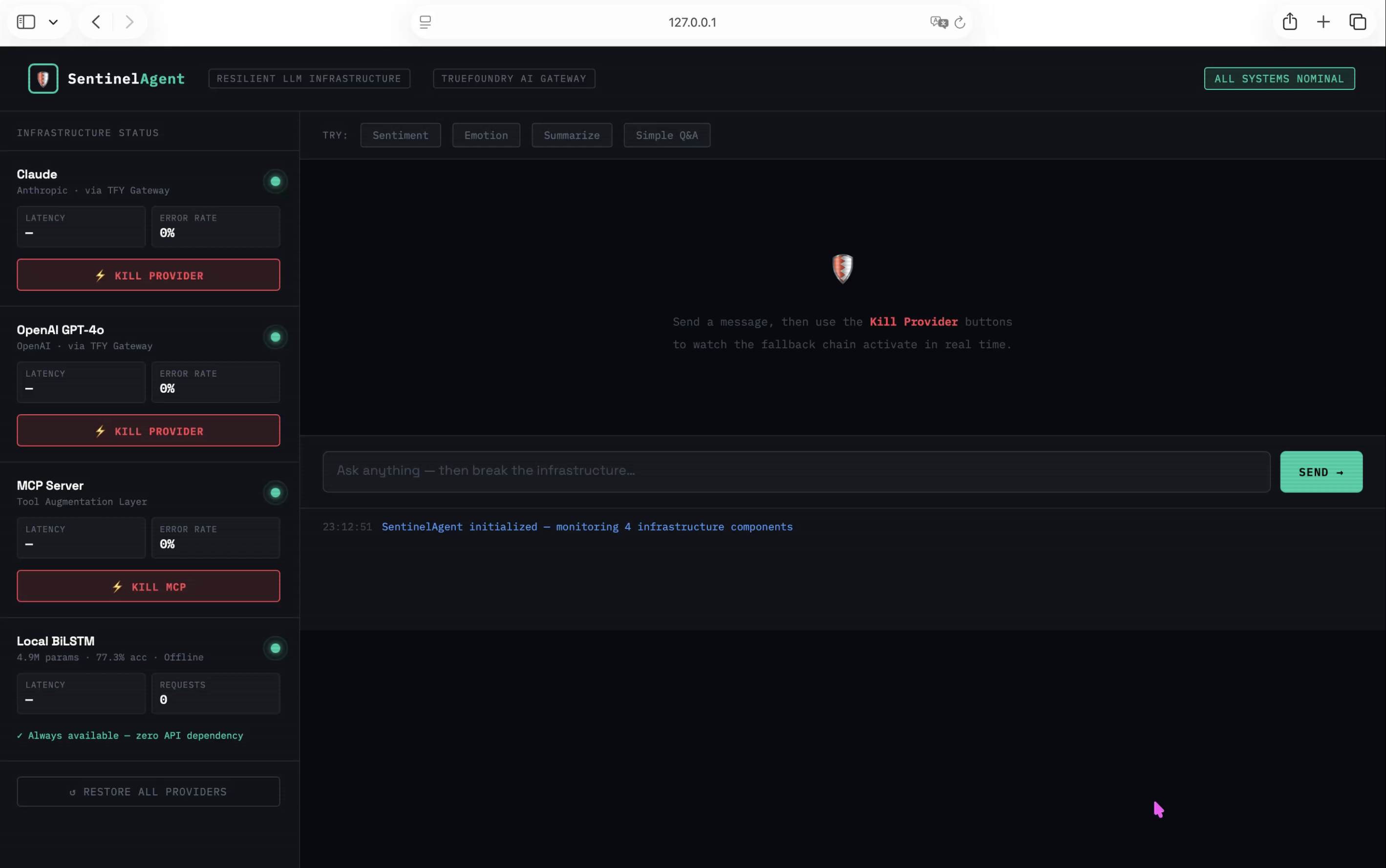
SentinelAgent live dashboard — real-time provider health monitoring across Claude, OpenAI, MCP Server, and local BiLSTM fallback
-
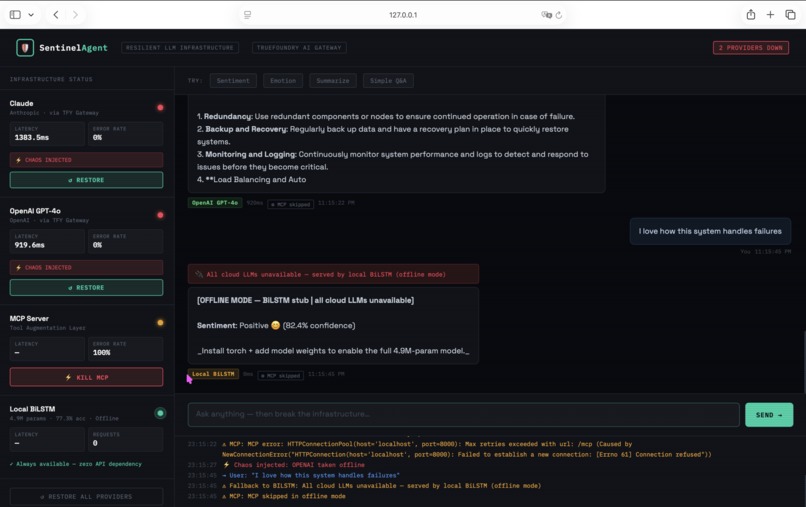
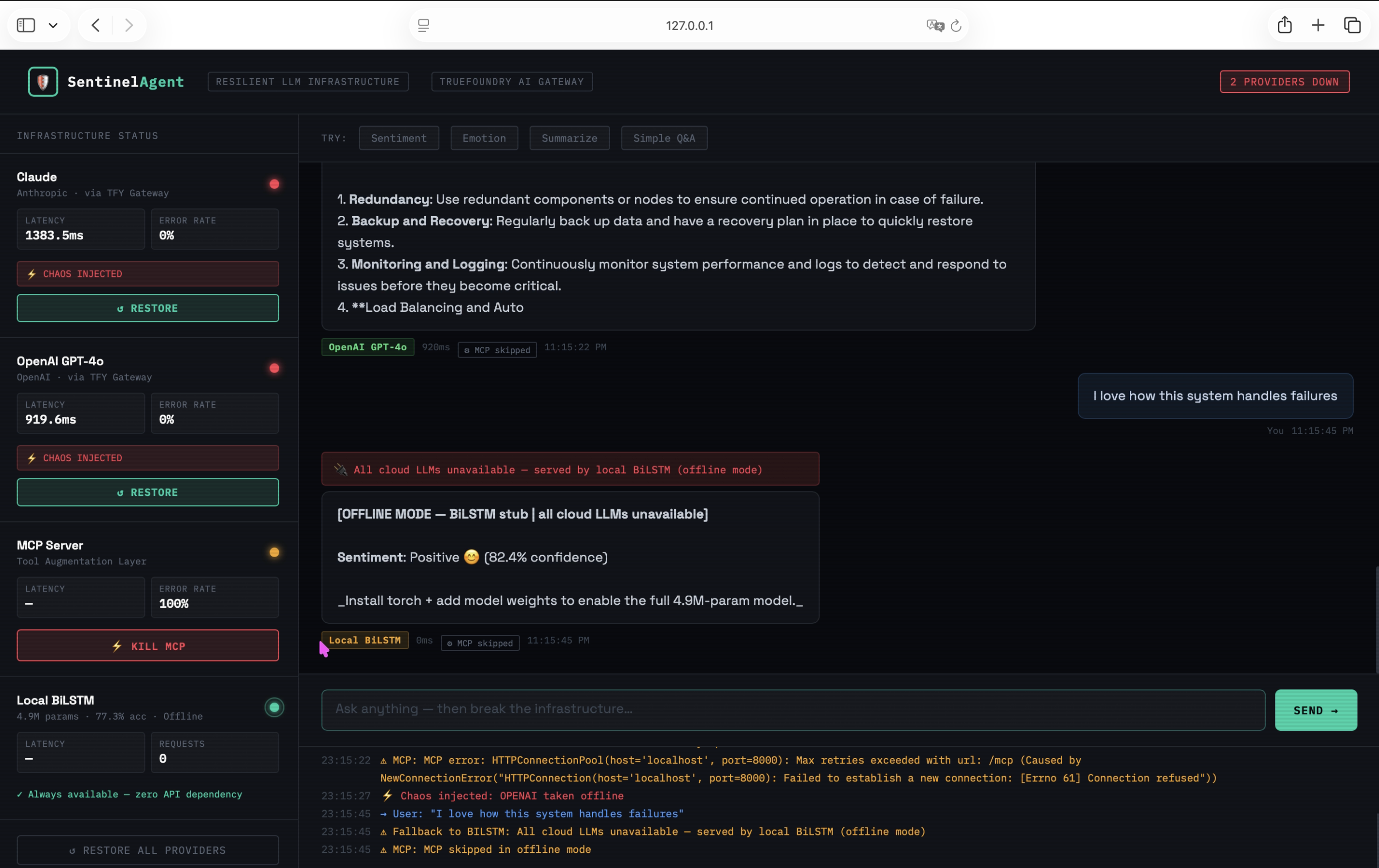
SentinelAgent dashboard showing graceful degradation — Claude and OpenAI both down, local BiLSTM serving responses with zero API dependency
Inspiration
Production LLM agents fail silently when infrastructure breaks. A Claude API brownout, an MCP server crash — users get blank screens. There's no graceful story. I wanted to build one.
What it does
SentinelAgent is a resilient multi-agent system with a 3-tier fallback chain: Claude → OpenAI → Local BiLSTM (4.9M params, 77.31% accuracy, 1.6M tweets)
When Claude fails, it automatically routes to OpenAI. When ALL cloud LLMs fail, my own PyTorch BiLSTM model serves sentiment analysis locally with zero API dependency. A live dashboard shows provider health, latency, error rates, and a real-time request log. Chaos injection buttons let you kill any provider mid-demo to watch the fallback activate instantly.
How we built it
- Flask API with /chat, /status, and /chaos endpoints
- Health monitor with circuit breaker logic per provider
- TrueFoundry AI Gateway for multi-LLM routing
- PyTorch BiLSTM model as offline fallback
- MCP client for tool augmentation (skipped gracefully when down)
- Vanilla JS dashboard with 3-second status polling
Challenges we ran into
- Making BiLSTM load conditionally so the app runs without torch installed
- Circuit breaker recovery logic — knowing when to retry a dead provider
- MCP failing silently vs loudly — had to distinguish connection errors
Accomplishments that we're proud of
- A real trained ML model as fallback, not a mock
- The chaos demo is visually compelling — judges can break it live
- Built in one night from scratch, fully working
What we learned
- How to design agentic systems that degrade gracefully
- Circuit breaker patterns applied to LLM infrastructure
- TrueFoundry AI Gateway routing and observability
What's next for SentinelAgent
- Full TrueFoundry Gateway integration for observability dashboard
- Streaming responses
- Deploy on AWS EC2 with public URL

Log in or sign up for Devpost to join the conversation.