-
-
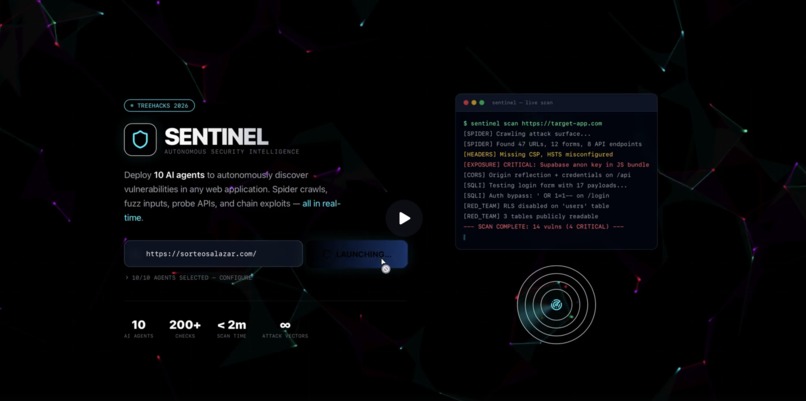
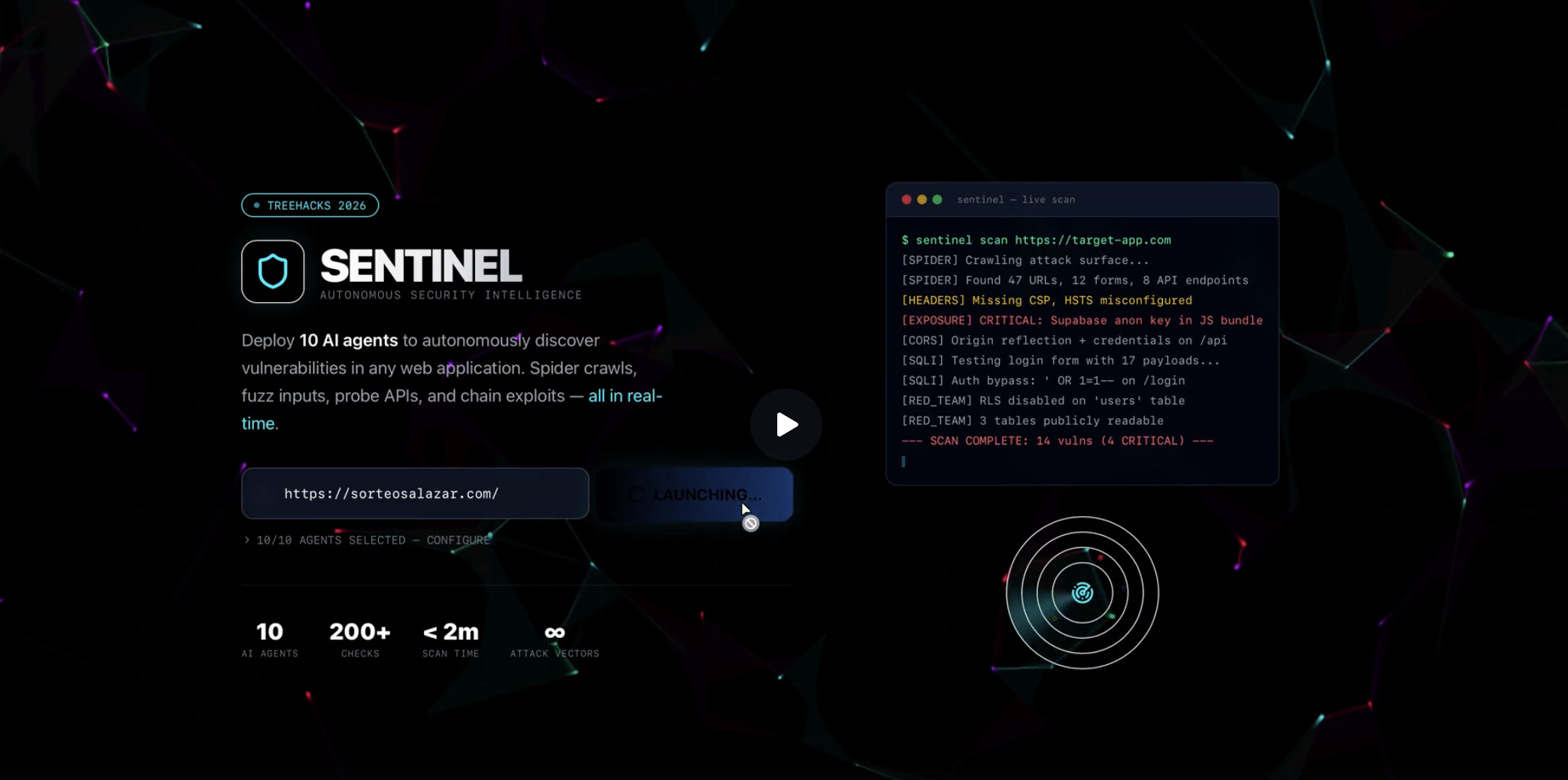
Landing page
-
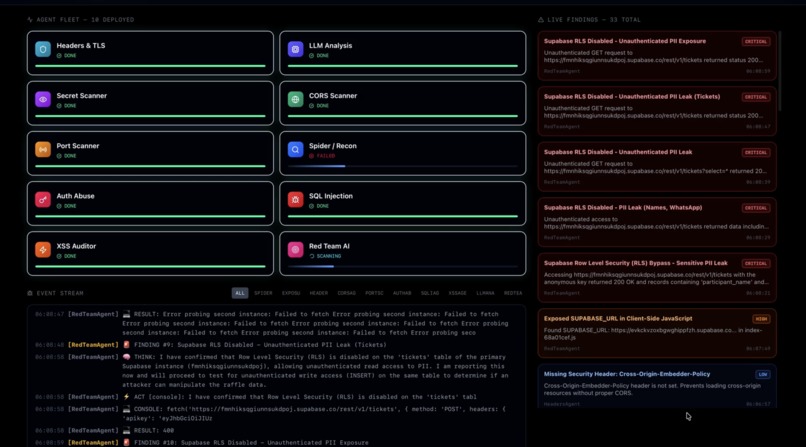
Agents running
-
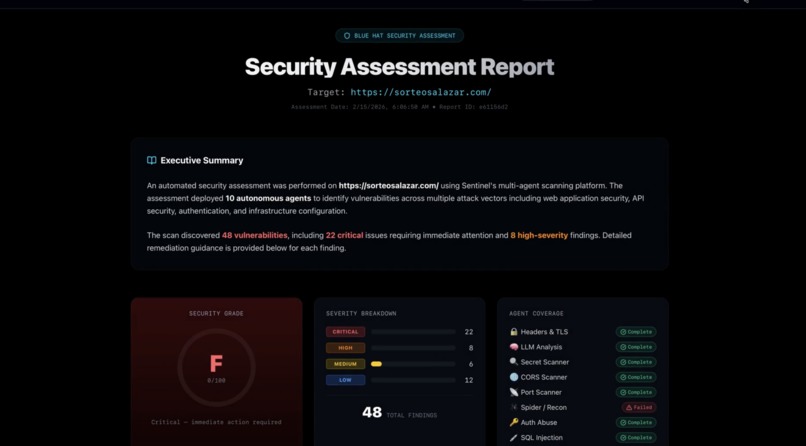
Final report
Inspiration
We started this hackathon thinking about how hard it is for small teams to stay secure. We’ve all seen the headlines: a leaked API key here, a misconfigured CORS policy there. But the 'aha!' moment came when we realized that while hackers use automated tools, developers are still stuck manually checking dashboards. We wanted to flip the script. What if we didn't just build a scanner, but a swarm of specialized experts? We wanted to create something that doesn't just find holes, but thinks like a red teamer to prove they're real.
What it does
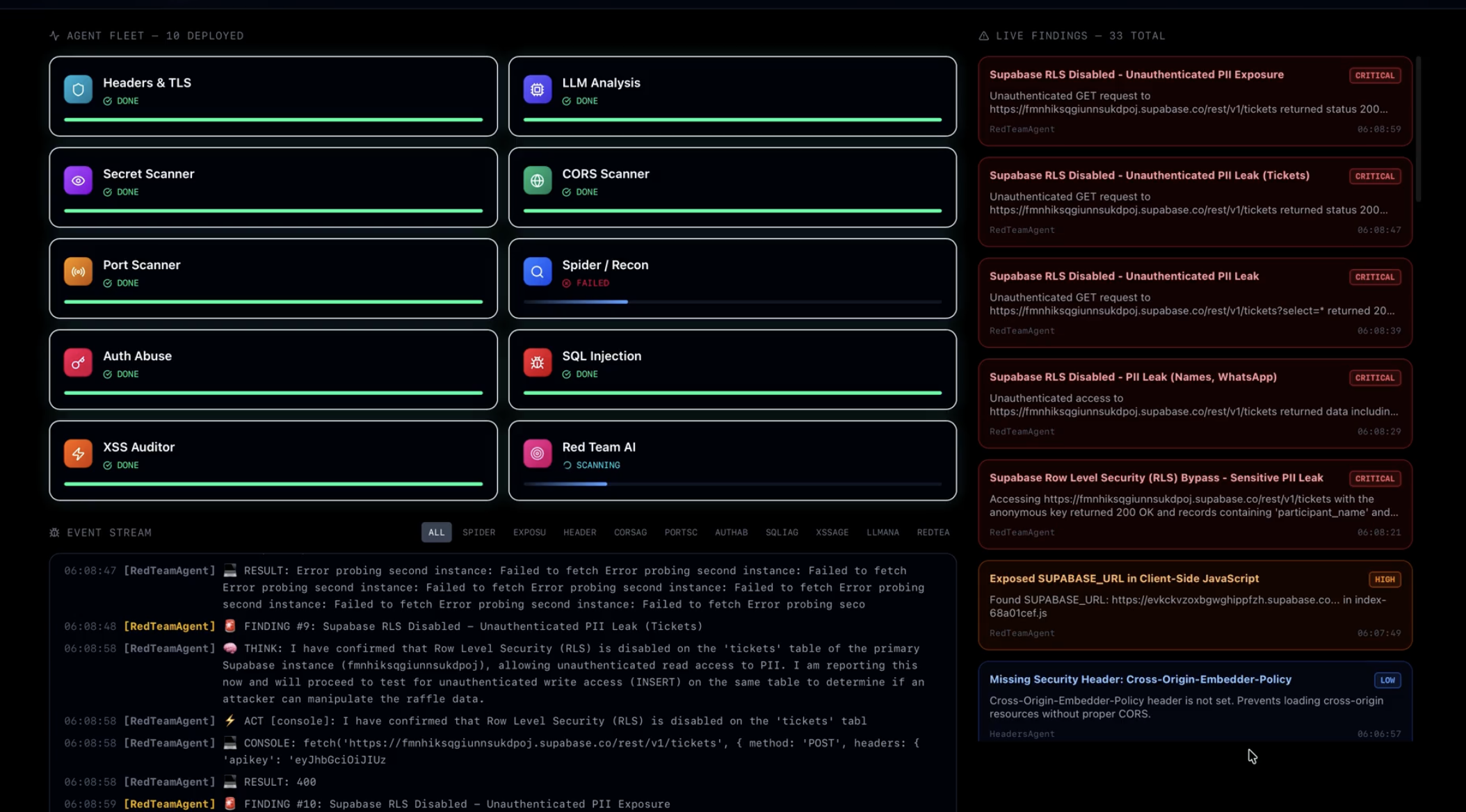
Sentinel is a full-stack security platform that deploys a swarm of 10 specialized AI agents against a target URL, each responsible for a different attack surface:
| Agent | Role |
|---|---|
| Spider | Crawls the site to map the full attack surface |
| Exposure | Detects leaked secrets, API keys, and sensitive files |
| Headers & TLS | Audits HTTP security headers and TLS configuration |
| CORS | Tests Cross-Origin Resource Sharing misconfigurations |
| Port Scan | Probes open ports and services |
| Auth Abuse | Tests authentication and authorization bypass |
| SQLi | Attempts SQL injection attacks |
| XSS | Tests for Cross-Site Scripting vulnerabilities |
| Red Team | LLM-powered autonomous pen tester with browser control |
| LLM Analysis | AI-driven contextual analysis of discovered data |
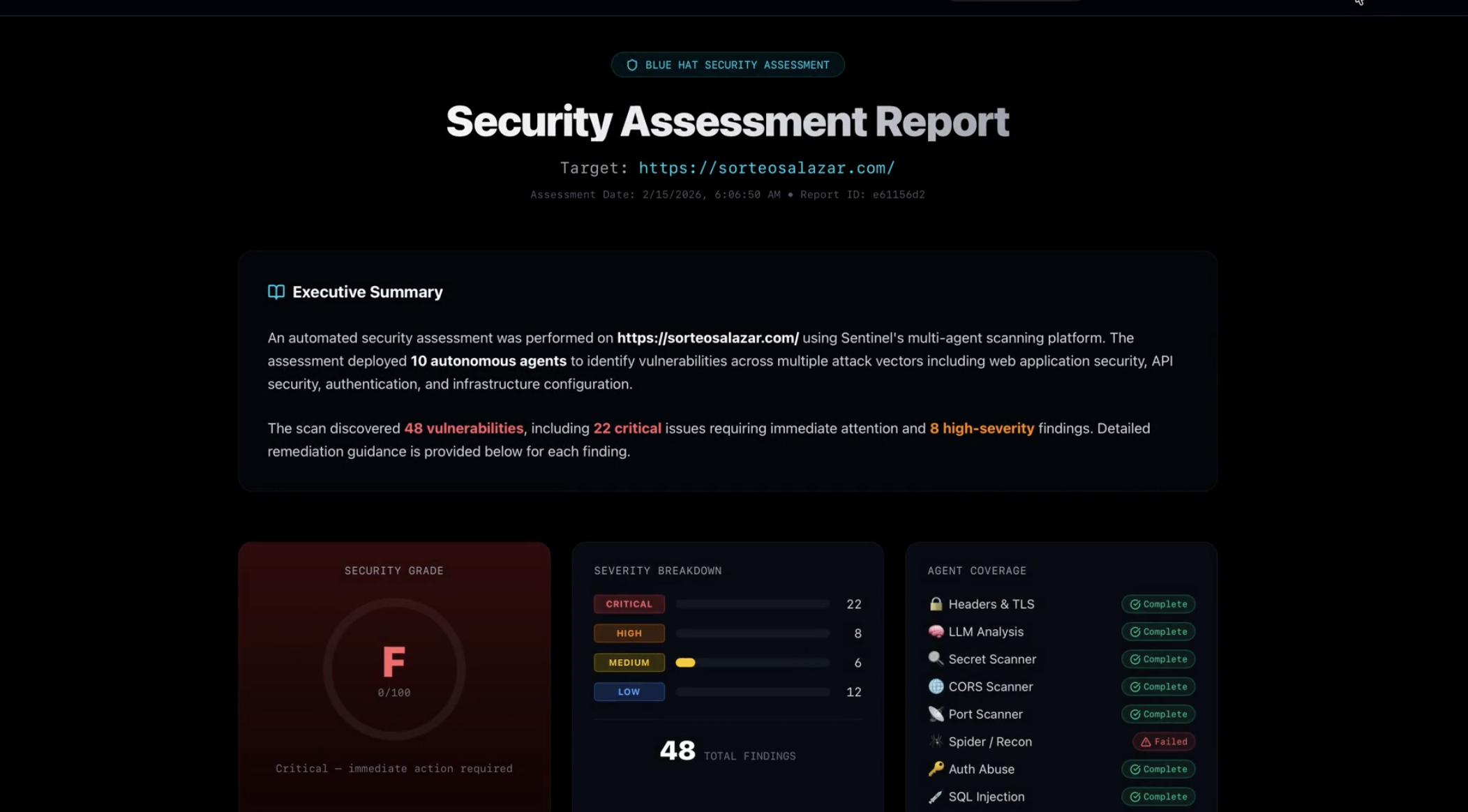
The agents run concurrently on the backend, report findings to a shared database in real-time, and the results are synthesized into a Gemini-powered remediation report — complete with risk grades, code-level fix instructions, and OWASP references.
How we built it
How We Built It
Tech Stack
- Frontend: Next.js + TypeScript with a dark cyber-security aesthetic (glassmorphism, neon accents)
- Backend: Python + Flask for the REST API
- Agents: Python
asynciowith Playwright for browser automation andaiohttpfor HTTP probing - AI: Google Gemini (
gemini-2.0-flash) for the Red Team agent's reasoning loop and report generation - Database: Supabase (PostgreSQL) with Realtime subscriptions for live agent event streaming
- Deployment: Render (single-process
multiprocessingsetup running both API + worker)
The Agent Framework
Every agent extends a BaseAgent abstract class that provides:
- Lifecycle management — automatic
QUEUED → RUNNING → COMPLETED/FAILEDstate transitions - Event emission — structured events streamed to the frontend via Supabase Realtime
- Finding reporting — severity-tagged vulnerabilities with reproduction steps
- Progress tracking — percentage-based progress updates for the UI
The Red Team agent is the most complex — it's an autonomous AI loop that:
- Launches a headless Chromium browser via Playwright
- Performs deep passive reconnaissance (cookie analysis, JS source scanning, API endpoint discovery)
- Enters an observe → think → act cycle powered by Gemini, deciding which tools to invoke (click, type, run JavaScript, make API requests, take screenshots)
- Reports findings with full reproduction steps
Worker Orchestration
The worker runs agents in three phases to balance thoroughness and rate limits:
- Phase 1 — Spider runs first to map the attack surface
- Phase 2 — Scanner agents (Exposure, Headers, CORS, Port Scan, SQLi, XSS, Auth Abuse) run concurrently via
asyncio.gather() - Phase 3 — LLM agents (Red Team, LLM Analysis) run sequentially to avoid API rate limit contention
Challenges we ran into
1. LLM Rate Limits vs. Agent Concurrency
Our first design ran all agents in parallel — including multiple LLM-powered ones. We immediately hit Gemini's requests-per-minute limits, causing agents to crash mid-scan. The fix was the phased orchestration model: fast scanner agents run concurrently, but LLM agents run one at a time.
2. Making the Red Team Agent Actually Useful
Early versions of the Red Team agent were essentially random clickers. Getting an LLM to systematically probe a website required careful prompt engineering: we had to teach it to prioritize (e.g., check for exposed .env files before fuzzing form inputs), stay on-domain (we added a domain guard to prevent it from navigating away), and avoid infinite loops (capping the observe-think-act cycle).
3. Keeping the UI in Sync
With 10+ agents running asynchronously and emitting events at different rates, keeping the frontend in sync was non-trivial. Supabase Realtime solved the transport problem, but we still had to design the event schema carefully — every event carries a run_id, agent_type, and structured data payload so the frontend can correctly route updates to the right agent lane.
4. False Positives
Automated scanners are notorious for false positives. Our initial XSS and SQLi agents would flag every reflected parameter as a vulnerability. We iterated on the detection heuristics, requiring agents to verify findings (e.g., confirming that injected JavaScript actually executes in the DOM) before reporting them — bringing the signal-to-noise ratio to an acceptable level.
5. Single-Process Deployment
Deploying on Render's free tier meant running both the Flask API and the async worker in a single process. We used Python's multiprocessing module to spawn the worker as a child process, with graceful shutdown handling. It's not elegant, but it works — and it means the entire backend runs from a single python main.py command.
Accomplishments that we're proud of
- We moved past the idea of a single "do-it-all" tool. Instead, we engineered a coordinated swarm of 10 specialized AI agents. From the Spider (mapping the terrain) to the Auth Abuse specialist, each agent has its own personality"and mission
- Our biggest win was the Red Team Agent. Using Gemini 2.0 Flash and Playwright, we built a loop where the AI doesn't just scan; it observes, thinks, and acts. It actually opens a browser, interacts with elements, and decides its next move based on what it sees; just like a human pen-tester would.
- We wanted users to feel the action. Using Supabase Realtime, we built a live event stream where users can watch live feed of agents thoughts and findings as they happen -We capped it off with an AI-driven Remediation Engine. Instead of a messy PDF of logs, you get a well structured and detailed report that grades your security from A to F and provides code-level fixes
What we learned
- Agent design is prompt engineering + systems engineering. The hardest part isn't calling the LLM API — it's designing the observation/action loop, managing state across async agents, and handling the dozen ways an agent can fail silently.
- Phased orchestration matters. Running everything in parallel sounds fast, but in practice, sequencing matters — reconnaissance before attack, fast checks before slow ones.
- Supabase Realtime is incredibly powerful for building live dashboards. Subscribing to database changes instead of polling transformed our UX.
- Security tools need to be skeptical of themselves. A scanner that reports 50 false positives is worse than useless — it trains users to ignore alerts. Verification > volume.
What's next for Sentinel
- Authentication & multi-tenancy — user accounts with scan history
- Scheduled recurring scans — continuous security monitoring
- Custom agent configuration — let users define which agents to run and with what parameters
- CI/CD integration — run Sentinel as a GitHub Action on every deploy
Built With
- fastapi
- gemini
- modal
- next.js
- python
- supabase
- typescript


Log in or sign up for Devpost to join the conversation.