Sentinel-X
Autonomous Multi-Agent Security Operations Platform
The Problem
Modern Security Operations Centers (SOCs) are overwhelmed by alert fatigue. Every day, analysts receive thousands of low-to-medium severity alerts — SSH brute-force attempts, suspicious login spikes, anomalous IP scans.
Even for small incidents, analysts must:
- Parse raw telemetry logs
- Query historical authentication data
- Validate threat intelligence
- Create firewall remediation rules
- Document incidents for compliance (SOC2, NIST, etc.)
This repetitive workflow increases Mean Time To Respond (MTTR) and distracts teams from high-severity investigations.
Sentinel-X is not designed to replace SOC teams. Instead, it reduces their workload by automatically detecting, enforcing, and documenting clearly defined, repetitive security threats.
We don't just detect threats — we enforce action and complete the compliance loop.
The Solution: A Multi-Agent System (MAS)
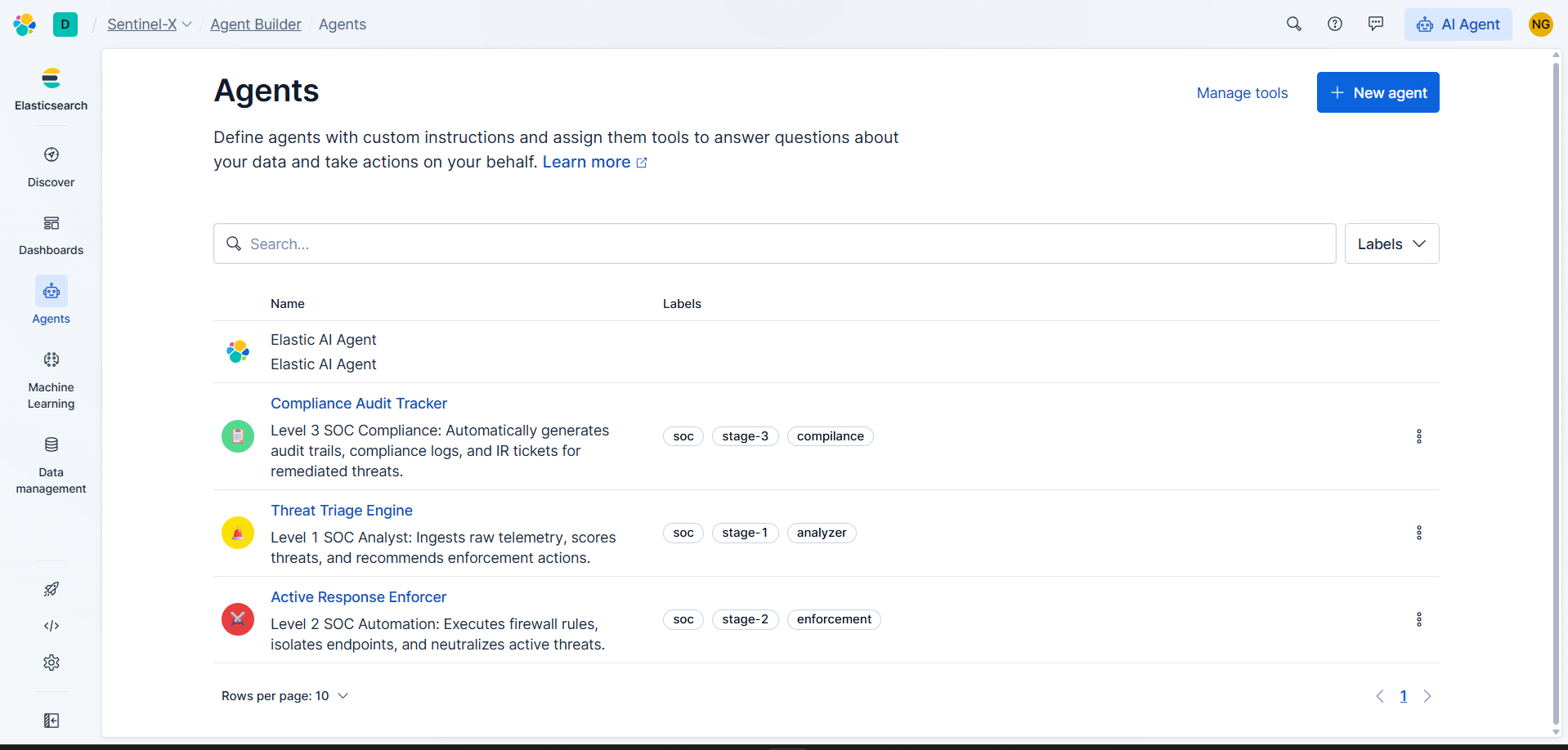
Sentinel-X is a sequential, state-driven Multi-Agent System built using Elastic Agent Builder and Elasticsearch.
Instead of one general AI model, we use three specialized agents. Each agent has a narrow, deterministic responsibility and specific Elastic tools. Agents pass structured JSON state to the next stage to ensure reliable multi-step execution.
🕵️ S-X.01 — Threat Triage Engine
Role: The Data Hunter
This agent ingests raw logs and performs contextual threat analysis using live Elasticsearch data.
Tools Used:
| Tool | Description |
|---|---|
platform.core.search |
Searches historical logs for known malicious IPs and anomaly patterns |
platform.core.generate_esql |
Dynamically generates ES\ |
platform.core.execute_esql |
Executes ES\ |
platform.core.index_explorer |
Identifies relevant data streams such as logs-network-* or logs-auth-* |
Functionality:
S-X.01 extracts Indicators of Compromise (IoCs), maps behavior to MITRE ATT&CK techniques (e.g., T1110), calculates a confidence score, and produces a structured decision: BLOCK or MONITOR.
All decisions are validated against real Elasticsearch cluster data — not prompt-based assumptions.
⚡ S-X.02 — Active Enforcer
Role: The Muscle
This agent transforms threat decisions into enforceable remediation actions.
Tools Used:
| Tool | Description |
|---|---|
platform.core.integration_knowledge |
Accesses Fleet integration docs for firewalls (Palo Alto, Fortinet, Cisco) to generate accurate JSON payloads |
platform.core.get_workflow_execution_status |
Simulates checking SOAR playbook execution status before proceeding |
Functionality:
When S-X.01 issues a BLOCK directive, S-X.02 generates a Zero-Trust deny policy and produces a validated firewall API execution log.
This enables automatic enforcement of repetitive, low-severity threats — eliminating the need for analysts to manually craft firewall rules.
📋 S-X.03 — Compliance & Audit Clerk
Role: The Auditor
Security enforcement is incomplete without compliance documentation.
Tools Used:
| Tool | Description |
|---|---|
platform.core.cases |
Interfaces with Elastic's native incident management system |
platform.core.get_document_by_id |
Retrieves the exact malicious Elasticsearch document for secure audit attachment |
Functionality:
S-X.03 maps the incident and remediation to SOC2 and NIST CSF controls, generates a structured JSON audit ledger, and indexes it back into Elasticsearch.
This ensures every enforcement action is automatically documented and audit-ready.
⚙️ Technical Execution
Sentinel-X is built on Elastic Cloud and connects securely to a Kibana endpoint using API key authentication.
The orchestration layer:
- Accepts raw telemetry input
- Executes agents sequentially
- Passes structured JSON state between agents
- Uses Elastic tool calls with defined timeouts
- Indexes final compliance records back into Elasticsearch
This architecture ensures deterministic multi-step automation, minimizes hallucination, and demonstrates real tool-driven execution — not simple prompt chaining.
🚀 Potential Impact
Security teams spend significant time handling repetitive, low-to-medium severity incidents such as brute-force attempts and suspicious login spikes. Even minor events can take 15–30 minutes to investigate, enforce, and document properly.
Sentinel-X reduces this workflow to under 30 seconds for clearly defined threat patterns by automating detection, enforcement, and compliance logging in a single pipeline.
By automatically enforcing repetitive threats and generating audit-ready records, Sentinel-X:
- Reduces alert fatigue:
- Lowers Mean Time To Respond (MTTR)
- Improves consistency in remediation actions
- Minimizes manual compliance documentation effort
This allows SOC analysts to focus on complex, high-severity investigations instead of repetitive operational tasks.
Sentinel-X demonstrates how Elastic Agent Builder can power reliable, multi-step AI agents that perform real operational work — not just analysis, but enforcement and documentation.
💡 What We Liked & Challenges Faced
One of the most powerful aspects of Elastic Agent Builder was assigning clearly scoped tools to each agent. Using generate_esql and execute_esql, our agents reason over real Elasticsearch data instead of static prompts. The integration_knowledge tool enabled the Active Enforcer to generate accurate, documentation-grounded firewall payloads.
A key challenge was building reliable multi-step orchestration. Passing structured JSON state between agents was critical to prevent hallucination and ensure deterministic execution. We also carefully managed tool timeouts and formatting to maintain stable, end-to-end workflow behavior while keeping enforcement realistic and responsible.
Built With
- agent-builder
- elastic
- elastic-cluster
- elasticsearch
- mas
- multi-agent-system


Log in or sign up for Devpost to join the conversation.