⚝ SENTINEL - Spectral Network Forensics Dashboard ⚝
Inspiration
The inspiration for SENTINEL came from a simple question: What if cybersecurity could be both powerful and beautiful?
Traditional network forensics tools are often intimidating, cluttered with technical jargon, and visually uninspiring. We wanted to create something different - a tool that transforms the abstract concept of network threats into something tangible, visual, and even artistic.
Drawing inspiration from Arkham Horror and H.P. Lovecraft's cosmic horror, we reimagined network packets as spectral entities - ghosts that drift through a haunted digital realm. Each packet becomes a character in a gothic narrative: benign traffic manifests as peaceful Spirits, suspicious patterns appear as erratic Wraiths, and malicious attacks take form as aggressive Revenants.
The goal was to make cybersecurity analysis not just functional, but immersive - where understanding network threats feels like consulting an ancient oracle rather than reading spreadsheets.
What it does
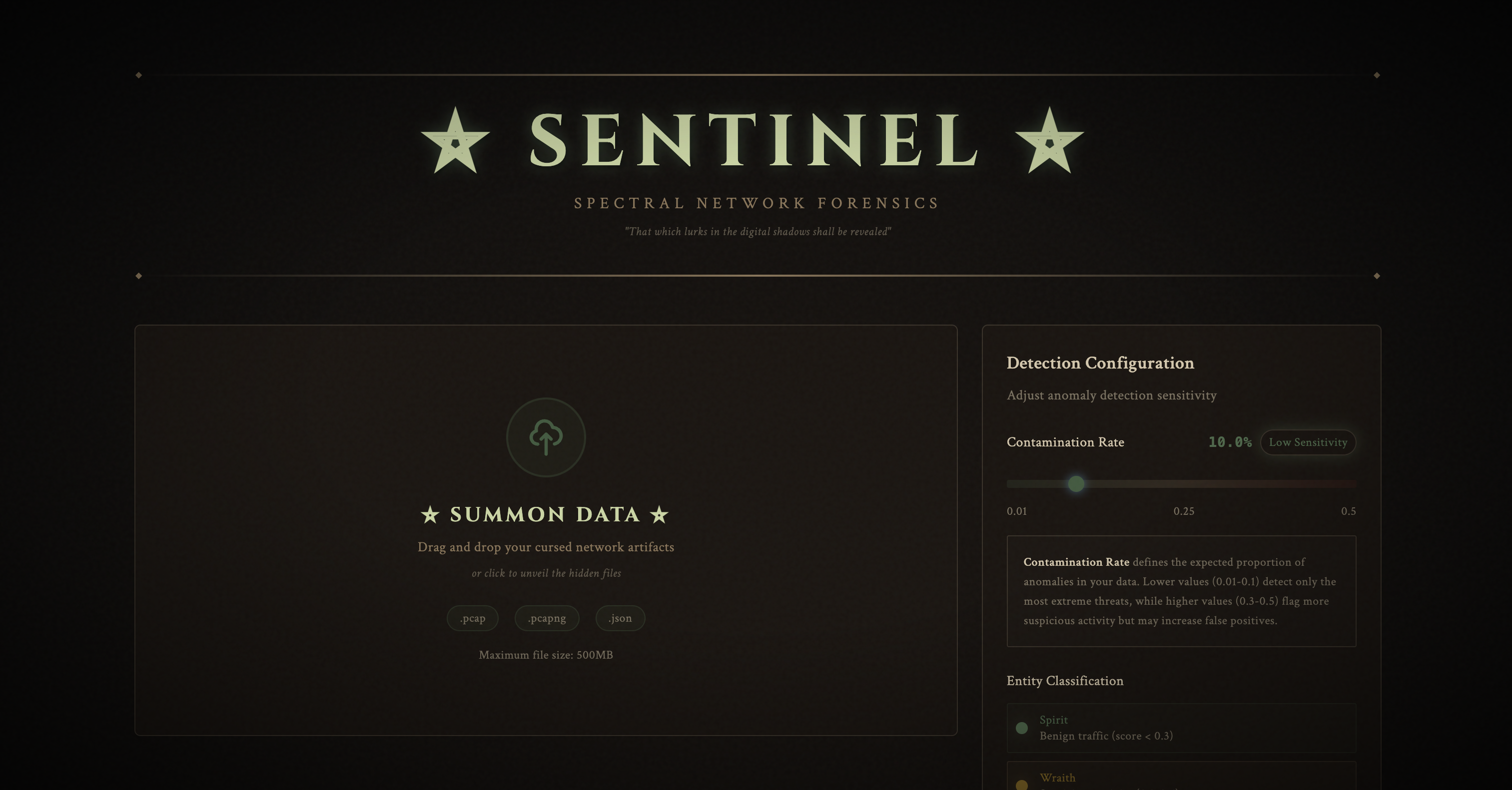
SENTINEL is a haunted cybersecurity forensics dashboard that analyzes network traffic and visualizes threats as spectral entities.
Core Features:
🔍 Intelligent Threat Detection
- Uploads PCAP files or JSON network logs (up to 500MB)
- Uses Isolation Forest machine learning to detect anomalies
- Classifies network events into three entity types:
- Spirits (Benign) - Normal traffic, ghostly green
- Wraiths (Suspicious) - Unusual patterns, sickly yellow
- Revenants (Malicious) - Confirmed threats, blood red
👻 Dual Visualization Modes
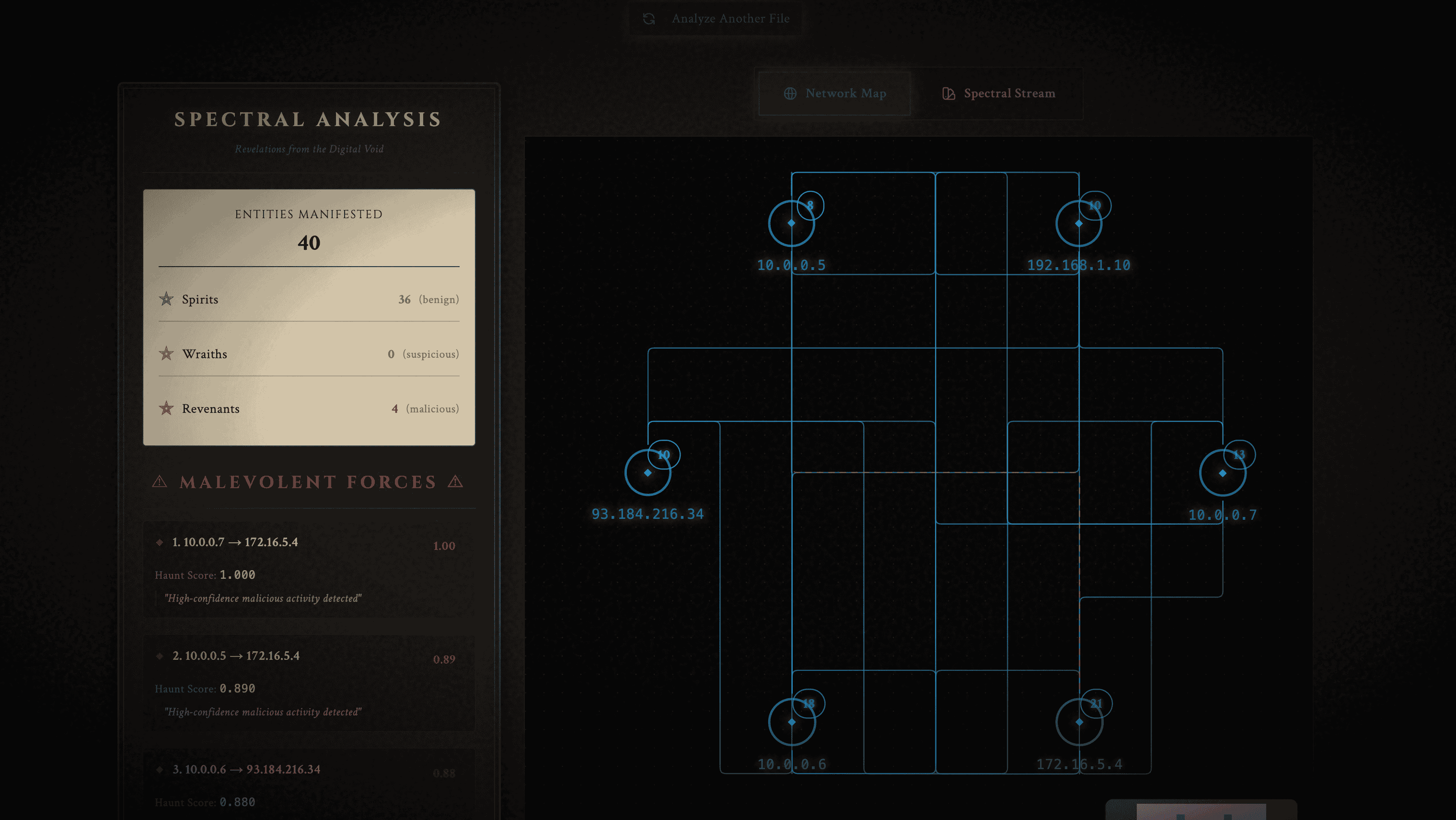
- Network Map: Graph-based visualization showing IP relationships
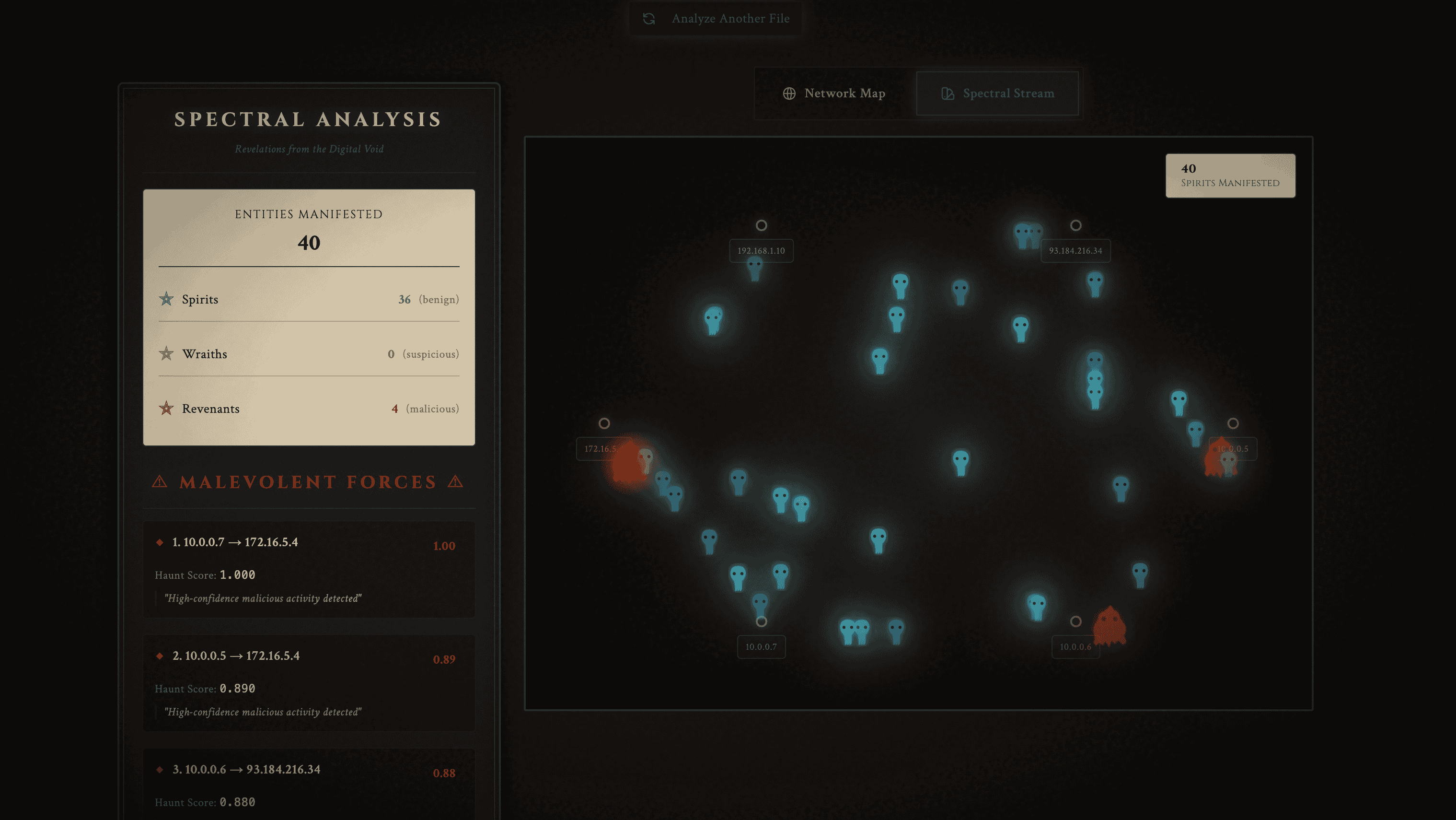
- Spectral Stream: Animated SVG ghosts traveling from source to destination IPs
- Each ghost has unique shapes and behaviors based on threat level
- Smooth floating for benign traffic
- Erratic wobbling for suspicious patterns
- Aggressive shaking for malicious attacks
🔮 AI-Powered Insights
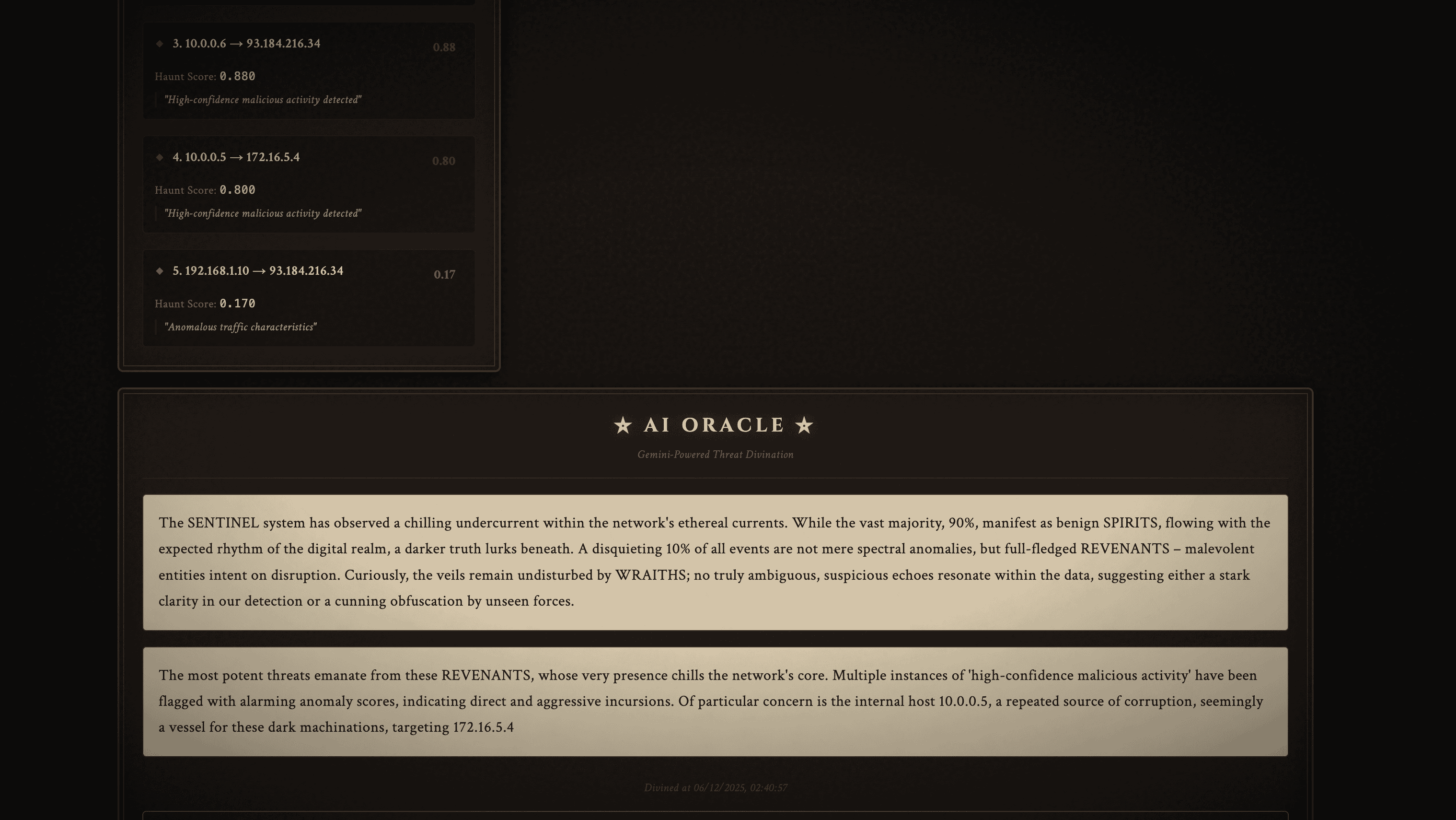
- Gemini AI integration generates gothic-themed threat analysis
- Provides contextual security recommendations
- Identifies attack patterns and vectors
- Written in atmospheric, occult-inspired language
🎨 Arkham Horror Aesthetic
- Vintage occult typography (Cinzel + Crimson Text)
- Aged parchment textures and tarnished brass accents
- Film grain overlay and vignette effects
- Gothic color palette: deep blacks, aged browns, spectral greens
How we built it
Architecture
Frontend (React + TypeScript)
- React 18 with TypeScript for type safety
- Custom SVG ghost rendering system
- React Flow for network graph visualization
- Context API for state management
- Tailwind CSS for styling with custom horror theme
Backend (FastAPI + Python)
- FastAPI for high-performance REST API
- Scapy for PCAP file parsing
- scikit-learn's Isolation Forest for anomaly detection
- Custom feature extraction from network packets
- Google Gemini AI for threat analysis
Machine Learning Pipeline
PCAP/JSON → Parser → Feature Extractor → Isolation Forest →
Threat Analyzer → Entity Classification → Spectral Profiles
Key Technical Achievements
1. Ghost Visualization System
- Hand-crafted SVG paths for three distinct ghost shapes
- Physics-based motion using easing functions
- Path interpolation from source to destination IPs
- Entity-specific behaviors (smooth, erratic, aggressive)
- Perlin noise for realistic erratic movement
2. Real-time Anomaly Detection
- Extracts 5+ features from network traffic
- Unsupervised learning (no training data needed)
- Configurable contamination rate (expected anomaly %)
- Anomaly scores mapped to threat tiers
3. AI Integration
- Structured prompts for consistent gothic-themed output
- Context-aware analysis based on threat summary
- Actionable security recommendations
- Error handling and retry logic
4. Horror Theme Implementation
- Custom CSS variables for consistent theming
- Google Fonts integration (Cinzel, Crimson Text)
- SVG noise filters for film grain effect
- Radial gradients for atmospheric vignette
- Parchment texture using fractal noise
Tech Stack
Frontend:
├── React 18
├── TypeScript
├── Vite
├── Tailwind CSS
├── React Flow
└── Custom SVG Rendering

Backend:
├── FastAPI
├── Python 3.10+
├── Scapy (packet parsing)
├── scikit-learn (ML)
├── Google Gemini AI
└── python-dotenv

Deployment:
├── Vercel (Frontend)
└── Render (Backend)
Challenges we ran into
1. Ghost Path Animation
Challenge: Making ghosts travel meaningfully from source to destination IPs instead of random floating.
Solution:
- Arranged all unique IPs in a circle around the screen
- Calculated paths using easing functions for smooth acceleration/deceleration
- Added entity-specific wobble perpendicular to the path
- Implemented screen wrapping and loop-back behavior
2. React Hooks Violations
Challenge: Conditional hook calls causing "Rendered more hooks than during the previous render" errors.
Solution:
- Moved all hooks to the top of components before any conditional returns
- Used
useMemofor expensive calculations - Ensured hooks always execute in the same order
3. Gemini API Integration
Challenge: Initial 404 errors due to incorrect API endpoint and model names.
Solution:
- Tested available models using the API's model listing endpoint
- Updated to use
gemini-2.5-flashinstead of deprecatedgemini-pro - Implemented robust error handling and response parsing
- Added debug logging for API responses
4. Performance with Large Datasets
Challenge: Rendering 1000+ animated ghosts caused frame rate drops.
Solution:
- Used CSS transforms for GPU acceleration
- Implemented
will-changehints for browser optimization - Batched state updates in React
- Optimized SVG rendering with reusable definitions
5. CORS Configuration
Challenge: Frontend couldn't communicate with deployed backend.
Solution:
- Configured specific allowed origins instead of wildcard
- Added environment variables for API URLs
- Updated both local and production configurations
- Tested cross-origin requests thoroughly
6. Horror Aesthetic Balance
Challenge: Making the UI spooky without sacrificing usability.
Solution:
- Maintained WCAG AAA contrast ratios (12:1 for parchment text)
- Used readable serif fonts (Crimson Text)
- Kept animations subtle (no flashing or strobing)
- Provided clear visual hierarchy
Accomplishments that we're proud of
🎨 Unique Visual Identity
Created a truly distinctive cybersecurity tool that looks like nothing else in the space. The Arkham Horror aesthetic isn't just decoration - it makes threat analysis more intuitive and engaging.
👻 Ghost Visualization Innovation
Built a custom SVG animation system where each ghost:
- Has a unique shape based on entity type
- Travels along meaningful paths (source → destination)
- Exhibits behavior that reflects threat level
- Creates an intuitive visual language for network traffic
🤖 AI Integration Done Right
Successfully integrated Gemini AI to generate contextual, gothic-themed security insights that are both atmospheric AND actionable. The AI understands the horror theme while providing real security value.
📊 End-to-End ML Pipeline
Implemented a complete machine learning pipeline from raw packets to classified threats:
- Parses PCAP and JSON formats
- Extracts relevant features
- Detects anomalies without training data
- Generates spectral profiles
- Provides threat summaries
🎭 Attention to Detail
- Hand-crafted three distinct ghost SVG shapes
- Custom gothic typography with wide letter-spacing
- Aged parchment textures using fractal noise
- Film grain animation with 8-second loop
- Ornate dividers with occult symbols
- Typewriter effect for dramatic reveals
🚀 Full Deployment
Successfully deployed both frontend and backend:
- Frontend on Vercel: https://sentinel-ai.vercel.app/
- Backend on Render: https://sentinal-asvj.onrender.com
- Configured CORS and environment variables
- Working end-to-end in production
What we learned
Technical Learnings
1. SVG Animation at Scale
- Learned to optimize SVG rendering for hundreds of elements
- Discovered the power of CSS transforms for GPU acceleration
- Understood the importance of
will-changehints
2. Machine Learning in Production
- Isolation Forest is perfect for unsupervised anomaly detection
- Feature engineering is crucial for network traffic analysis
- Contamination rate significantly impacts classification
3. AI Prompt Engineering
- Structured prompts produce more consistent results
- Context matters - providing threat data improves relevance
- Balancing creativity (gothic theme) with accuracy (security advice)
4. React Performance Optimization
- Hook order matters - always call hooks unconditionally
useMemoanduseCallbackprevent unnecessary re-renders- Batching state updates improves animation smoothness
5. Deployment Challenges
- Environment variables need different handling in dev vs. prod
- CORS must be configured explicitly for security
- API endpoints need to be environment-aware
Design Learnings
1. Theme Consistency
- CSS custom properties make theming manageable
- Typography choices dramatically impact atmosphere
- Color psychology: green = safe, yellow = caution, red = danger
2. Accessibility in Dark Themes
- High contrast is possible with dark backgrounds
- Serif fonts can be readable with proper sizing
- Animations should be subtle, not distracting
3. User Experience
- Visual metaphors (ghosts) make abstract concepts concrete
- Progressive disclosure: show summary first, details on demand
- Loading states should match the theme (crystal ball, not spinner)
Project Management
1. Iterative Development
- Started with basic functionality, added polish incrementally
- User feedback (even from ourselves) drove improvements
- Refactoring is necessary - first version is rarely best
2. Documentation Matters
- Good README helps others understand the project
- Code comments explain "why", not just "what"
- Architecture diagrams clarify system design
What's next for Sentinel
Short-term Enhancements
🎵 Sound Design
- Ambient horror soundscape
- Whispers for suspicious activity
- Chains rattling for malicious threats
- Spatial audio based on ghost positions
📊 Enhanced Analytics
- Historical trend analysis
- Multi-file comparison
- Export reports as PDF with gothic styling
- Custom anomaly thresholds per IP
🎨 Visual Improvements
- More ghost variants (10+ unique shapes)
- Particle effects (spectral dust, ectoplasm)
- 3D visualization mode using Three.js
- Custom cursors (gothic pointer designs)
Medium-term Features
🔴 Real-time Monitoring
- Live packet capture integration
- Streaming analysis (not just file upload)
- Real-time ghost spawning
- Alert system for critical threats
🧠 Advanced ML
- Custom model training on user data
- Supervised learning for known threats
- Behavioral analysis over time
- Threat prediction (not just detection)
👥 Collaboration Features
- Multi-user workspaces
- Shared threat investigations
- Comments and annotations
- Team dashboards
Long-term Vision
🌐 Enterprise Platform
- Multi-tenant architecture
- Role-based access control
- Integration with SIEM systems
- Compliance reporting (SOC 2, ISO 27001)
🎓 Educational Tool
- Interactive tutorials
- Capture-the-flag challenges
- Threat scenario simulations
- Cybersecurity training platform
🔬 Research Applications
- Dataset generation for ML research
- Visualization techniques for academic papers
- Open-source threat intelligence
- Community-driven threat signatures
🎮 Gamification
- "Exorcise" threats by clicking ghosts
- Achievement system for threat hunters
- Leaderboards for fastest threat detection
- Narrative-driven investigation mode
Impact & Vision
SENTINEL represents a new approach to cybersecurity tools - one that prioritizes user experience alongside technical capability. By making threat analysis visually engaging and thematically cohesive, we hope to:
- Lower the barrier to entry for cybersecurity professionals
- Make threat hunting more intuitive through visual metaphors
- Demonstrate that security tools can be beautiful without sacrificing functionality
- Inspire others to rethink how we visualize complex data
The future of cybersecurity doesn't have to be boring spreadsheets and terminal windows. It can be immersive, artistic, and effective all at once.
"In darkness, we find the truth" ⚝
SENTINEL - Where network forensics meets gothic horror
Live Demo: https://sentinel-ai.vercel.app/
GitHub: [Your Repository URL]
Est. MMXXIV
Built With
- context-api
- cors
- cors-(security)
- css-custom-properties
- css3
- easing-functions
- environment-variables
- error-handling
- eslint
- fastapi
- gemini-api
- git
- github
- google-fonts
- google-gemini-ai
- html5
- isolation-forest
- javascript
- mermaid
- npm
- numpy
- perlin-noise
- pip
- pydantic
- python
- python-dotenv
- react
- react-flow
- render
- rest-api
- scapy
- scikit-learn
- svg
- svg-animation
- tailwind
- typescript
- typescript-compiler
- uvicorn
- validation
- venv
- vercel
- vite

Log in or sign up for Devpost to join the conversation.