-
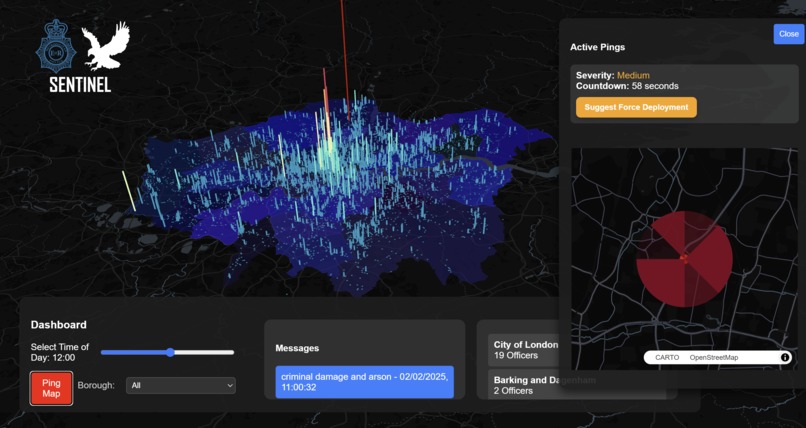
Dashboard view
-
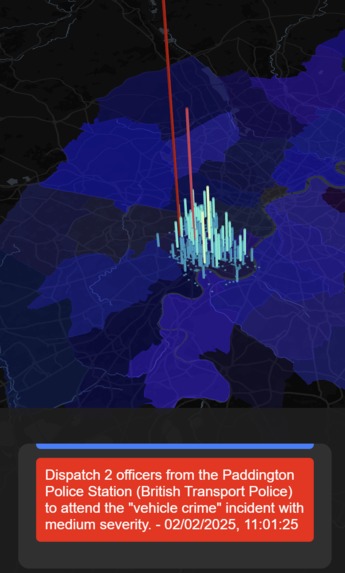
Dispatch suggestions
-
-
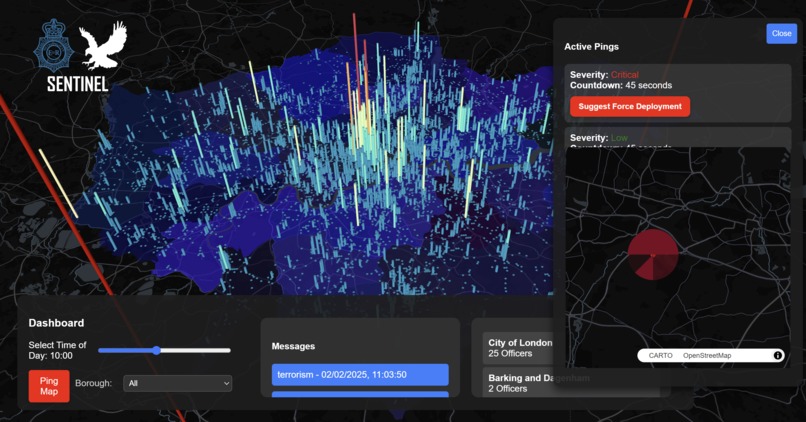
multiple alerts coming from all over london


Inspiration
The Metropolitan Police face challenges in responding to crime efficiently due to fragmented data and reactive deployment strategies. We were inspired by the potential of real-time data visualization and AI-driven analytics to bridge this gap and improve police response times. By leveraging predictive analytics and geospatial mapping, we aim to empower law enforcement with a proactive approach to crime prevention.
What it does
Sentinel is a crime visualization and officer deployment tool that:
Analyzes real-time and historical crime data to identify hotspots.
Provides an interactive heatmap to visualize crime trends.
Uses AI-driven insights to suggest optimal police deployments.
Helps allocate limited resources efficiently to high-risk areas.
Enhances coordination among teams for faster response times.
How we built it
Data Processing: We aggregated historical crime data and real-time reports.
Machine Learning: Implemented predictive models for crime trend forecasting.
Geospatial Visualization: Built an interactive map using crime density estimation techniques.
Deployment Optimization: Integrated AI algorithms to recommend officer placements.
User Interface: Developed a clean, intuitive dashboard for police departments.
Challenges we ran into
Data Quality: Handling inconsistencies and missing data from crime reports.
Real-Time Processing: Ensuring live data updates without lag.
Optimization Complexity: Balancing predictive accuracy with real-world constraints on police movement and resource limitations.
Accomplishments that we're proud of
Successfully developed a working prototype that visualizes crime hotspots dynamically.
Built an AI-driven model that enhances resource allocation for law enforcement.
Created an intuitive and user-friendly interface that simplifies decision-making for officers.
What we learned
The importance of data-driven decision-making in law enforcement.
How to optimize geospatial data for meaningful visual insights.
Challenges and considerations in building AI models for critical applications.
How to design user-friendly tools for professionals in high-pressure environments.
What's next for Sentinel
Real-Time Integration: Connect with live police data feeds for instant crime updates.
Advanced Predictive Models: Improve AI-driven crime forecasting for better accuracy.
Mobile Support: Develop a mobile-friendly version for officers on the go.
Ethical Oversight: Work with policymakers to ensure fairness and transparency in predictive policing.
Scaling Nationwide: Expand Sentinel to be used across different law enforcement agencies for broader impact.
Built With
- deck.gl
- flask
- javascript
- openai
- python
- react
- scikit-learn


Log in or sign up for Devpost to join the conversation.