-
-
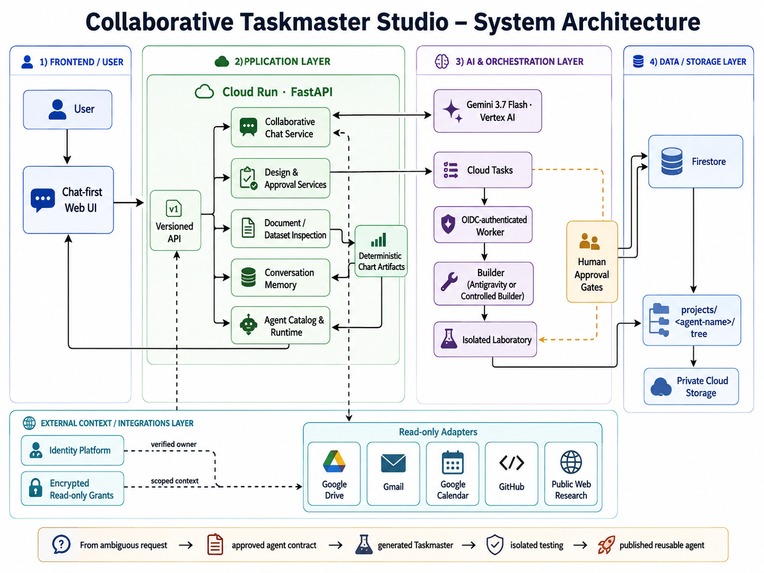
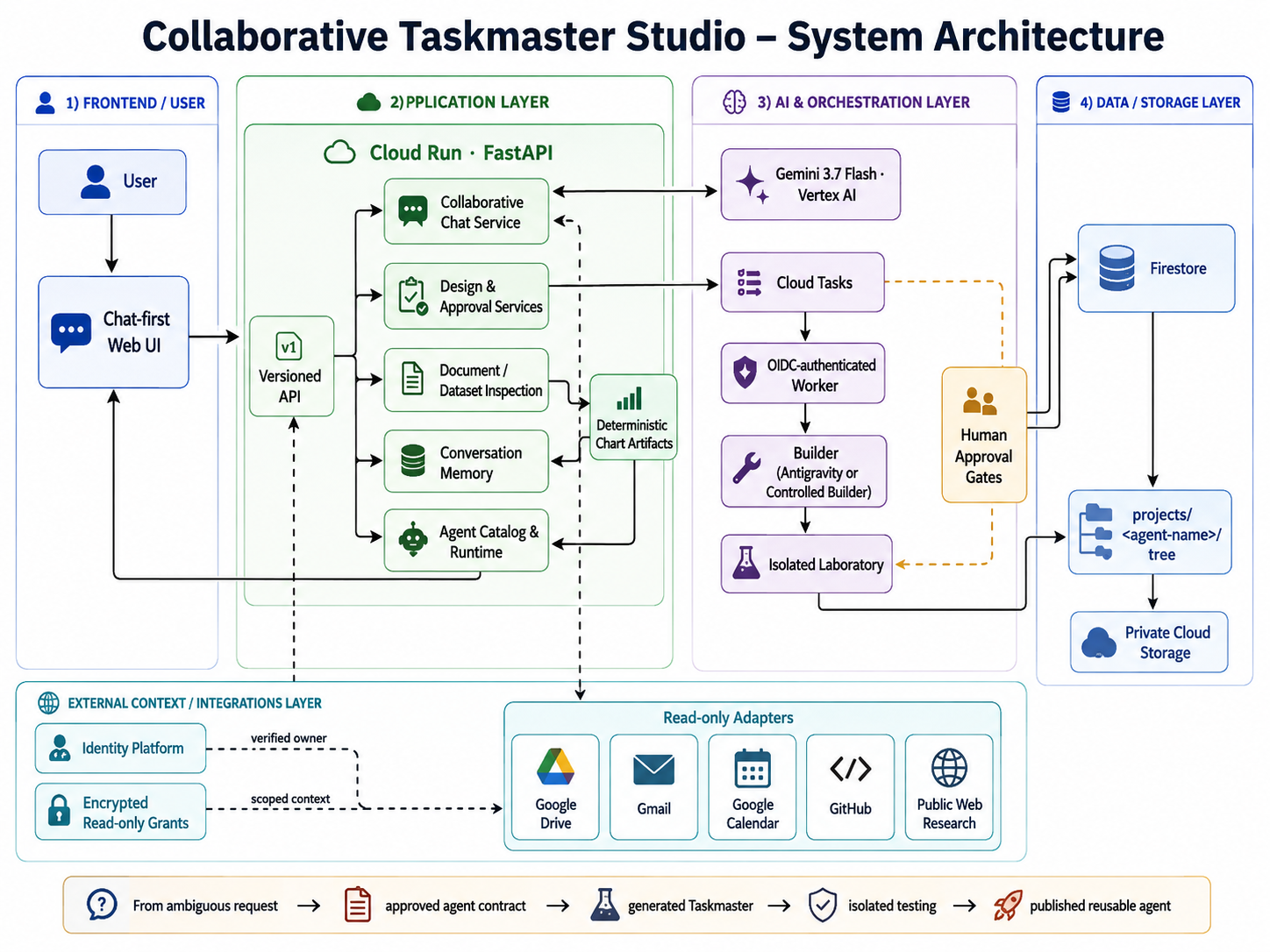
1. Arquitectura general del sistema
-
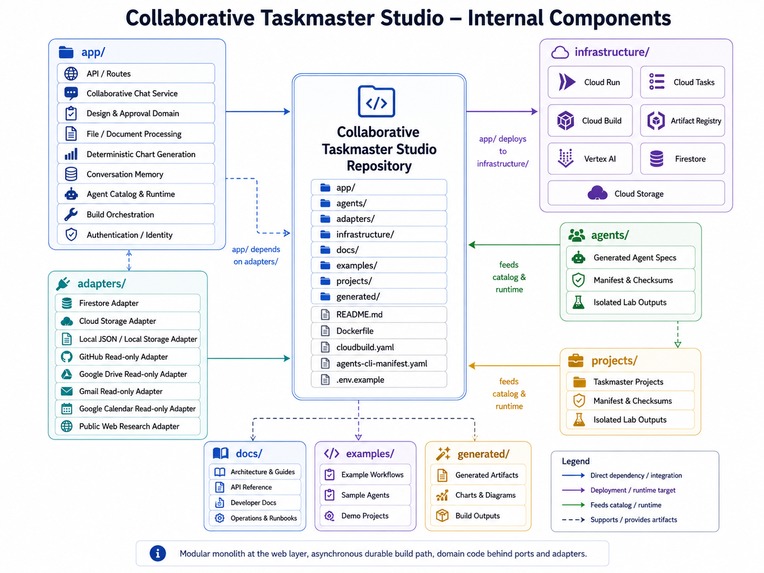
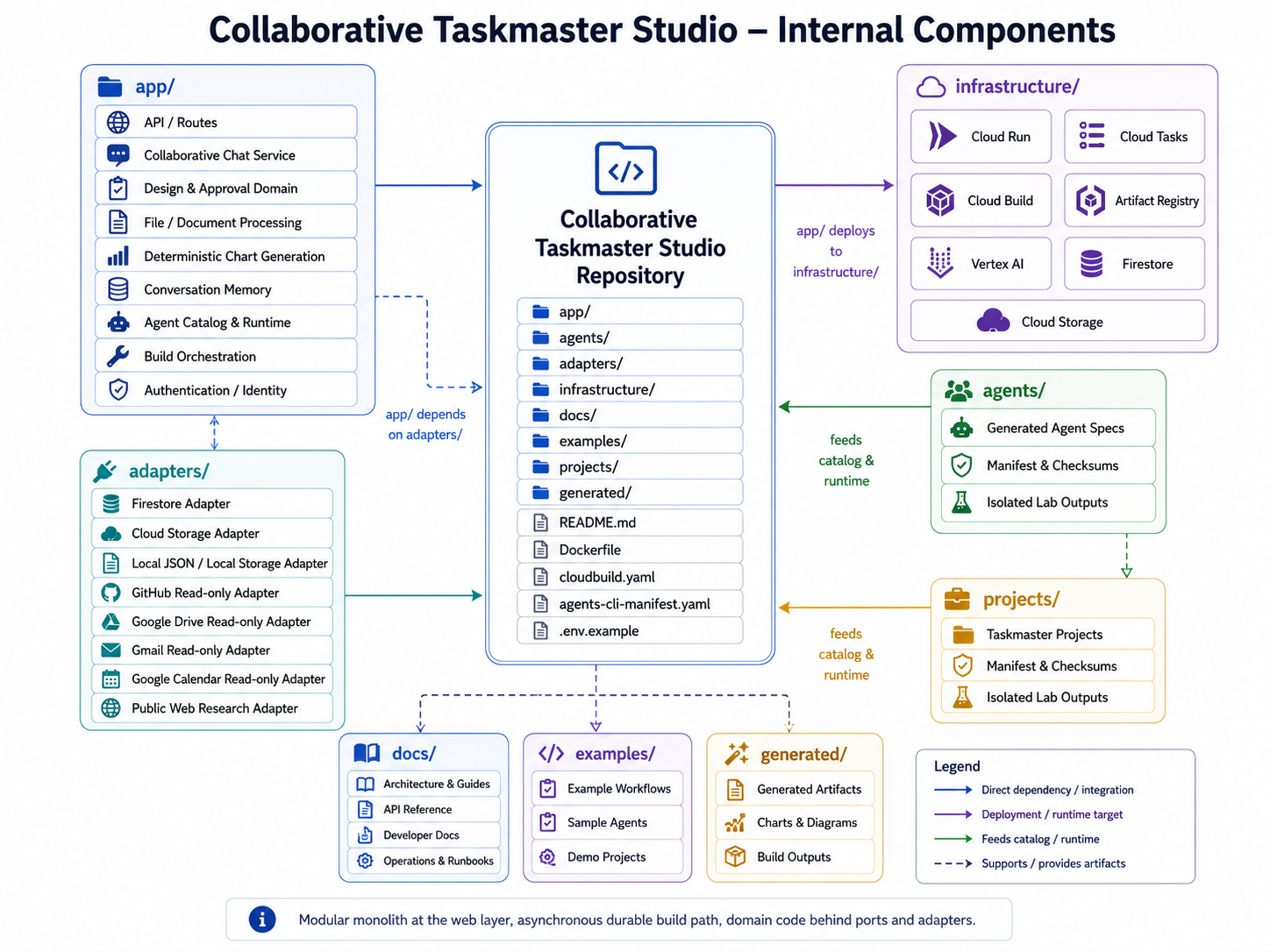
3. Componentes internos del repositorio
-
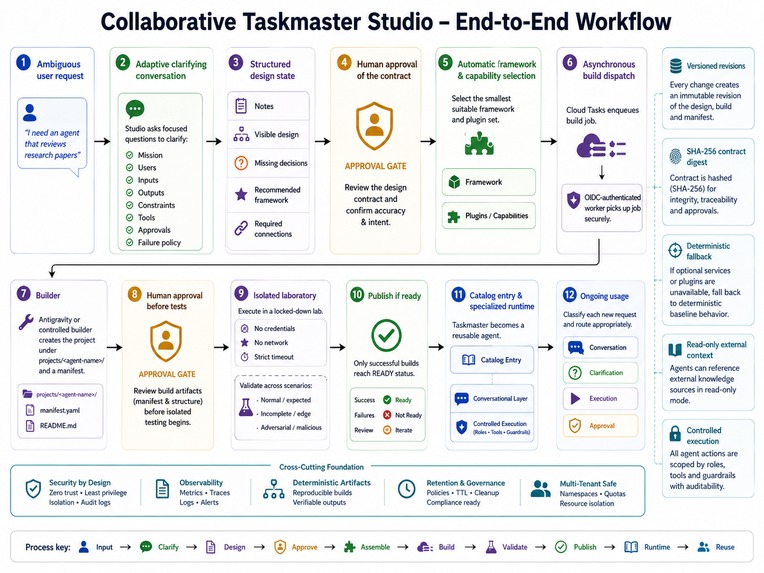
2. Flujo de funcionamiento de extremo a extremo
-
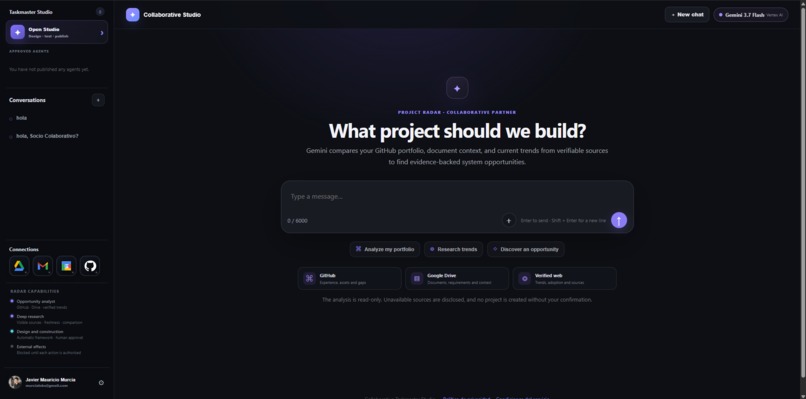
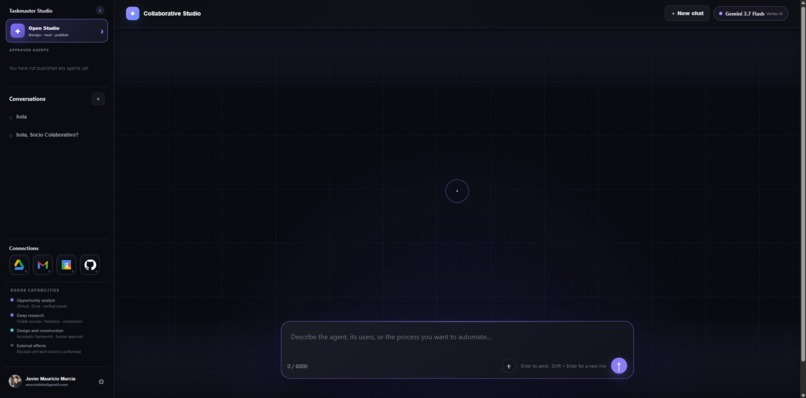
collaborative-taskmaster-studio-home
-
collaborative-taskmaster-studio-open-studio
-
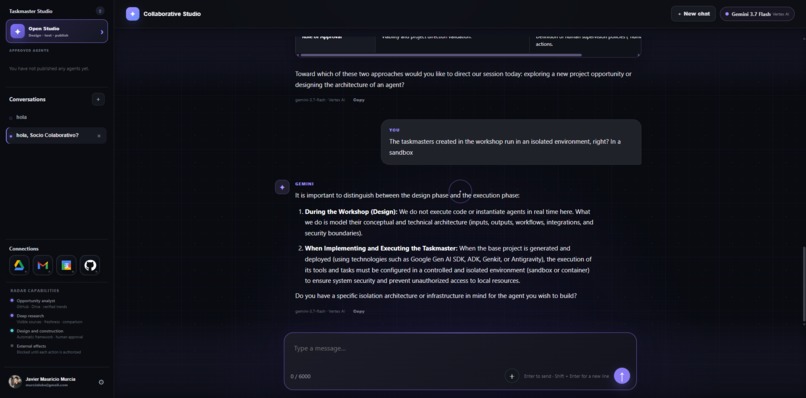
collaborative-taskmaster-studio-agent
Inspiration
Most agent-building platforms begin after the hardest decisions have already been made. They assume the user already knows the agent's exact objective, inputs, outputs, tools, permissions, workflow, failure policy, and framework.
Real requests rarely arrive that clearly. They usually begin with something like:
“I need an agent that reviews research papers.”
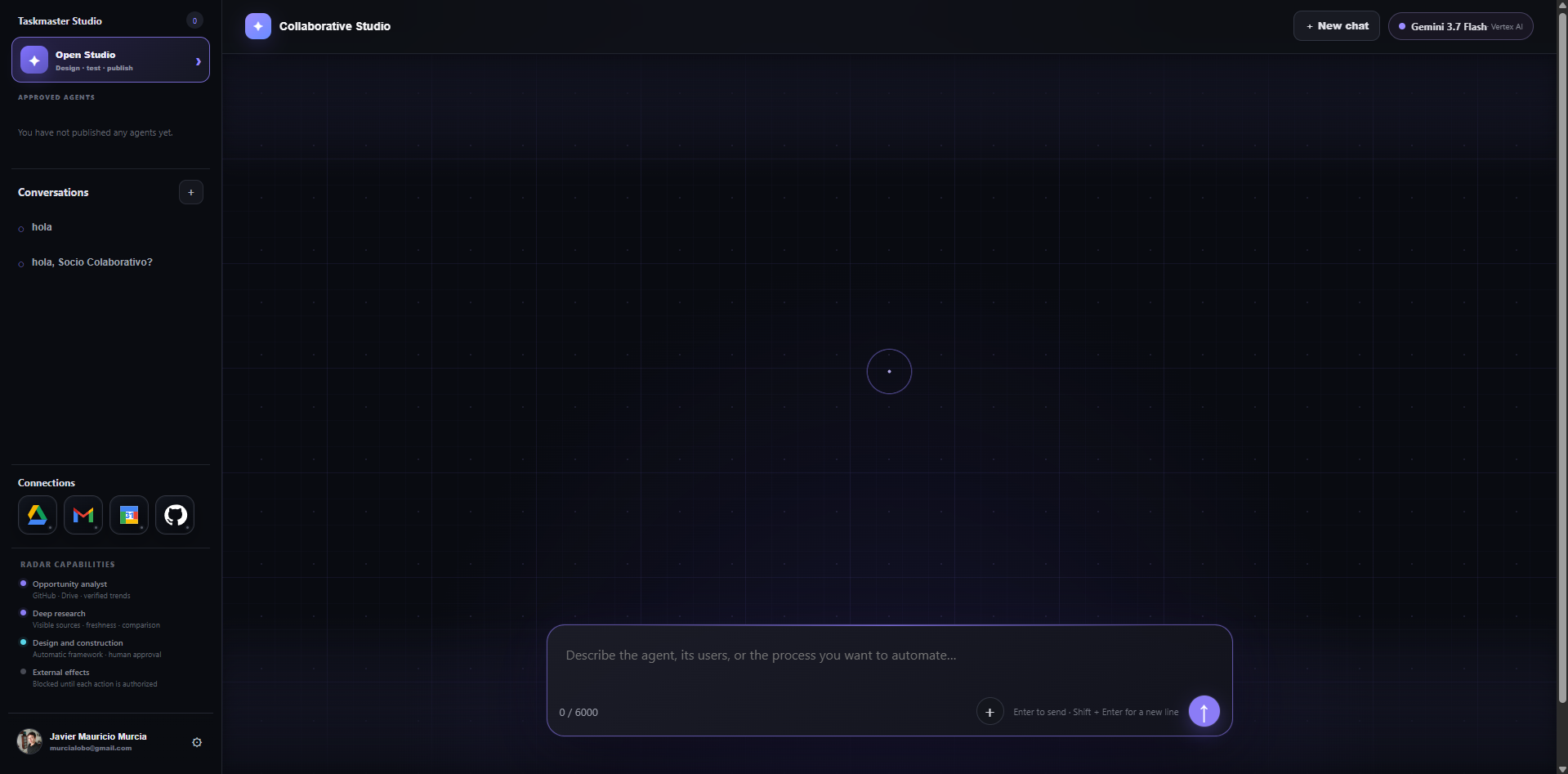
Collaborative Taskmaster Studio was created to bridge the gap between that ambiguous idea and a safe, working, reusable AI agent. Instead of immediately generating code or returning a generic checklist, it collaborates with the user, identifies missing decisions, proposes an architecture, and keeps humans in control of every consequential stage.
What it does
Collaborative Taskmaster Studio combines two complementary roles:
- A collaborative AI partner that helps the user discover, clarify, and structure what should be built.
- A Taskmaster factory that converts the approved design into a tested and reusable specialized agent.
The Studio guides the user through an adaptive conversation covering:
- mission and intended users;
- required inputs and outputs;
- workflow and tools;
- external connections;
- constraints and failure policies;
- human approval requirements.
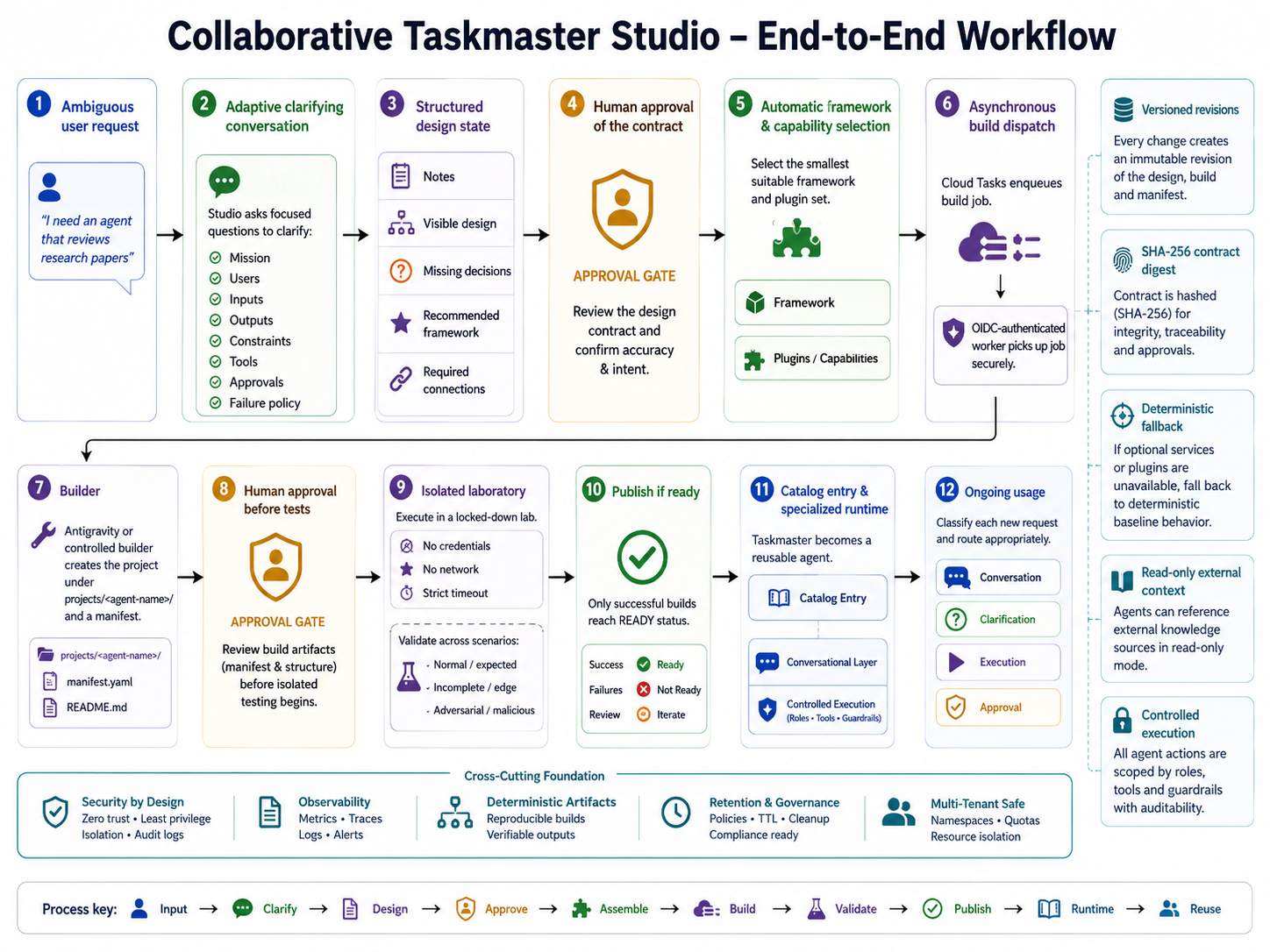
Gemini transforms that conversation into a visible, versioned design contract. The user can review missing decisions, inspect the recommended framework, request revisions, and explicitly approve the final design.
After approval, the Studio:
- freezes the contract with a SHA-256 digest;
- selects the smallest suitable framework and capability set;
- dispatches construction asynchronously;
- creates a real project under
projects/<agent-name>/; - asks for a second human approval before testing;
- runs expected, incomplete-input, and adversarial scenarios in an isolated laboratory;
- publishes only successful builds to the agent catalog.
Every published Taskmaster receives both a specialized execution workflow and a conversational layer. It can explain what it does, what it cannot do, what information it needs, and which operations require approval before attempting execution.
Document, dataset, and visualization capabilities
The conversational experience supports multiple PDF, DOCX, XLSX, CSV, PPTX, text, structured-data, and image files.
Users can:
- monitor upload progress;
- inspect attached files;
- remove or reuse session files;
- analyze multiple spreadsheets and datasets;
- generate comparison tables and executive summaries;
- render colorful, deterministic charts directly inside the conversation.
Instead of returning Python or JavaScript plotting code, the backend produces validated chart artifacts that the browser renders with Google Charts. Large CSV and XLSX inputs use chunked uploads and bounded extraction so complete files are not copied blindly into a model prompt.
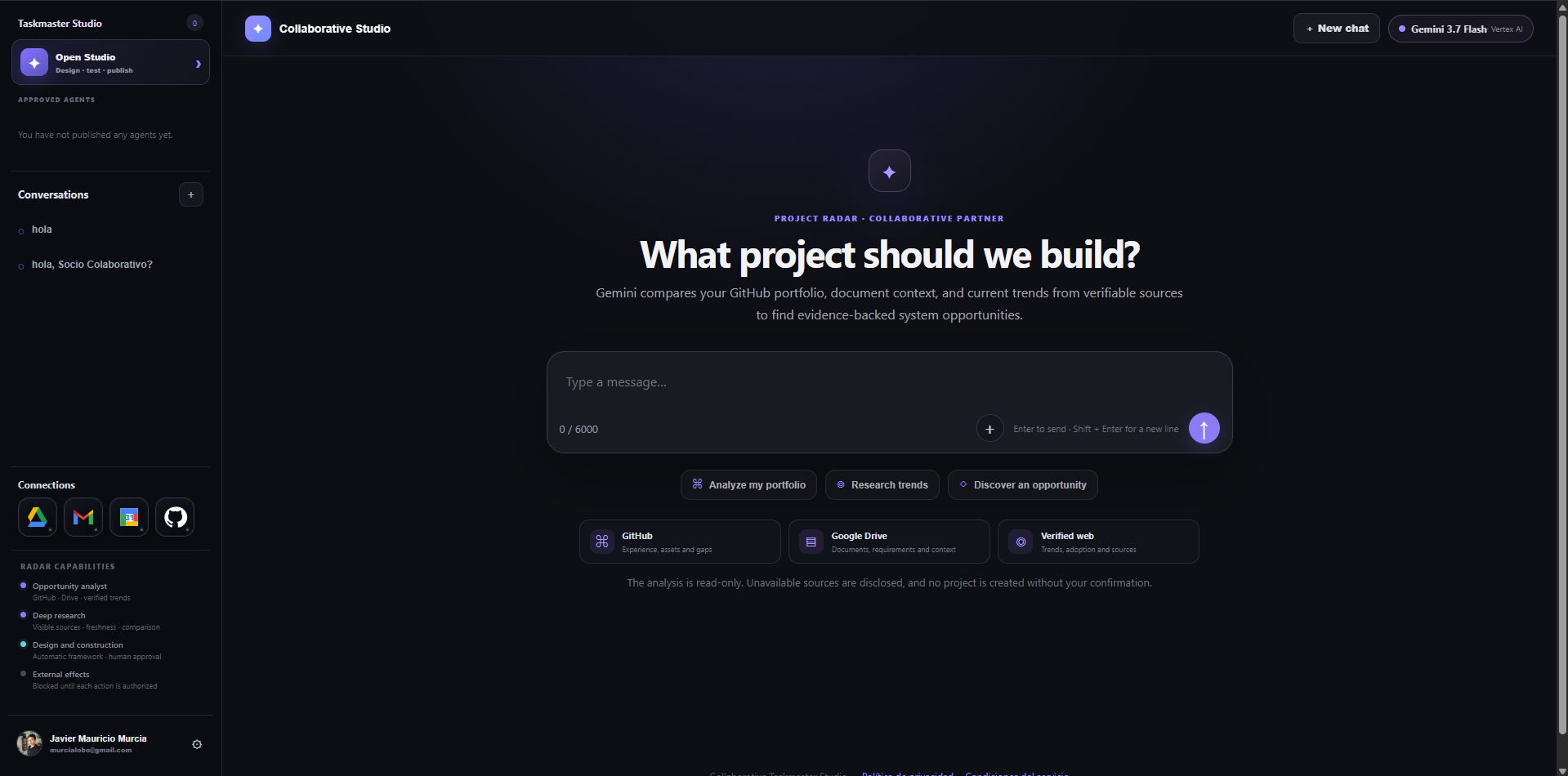
The Studio can also access user-authorized context from Google Drive, Gmail, Google Calendar, GitHub, and public web research through isolated read-only connections.
How we built it
The application runs as a FastAPI service on Google Cloud Run with a chat-first web interface.
Gemini 3.7 Flash on Vertex AI powers collaborative conversation, structured synthesis, framework recommendations, translations, and specialized Taskmaster responses.
The durable workflow uses:
- Cloud Run for the public application and worker endpoint;
- Vertex AI for managed Gemini access;
- Firestore for projects, conversations, immutable revisions, approvals, events, and build state;
- Cloud Tasks for durable asynchronous construction;
- Cloud Storage for private file-by-file Taskmaster project persistence;
- Identity Platform and OAuth for verified, owner-isolated accounts and external connections;
- Cloud Build and Artifact Registry for tested container delivery;
- Google Charts for interactive in-chat visualizations.
Generated projects can target Google ADK, Google Gen AI SDK, Genkit, or an Antigravity-based construction path. If an optional framework or service is unavailable, the system exposes that limitation and uses a deterministic controlled fallback instead of pretending the capability exists.
Safety and human control
The model does not receive production credentials and cannot approve its own work.
The architecture separates conversation, domain decisions, construction, testing, and publication. Human approval gates protect both the design contract and laboratory execution.
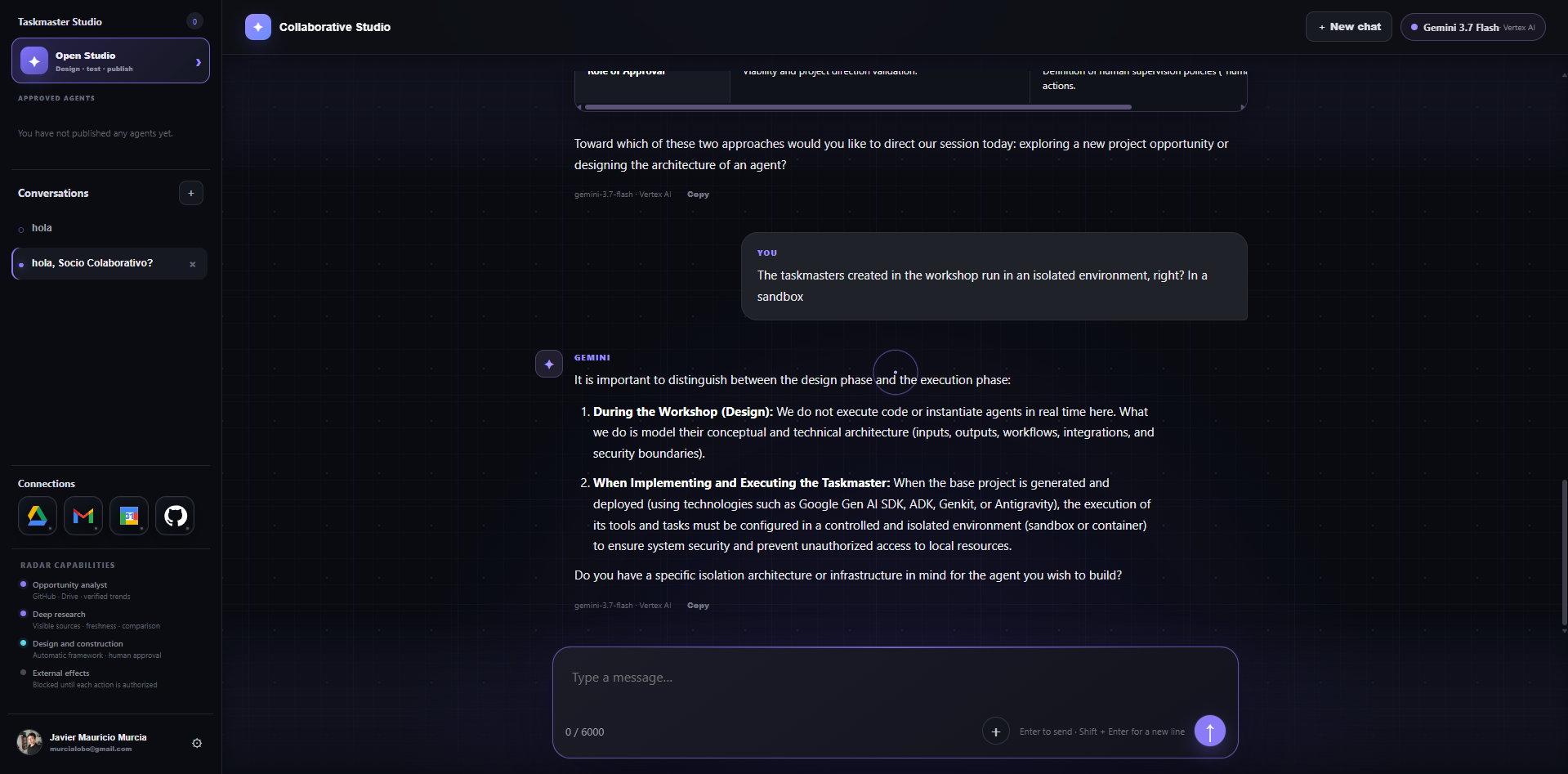
The isolated laboratory runs generated projects with:
- no inherited cloud or OAuth credentials;
- blocked network access;
- strict execution timeouts;
- confined filesystem paths;
- normal, incomplete, and adversarial test scenarios.
OAuth grants are encrypted and isolated per verified owner. External integrations remain read-only, and connecting a service does not grant permission to modify external resources.
Challenges we faced
One of the largest challenges was making the workflow durable. Agent construction can outlive a web request, browser session, or Cloud Run instance. We used Cloud Tasks and persisted build state so interrupted work could be recovered without duplicating builds or losing approvals.
Another challenge was separating genuine capabilities from model-generated claims. The system verifies connections, files, frameworks, builds, and test results before presenting them as available.
Document and dataset processing also required careful limits. We implemented multiple-file support, chunked uploads, bounded extraction, archive-expansion limits, and deterministic visualization artifacts.
Finally, we needed generated Taskmasters to be more than one-shot workflows. The conversational routing layer lets each published agent guide the user within its approved specialty while preserving its tools, boundaries, and approval requirements.
Accomplishments
We completed a public, end-to-end system that can move from an ambiguous request to a reusable Taskmaster agent.
The result includes:
- adaptive collaborative discovery;
- visible and versioned design contracts;
- automatic framework selection;
- two independent human approval gates;
- durable asynchronous construction;
- isolated testing;
- persistent project trees and catalog entries;
- specialized conversational agents;
- document and multi-dataset analysis;
- direct in-chat visualizations;
- bilingual Spanish and English conversations;
- read-only external context with multi-user isolation.
What we learned
The most important lesson was that reliable agentic systems require more than a capable model. They need explicit state, bounded tools, recoverable workflows, deterministic artifacts, least-privilege access, and visible human decisions.
We also learned that collaboration improves when the system explains missing information progressively instead of presenting a large generic questionnaire. Users should be able to see what the agent understood, what remains unresolved, and exactly what they are approving.
What's next
The next steps are completing Google OAuth verification, adding more specialized evaluation suites, expanding the framework and connector catalog, improving collaborative team workflows, and introducing additional observability for published Taskmasters.
Our long-term goal is to make agent creation understandable and auditable: not simply generating an agent, but helping people confidently decide what should be built, how it should operate, and when it should be allowed to act.
Built With
- ai-agents
- antigravity
- artifact-registry
- cloud-build
- cloud-storage
- cloud-tasks
- fastapi
- firestore
- genkit
- gmail-api
- google-calendar-api
- google-chart
- google-drive-api
- human-in-the-loop
- identity-platform
- oauth
- python

Log in or sign up for Devpost to join the conversation.