-
-
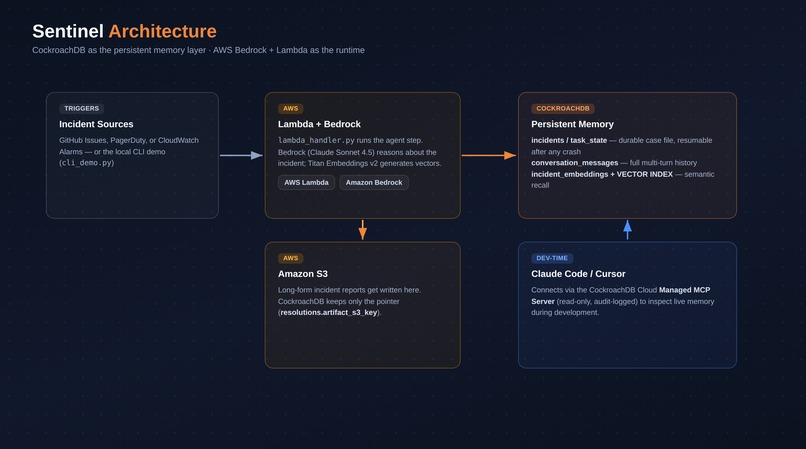
architecture
Inspiration
AI agents are moving fast from demos into real production work — writing code, triaging incidents, running pipelines. But almost every agent demo we'd seen kept its "memory" in a Python dict or a local file, which is fine for a five-minute demo and completely wrong for production. The moment the process restarts, scales past one instance, or a region blips, that memory is just gone. The CockroachDB × AWS Hackathon's framing nailed the actual problem: agents need memory that never goes down — durable, distributed, and consistent, not a toy in-memory cache.
We wanted to build something that took that literally: an agent where you could kill the process mid-task, come back an hour later from a completely different machine, and it would pick up exactly where it left off — because none of its state ever lived only in memory.
What it does
Sentinel is an incident-triage agent for DevOps teams. When an incident comes in (from an alert, a webhook, or our CLI demo), it:
- Embeds the incident text and searches CockroachDB's Distributed Vector Indexing for similar past incidents and how they were resolved.
- Sends the incident, the retrieved memories, and the full conversation history to Amazon Bedrock (Claude) for a triage decision — a root-cause hypothesis, a next diagnostic step, and whether it looks safe to resolve autonomously or needs a human.
- Writes the response, updated task state, and (once resolved) a full incident report back to CockroachDB — and to S3 for the longer write-up — all inside a transaction.
Because every one of those steps reads and writes through CockroachDB, any later invocation — a retry, a follow-up question hours later, a totally different Lambda cold start — resumes from exactly what's in the database. We tested this literally: killing the process mid-conversation and reopening it from a fresh terminal, and the agent picked the conversation back up with full context, because nothing lived only in memory.
How we built it
- CockroachDB is the persistent memory layer:
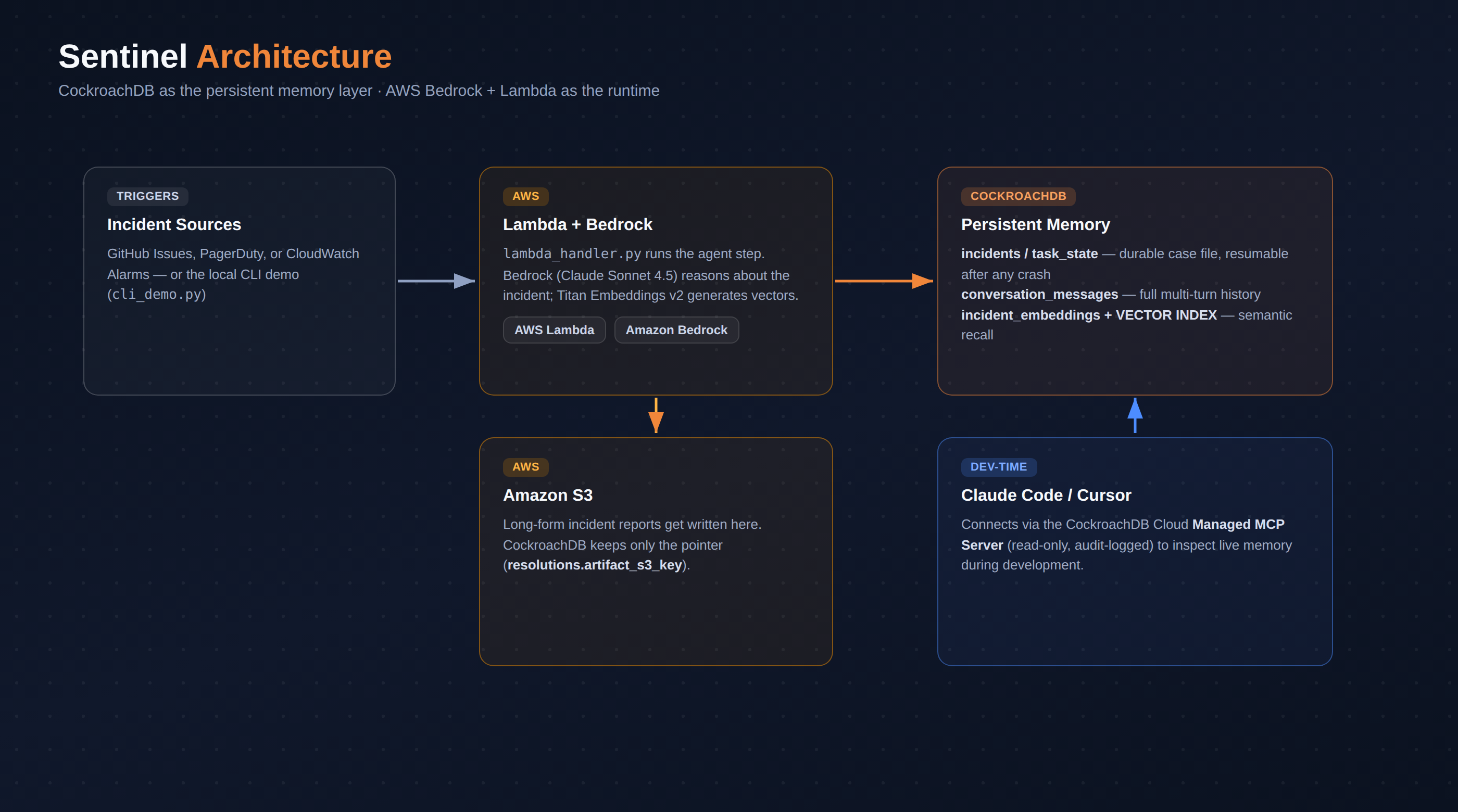
incidentsandtask_statefor durable case-file/task-progress state,conversation_messagesfor full multi-turn history, andincident_embeddings(aVECTOR(1024)column with aCREATE VECTOR INDEX) for semantic recall of similar past incidents. - Amazon Bedrock provides both the reasoning (Claude Sonnet 4.5) and the embeddings (Titan Text Embeddings V2) — no separate model-hosting infrastructure.
- AWS Lambda runs the agent step end-to-end as a stateless function, deployed via an AWS SAM template; Amazon S3 stores the longer-form incident reports, with CockroachDB keeping just the pointer.
- The CockroachDB Cloud Managed MCP Server let us inspect the live memory store directly from Claude Code during development — read-only, fully audit-logged, with zero custom proxy code.
- The ccloud CLI's agent-ready design informed our provisioning script for non-interactive cluster setup.
Challenges we ran into
- CockroachDB Cloud's browser SQL Shell intermittently timed out on
CREATE DATABASEspecifically (while every other statement, includingCREATE TABLEandCREATE VECTOR INDEX, ran fine) — we worked around it by just running everything againstdefaultdbinstead of provisioning a separate database, which works just as well for this use case. - Bedrock's newest Claude models require routing through a cross-region inference profile rather than the bare model ID — on-demand
InvokeModelcalls kept failing until we prefixed the model ID correctly (global.anthropic.claude-sonnet-4-5-...instead of the plain model ID). - Windows consoles default to a legacy
cp1252encoding that can't render some characters an LLM naturally produces (em dashes, smart quotes), which crashed our first demo recording with aUnicodeEncodeError. Fixed by forcing UTF-8 stdout in the CLI (with a safe fallback) so this can't happen to anyone running the repo. - AWS's "new customer" free-tier eligibility didn't apply to this account, which was a bit of a scare mid-hackathon — but it turned out to be a non-issue, since Bedrock + Lambda + S3 usage for a demo like this runs to a few cents total.
Accomplishments that we're proud of
Getting genuine cross-process persistence working, not just claiming it: you can watch the agent recall a seeded incident's root cause purely from CockroachDB's vector index (with the actual cosine-distance score printed), and continue a conversation from a completely fresh process invocation with full context intact.
What we learned
That "agentic memory" isn't really a new problem — it's the same durability and consistency problem databases have always solved, just applied to a new kind of client that writes constantly and can't tolerate a maintenance window. Reaching for CockroachDB instead of a bespoke vector store + a separate state store also just... simplified everything. One connection string, one consistency model, no dual-write problem between an app DB and a vector DB.
What's next
Exposing the CockroachDB Agent Skills to the running agent (not just used at dev-time) via an MCP resource, so it can self-correct its own query patterns; a LangChain wrapper so Sentinel can drop into existing agent graphs; and multi-tenant isolation via CockroachDB row-level security for real multi-team usage.
Built With
- amazon-web-services
- anthropic-claude
- aws-bedrock
- aws-lambda
- aws-sam
- boto3
- cockroachdb
- cockroachdb-cloud
- distributed-vector-indexing
- llm-agent
- model-context-protocol
- postgresql
- psycopg
- python
- vector-search

Log in or sign up for Devpost to join the conversation.