-
-
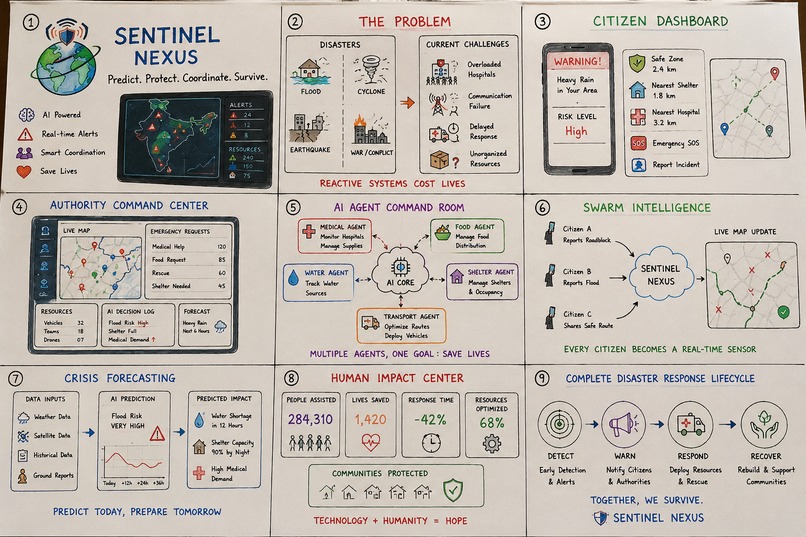
One platform. One mission. Save lives before disaster strikes.
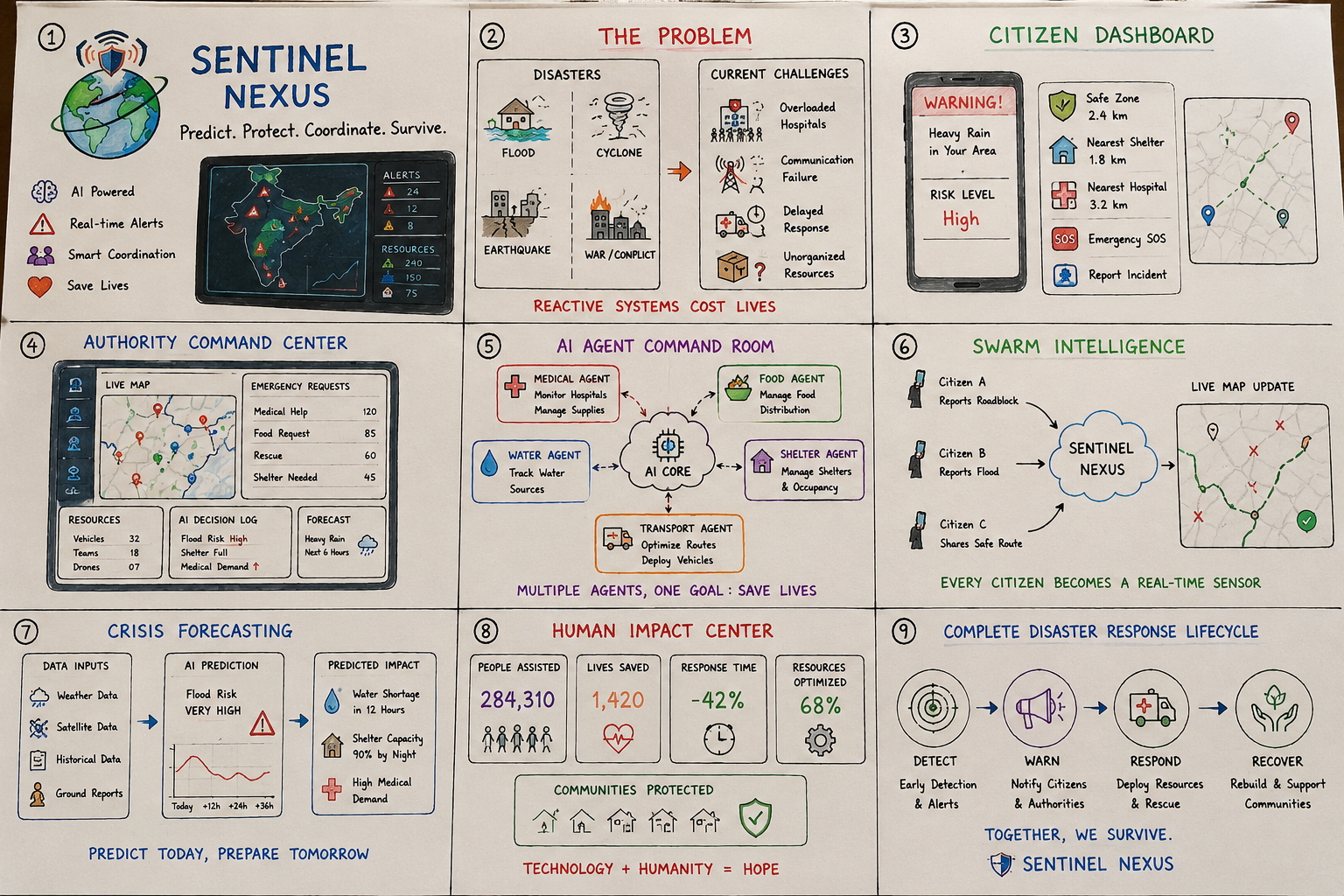
Sentinel Nexus | Predict. Protect. Coordinate. Survive.
Inspiration
The idea for Sentinel Nexus started during discussions about how people are affected when disasters suddenly disrupt normal life. We noticed that during floods, cyclones, earthquakes, and conflicts, information often reaches people too late. Families struggle to find safe places, authorities receive an overwhelming number of requests, and emergency resources are difficult to coordinate efficiently.
Instead of building another general-purpose AI application, we wanted to work on a problem that could have a direct social impact. Our goal was to explore how technology could help people make faster and better decisions during critical situations.
This led us to create Sentinel Nexus.
What it does
Sentinel Nexus is a humanitarian intelligence platform that assists citizens, volunteers, and emergency authorities during disasters.
Citizens can receive alerts, discover safe locations, find shelters, locate nearby hospitals, and submit emergency requests. Authorities can monitor situations through a centralized command interface, review priority cases, and coordinate available resources.
The platform also introduces forecasting capabilities that help identify potential future issues, such as shortages of water, shelter capacity, or medical support. By combining real-time information with predictive insights, Sentinel Nexus aims to support faster and more informed decision-making.
How we built it
We started by mapping the journey of a person affected by a disaster. We then identified the different groups involved in emergency response and designed separate workflows for citizens, volunteers, and authorities.
After defining these workflows, we built dashboard concepts that could display emergency information in a clear and organized manner. We designed interactive simulations, location-based services, reporting mechanisms, and forecasting components that work together as a connected system.
A significant part of our effort went into creating understandable AI outputs. Instead of simply generating recommendations, we focused on explaining why certain actions or priorities were suggested.
Challenges we ran into
One challenge was deciding how to present large amounts of information without overwhelming users during emergencies.
Another challenge involved designing a platform that could support different disaster scenarios while keeping the user experience consistent. Floods, cyclones, and conflict situations each require different types of responses, so we had to create a flexible system architecture.
We also spent time improving the interaction between different stakeholders to ensure that information could move smoothly between citizens, volunteers, and authorities.
Accomplishments that we're proud of
One accomplishment we are particularly proud of is bringing multiple disaster-response activities into a single platform.
Some of the features we successfully designed include:
- Emergency reporting workflows
- Resource coordination concepts
- Community-driven situational awareness
- Predictive risk analysis
- Multi-role dashboards
- Explainable AI decision support
We are especially proud that the project focuses on a real-world challenge rather than a purely technical problem.
What we learned
Working on Sentinel Nexus helped us better understand the complexity of disaster management and emergency operations.
We learned how important clear communication, information prioritization, and resource coordination are during crises. We also gained experience in designing systems that combine mapping, forecasting, data visualization, and AI-assisted decision support.
Most importantly, we learned that technology becomes more meaningful when it helps solve problems that directly affect people and communities.
What's next for Sentinel Nexus
Our next step is to transform Sentinel Nexus into a more advanced and realistic humanitarian assistance platform.
Future improvements may include:
- Integration with live environmental data
- Enhanced forecasting capabilities
- Multi-language support
- Improved offline communication features
- Expanded volunteer coordination tools
- Additional simulation and planning capabilities
Our long-term vision is to create a system that can help communities become more prepared, more informed, and more resilient when facing emergencies.
Sentinel Nexus
Predict. Protect. Coordinate. Survive.
Helping communities make informed decisions before, during, and after disasters.


Log in or sign up for Devpost to join the conversation.