-
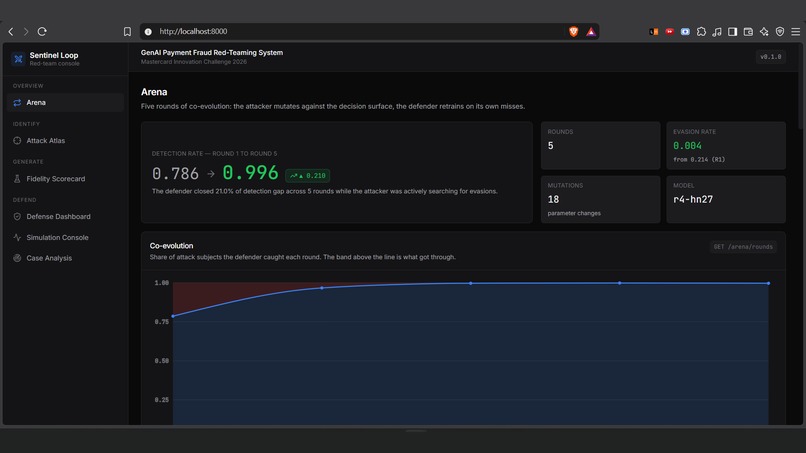
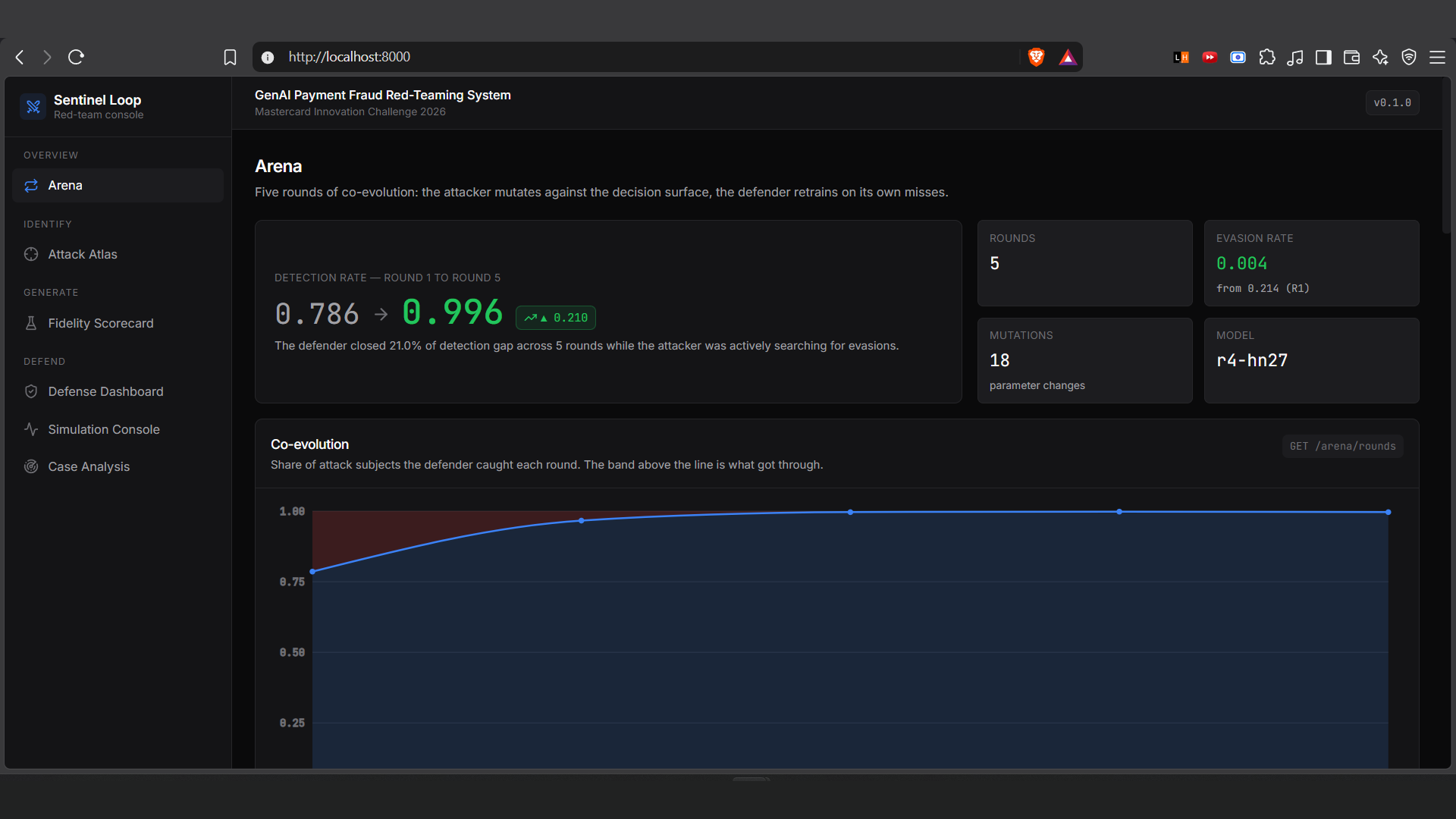
Sentinel Loop console showing red-team co-evolution, with detection rising from 0.786 to 0.996.
-
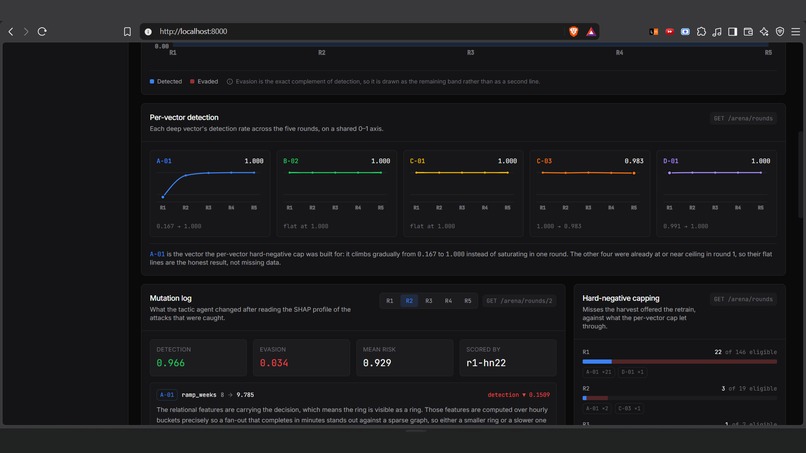
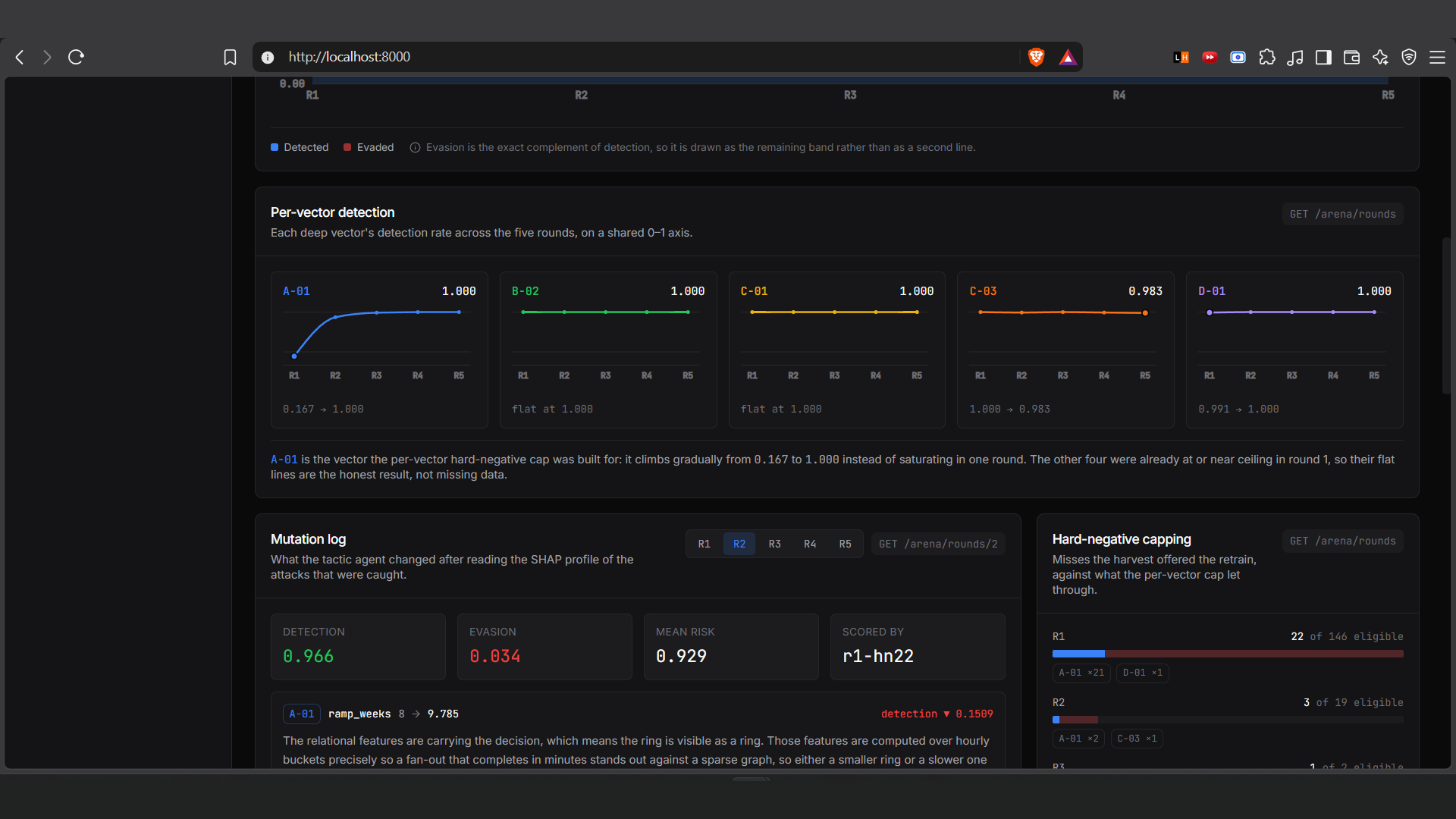
Per-vector detection across rounds A-01 to D-01 with Round 2 mutation logs and capping stats
-
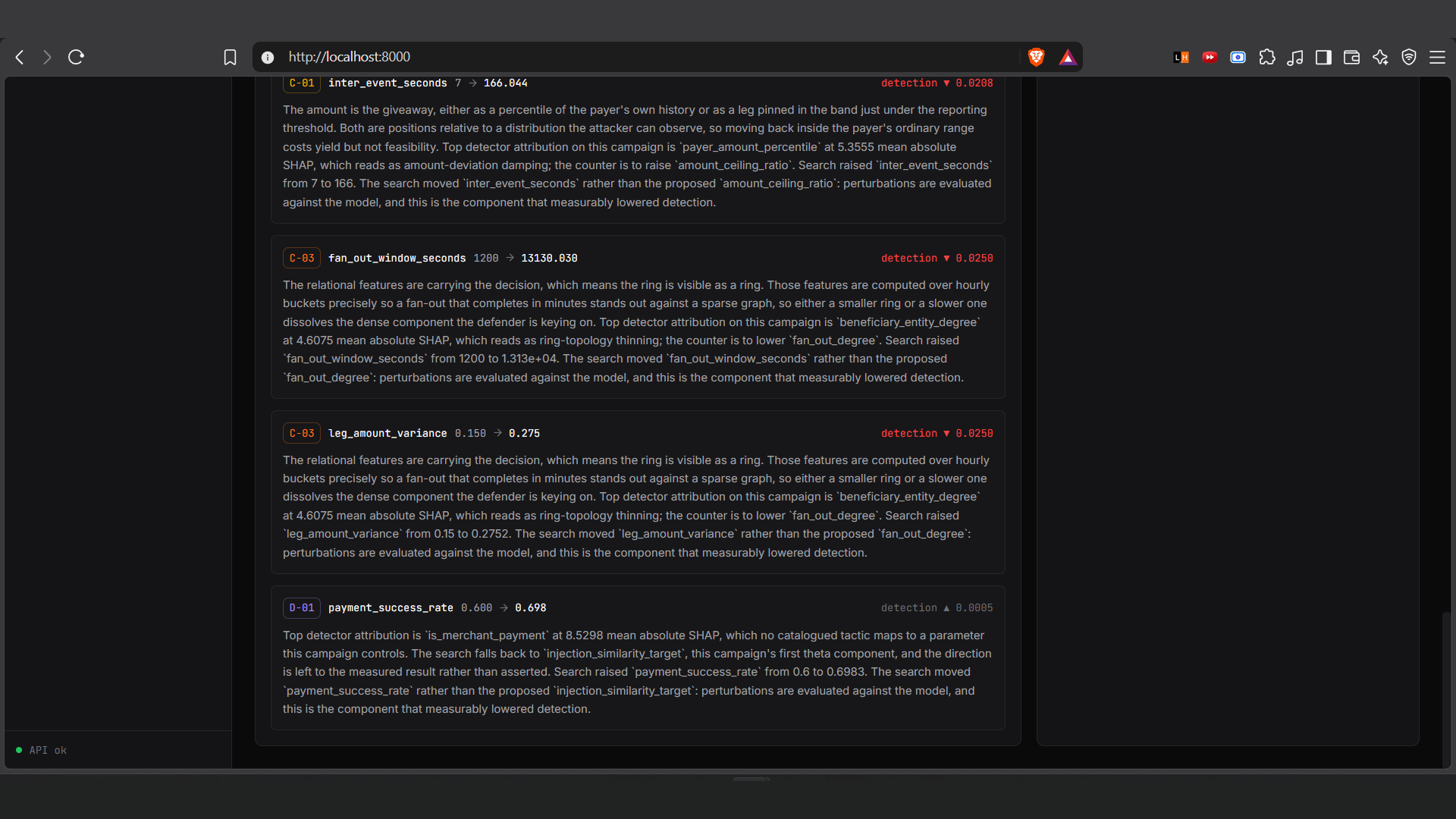
Tactic mutation logs showing feature perturbations like inter_event_seconds to test model limits.
-
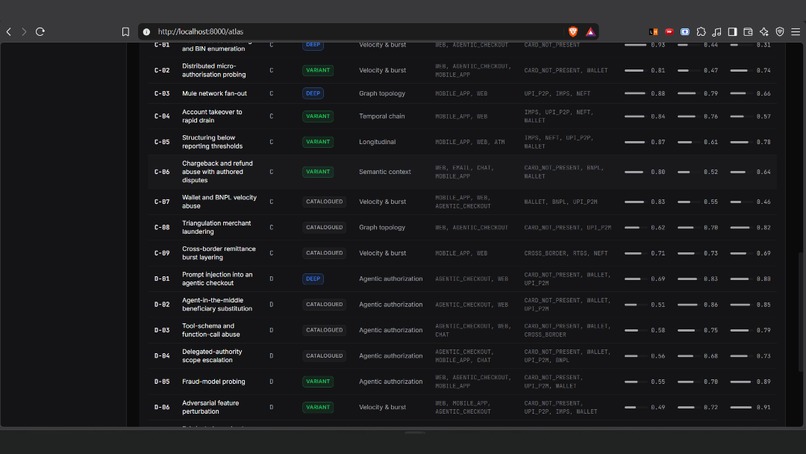
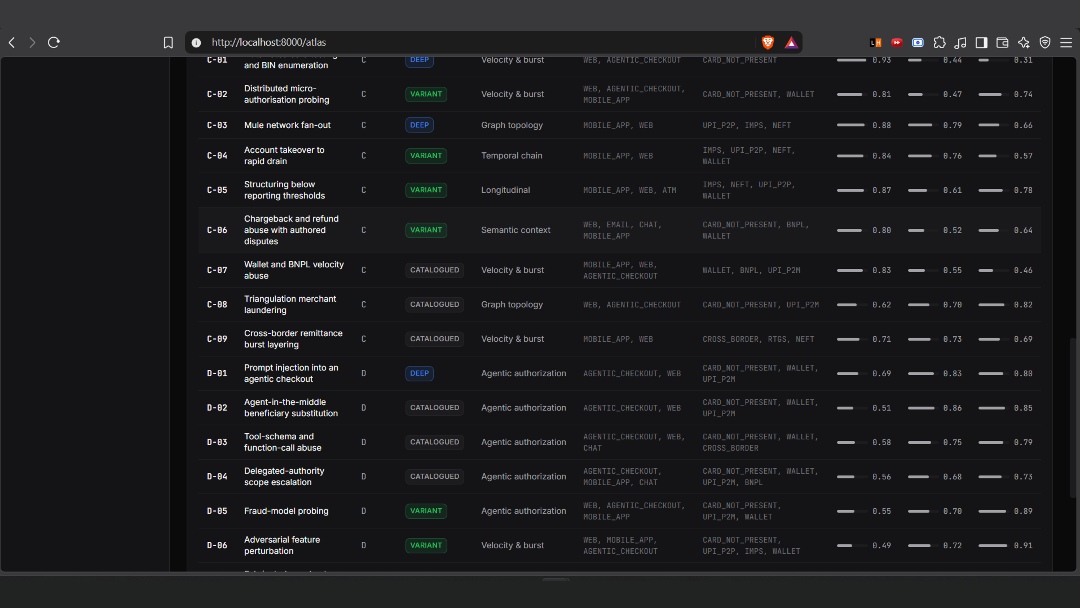
Attack Atlas listing threat vectors across categories like graph topology and agentic authorization
-
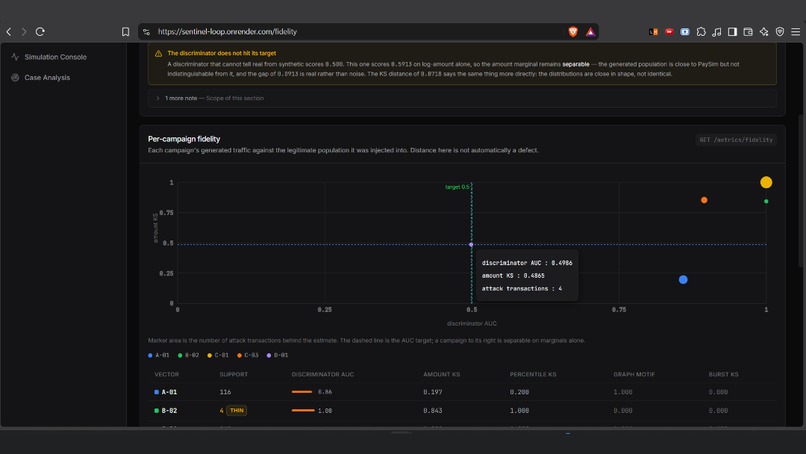
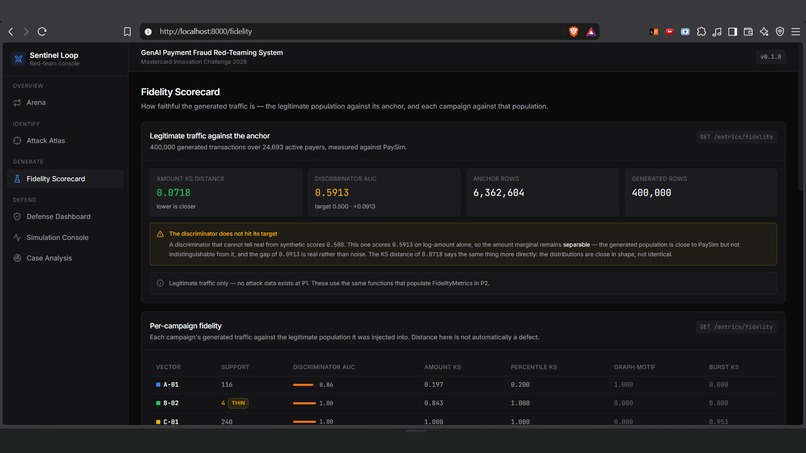
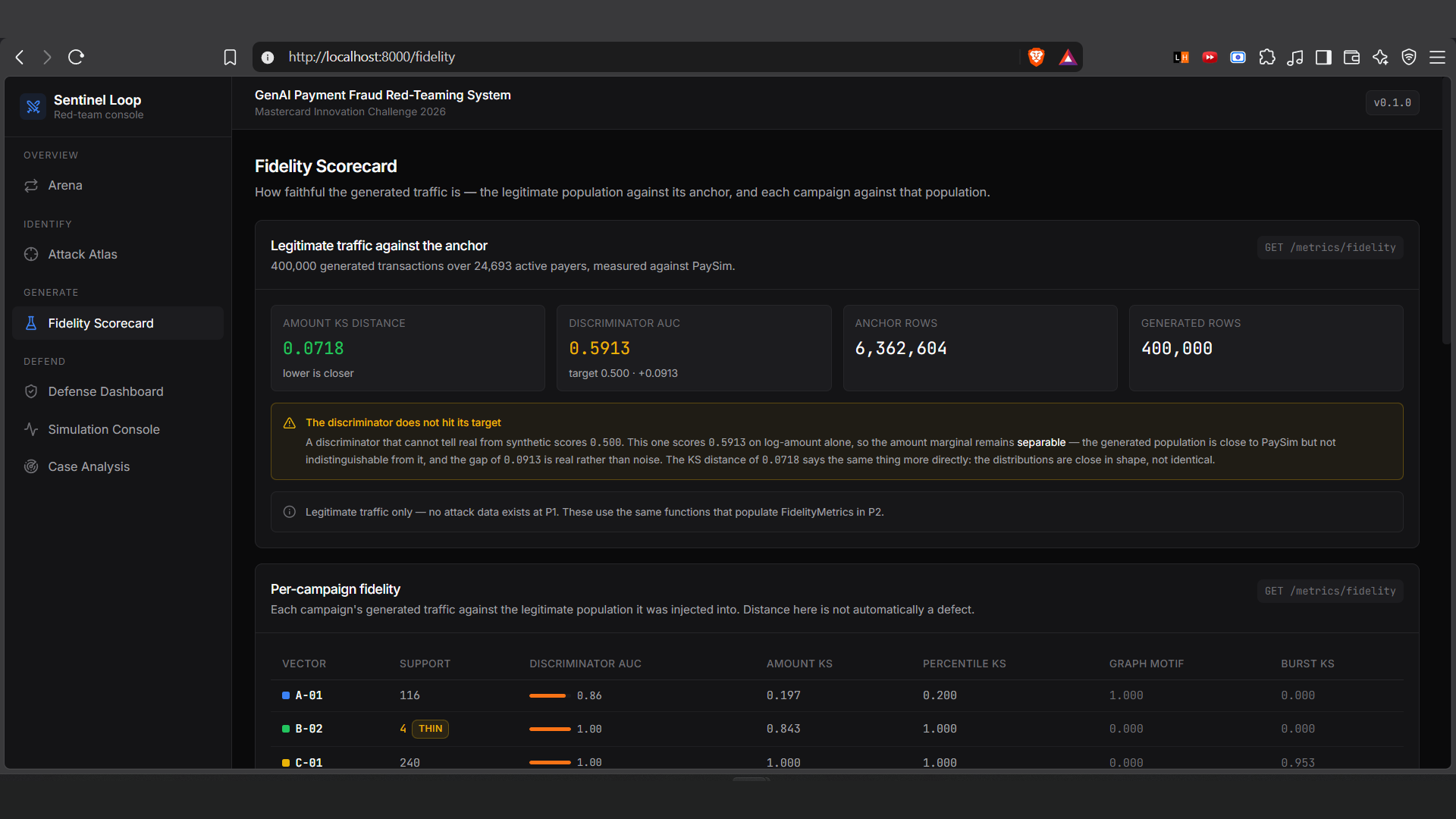
Fidelity Scorecard evaluating 400k synthetic transactions against the PaySim anchor dataset.
-
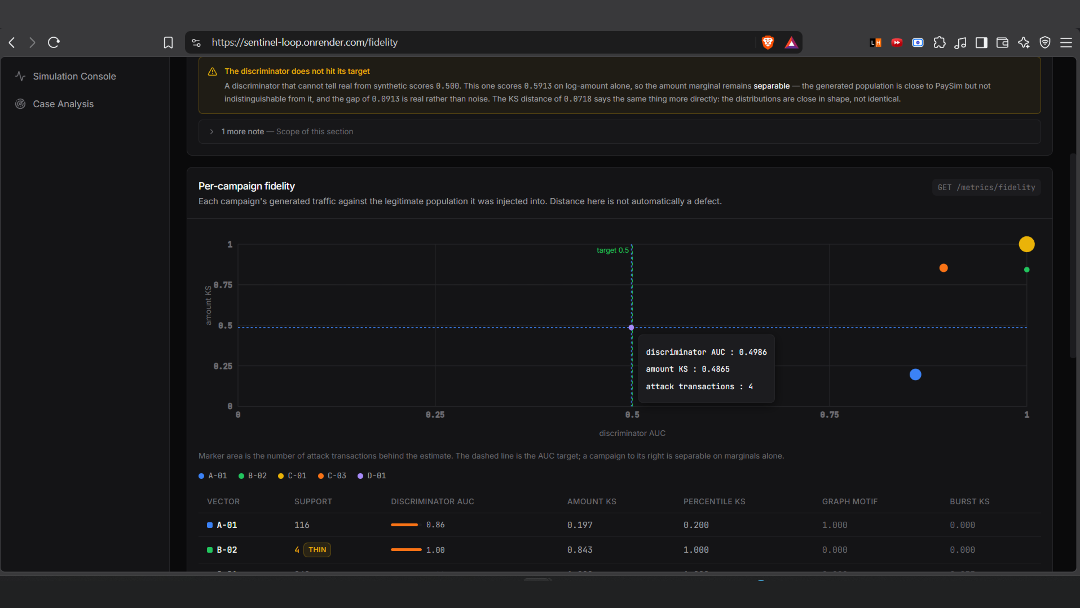
Scatter plot mapping Amount KS vs Discriminator AUC to verify synthetic traffic realism
-
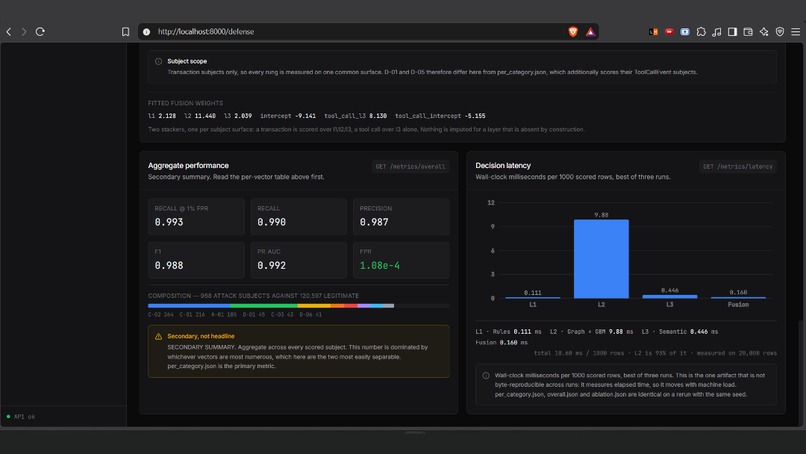
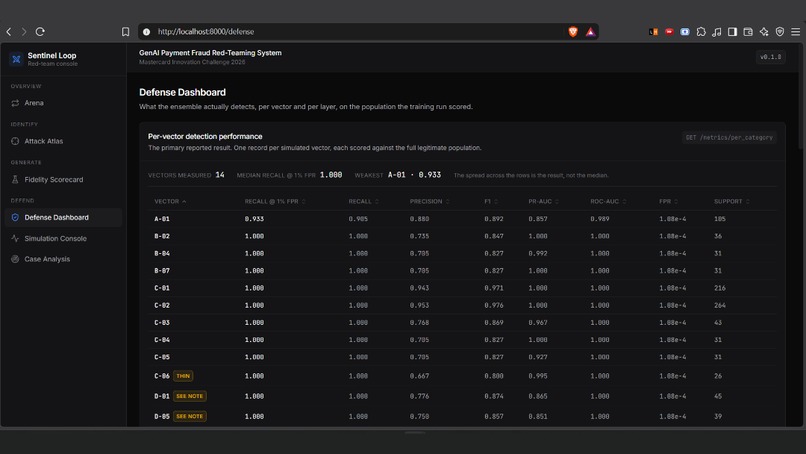
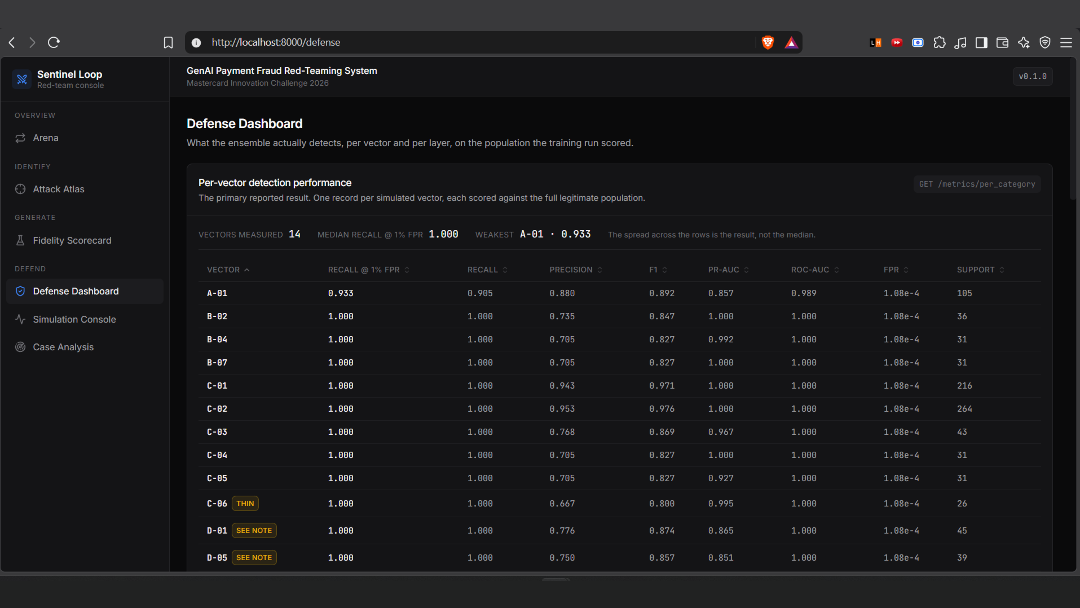
Defense Dashboard tracking 14 attack vectors with Recall @ 1% FPR, precision, and F1-scores.
-
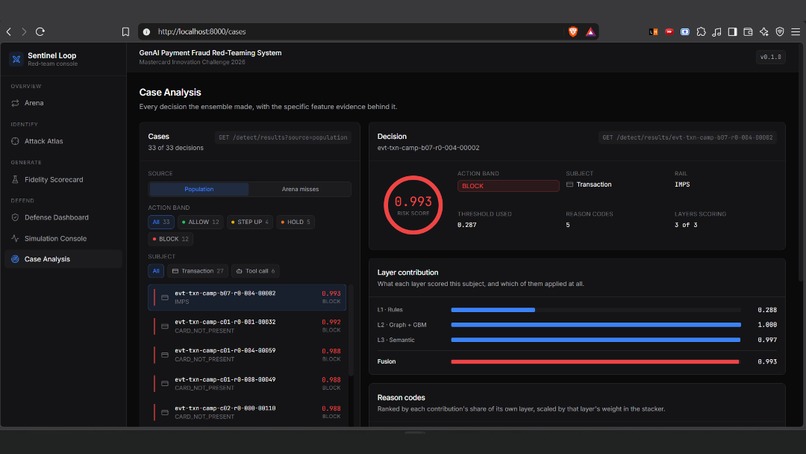
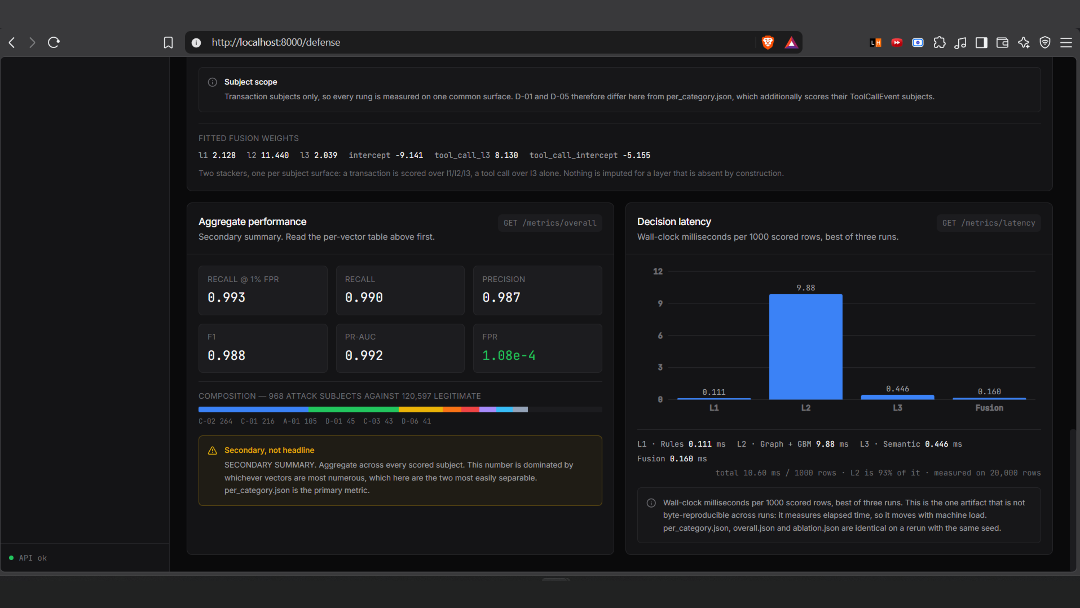
Aggregate accuracy metrics (0.993 Recall) paired with decision latency across L1, L2, and L3 layers.
-
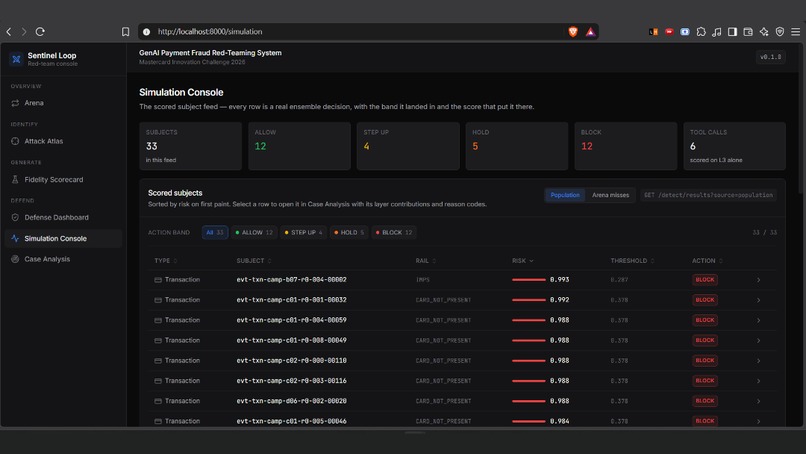
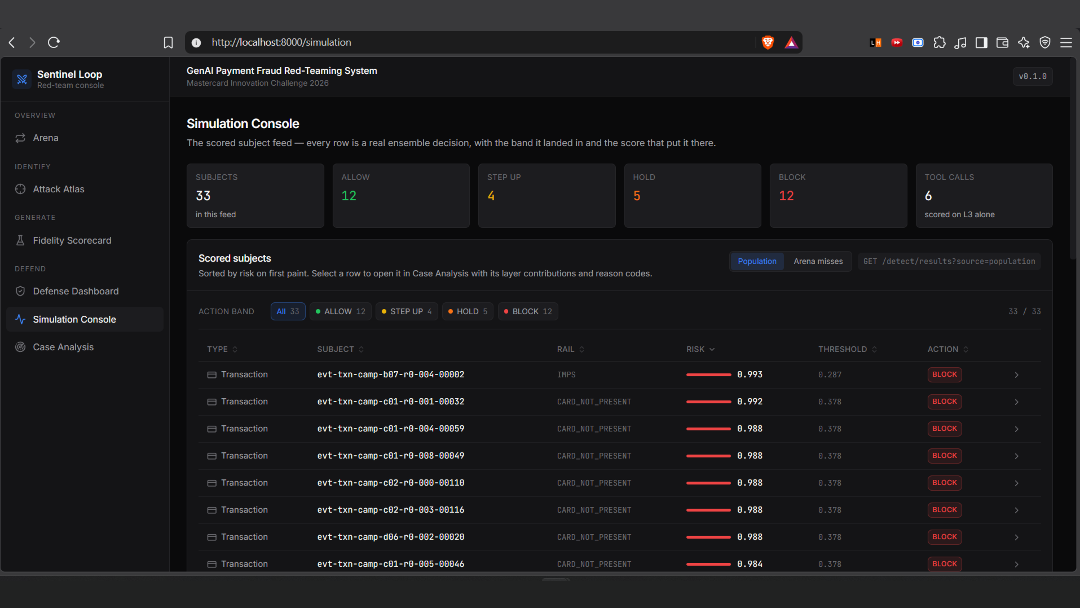
Live simulation feed categorizing transactions into Allow, Step Up, Hold, and Block bands
-

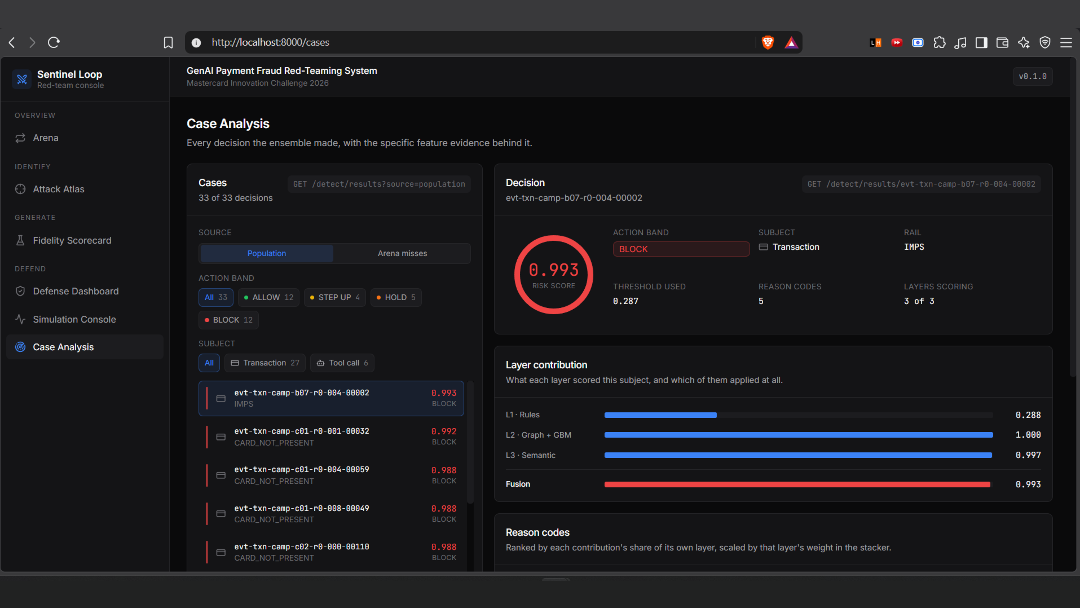
Case analysis of a Block decision (Risk: 0.993) with layer contributions from L1, L2, and L3.
Inspiration
The Widening Fraud Gap: Generative AI has dramatically lowered the cost of orchestrating complex cyberattacks—such as deepfake audio/video calls, synthetic identity theft, and tailored scams—costing bad actors mere cents to execute at scale.
The Blind Spot of Traditional Models: Standard fraud detection systems are inherently reactive; they rely on historical labeled data and can only recognize fraud that has already occurred, leaving real customers to bear the cost of first-wave attacks.
Emerging Threat Surfaces: As payments move toward agentic checkouts and LLM-driven interactions, the AI stack itself becomes an uncatalogued target for prompt injections, agent-in-the-middle substitutions, and model probing.
What it does
Closed-Loop AI Red-Teaming: Sentinel invents prospective GenAI attack vectors, simulates them safely on synthetic datasets, and trains defensive models before threats hit production networks.
Comprehensive Vector Taxonomy: Identifies 34 GenAI attack vectors, including 6 first-class AI-stack threat vectors (e.g., prompt injection in agentic checkouts, tool-schema abuse, model probing) absent from conventional fraud taxonomies.
Explainable Multi-Layer Scoring: Combines Rules, Graph + Gradient Boosted Machines (GBM), and a Semantic Layer to produce a calibrated risk score accompanied by ranked, plain-language reason codes.
How we built it
Four-Stage Pipeline: Built on an Identify $\rightarrow$ Generate $\rightarrow$ Defend $\rightarrow$ Arena architecture.
Synthetic Simulation Network: Created a 3-layer simulator (narrative, mechanics, stats) running over a 400,000-transaction synthetic payment network.
Adversarial Arena (Co-evolution): Implemented an automated loop where the attacker mutates parameters against the deployed defender model, and harvested evasion data is fed back into retraining iterations.
Low-Latency Inference Pipeline: Optimized response pipelines to execute decisions within a 10.6 ms budget per 1,000 decisions to meet real-time authorization constraints.
Challenges we ran into
Uncharted Attack Vectors: Cataloging and modeling attack vectors targeted directly at the AI stack itself (such as delegated-authority scope escalation) without existing industry taxonomies or historical training data.
Real-Time Latency Budgets: Balancing multi-layered detection—specifically the computation-heavy Graph + GBM layer (which takes ~9.88 ms)—to stay well within strict live authorization limits.
Safety & Privacy Constraints: Ensuring synthetic attack data accurately mirrored real-world signal footprints (e.g., carrier mismatches, velocity bursts) without generating actual deepfakes, malicious payloads, or exposing sensitive user data.
Accomplishments that we're proud of
Co-Evolutionary Performance: Raised detection rates from 0.786 to 0.996 across 5 arena rounds while the adversary was actively modifying attack strategies.
High Operational Accuracy: Achieved a 0.993 Recall @ 1% False Positive Rate (FPR) on synthetic validation sets.
Statistical Data Fidelity: Validated synthetic transaction fidelity against 6.36 million real transaction rows with a Kolmogorov-Smirnov (KS) distance of 0.0718.
Transparent Decisions: Delivered fully explainable outputs with ranked reason codes in 10.6 ms per 1,000 decisions.
What we learned
Focusing on Signal Footprints: Complex attacks are best identified by analyzing transaction signal chains (e.g., payee addition shortly before large transfers) rather than waiting for explicit historical labels.
Proactive Defense via Red-Teaming: Continuously probing a defense model against automated adversarial mutations is far more effective and ethical than static model updates or periodic manual audits.
What's next for Sentinel Loop
Expanding Coverage: Scaling detection coverage across all 34 catalogued GenAI vectors beyond the initial active set.
Fintech & Bank Pilots: Partnering with payment service providers (PSPs), UPI applications, and agentic-commerce platforms to pilot test defenses in sandboxed environments.
Standardizing Industry Benchmarks: Working alongside financial regulators (such as RBI and NPCI) and card networks to establish a standardized, testable benchmark for GenAI fraud readiness.

Log in or sign up for Devpost to join the conversation.