-
-

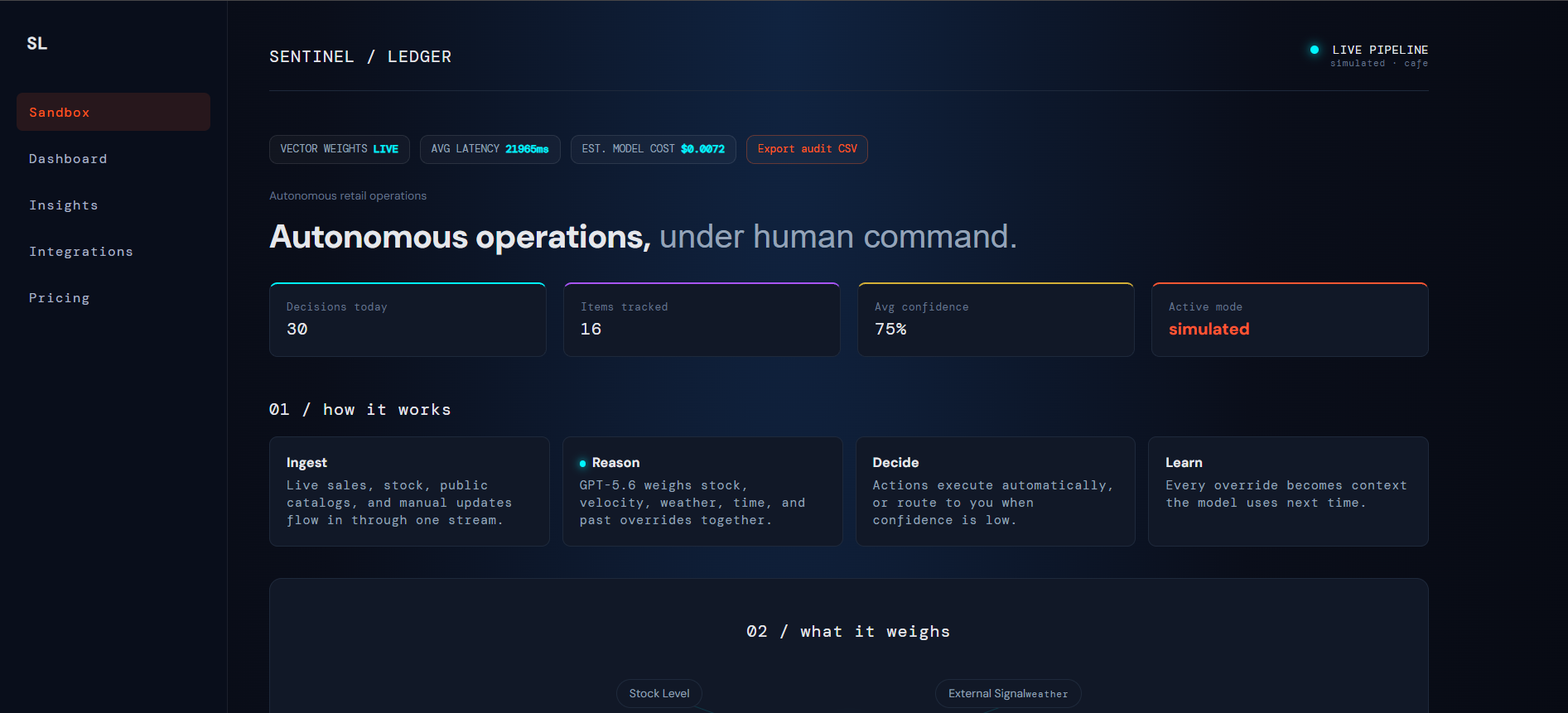
Sentinel Ledger landing overview - autonomous operational decisions driven by multi-model intelligence.
-
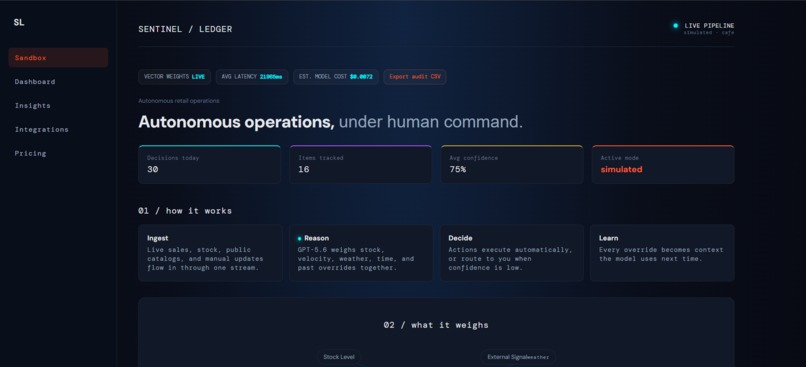
Dashboard- The main workspace HUD displaying real-time telemetry tickers, latency metrics, and daily decision counters.
-
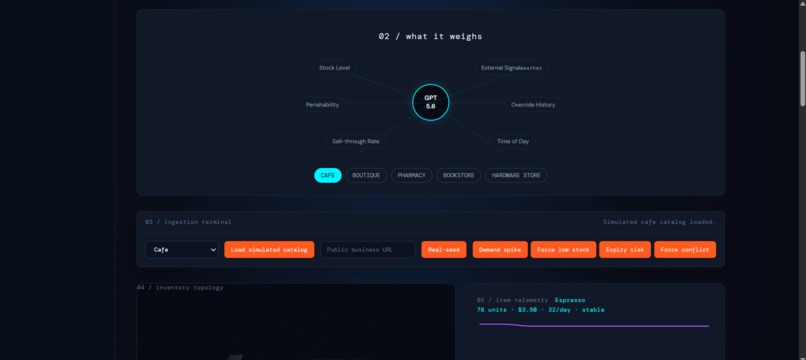
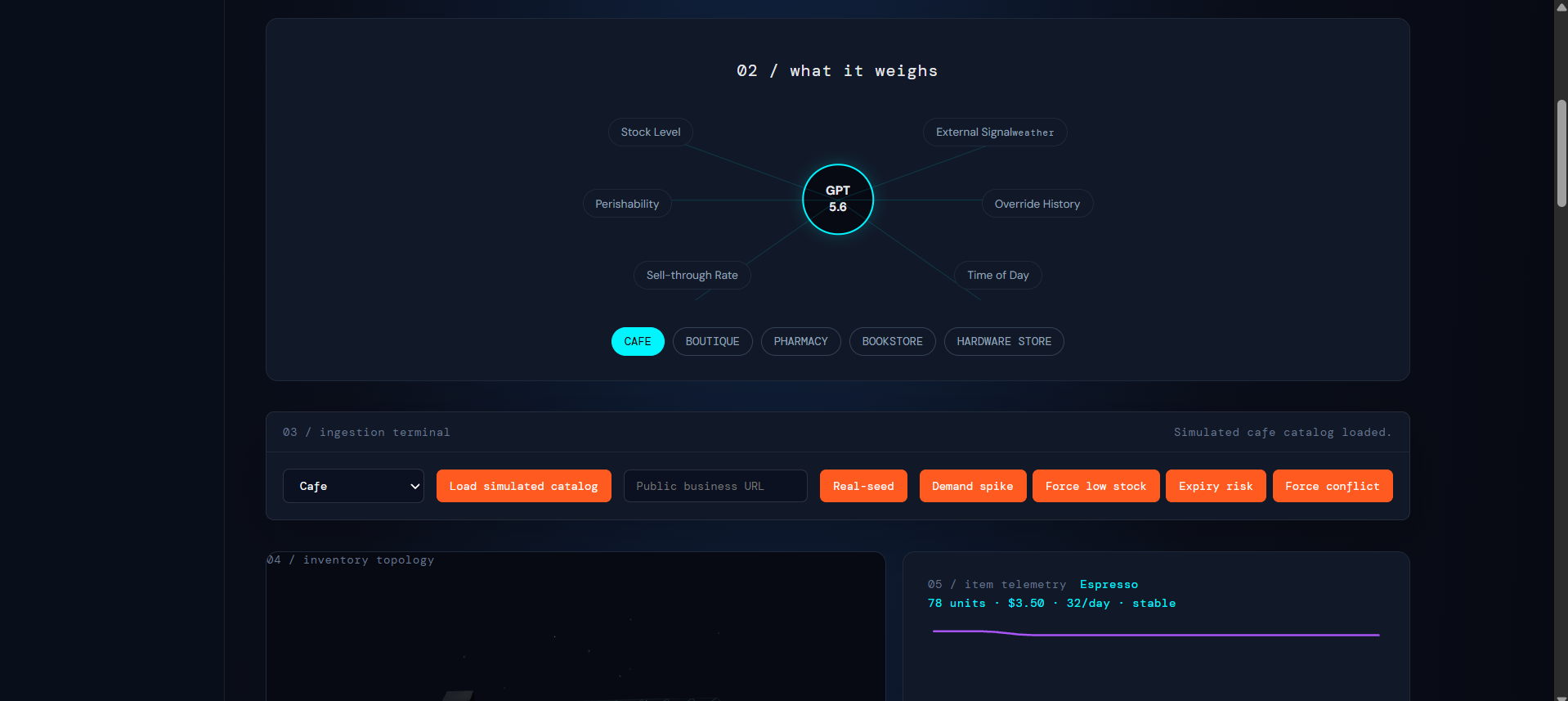
The multi-modal context node network mapping GPT-5.6 inputs across stock levels, weather vectors, and override history.
-
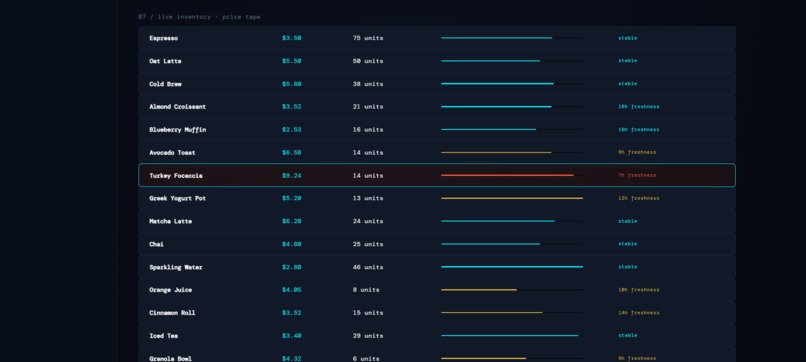
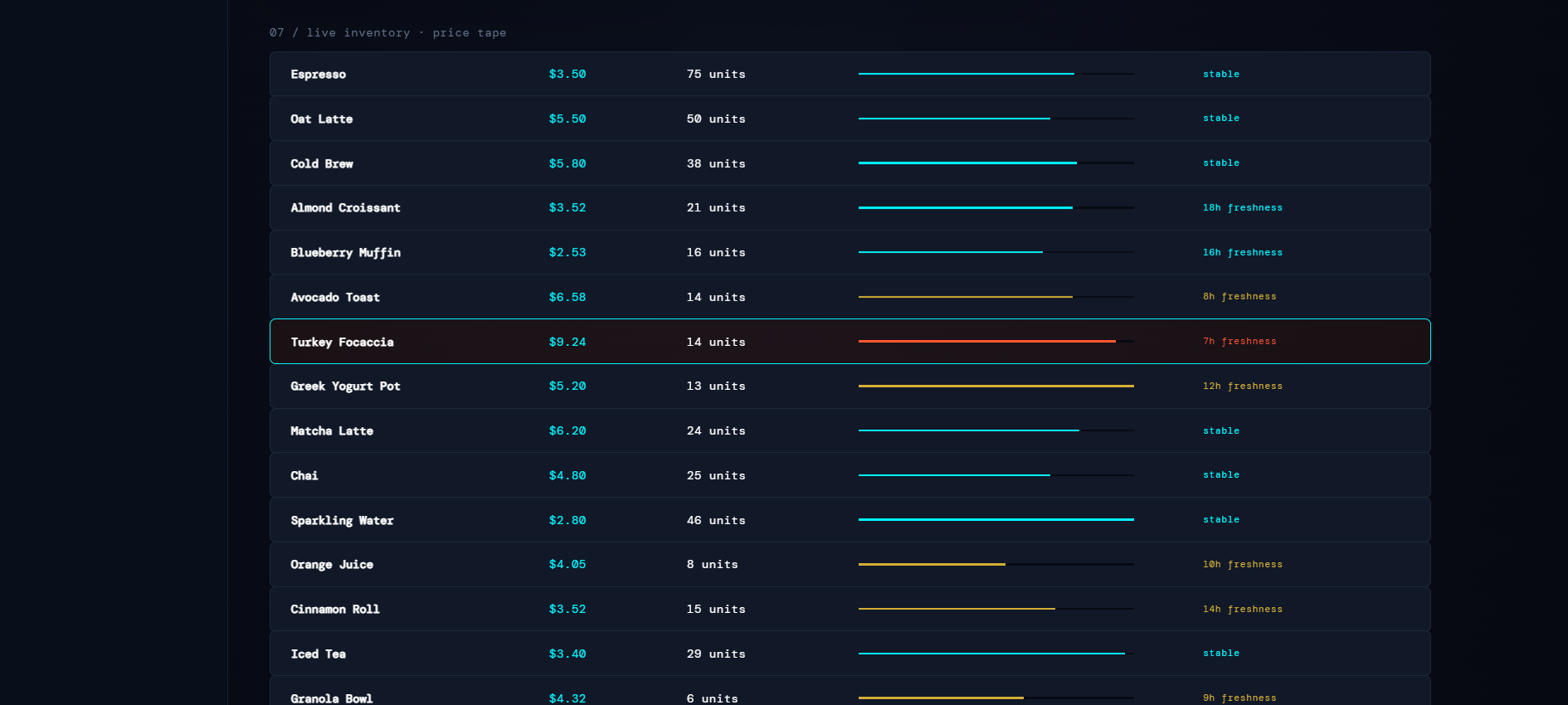
The price tape and live inventory table tracking units, pricing vectors, and perishability countdowns.
-
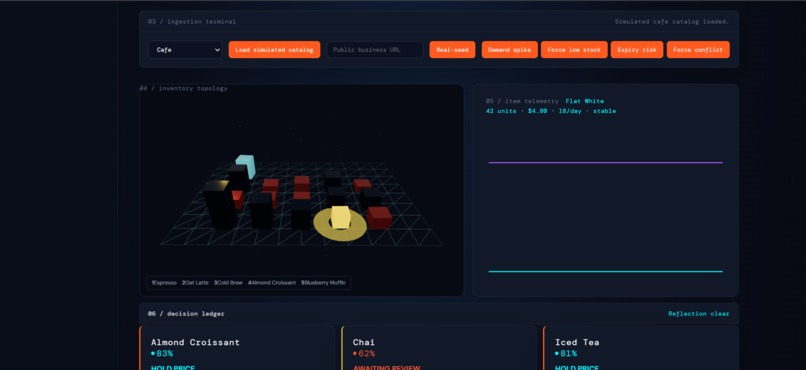
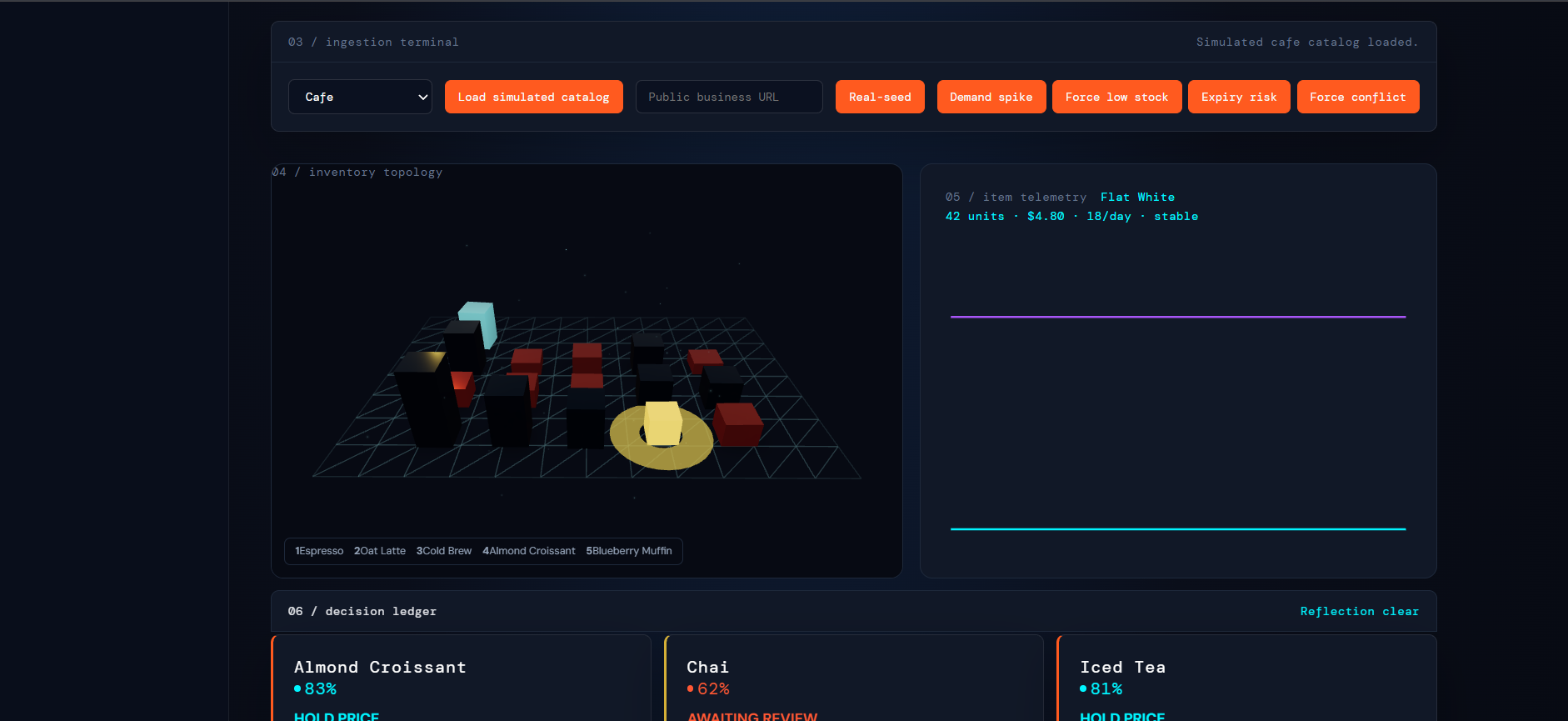
The interactive 3D inventory topology canvas rendering real-time shelf nodes and item status levels.
-
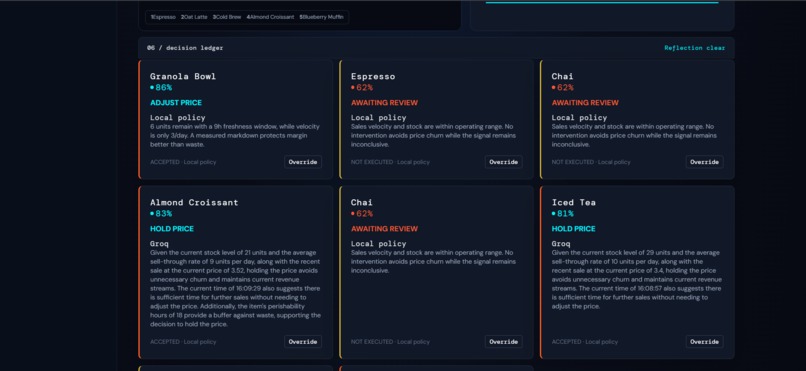
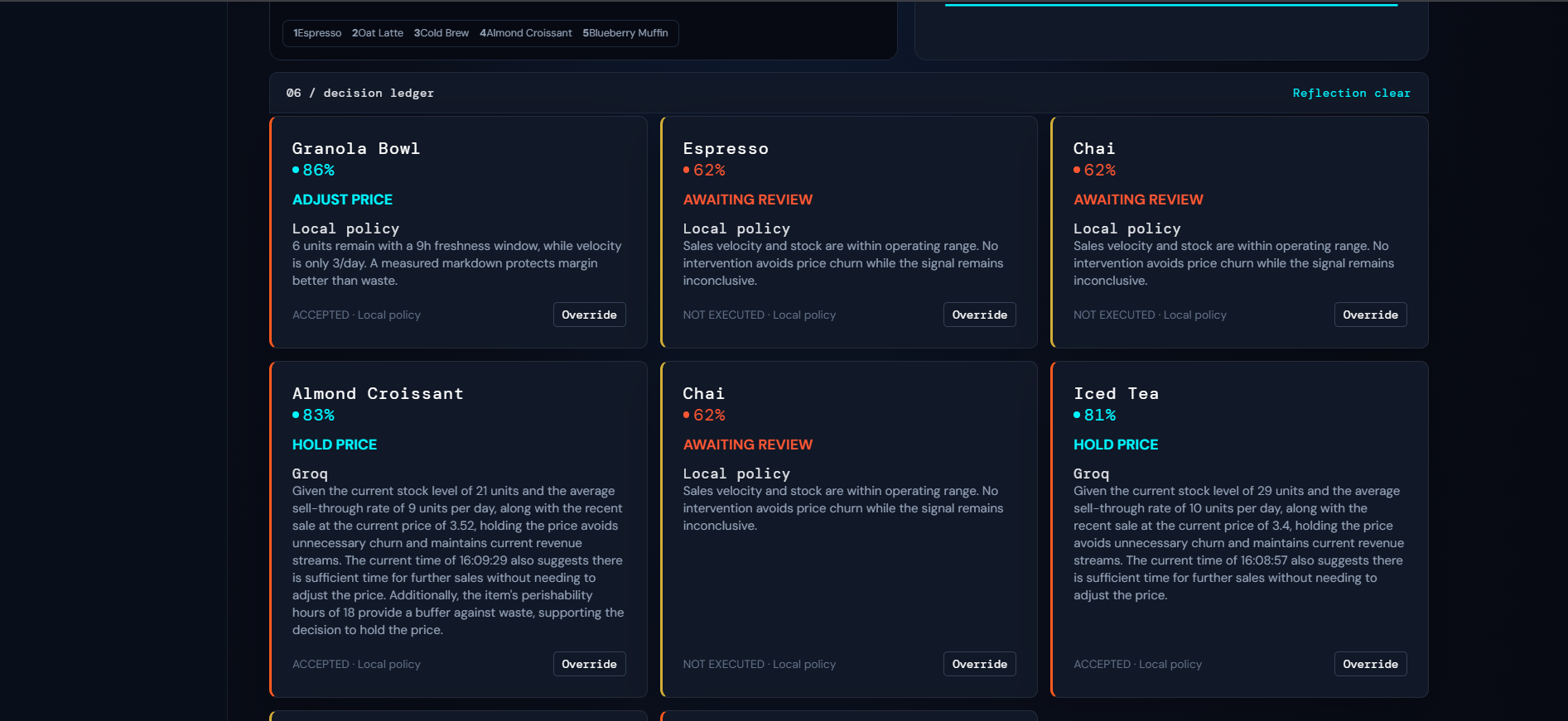
he Live Decision Ledger cards showing model confidence scores, reasoning explanations, and human override actions.
-
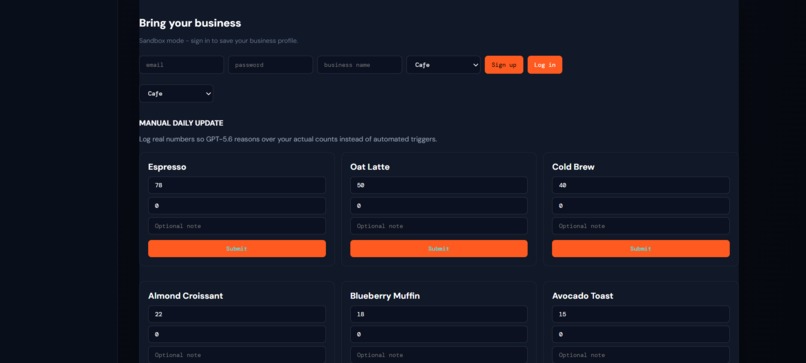
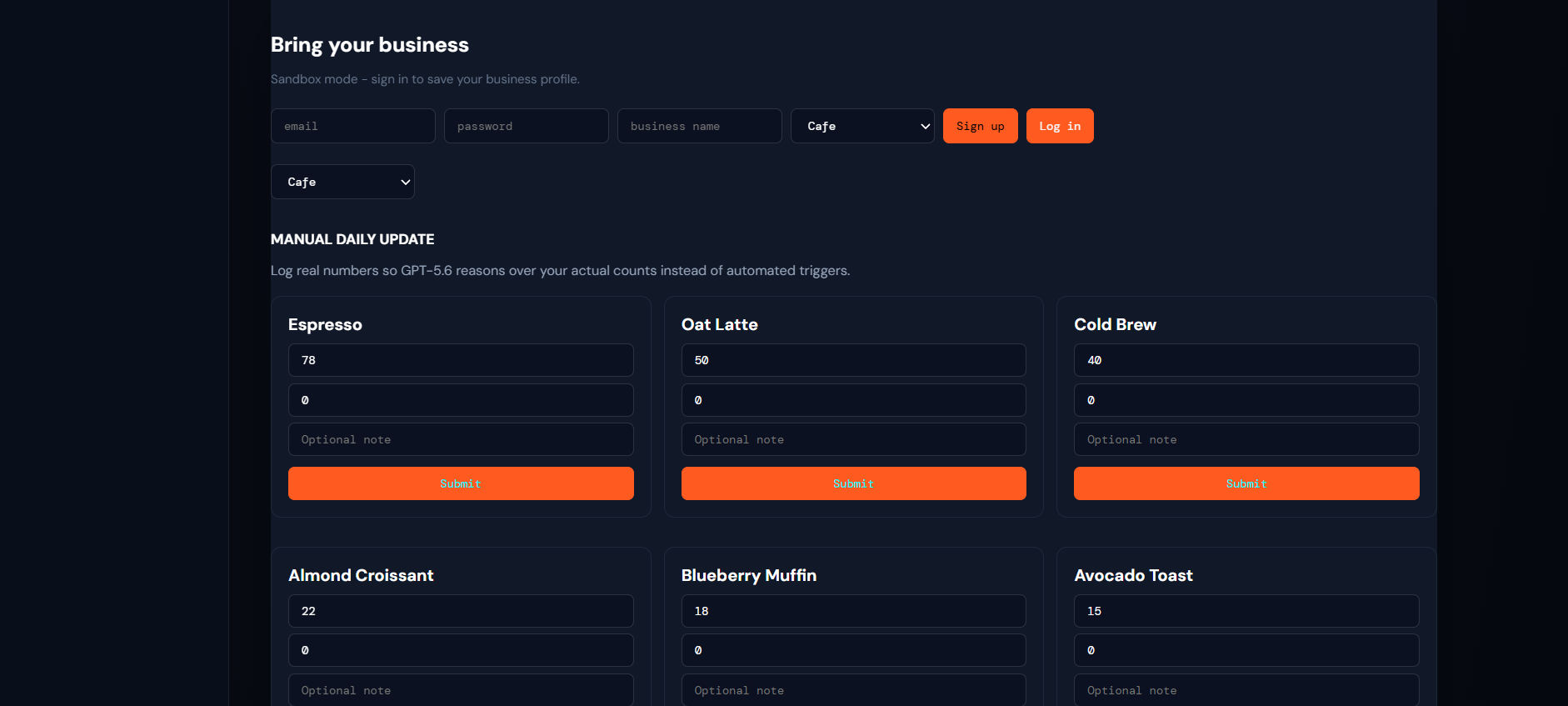
The business sandbox profile and manual daily update form for logging real counts instead of automated triggers.
-
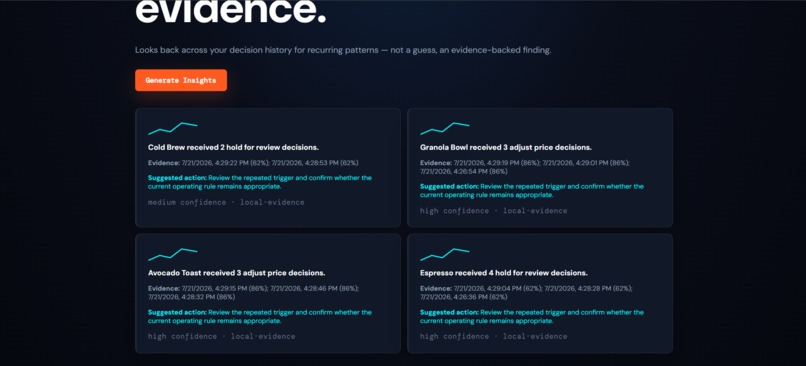
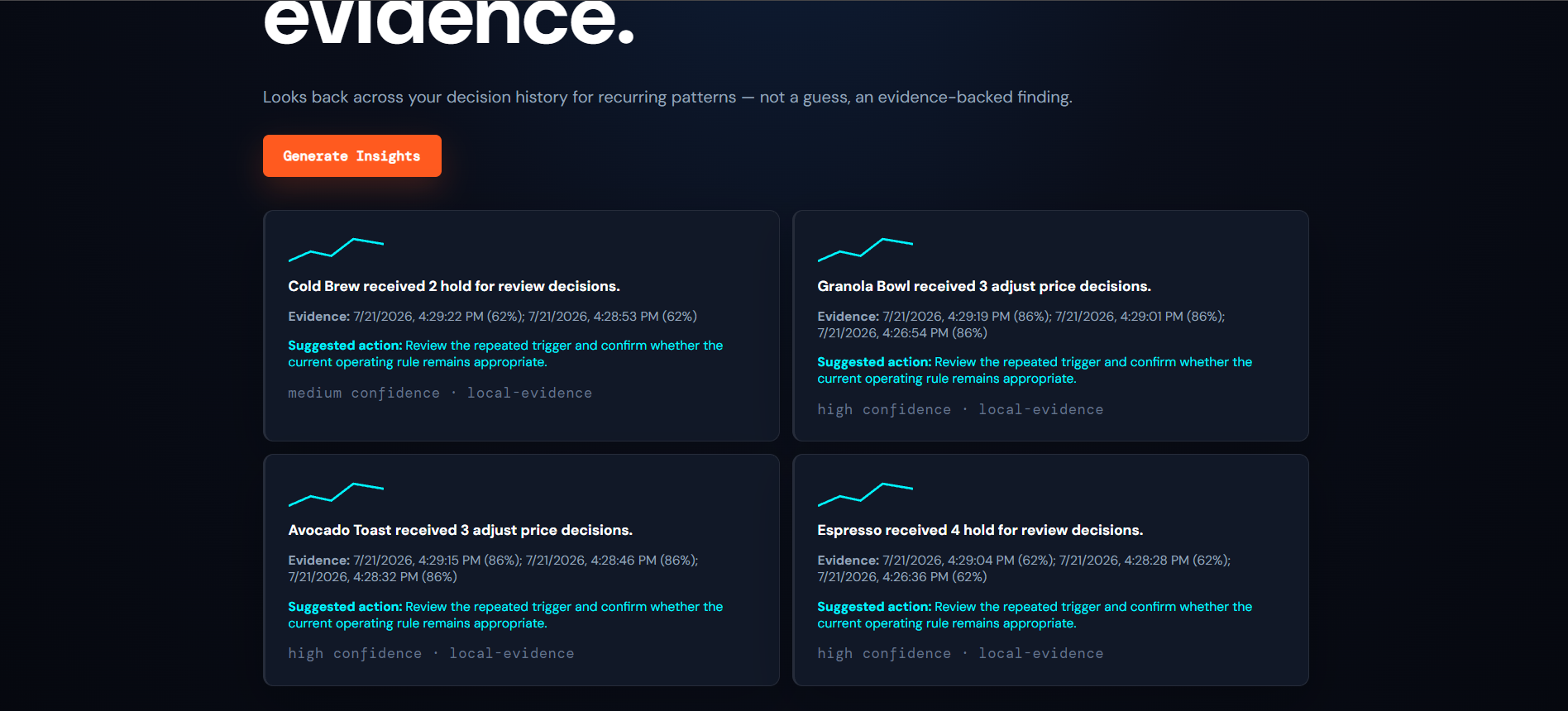
The Insights retrospective view analyzing decision history to surface evidence-backed operational improvements.

Inspiration
Every small business owner makes dozens of pricing and inventory calls a day, mostly by gut feeling, mostly a beat too late. They're running the same loop in their head, all day: notice something's off, decide what to do about it, act, and hope they remembered why they did it next time someone asks. That loop lives entirely in one person's head. Sentinel Ledger takes that loop and runs it live, continuously, with a paper trail — so the business isn't relying on someone happening to notice in time.
This isn't a retrospective analytics tool that tells you what you should have done yesterday. It's a decision-maker that acts on what's happening right now, and shows you exactly why, so you can agree, override, or learn from its reasoning.
What it does
Sentinel Ledger is a live decision system with GPT-5.6 sitting inline in a real-time pipeline, not bolted on as a chat feature. It ingests live sales, stock, and demand signals, simulated for demo, manually logged by a real business, or seeded from a business's public catalog and fires pricing and inventory decisions with a plain-language justification for every single call.
It also knows when not to act alone. Any proposed price change beyond ±30% gets automatically intercepted and routed to a human review queue instead of executing a deterministic guardrail sitting between the model's output and anything actually taking effect. If GPT-5.6 gets rate-limited, Groq steps in as a fallback, run through the exact same evidence and anti-template checks, and every decision is honestly labeled with which model actually answered, never faked as GPT-5.6 if it wasn't.
Every decision and every human override is logged permanently, exportable as an HMAC-signed audit record. A separate Insights engine - a second, distinct GPT-5.6 pass, periodically mines that decision history for real patterns: a price that keeps dropping every heat wave, a weekday that consistently under-sells. That's the actual difference between a one-off chat answer and a system that gets smarter about a specific business the longer it runs.
Key pieces:
- Live decision engine — weighs stock level, perishability, sell-through rate, external signals like weather, time of day, and past overrides together for every call, and routes low-confidence decisions to human review instead of guessing.
- Safety interceptor — hard-caps autonomous action at ±30% price movement; anything beyond that is flagged, not executed.
- Insights / Retrospective engine — evidence-backed pattern mining over accumulated decision history, not speculation.
- Bring Your Business mode — real businesses seed their real public catalog or log real daily numbers, and get the same reasoning engine applied to real data.
- Adaptive schema — cafes, boutiques, pharmacies, bookstores, hardware stores, or any custom type, adjusting which fields even matter (a hardware store has no "freshness window").
- Human-in-the-loop — every decision is overridable, and the override becomes context for future decisions on that same item.
How I built it
Built solo over several days with Codex and GPT-5.6, from an empty repo to a full multi-page product: Node/Express backend with a WebSocket event pipeline, a React frontend with Three.js (via React Three Fiber) for a live 3D inventory visualization, GSAP for entrance and scroll animation, and a structured-output GPT-5.6 integration for the decision and insights engines.
Codex handled most of the scaffolding and iteration - the initial backend and simulator, the decision engine's prompt engineering, the multi-page restructure (landing, sandbox, authenticated dashboard, insights, integrations, pricing), while I drove architecture and product calls directly in conversation with it, pushing specifically on the decision engine's reasoning quality until it stopped producing templated output and started actually weighing competing signals per decision.
Challenges I ran into
Getting GPT-5.6's reasoning to be genuinely fresh per decision, not templated, early runs produced near-identical sentence structures across different items regardless of what was actually happening with the stock. I iterated on the system prompt with explicit anti-repetition rules and concrete good/bad reasoning examples until the model reliably cited item-specific evidence instead of defaulting to safe, generic phrasing.
Groq flatly rejected our fallback calls with a 400 before I realized it
doesn't accept OpenAI's strict json_schema payload shape, it needed its
own request format entirely while still landing on the exact same output
contract, so a decision card looks identical whether GPT-5.6 or Groq
actually answered it.
The scariest one: an early version of the ingestion loop fired over 1,300 uncontrolled model calls with zero human in the loop and burned through both providers' quotas in one sitting. That's what forced the per-item throttle, the skip-if-nothing-changed guard, and the 15-minute circuit breaker after three consecutive 429s — none of it was planned upfront, it came directly from watching the system misbehave and fixing what actually broke.
What I learned
How much of "making AI feel trustworthy" comes down to forcing it to show its work with real evidence instead of just an answer — and separately, how much of building something autonomous is actually about deciding when it should stop and ask a human, not how smart its calls sound. The interceptor, the circuit breaker, and the honest engine-labeling weren't the interesting GPT-5.6 prompt work, they were the part that makes the whole thing something you could actually hand to a real business owner.
What's next for Sentinel Ledger
Real POS integration (Square, Shopify, Toast) to replace the simulated ingestion layer with live data. the ingestion layer is already architected so a real webhook can swap in without touching the decision engine, plus a real billing system behind the pricing tiers already built into the product.

Log in or sign up for Devpost to join the conversation.