-
-
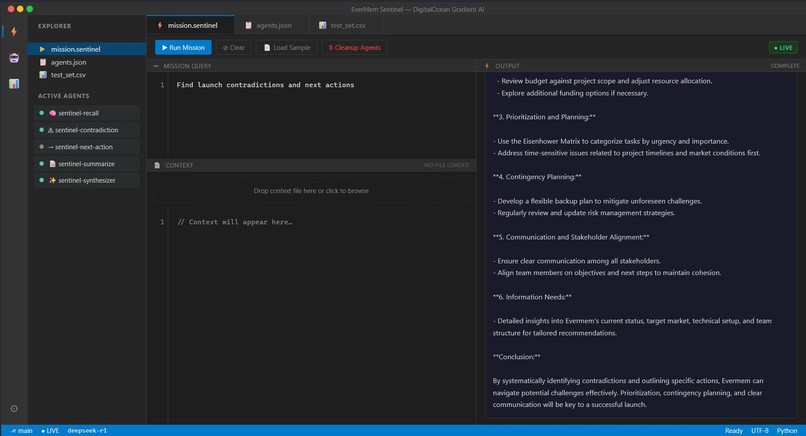
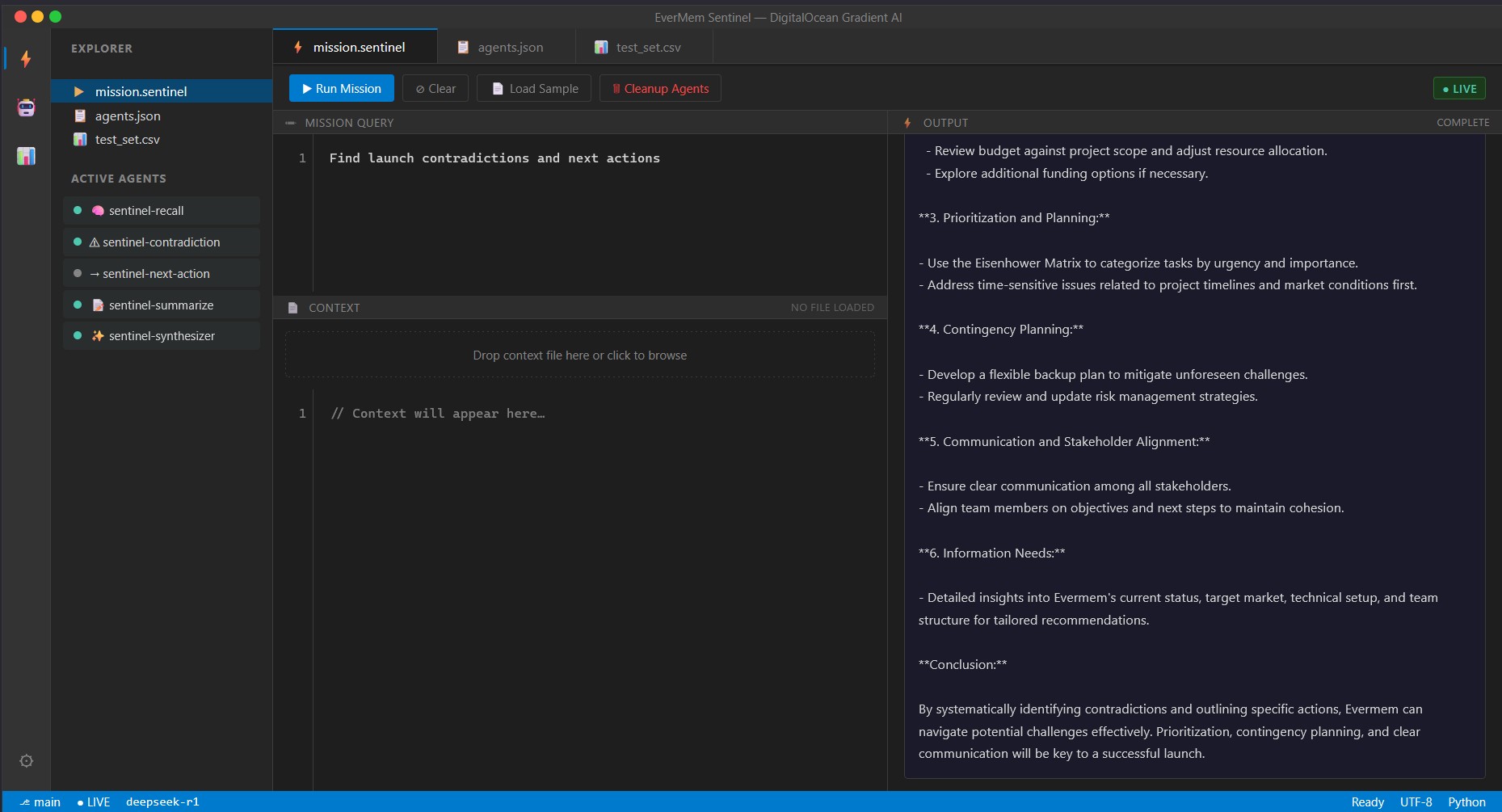
Front End running
Inspiration
Sentinel started from a simple but painful reality: teams are drowning in fragmented memory. Product notes, launch plans, research docs, and operator handoffs often disagree with each other, and static single-agent flows are weak at catching contradictions or turning messy context into a clear next move. We wanted to build a system that could act more like a mission commander than a chatbot: dynamically create the right specialists for the job, coordinate them, and return an operator-ready answer. That became Sentinel — an autonomous multi-agent memory operations system built for DigitalOcean GenAI.
What it does
Sentinel takes in a mission query plus optional context, then plans the work, spawns specialist agents at runtime, executes them as a coordinated swarm, and synthesizes the results into a final brief. Instead of relying on one fixed pipeline, it routes work by mission type such as recall, contradiction detection, next-action planning, and summarization. The current demo flow shows this on contradiction-rich launch data, where Sentinel identifies conflicting dates, surfaces memory risk, and proposes risk-aware next actions. It supports both a live DigitalOcean execution path and a local mock fallback, with structured outputs designed for automation and future evaluation pipelines.
How we built it
We built Sentinel as a Python-first system with a modular architecture around an orchestrator, agent factory, DigitalOcean client, config layer, and CLI. The CLI receives the mission and context, the orchestrator plans the specialist tasks, the agent factory generates targeted prompts and metadata, the DigitalOcean client handles agent creation and inference, and Sentinel merges everything into a final operator-ready response. The repo includes a starter evaluation dataset, tests, and a sample knowledge base for demoing contradiction detection. The DigitalOcean integration is split between GenAI v2 agent management and inference endpoints, while the mock mode lets us develop and demo quickly without blocking on live infrastructure.
Challenges we ran into
The hardest part was avoiding the usual “multi-agent theater” problem, where multiple agents exist but do not actually add meaningful specialization. We had to make the runtime agent spawning useful, not decorative, and keep the system flexible without turning it into an over-engineered maze. Another challenge was building around a DigitalOcean-native execution path while still keeping the project easy to run locally. That meant designing a clean separation between orchestration logic and provider-specific API behavior, so the system could work in mock mode during rapid iteration and flip into live mode with minimal changes. We also had to think carefully about structured outputs and evaluation from the start so Sentinel could evolve beyond a demo into something measurable and automatable.
Accomplishments that we're proud of
We are proud that Sentinel is not a fixed chain pretending to be agentic. It actually creates specialist agents dynamically at runtime based on the mission, routes by task type, and returns a synthesized operator brief rather than raw model chatter. We are also proud of the clean developer experience: simple CLI entry points, test coverage, a starter eval set, a live DigitalOcean path, and a mock fallback that makes the project practical to build and demonstrate. Most importantly, Sentinel already shows a concrete high-value use case: finding contradictions in memory and converting them into actionable recommendations.
What we learned
We learned that memory operations is a strong proving ground for agentic systems. It is concrete, high stakes, and easy to evaluate: either the system caught the contradiction, identified the risk, and proposed a sensible next action, or it did not. We also learned that dynamic specialization matters more than agent count. A smaller number of well-targeted specialist roles is more useful than a large static swarm. On the engineering side, we learned that building with a mock/live split dramatically improves iteration speed, and that structured outputs plus evaluations should be part of the design from day one, not bolted on later.
What's next for Sentinel
Next, we want to expand Sentinel from a CLI-driven memory operations system into a broader mission-control layer for knowledge-heavy teams. That includes deeper evaluation pipelines, richer specialist types, improved synthesis quality, and stronger automation hooks for downstream workflows. We also want to harden the live DigitalOcean path, refine the operator UX, and push Sentinel toward more persistent, production-grade memory reasoning for launch ops, research coordination, incident analysis, and decision support. The long-term vision is a system that does not just retrieve information, but actively pressure-tests it, resolves contradictions, and helps teams act with confidence.
Built With
- cli
- csv
- digitalocean
- dotenv
- genai
- github
- json
- pytest
- python
- rest

Log in or sign up for Devpost to join the conversation.