-
-
Dashboard
-
Inspiration
Modern households are filled with connected gadgets: smartphones, laptops, TVs, baby monitors, smart plugs, and printers. Many cheap IoT devices keep default factory credentials or never receive firmware updates, leaving home networks vulnerable to intruders. Existing cybersecurity tools output complex, jargon-heavy alerts that ordinary homeowners cannot understand. Worse, even when aware of an issue, people hesitate to block a suspicious device out of fear of breaking their internet setup. We set out to solve this: Sentinel turns home network defense into an intuitive voice experience for Alexa+. It translates cryptic technical diagnostics into clear, everyday language and provides safe, reversible, voice-confirmed controls.
What it does
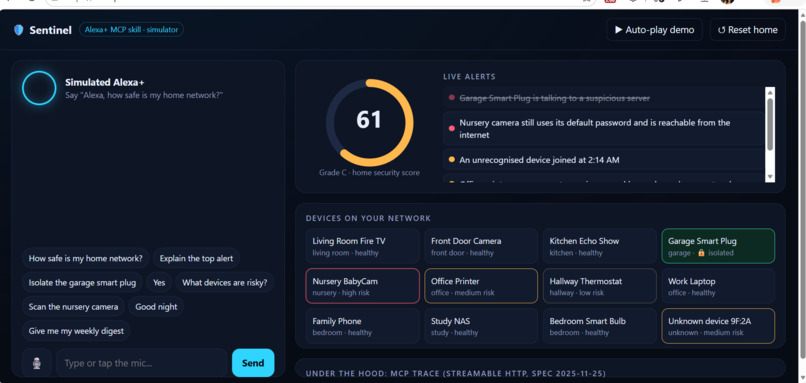
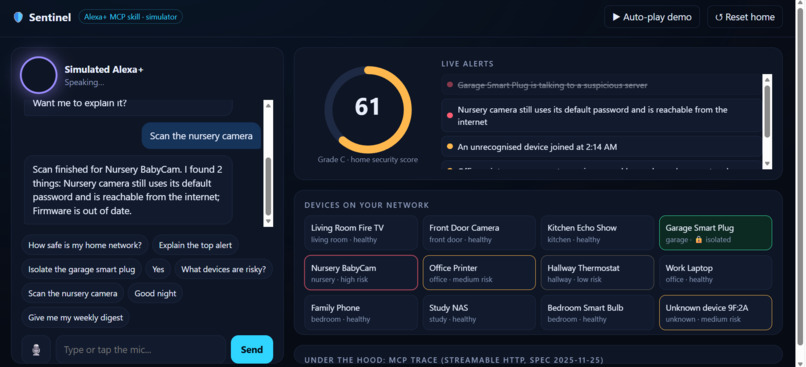
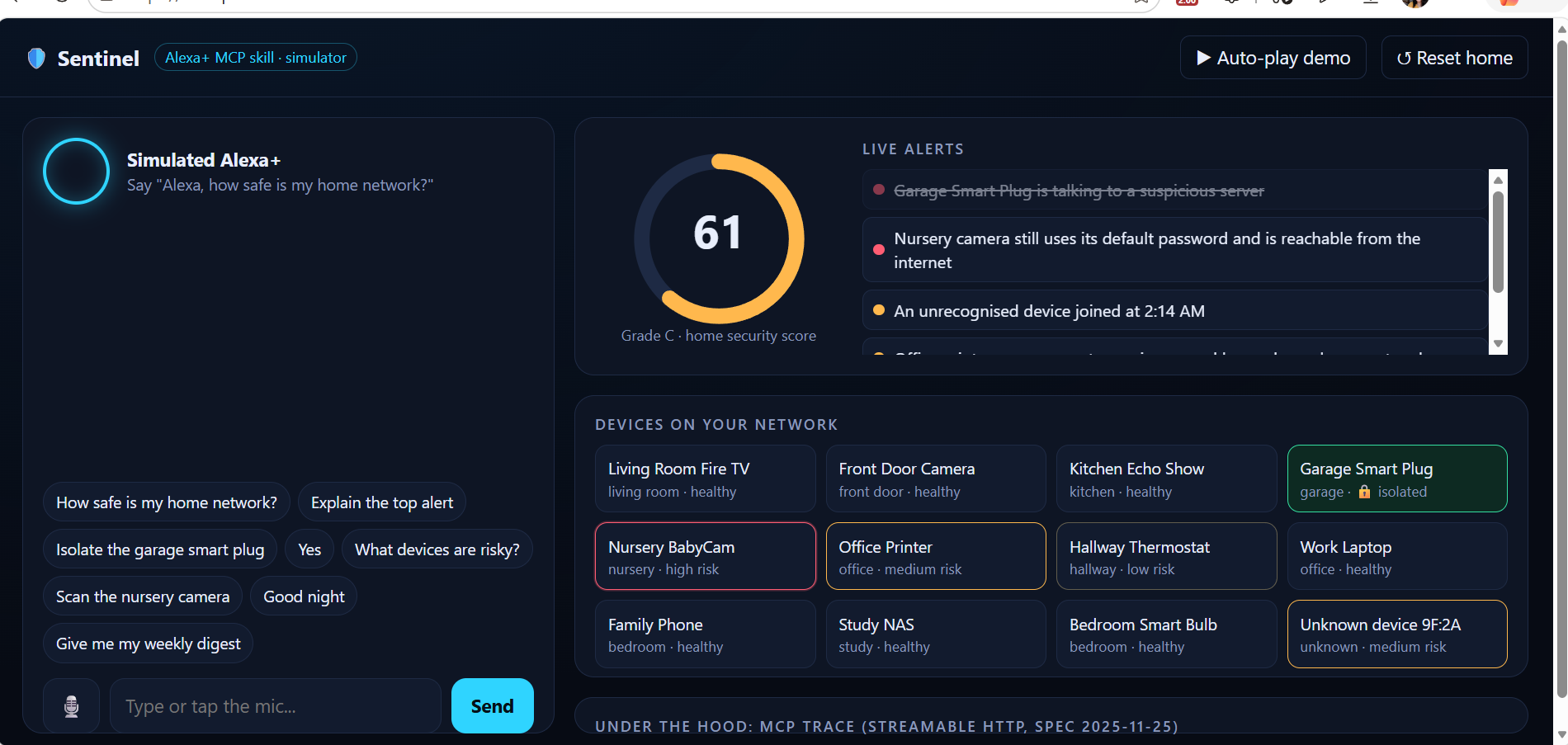
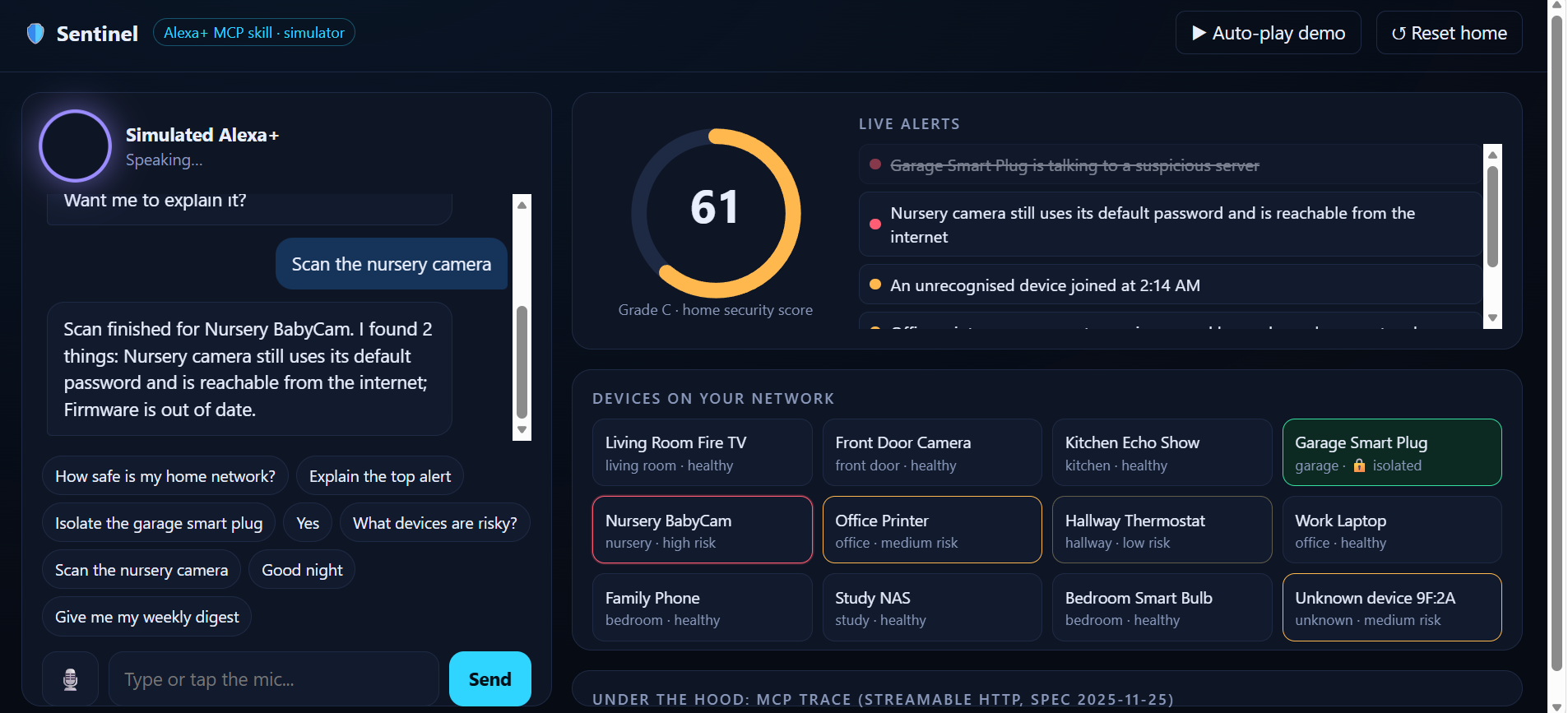
Sentinel connects directly into Alexa+ via the open Model Context Protocol (MCP), equipping the assistant with 9 dedicated home security tools: Natural Voice Health Checks: Users ask, "How safe is my home network?" and receive an overall score out of 100 alongside the single most critical risk in plain words. Safe, Reversible Isolation: If an appliance (such as an infected plug or camera) shows anomalous behavior, Sentinel enforces a two-turn confirmation guard. It asks for permission first ("Should I go ahead?"), cuts internet access only after approval, and allows full restoration at any time. Plain-Language Threat Summaries: Demystifies vulnerabilities (e.g., explaining an unpatched CVE on a nursery camera simply) without overwhelming non-technical users. Smart Routines: Executes everyday checks, including a 5-point bedtime check ("Alexa, Good night") and temporary isolated guest Wi-Fi networks. Transparent Architecture: A built-in "Under the Hood" panel lets users and judges inspect live MCP JSON-RPC tool calls as they execute.
How we built it
Sentinel MCP Server: Built in Node.js (ES Modules) to expose 9 modular security tools over standard JSON-RPC. Includes defensive safety layers: Origin header verification, strict input validation, and optional API key authentication.
Simulated Alexa+ Intent Engine: A Node.js and Express dispatcher that parses user intent and routes conversational requests to the corresponding MCP tool.
Web Client Experience: Built with HTML5, CSS3, and JavaScript, featuring an interactive safety score ring, live IoT device cards, voice/text chat, and a live MCP trace view. Mock State Store: Manages realistic states for 12 simulated IoT devices and 5 live threat alerts, dynamically updating safety scores (e.g., jumping from 43 to 61 upon device quarantine).
Automated Test Suite: 7 end-to-end automated tests verifying tool discovery, invocation, parameter boundaries, and state mutations.
Challenges we ran into
Non-Destructive Voice Design: Voice controls can lead to accidental disruption if an essential device is severed without consent. Designing the state machine inside quarantine_device to reliably pause and demand explicit user confirmation was essential.
MCP Schema Alignment: Defining clean, typed tool definitions so the assistant extracts device names, duration windows, and action flags correctly without hallucinating parameters.
Simulating High-Fidelity IoT State: Balancing realism with hackathon constraints required building an in-memory home network state engine that accurately models real router threats (open ports, unpatched firmware, default passwords) without needing physical hardware.
Accomplishments that we're proud of
Developing a fully functional, standards-compliant MCP server featuring 9 working tools. Creating a safety-first confirmation pattern that makes device quarantine reversible and risk-free for non-technical users. Achieving a 100% pass rate across all 7 automated end-to-end tests. Transforming complex network security diagnostics into accessible, everyday voice commands.
What we learned
Structuring production-ready tool schemas adhering to the open Model Context Protocol (MCP) standard. Designing conversational guardrails and two-step human-in-the-loop validation for agentic tools executing network-level actions. Crafting plain-language security summaries that convey risk urgency without inducing user panic.
What's next for Sentinel: Home Network Guardian
Real Router Firmware Integration: Hooking into real OpenWrt, eero, and Home Assistant APIs to execute actual network isolation at the packet level.
Multi-Tenant OAuth: Adding full user authentication so separate households securely control their own private network data.
Proactive Voice Alerts: Enabling proactive Alexa+ audio notifications the moment an IoT device exhibits suspicious outbound traffic, preventing attacks before they spread.
Built With
- alexa
- alexa-plus
- amazon-developer
- api
- conversational-ai
- css3
- cybersecurity
- e2e-testing
- express.js
- git
- github
- home-automation
- html5
- iot
- javascript
- json-rpc
- mcp
- natural-language-processing
- network-security
- node.js
- open-source
- rest-api
- smart-home
- web-app
- websockets

Log in or sign up for Devpost to join the conversation.