Inspiration
Environmental risks such as wildfires and floods can develop quickly and affect communities, ecosystems, and infrastructure. However, environmental information is not always easy to interpret, especially when different indicators need to be considered together.
This inspired us to build Sentinel Habitat, an experimental environmental intelligence platform designed to turn environmental indicators into understandable risk insights. Our goal is to explore how artificial intelligence can help people interpret environmental conditions, understand uncertainty, and identify possible actions.
What it does
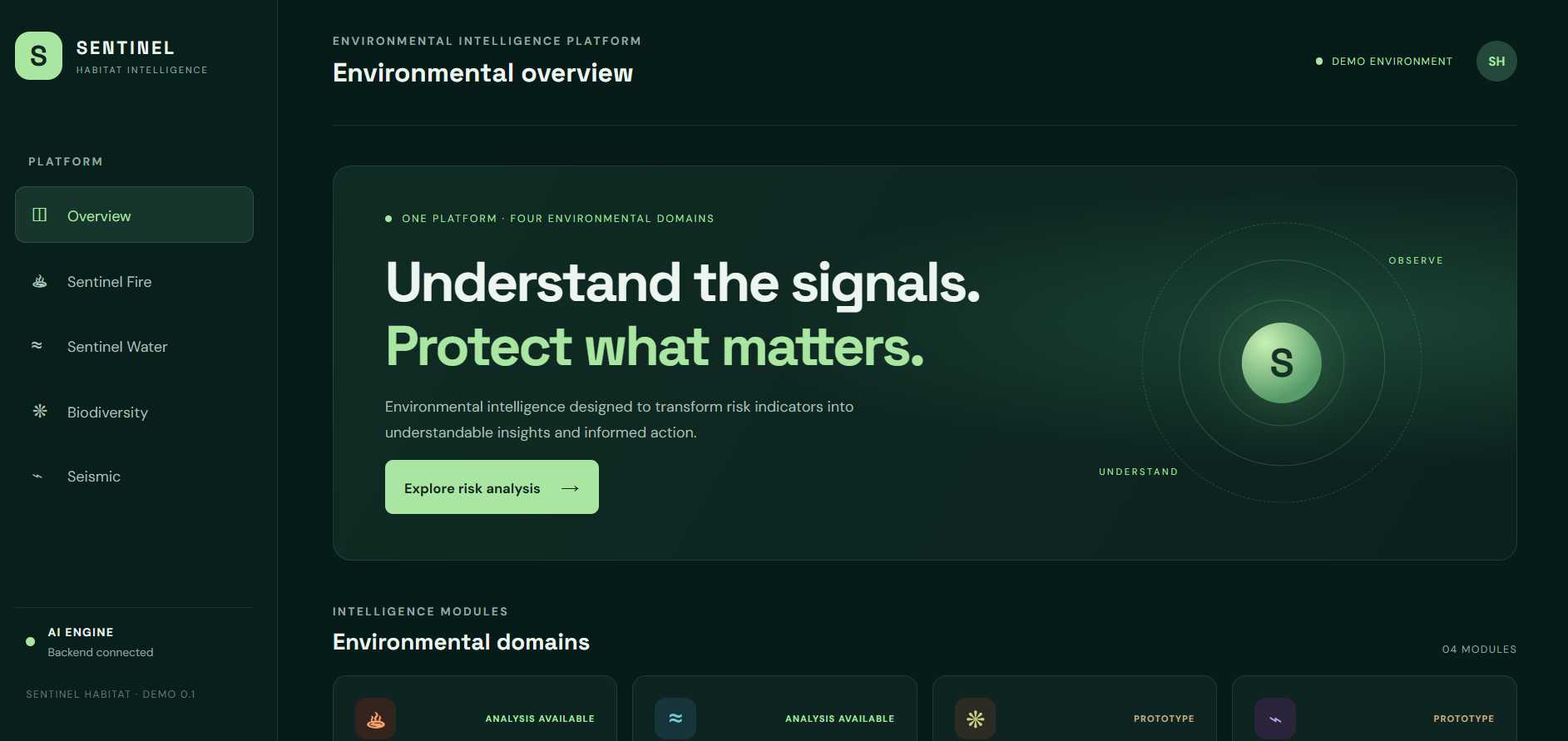
Sentinel Habitat is a modular prototype for environmental risk analysis. It brings together different environmental domains under one platform:
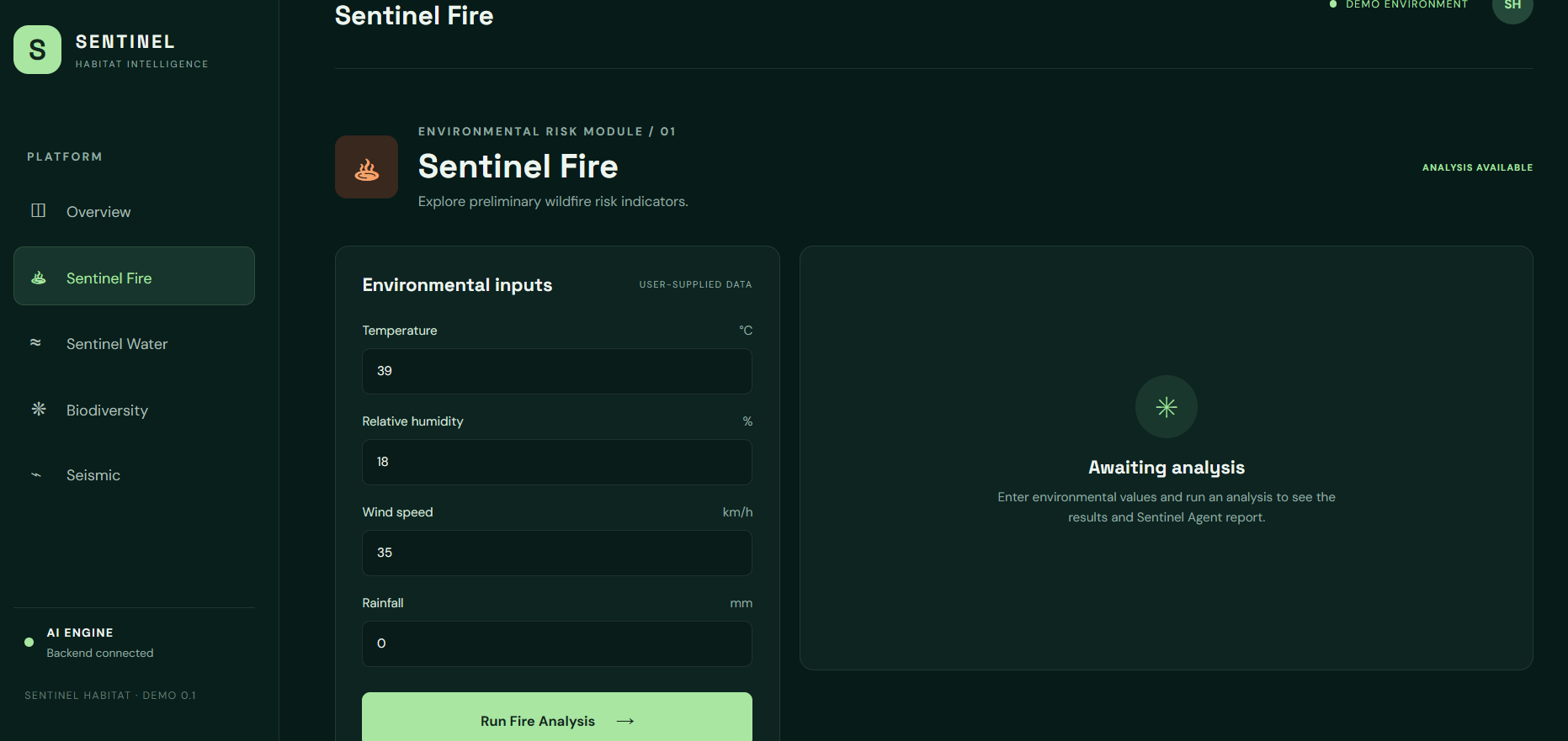
Sentinel Fire: Evaluates preliminary wildfire risk using temperature, humidity, wind speed, and rainfall.
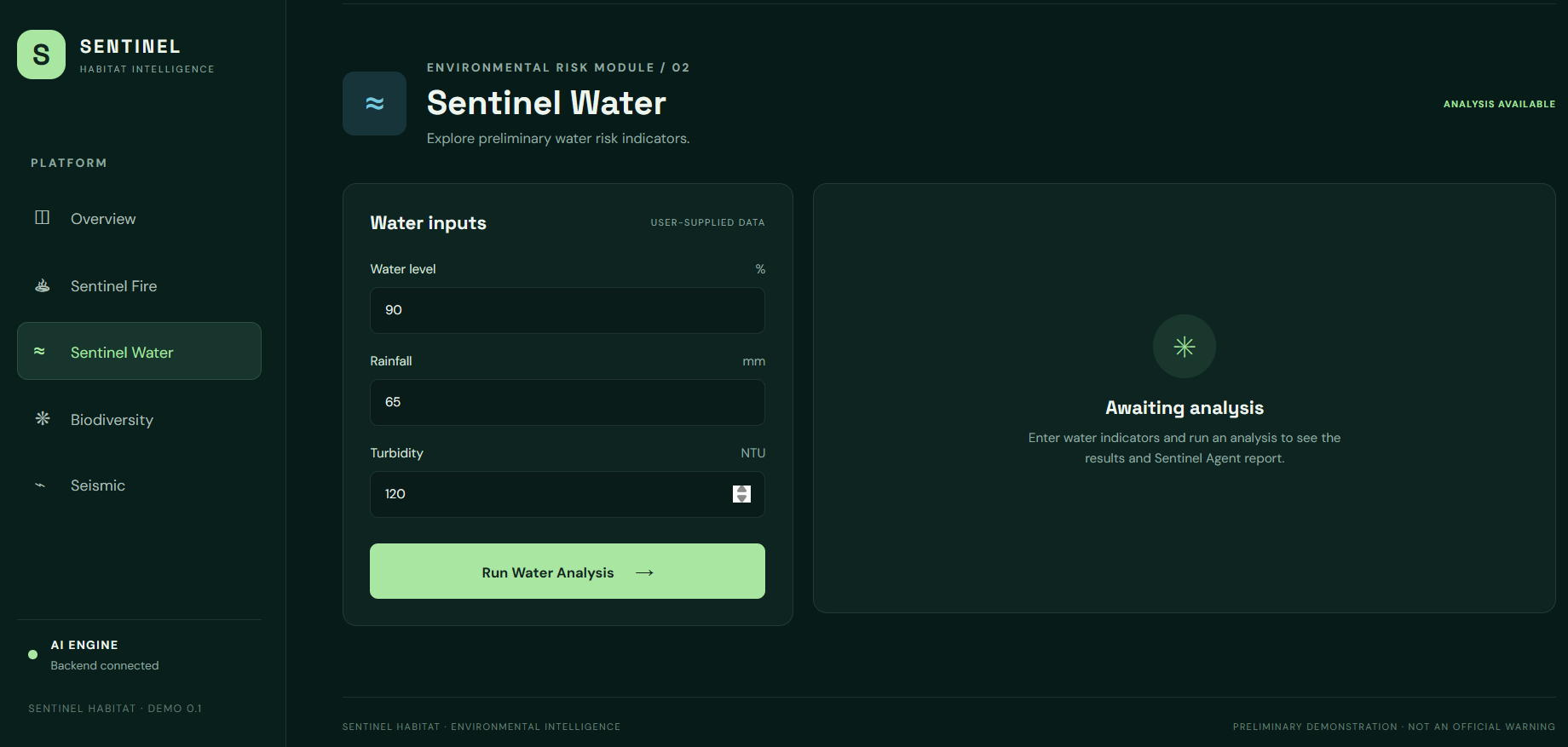
Sentinel Water: Evaluates preliminary water-related risk using water level, rainfall, and turbidity.
Sentinel Biodiversity: A planned module focused on analyzing ecosystem changes and deforestation using geospatial and satellite information.
Sentinel Seismic: A planned module to explore seismic signal analysis and post-event information.
The platform also includes Sentinel Agent, an AI-powered assistant that uses NVIDIA Nemotron to explain analysis results, highlight uncertainty, and suggest recommendations.
The current Fire and Water modules use user-provided or simulated data and preliminary rule-based calculations. The platform is an experimental prototype, not an official monitoring or emergency warning system.
How we built it
We built Sentinel Habitat using a modular architecture:
Python and FastAPI for the backend and API endpoints.
HTML, CSS, and JavaScript for the web interface.
NVIDIA Nemotron 3 Nano 30B A3B for AI-generated explanations.
Nebius AI Studio / Token Factory to access the language model.
GitHub for source code management and collaboration.
Render to deploy the web application.
The backend processes environmental indicators and generates preliminary assessments for the Fire and Water modules. The results are then sent to the AI agent, which produces explanations designed to make the information easier to understand.
Challenges we ran into
One of our main challenges was connecting the application to the NVIDIA Nemotron model through Nebius Token Factory and configuring the backend to handle AI responses correctly.
We also had to design a modular architecture that could support different environmental domains without presenting simulated information as real-world measurements.
Another challenge was working within limited time and resources while prioritizing a functional prototype, a public repository, and a deployed demonstration.
Accomplishments that we're proud of
We are proud to have built and deployed a working web prototype that combines environmental risk assessment with AI-generated explanations.
Some of our key accomplishments include:
Implementing preliminary Fire and Water risk analysis.
Integrating NVIDIA Nemotron through Nebius Token Factory.
Creating an AI agent that explains results and communicates uncertainty.
Designing a modular architecture that can be extended to other environmental domains.
Publishing the source code in a public GitHub repository.
Deploying the application so others can explore the prototype.
What we learned
We learned how to integrate a large language model into a real application using an API, structure a backend with FastAPI, and connect it to a web interface.
We also learned that AI-generated explanations should not replace evidence or reliable measurements. Communicating limitations, uncertainty, and the origin of data is essential when developing systems related to environmental risks.
What's next for Sentinel Habitat
Our next steps are to connect the platform to reliable environmental data sources, develop the Biodiversity and Seismic modules, improve the risk assessment methods, and introduce data persistence and historical analysis.
We also want to develop a verification loop that compares AI-generated explanations with evidence from trusted sources.
Our long-term vision is to make Sentinel Habitat a more complete environmental intelligence platform that helps transform complex environmental information into clearer, more accessible insights.

Log in or sign up for Devpost to join the conversation.