Inspiration
Production QNX images ship in cars, medical devices, and industrial systems — yet a single unsafe setting (a debug shell left on a serial console, a world-writable startup script, telnet still enabled) can turn a safety-critical system into an open door. I wanted a tool that catches those mistakes before the image ships — not after.
What it does
Sentinel audits the files that define a QNX target image — startup scripts, mkifs buildfiles, component versions, sshd_config, and passwd/shadow — and flags production-unsafe configuration with severity, exact file and line, a plain-English explanation, and a suggested patch. It then applies the mechanically safe fixes and re-audits to prove the image is clean.
Demo results (all real output):
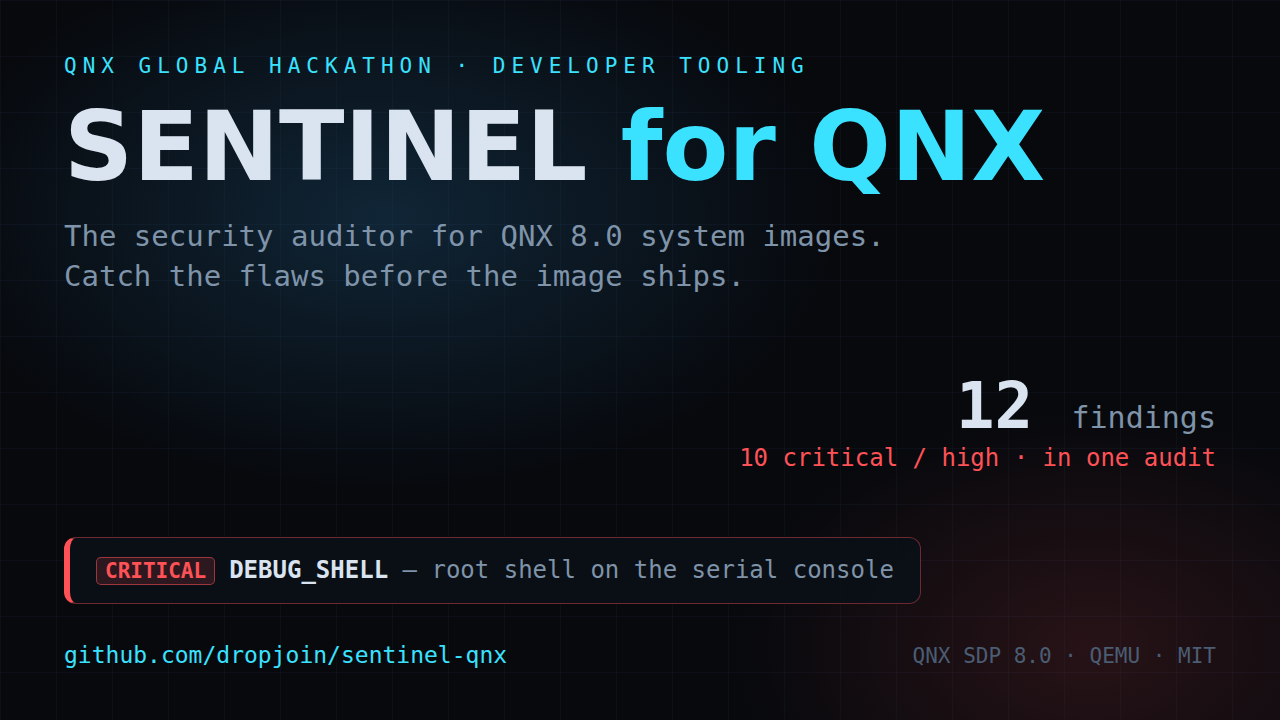
- Full audit of a flawed image definition finds 12 findings, 10 critical or high (debug shell on the serial console, telnet via inetd, world-writable startup script, OpenSSL 1.0.2, unsafe sshd_config, missing adaptive partitioning).
- The auto-fix pass takes the fixable set from 8 findings to 3, with the remaining 3 honestly labelled as human decisions (component upgrades, account changes, APS design).
- The hardened sample set audits clean with exit code 0.
Proof on QNX SDP 8.0: qcc (GCC 12.2.0) compiles a real QNX binary (ELF 64-bit, interpreter /usr/lib/ldqnx-64.so.2). Booting the hardened image on the QEMU target (mkqnximage --run from the QNX SDP 8.0 Quick Start image) is a separate manual validation step, not part of the demo script — the automated demo flow does not depend on QEMU.
How I built it
Deterministic audit core (8 rule families), runs fully offline, test suite 14/14 passing, MIT licensed. Built with QNX SDP 8.0 host tools on Linux; the audited artifacts are the target image files themselves (mkifs buildfiles, startup scripts). The automated demo flow (sh demo/run_demo.sh) audits a sample image definition, applies the suggested fixes, and re-audits clean; it does not depend on QEMU. Booting the hardened image on the QEMU target is a separate manual validation step, not part of the demo script, and the compile proof uses qcc 12.2.0 cross-compilation.
Challenges I ran into
Making the auto-fix honest: some findings cannot be fixed automatically without changing intended behaviour, so Sentinel labels those as human decisions instead of silently "fixing" them. Keeping the audit deterministic and offline also mattered, so results are reproducible anywhere.
What's next
More rule families covering additional QNX services and image components, plus CI integration so every image build is audited automatically.
Built With
- python
- qemu
- qnx
- qnx-sdp-8.0
