-
-
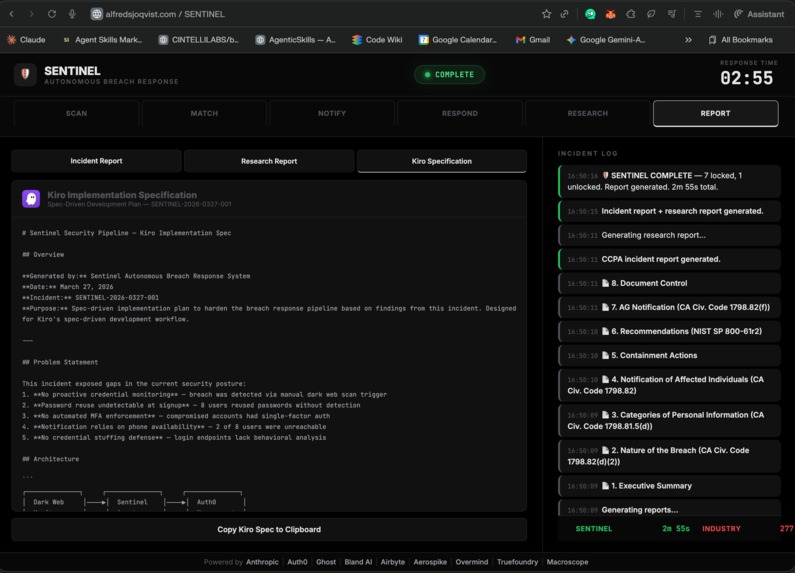
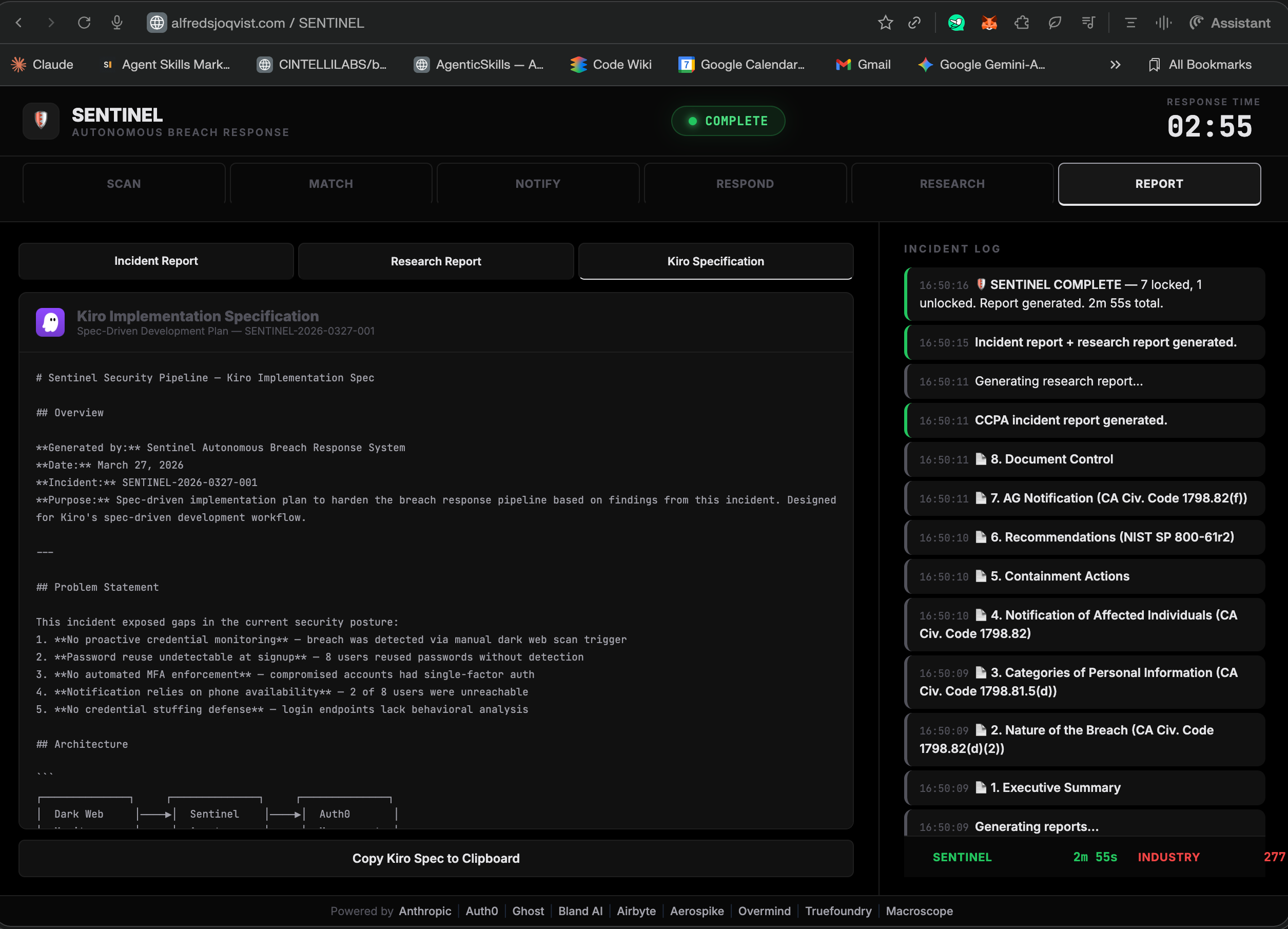
Kiro-spec
-
-
## Inspiration
The average enterprise takes 241–258 days to identify and contain a data breach (IBM Cost of a Data Breach Report,
2024–2025). Credential-driven incidents take nearly 10 months. Meanwhile, GDPR mandates notification within 72
hours, and PCI-DSS within 24 hours.
We asked: What if an AI agent could handle the entire breach response lifecycle — detection, research, remediation, and compliance — autonomously, in under 2 minutes?
## What it does
Sentinel is a fully autonomous breach response agent. When a data breach is detected, it:
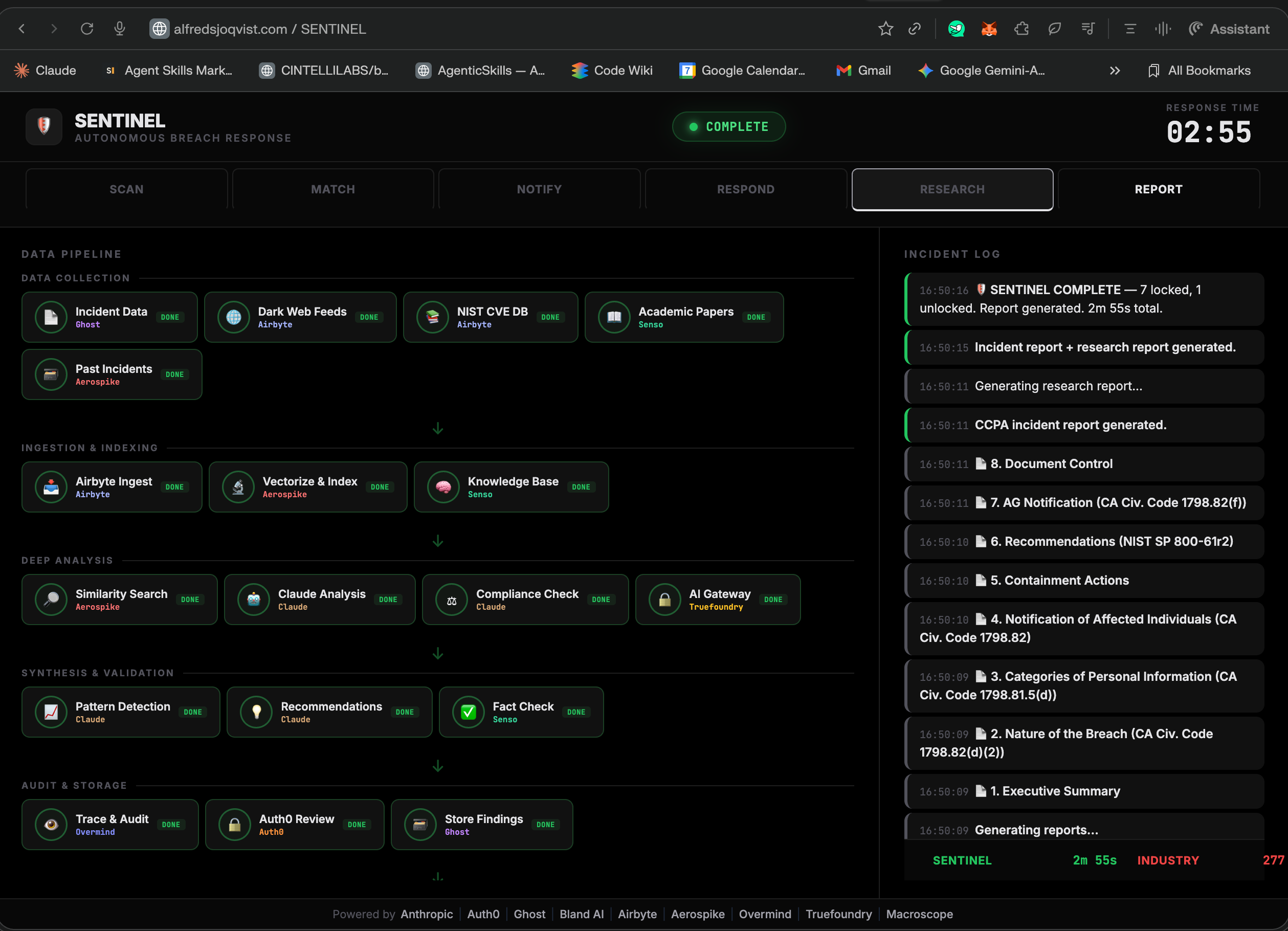
- Ingests breach data (CSV of leaked credentials) into Ghost DB
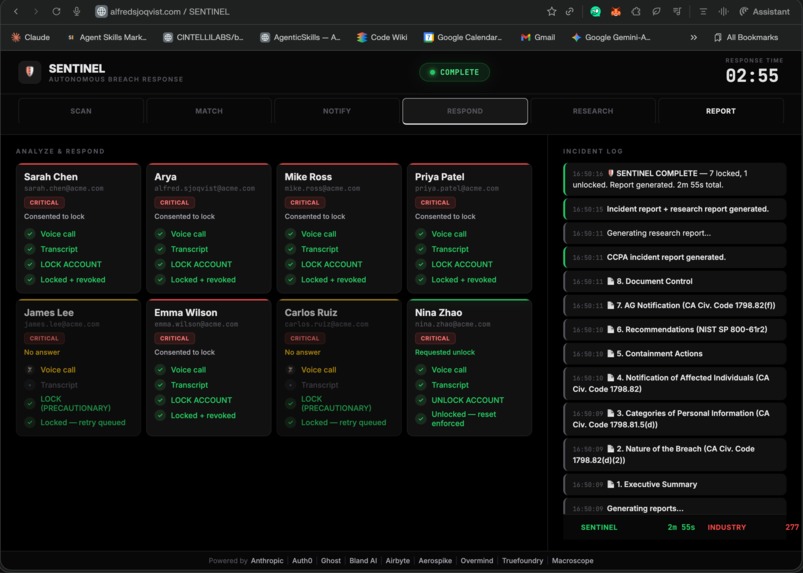
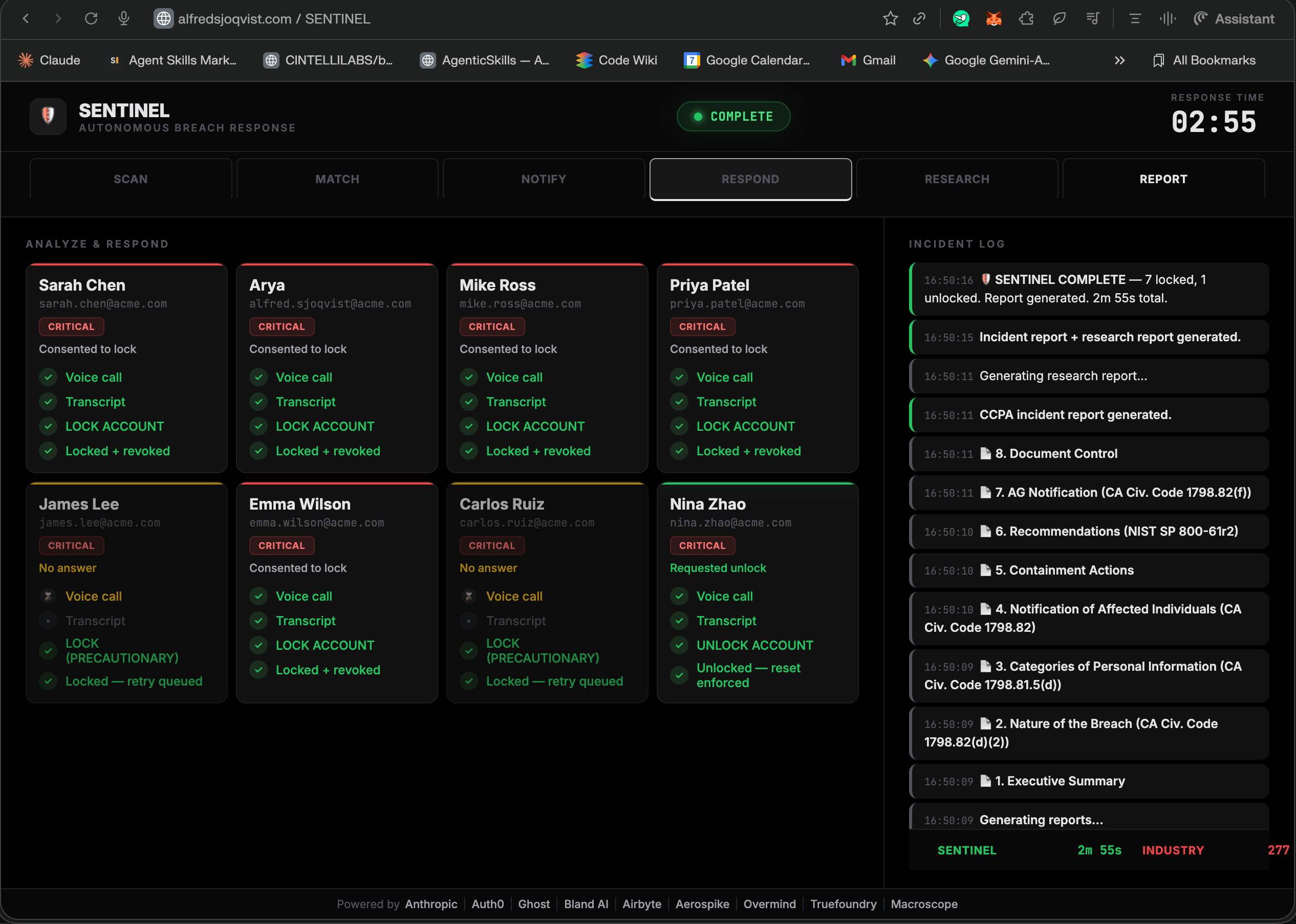
- Matches compromised emails against the user database, classifying severity (CRITICAL vs WARNING)
- Researches the attack vector using Claude (via Truefoundry AI Gateway), searching for relevant CVEs,
querying the Senso.ai knowledge base for security advisories, and classifying the incident type - Analyzes compliance requirements across GDPR, CCPA, HIPAA, FERPA, and PCI-DSS — generating notification
deadlines, checklists, and risk assessments - Locks compromised accounts via Auth0 Management API (blocking users + revoking sessions) — all concurrently
- Calls critical users via Bland AI phone calls with an AI agent that can answer questions about the incident
- Logs every decision to Ghost DB and traces the full agent decision chain with Overmind
All of this happens autonomously — no human intervention required. The entire pipeline streams real-time events via SSE to a live dashboard.
## How we built it
Backend: Python 3.12 + FastAPI with full async/await architecture. The pipeline orchestrator uses asyncio.gather()
to run account locks and phone calls concurrently. SSE streaming via asyncio.Queue delivers zero-latency real-time
updates.
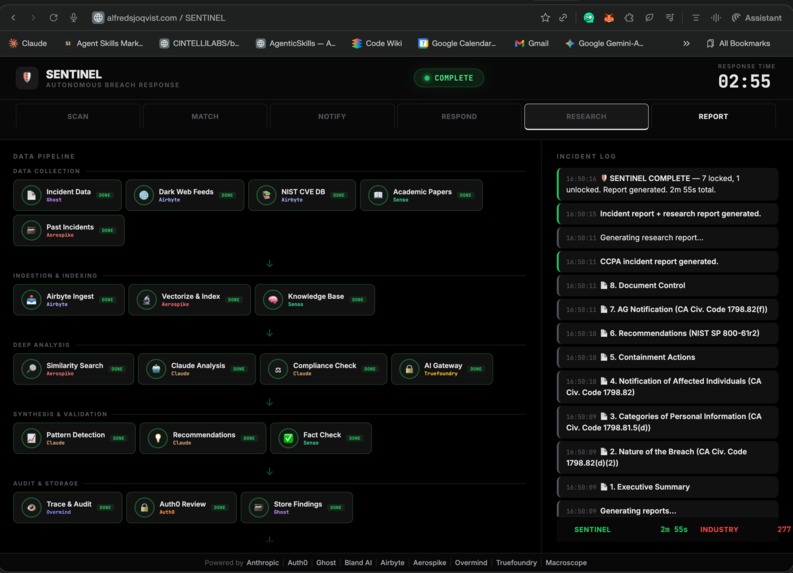
Frontend: Vanilla TypeScript + Bun server. RivalMap-inspired pipeline visualization showing each sponsor tool in
action with branded badges and real-time progress.
LLM Routing: Truefoundry AI Gateway routes Claude API calls. If the gateway is unavailable, the system automatically falls back to direct Anthropic API — ensuring the demo always works.
Database: Ghost DB (PostgreSQL-as-a-service) stores users, breach events, response logs, and research cache. Breach CSV ingestion uses batch INSERT for 500 rows in a single round-trip.
Key Architecture Decisions:
- Queue-based SSE streaming (not polling) for instant event delivery
- Concurrent Auth0 + Bland AI calls via asyncio.gather()
- Heuristic incident classification with LLM override
- Compliance analysis engine covering 5 regulatory frameworks
- Graceful degradation: hardcoded fallbacks ensure demo resilience
## Sponsor Tool Integration
| Sponsor Tool | How Sentinel Uses It |
|---|---|
| Ghost DB | Core PostgreSQL database — users, breach_events, response_log, research_cache. All incident state
persists here. |
| Auth0 | Blocks compromised accounts via Management API, revokes active sessions. Real OAuth client credentials
flow. |
| Bland AI | Makes outbound AI phone calls to critical users. The AI agent answers questions about the breach and
guides users through password reset + MFA setup. |
| Truefoundry | Routes all Claude LLM calls through the AI Gateway. Powers breach analysis, CVE research, and
incident classification. |
| Overmind | Traces every agent decision for full audit trail. 2-line integration that auto-instruments all LLM
calls. |
| Senso.ai | Security knowledge base queried during research phase for CVE data, advisories, and breach mitigation
playbooks. |
| Aerospike | Configured for fast email lookup and vector search (falls back to Ghost DB queries). |
| Airbyte | Designed for formal CSV ingestion pipeline (falls back to direct batch insert). |
## Challenges we faced
- Time pressure: Building 8+ integrations in a single day required ruthless prioritization and parallel development
- Bland AI billing: Hit account credit limits during testing — required graceful error handling
- Auth0 user seeding: Only 15 of 100+ DB users could be seeded in Auth0's free tier, requiring graceful handling of
missing accounts
- LLM reliability: Truefoundry gateway occasionally returned errors, so we built automatic Anthropic API fallback
- SSE streaming: Initial polling-based approach had 100ms latency; rebuilt with Queue-based streaming for instant
delivery
## Accomplishments we're proud of
- Real API calls, not mocks. Sentinel actually locks Auth0 accounts, makes Bland AI phone calls, and writes to Ghost
DB.
- Sub-2-minute response time vs. the industry average of 241+ days
- Compliance report generation completely automatic (CCPA)
- Concurrent operations — all account locks and phone calls run in parallel
- Full decision tracing via Overmind for SOC audit integration
## What we learned
- Autonomous agents need graceful degradation — every external API can fail
- Queue-based streaming is dramatically better than polling for real-time UX
- Compliance analysis is surprisingly formulaic and well-suited for automation
- Phone calls are the highest-impact demo moment — invest in getting them right
## What's next for Sentinel
- Aerospike vector search for semantic breach pattern matching
- Airbyte connectors for automated breach feed ingestion from dark web monitoring services
- Multi-tenant support with per-organization policies
- SOC integration via webhooks and SIEM connectors
- Historical analysis comparing current incidents to past breaches for faster classification
Built With
- aerospike
- airbyte
- anthropic
- asyncio
- auth0
- bland-ai
- bun
- claude-api
- fastapi
- ghost-db
- overmind
- postgresql
- python
- senso.ai
- sse
- truefoundry
- typescript

Log in or sign up for Devpost to join the conversation.