-
-
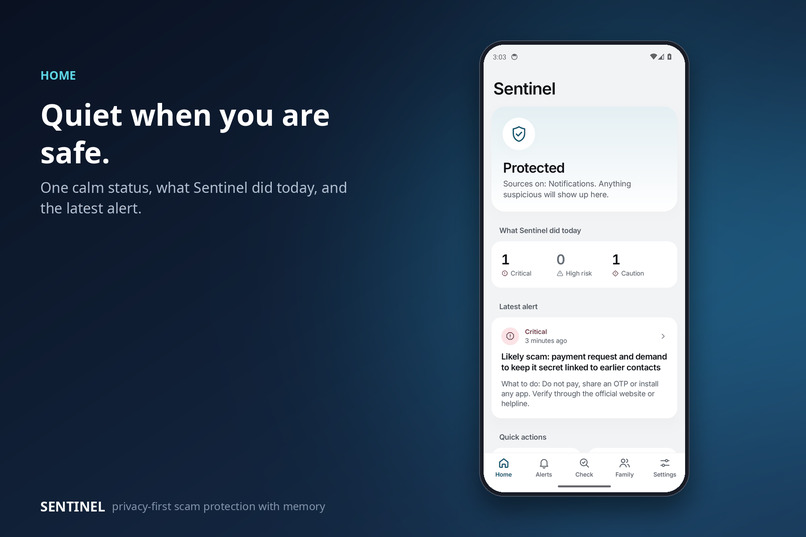
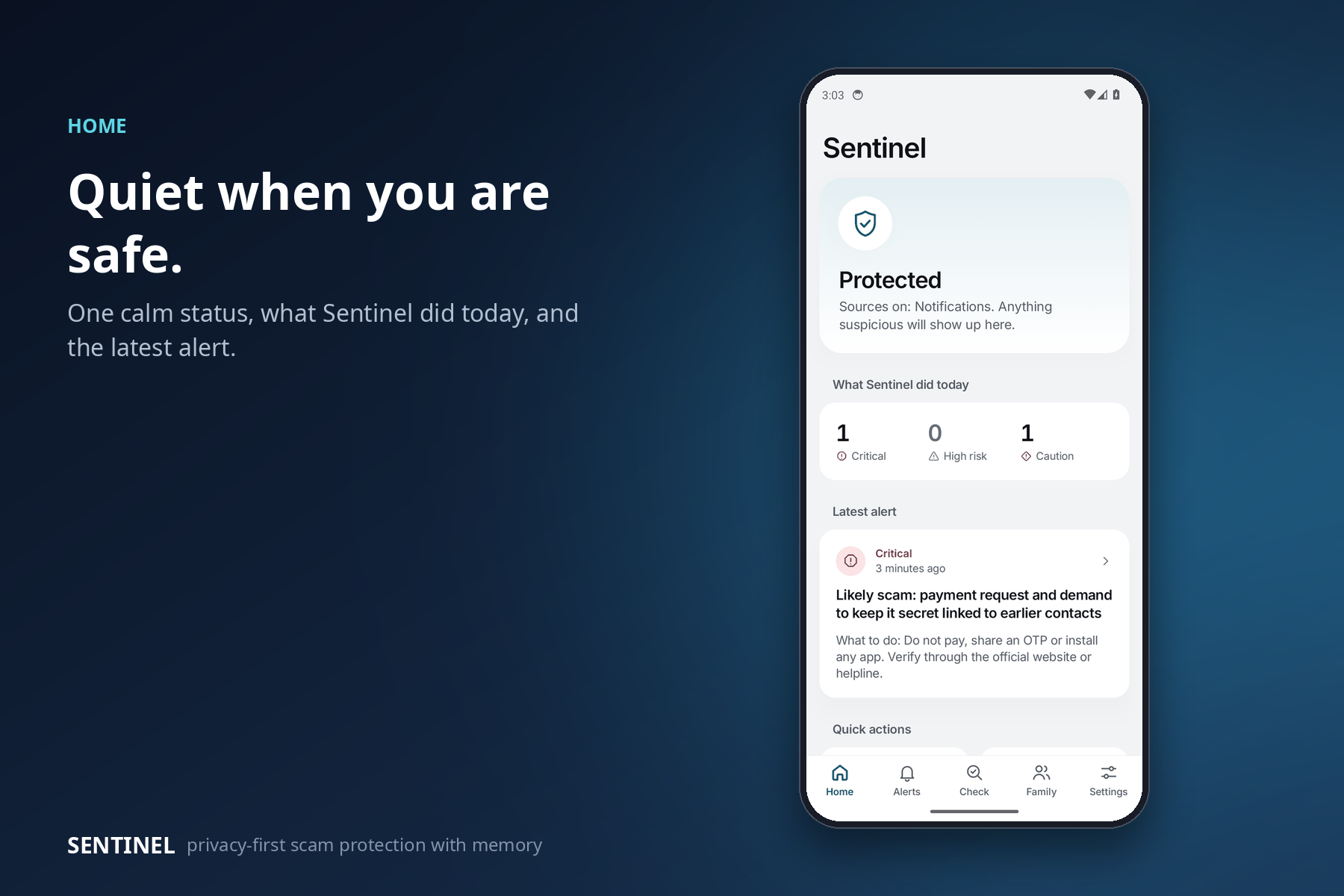
Home stays quiet when you're safe: one status, what Sentinel did today, and your latest alert.
-
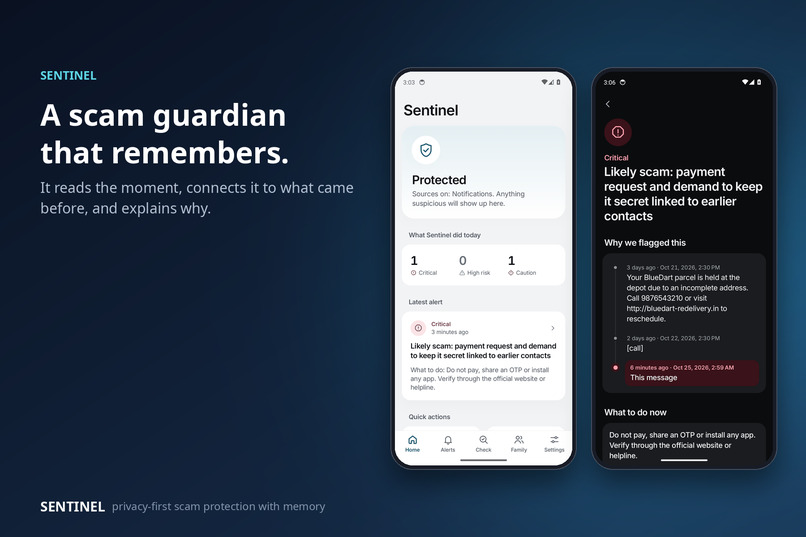
Sentinel, a privacy-first scam guardian for Android that remembers past events and explains every warning.
-
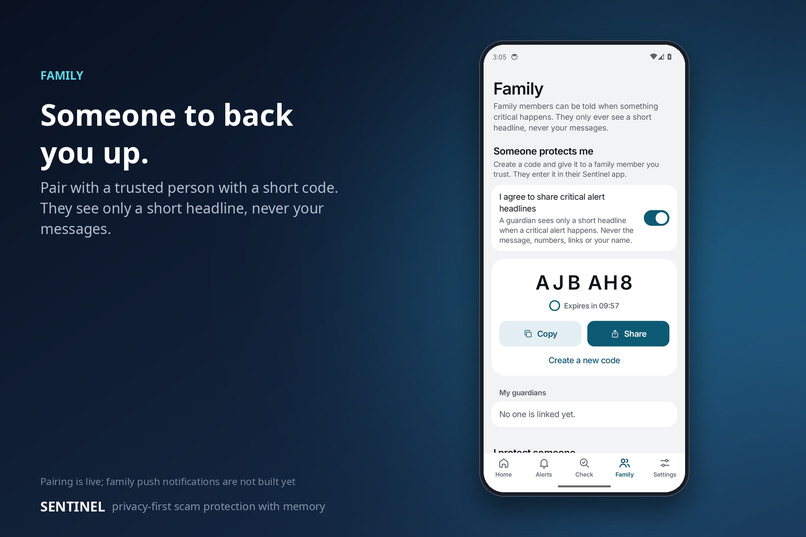
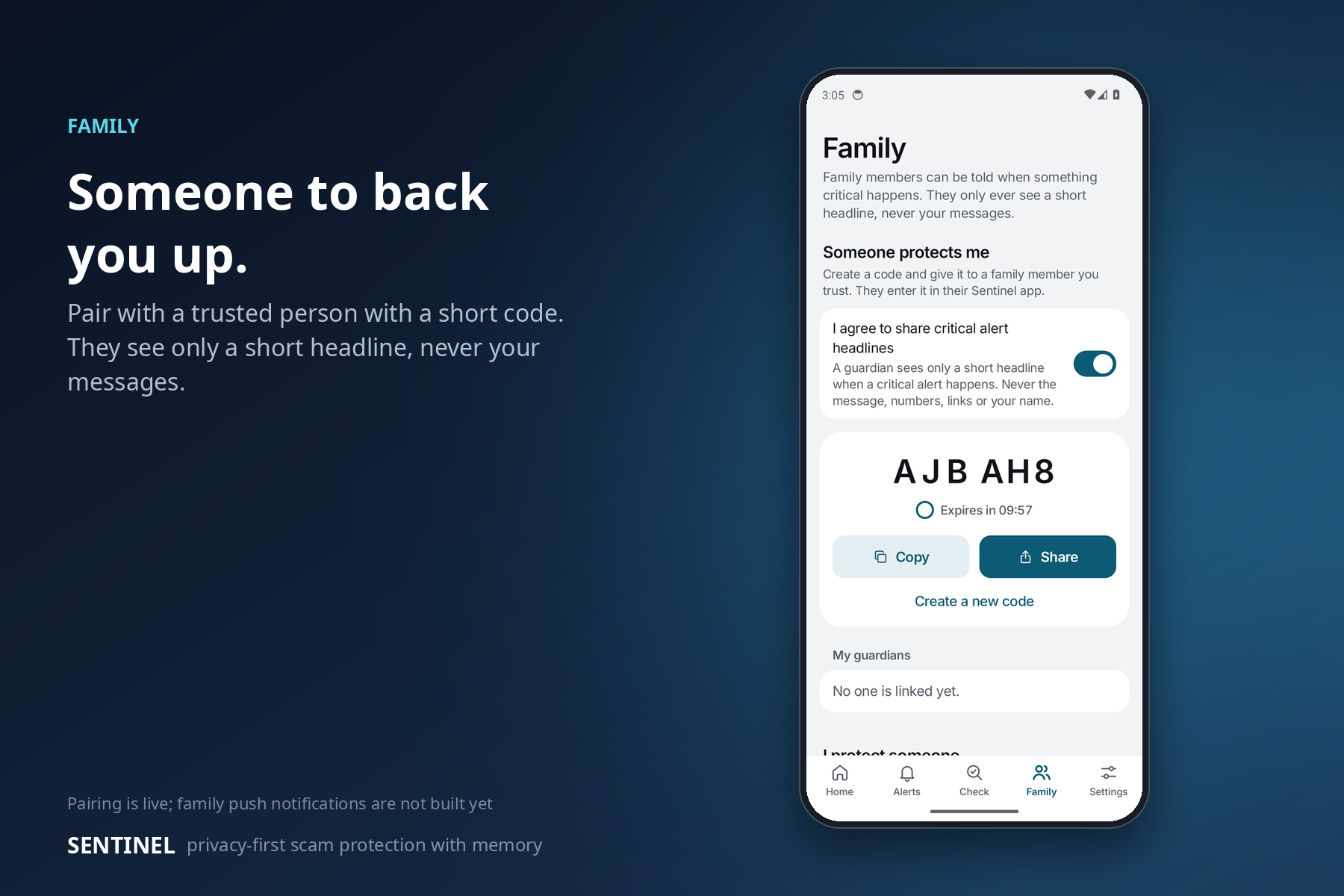
Pair a trusted person with a short code. They see only a short headline for critical alerts, never your messages.
-
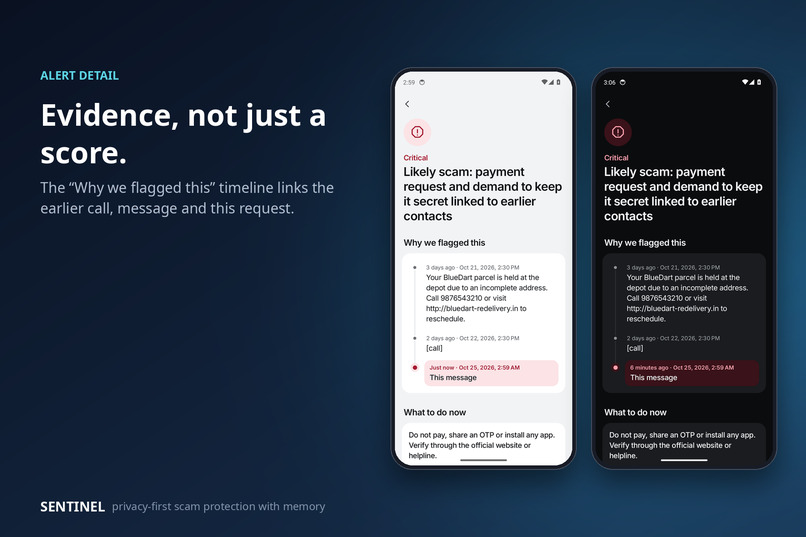
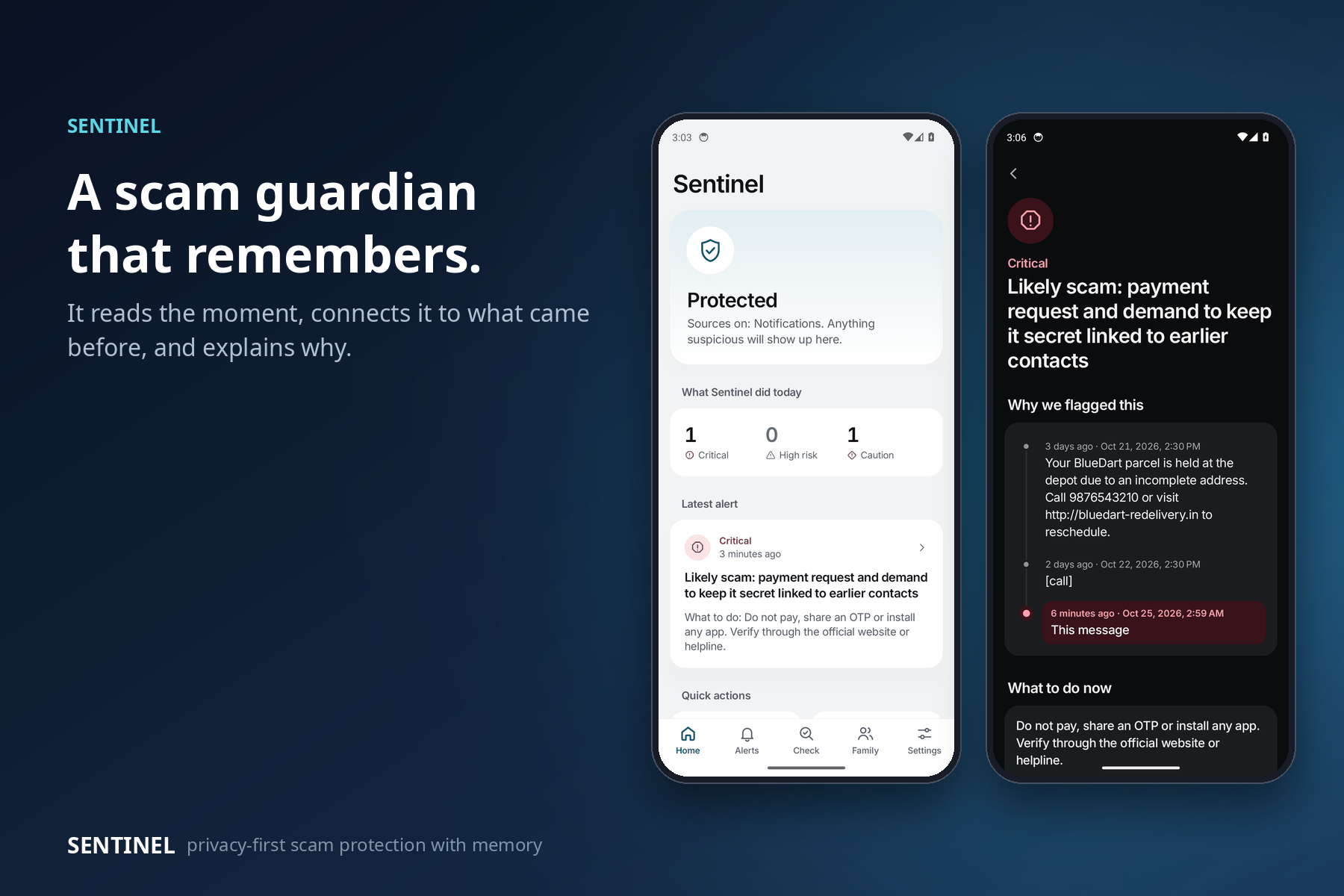
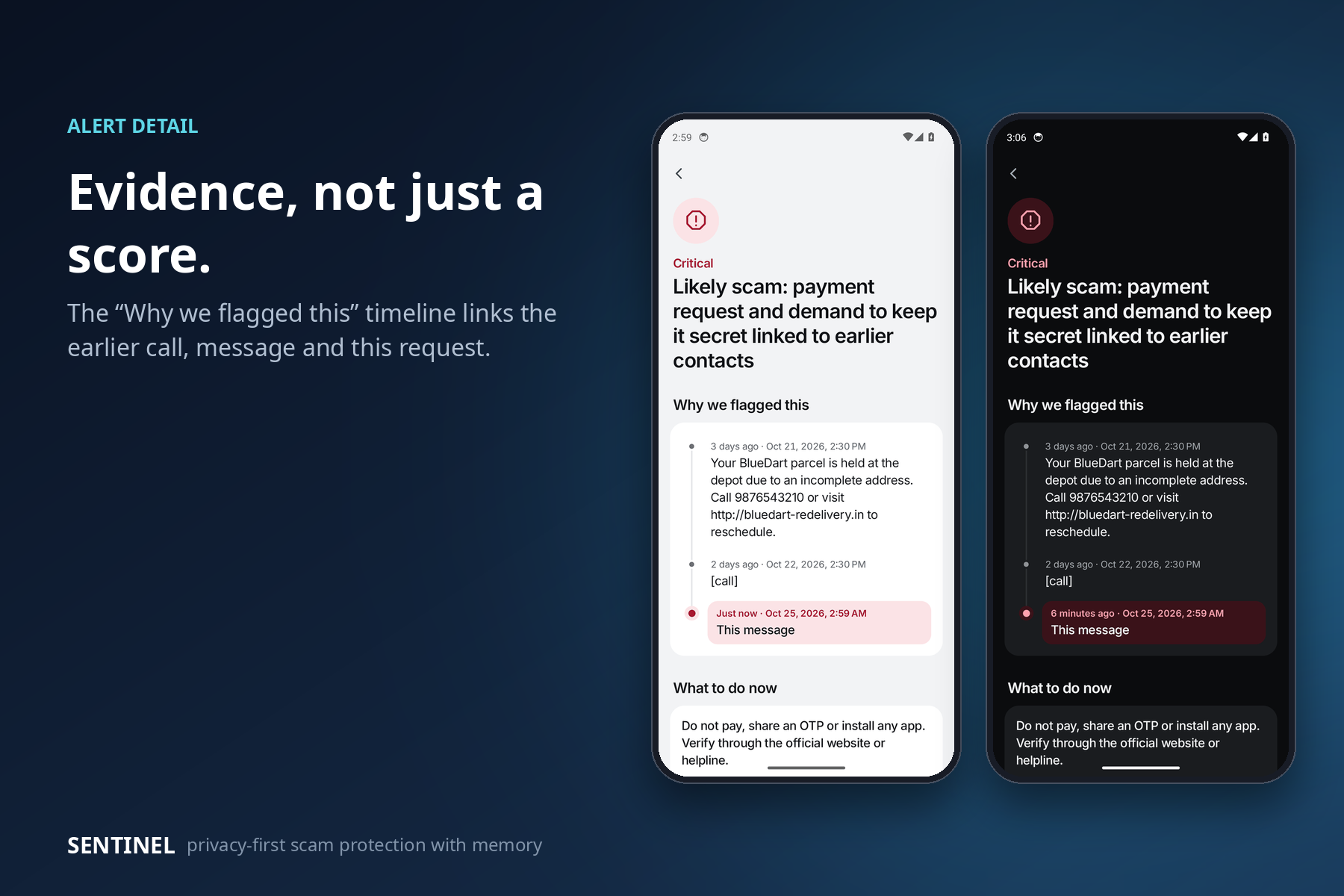
Every alert comes with evidence.Why we flagged this timeline links the earlier call and message to the new request (light and dark themes).
-
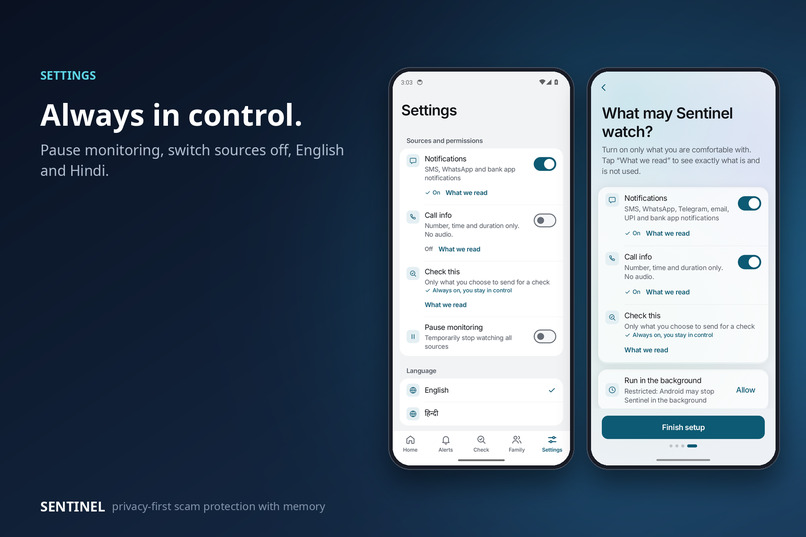
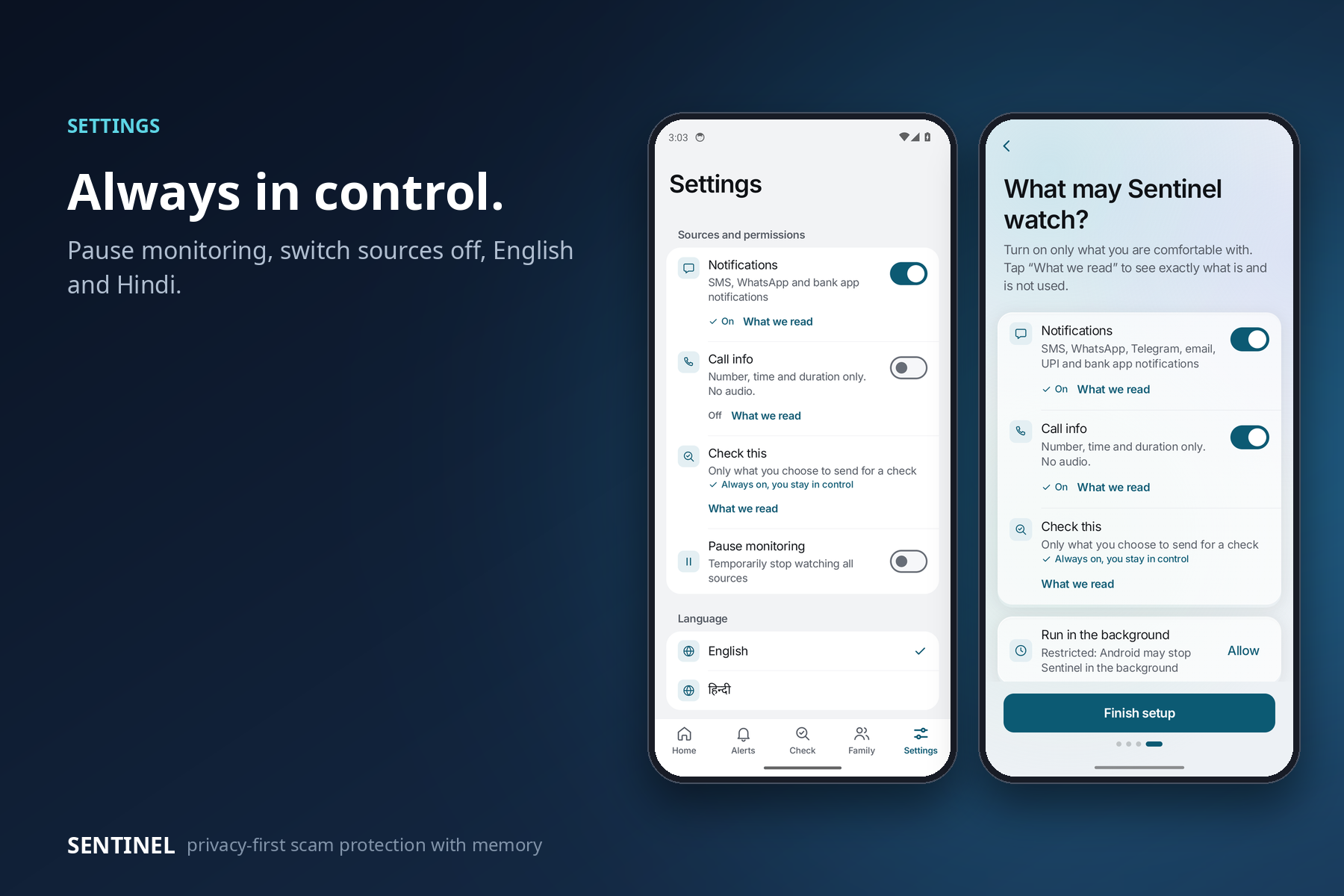
Always in control: pause monitoring, switch sources off, and change language at any time.
-
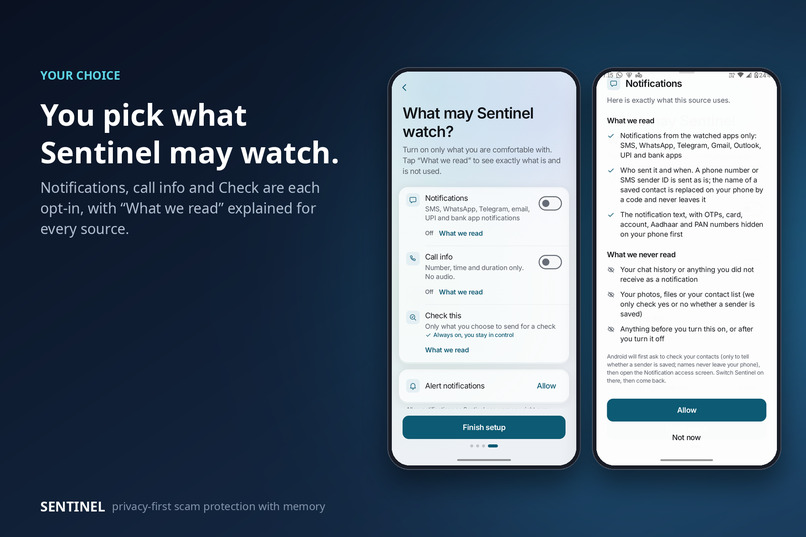
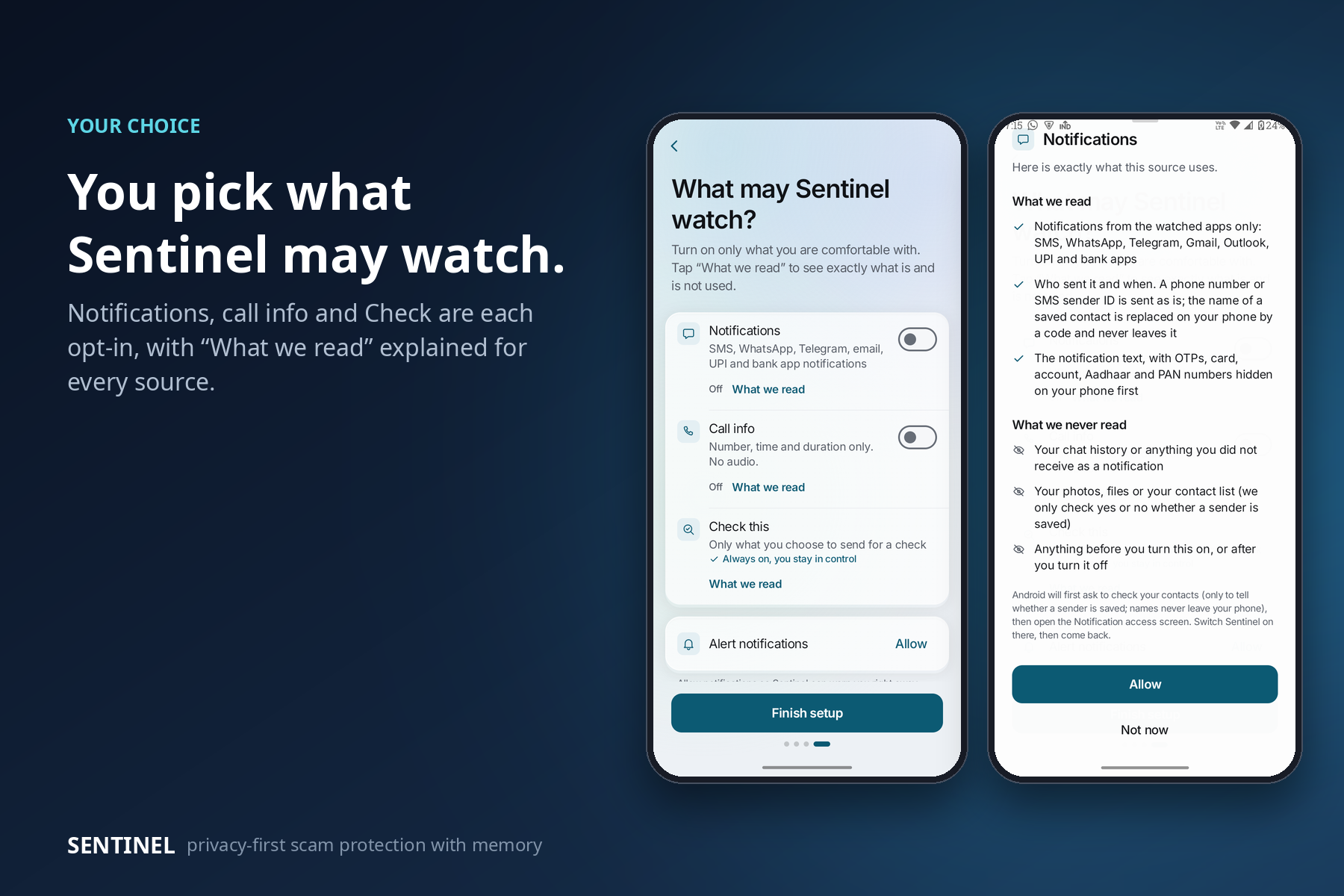
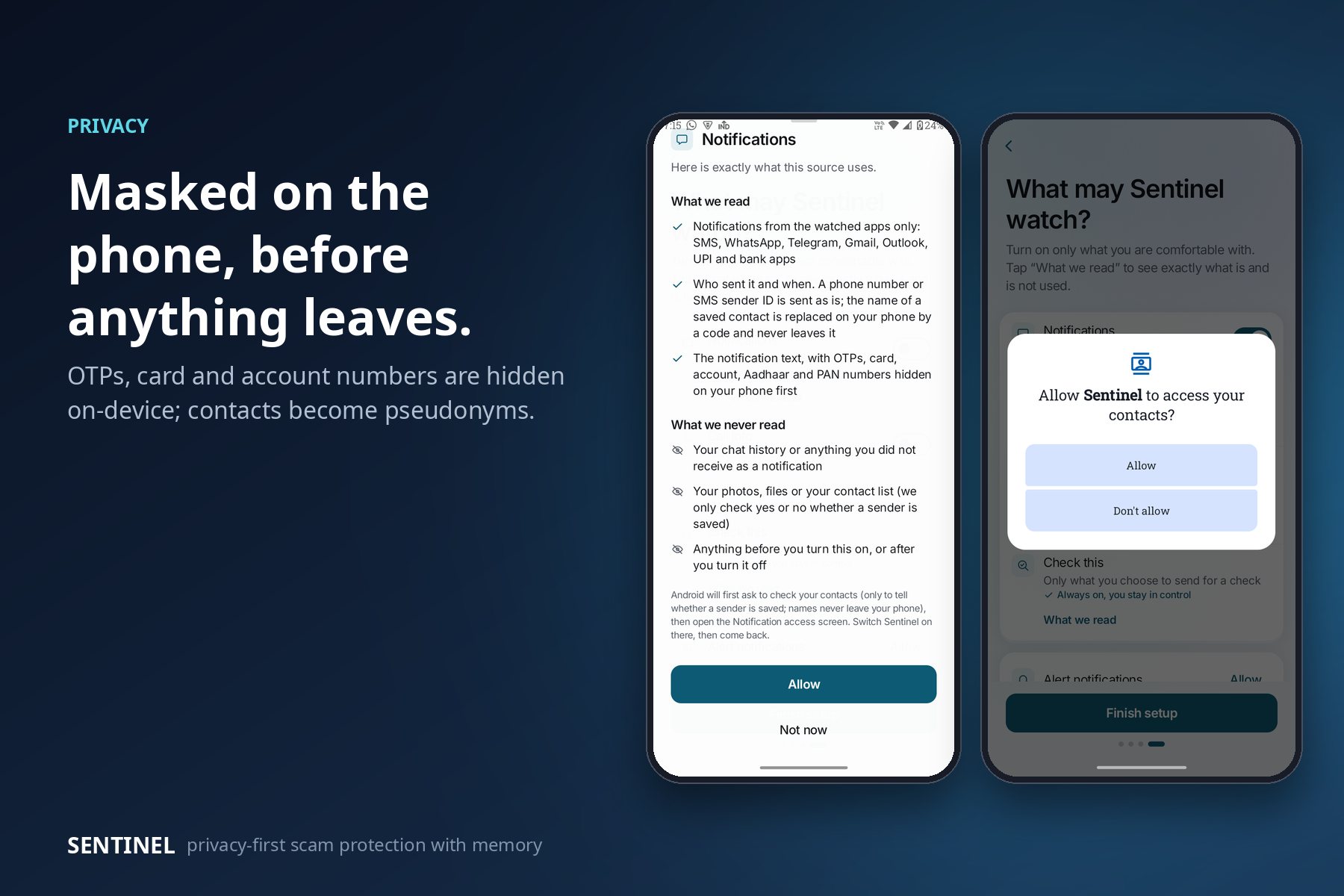
You choose what Sentinel may watch. Notifications, call info and Check are each opt-in, and "What we read" explains every source.
-
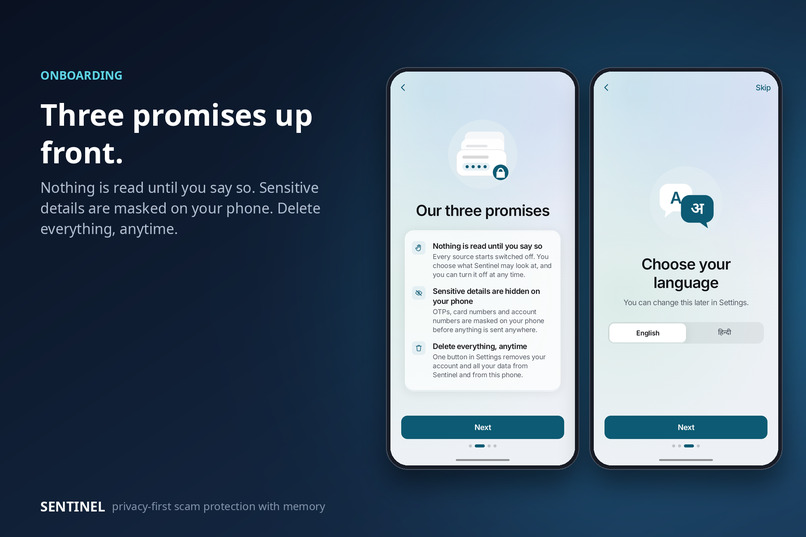
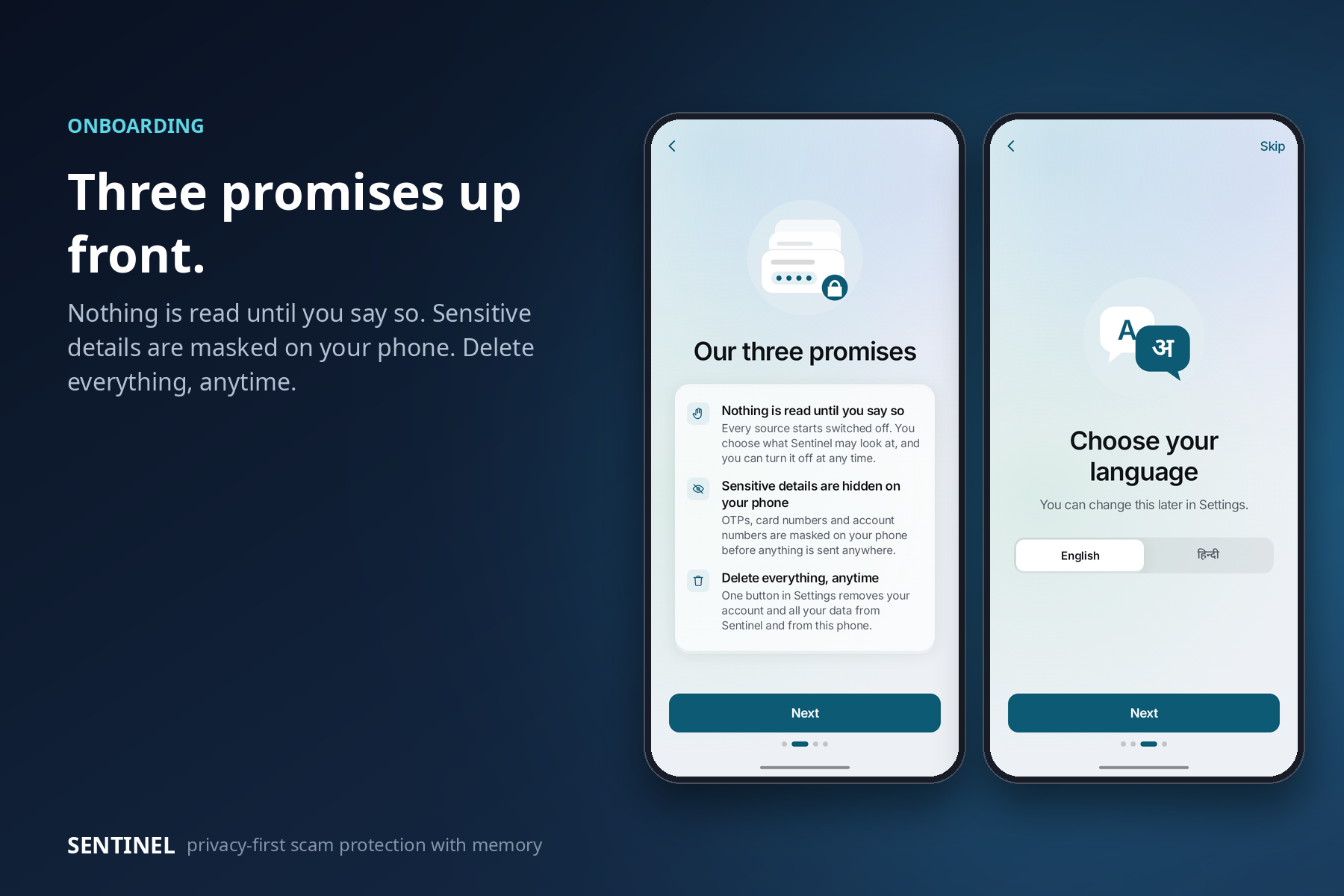
Three promises up front: nothing is read until you say so, sensitive details are masked on your phone, and you can delete everything anytime
-
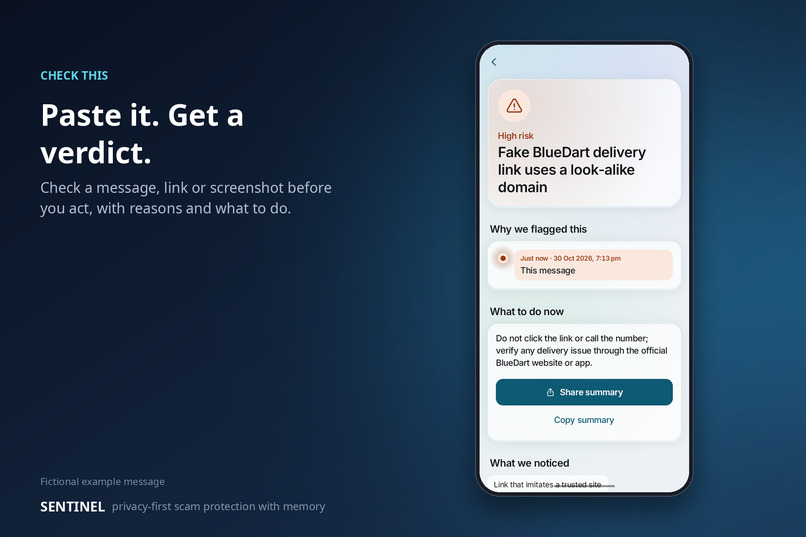
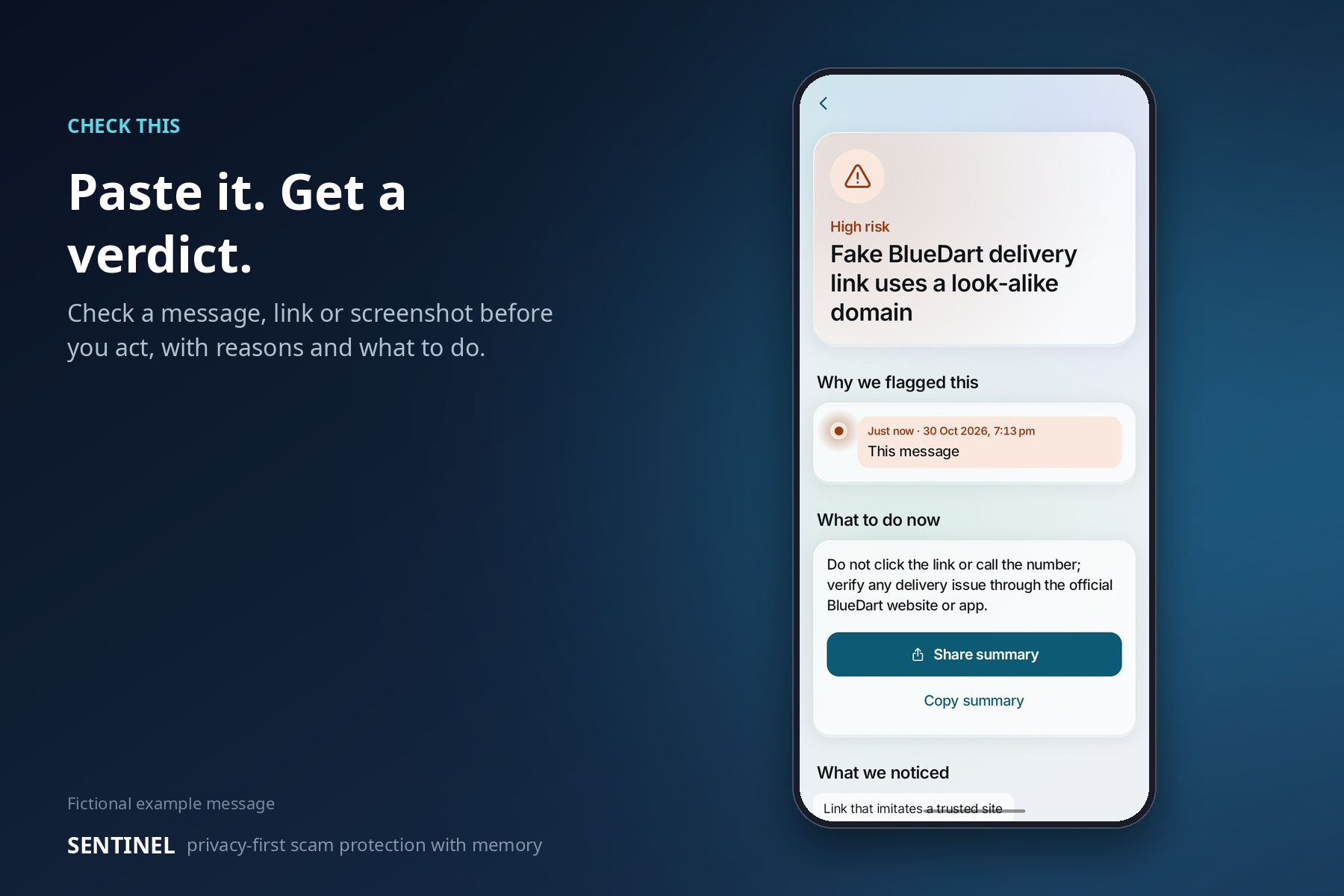
Check a message, link or screenshot before you act, and get a verdict with reasons and what to do. Message shown is a fictional example.
-
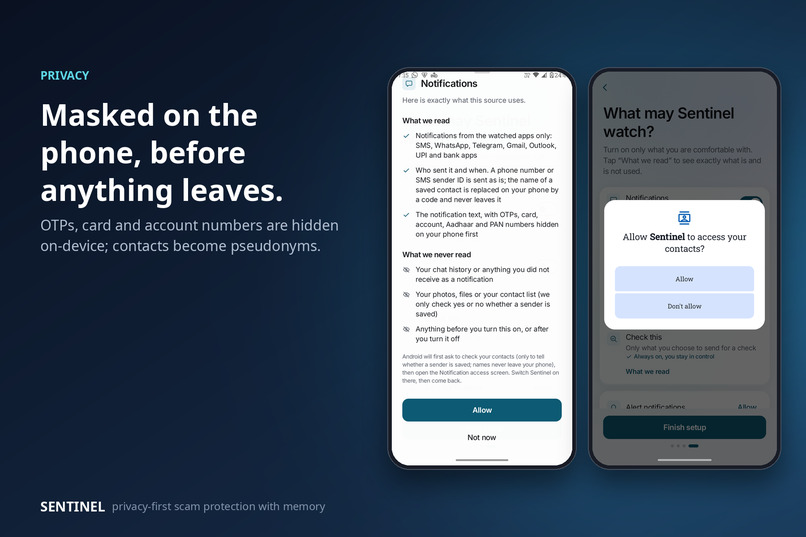
Sensitive content such as OTPs, card and account numbers is masked on the phone before anything is sent, and contacts become pseudonyms.
The Problem: Fraud Doesn't Happen in Isolation
A scam rarely begins with someone asking you to transfer money.
It might start with a seemingly legitimate job offer, a phone call from a recruiter, an investment opportunity, an email, or a message from someone pretending to be trustworthy. Each interaction may appear harmless on its own. However, when connected, they can reveal a carefully orchestrated fraud attempt.
The problem with conventional fraud detection is that it often examines individual events in isolation. It can identify suspicious messages or flag known scam numbers, but it struggles to understand the bigger picture across multiple interactions and over time.
We wanted to solve a much bigger problem:
What if an AI could remember, connect the dots, investigate suspicious behaviour, and warn you before you become a victim?
Introducing Sentinel
Sentinel is an AI-powered proactive fraud prevention system that combines autonomous AI agents, persistent memory, and contextual intelligence to identify potential fraud before it results in financial or personal loss.
Instead of simply classifying a message as spam or legitimate, Sentinel aims to understand the context behind interactions, recognize suspicious relationships, investigate entities, and uncover patterns that would otherwise go unnoticed.
Its central idea is simple: fraud prevention should be based on context, not just isolated signals.
How We Built It
We approached Sentinel by combining three fundamental capabilities:
1. Persistent Memory Layer
Memory is at the heart of Sentinel.
The system maintains contextual information from relevant interactions and uses it to connect seemingly unrelated events. A phone number encountered in one interaction, an organization mentioned in another, or a suspicious payment request later on could collectively reveal a potential fraud pattern.
This allows Sentinel to build a continuously evolving understanding of entities, relationships, and historical interactions rather than starting from scratch every time.
2. Autonomous AI Agents
We designed Sentinel around an agentic architecture where AI agents can investigate suspicious activity instead of relying exclusively on a single classification step.
Agents can analyze available evidence, investigate suspicious entities, identify connections, evaluate potential threats, and contribute to an explainable risk assessment.
The goal is to move from simply detecting suspicious activity to actively investigating why it might be suspicious.
3. Context-Aware Fraud Intelligence
Sentinel combines information from multiple interactions to understand the broader context of a potential threat.
Rather than relying solely on keywords, individual messages, or static fraud databases, it aims to identify behavioural patterns, suspicious relationships, inconsistencies, and connections across events.
The result is a more contextual approach to identifying potential fraud.
Real-World Use Cases
We designed Sentinel to address fraud beyond traditional banking and payment systems.
- Job and Recruitment Scams: Identify suspicious recruiters, fake job opportunities, and advance-fee requests.
- Investment Scams: Recognize suspicious investment propositions and potentially connected entities.
- Phishing and Impersonation: Identify suspicious communications and attempts to impersonate trusted individuals or organizations.
- Payment Fraud: Connect suspicious payment requests with previously observed warning signs.
- Social Engineering: Recognize patterns where fraudsters gradually build trust before making malicious requests.
Challenges We Faced
One of our biggest challenges was designing a system that could reason across interactions rather than analyze them independently.
Building a useful memory layer required thinking beyond storing conversations. We needed to consider how information should be retained, retrieved, connected, and used during future investigations.
Another challenge was designing the agentic workflow. Autonomous agents need to investigate efficiently while grounding their conclusions in available evidence. Simply asking an LLM whether something is fraudulent is not sufficient for a reliable fraud prevention system.
We also had to consider false positives, explainability, privacy, and the balance between proactive protection and user control.
What We Learned
Building Sentinel changed how we think about AI-powered security.
We learned that the real potential of agentic AI isn't just automating individual tasks. It is giving systems the ability to maintain context, connect information over time, and investigate problems that require multiple steps of reasoning.
We also explored how persistent memory can transform an AI system from a reactive assistant into something that becomes more context-aware with every relevant interaction.
What's Next?
Our vision is to make Sentinel a personal intelligence and protection layer that works across the digital interactions people already have.
We want to move fraud prevention from reactive alerts to proactive intelligence.
Because the best time to stop fraud isn't after the money is gone.
It's before the scam succeeds.
Sentinel — Stop a scam before the money leaves.
Built With
- agentic
- ai
- python

