-
-
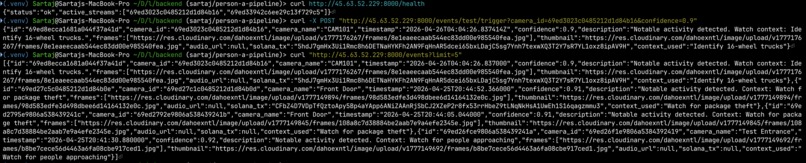
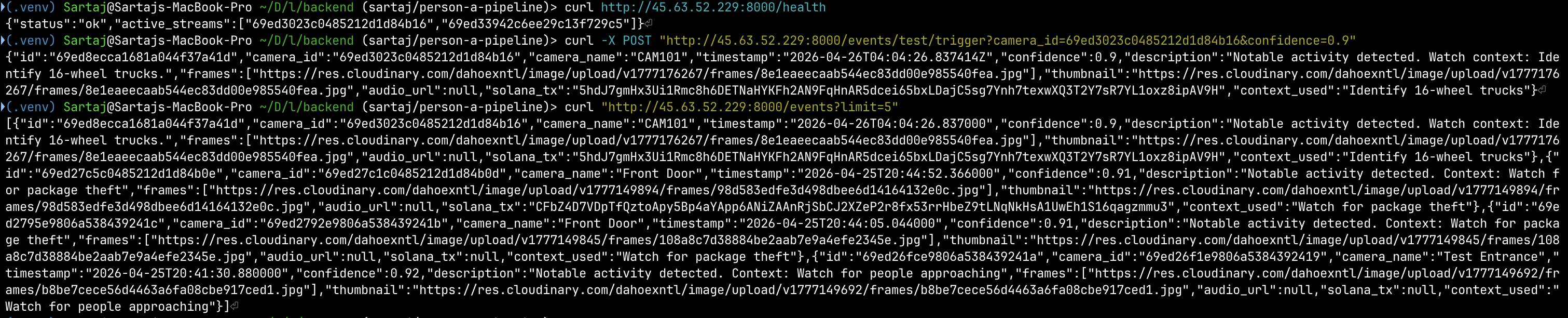
successful classification with 90%+ confidence!
-
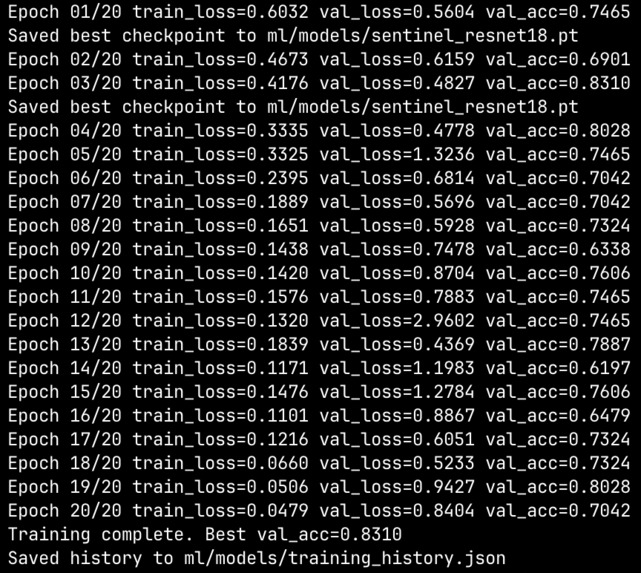
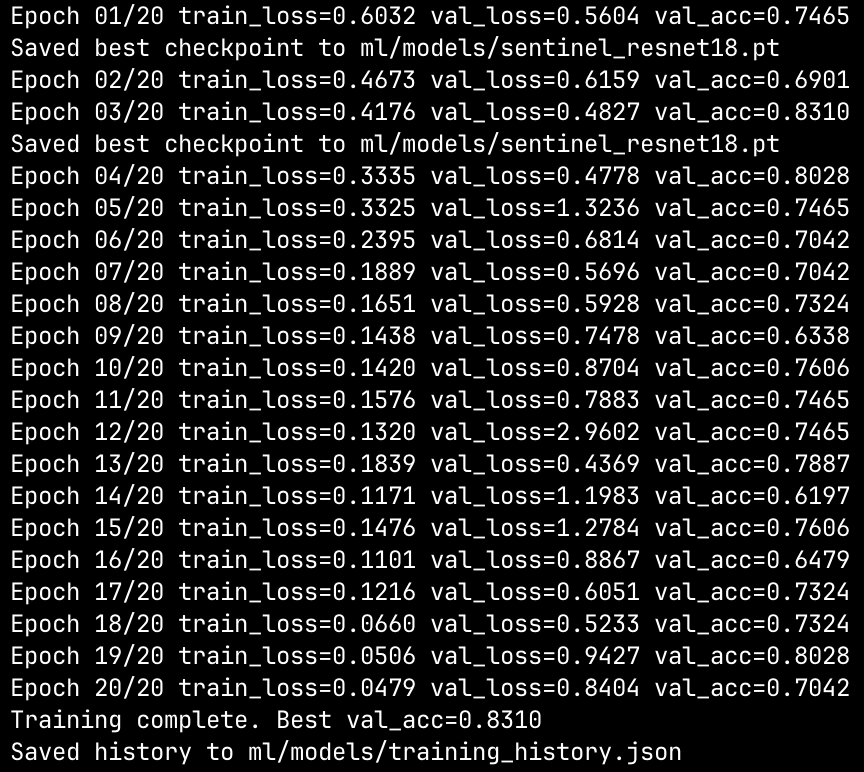
training our custom res_net model (83% accuracy for notable events)!
-

training image (finding a snack thief!)

Inspiration
Security cameras generate 24/7 footage, but in practice humans review only a tiny fraction of it. We wanted Sentinel.ai to act like an AI security analyst: detect notable moments in near real time, explain what happened in 1 concise alert, and produce a verifiable event trail instead of storing hours of video nobody watches.
What it does
Sentinel.ai monitors live camera streams and flags important activity. In our deployed run, it watched 2 active streams simultaneously and produced structured events with timestamps, confidence, media URLs, and on-chain transaction references. It detects people/objects, runs an event-notability gate, identifies known faces, generates a natural-language summary, and logs event metadata. The result is a real-time alert pipeline that turns raw frames into understandable, searchable, and auditable events.
How we built it
We built a FastAPI backend deployed on Vultr (4 vCPU / 16 GB RAM), with a stream manager ingesting camera feeds and buffering context frames (up to 60 seconds). The event cascade uses:
YOLOv8n (downloaded model size ~6.2 MB) for person/object detection ResNet-18 for notable-event gating Face embeddings for identity matching Gemma 4 for reasoning ElevenLabs for narration Cloudinary for media storage MongoDB for event persistence Solana devnet transaction hashes for tamper-evident provenance Frontend clients subscribe via WebSockets for live updates.
Challenges we ran into
The biggest challenge was balancing model quality with hackathon time constraints. Our first broad-label pass used 8,068 labeled frames and landed around 53.19% best validation accuracy, which was too noisy. We pivoted to a incident-specific dataset and hand-labeled 19 unique event intervals; that improved best validation accuracy to 83.10% after a 20-epoch run. We also hit deployment friction around Python/toolchain compatibility and Solana devnet rate limits (429 / 403 responses), so we added fallback behavior and resilient startup paths.
Accomplishments that we're proud of
We shipped a full end-to-end, multi-service AI system under hackathon constraints, in only 36 hours!:
Live streams resumed automatically at startup (2 streams active in production run) Event pipeline writes to MongoDB and returns queryable history (/events?limit=5) Cloudinary frame uploads succeeded with public URLs Solana logging produced real transaction signatures Custom ResNet model training and deployment worked end-to-end (ml/models/sentinel_resnet18.pt) We also designed the pipeline so each stage can fail gracefully without taking down the entire system.
What we learned
We learned that architecture wins: a cascade (detect -> gate -> reason) is more practical than forcing one giant model to do everything. Data quality mattered more than model depth: moving from weak auto-labeling to focused labels raised validation performance from ~0.53 to ~0.83. We also learned to design reliability first: async boundaries, service fallbacks, and explicit interfaces let us keep the system live even when one API degraded.
What's next for Sentinel.ai
Next steps:
Improve identity accuracy with stronger vector-search matching Upgrade from deprecated google.generativeai to the newer Gemini SDK Add threshold calibration per camera (confidence tuning by context) Improve operator UX (triage controls, confidence sliders, false-positive feedback) Harden production with worker queues, retry policies, and monitoring dashboards Target outcome: support more cameras per instance, lower false positives, and produce richer alerts (image + summary + narration + proof) with the same pipeline
Built With
- api
- atlas
- cloud
- cloudinary
- compute
- dlib
- elevenlabs
- embeddings)
- face-recognition
- fastapi
- gemini
- gemma
- git
- github
- mongodb
- opencv
- python
- pytorch
- react
- solana
- stream/event
- torchvision
- transaction
- typescript
- ultralytics
- vite
- vultr
- websockets
- yolov8


Log in or sign up for Devpost to join the conversation.