-
-
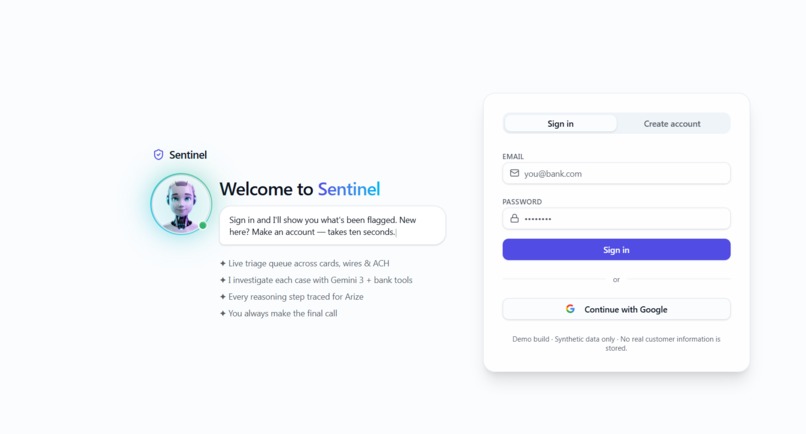
Login Page
INSPIRATION
Fraud teams are drowning. A mid-size bank can see thousands of suspicious transactions a day, and analysts have to manually comb through each one — checking account history, cross-referencing patterns, writing up findings — before they can even make a decision. The work is repetitive, high-stakes, and completely unsustainable at scale.
We wanted to flip that dynamic. What if an AI agent could do the legwork — pulling context, scoring risk, surfacing the right signals — and hand a human analyst a ready-to-review brief instead of a raw transaction log? That's the idea behind Sentinel. Not AI that replaces the human call, but AI that makes the human call better.
WHAT IT DOES
Sentinel is a human-in-the-loop fraud triage console. When a suspicious transaction comes in — card, wire transfer, or ACH — an AI agent backs by Gemini automatically investigates it: checking transaction history, flagging anomalous patterns, and scoring the risk. It then surfaces a structured finding to a human analyst, who reviews the evidence and makes the final call.
Every step of the agent's reasoning is logged to Arize, giving teams full visibility into why the AI flagged something — not just that it did. Analysts can approve, escalate, or dismiss a case in one click. No black boxes, no blind trust.
HOW WE BUILT IT
The frontend is a React app built on Lovable, with email/password and Google SSO auth baked in from the start. The fraud triage console surfaces synthetic case data across three transaction types: cards, wire transfers, and ACH.
The AI agent runs on Gemini, with a set of mock bank tools it can call to simulate context retrieval — account history lookups, velocity checks, peer comparisons. Agent reasoning traces are shipped to Arize in real time, so every inference step is observable and auditable. The whole thing is demo-safe: no real customer data, synthetic cases only.
CHALLENGES WE RAN INTO
Getting the agent to produce findings that were both useful and appropriately uncertain was harder than expected. Early outputs were either too confident ("definitely fraud") or too vague to act on. We spent a lot of time tuning prompts and tool schemas so the agent would reason visibly — showing its work — rather than just returning a verdict.
Wiring up Arize mid-hackathon was also a crunch. Observability feels like a "do it later" concern until you're debugging an agent that's silently going sideways. Once it was live, it immediately changed how we thought about the product.
ACCOMPLISHMENTS THAT WE'RE PROUD OF
Honestly? We shipped it. A full fraud triage flow — auth, case queue, AI investigation, Arize observability — end to end, in a hackathon window. That's not nothing.
Beyond the scope: the observability integration turned out to be the sleeper hit of the build. Seeing the agent's reasoning traced in Arize in real time made the human-in-the-loop story tangible in a way that a plain UI couldn't. It's the kind of thing that turns a demo into a real pitch.
WHAT WE LEARNED
Agents need guardrails, not just capabilities. The easiest thing is to give an AI a task and let it run — the hard thing is making sure a human can actually follow what it did and trust the output. Designing for interpretability from the start is completely different from bolting it on at the end.
We also learned that observability isn't an ops concern — it's a product feature. In a high-stakes domain like fraud, "why did the AI flag this?" is just as important as "did it flag it correctly?"
WHAT'S NEXT FOR SENTINEL
The reasoning panel is the next frontier — right now the agent's thought process is visible in Arize, but we want to surface a condensed version of it directly in the analyst console so reviewers never have to leave the app to understand a case.
Beyond that: real bank tool integrations (not mock calls), a feedback loop where analyst decisions improve the agent over time, and expanding case types to ACH return fraud and synthetic identity detection. The goal is a full production-ready co-pilot that any fraud ops team could deploy on day one.
Built With
- gemini-function-calling-observability:-arize-auth:-google-sso-(oauth-2.0)

Log in or sign up for Devpost to join the conversation.