🌍 Inspiration
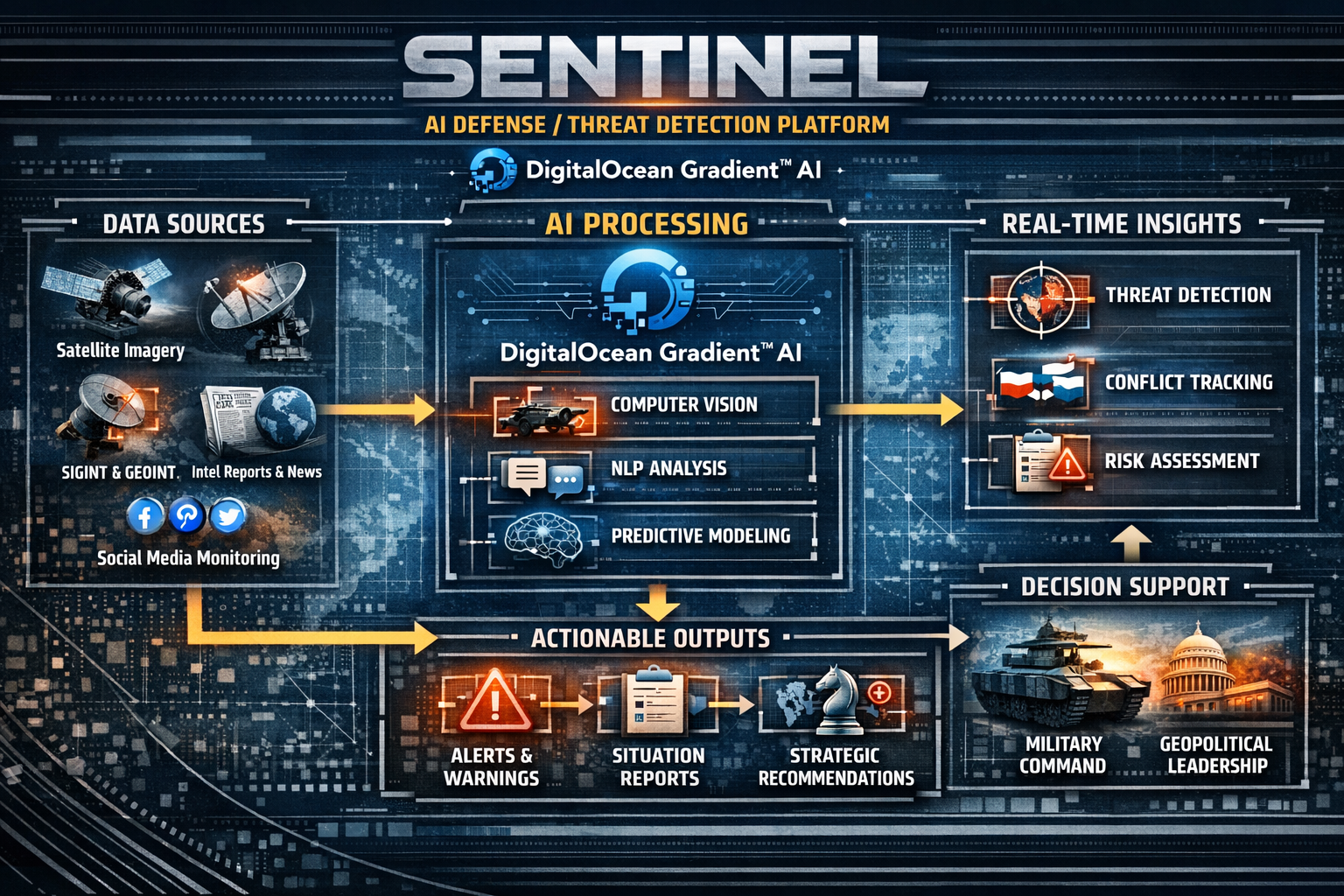
In an increasingly complex and volatile geopolitical landscape, the speed of information is critical. Traditional intelligence gathering can be fragmented and slow, making it difficult to anticipate and respond to emerging global threats. We were inspired to build SENTINEL by the critical need for a centralized, intelligent system that could process vast amounts of geopolitical data instantly. We wanted to create a platform that doesn't just display data, but actively synthesizes it into quantifiable, actionable strategic recommendations to help defense professionals stay one step ahead.
🎯 What it does
SENTINEL is a classified-level military intelligence and defense monitoring platform. It acts as an all-seeing eye for global security by synthesizing raw intelligence into a dynamic Threat Probability Score ($T_{score}$).
It provides:
- 🚨 Real-Time Threat Detection: Instantly identifies emerging risks. The platform calculates risk by aggregating localized threat factors ($R_i$), weighted by their severity ($w_i$), and historical regional volatility ($V$): $$ T_{score} = \alpha V + \sum_{i=1}^{n} w_i R_i $$ (where $\alpha$ is the regional instability constant).
- 🗺️ Conflict Tracking: Monitors active geopolitical scenarios with high-fidelity geospatial data.
- 🧠 AI-Powered Strategic Recommendations: Analyzes complex variables to suggest actionable defense strategies.
🛠️ How we built it
SENTINEL was engineered for speed, reliability, and advanced analytical power.
- The Brains: The core intelligence is built on DigitalOcean Gradient™ AI. To predict conflict escalation, our models utilize Bayesian inference. As new intelligence data ($D$) streams in, the platform continuously updates the probability of an escalation event ($E$): $$ P(E|D) = \frac{P(D|E)P(E)}{P(D)} $$ This allows SENTINEL to adjust its strategic recommendations in real-time as situations evolve.
- The Foundation: We built the entire application architecture using TypeScript (comprising 96.1% of the codebase). This ensured our platform was strongly typed, highly scalable, and capable of handling complex mathematical state management efficiently.
- The Interface: We utilized modular CSS to craft a sleek, dark-mode, command-center-style user interface that is intuitive for intelligence analysts to navigate without cognitive overload.
🚧 Challenges we ran into
Building a platform of this magnitude didn't come without hurdles:
- Algorithmic Optimization: Routing and calculating high-velocity mathematical models (like our Bayesian updates and geospatial distance calculations using the Haversine formula,
required heavy optimization in our TypeScript backend to maintain low latency.
- AI Contextualization: Fine-tuning the DigitalOcean Gradient™ models to understand the nuance of geopolitical conflicts—rather than just outputting raw probabilities—took significant iteration.
- UI/UX for Complex Data: Displaying dense, multi-layered data arrays without overwhelming the user was a major design challenge.
🏆 Accomplishments that we're proud of
- Successfully integrating DigitalOcean Gradient™ AI to deliver real-time, mathematically backed intelligence recommendations.
- Building a highly robust, production-ready codebase powered almost entirely by TypeScript.
- Translating complex statistical models into a visually striking, mission-control dashboard that truly feels like a "classified-level" tool.
- Taking an ambitious, high-stakes concept and turning it into a functional, high-performance platform.
📚 What we learned
- We gained deep, hands-on experience deploying and interacting with machine learning models using DigitalOcean Gradient™.
- We learned how to structure complex mathematical data pipelines in TypeScript to handle asynchronous, real-time updates smoothly.
- We discovered the importance of rigorous UI/UX design when building tools meant for high-stress, critical decision-making environments.
🚀 What's next for SENTINEL: AI Defense/Threat Detection Platform
This is just the beginning for SENTINEL. Moving forward, we plan to:
- Advanced Predictive Modeling: Incorporate deep neural networks to forecast future conflict zones using non-linear time-series forecasting.
- Integrate Live OSINT Feeds: Connect the platform directly to live Open-Source Intelligence (OSINT) APIs and satellite imagery datasets for broader data ingestion.
- Enhanced Collaborative Features: Allow multiple intelligence analysts to collaborate, annotate maps, and share secure briefings within the platform in real-time.


Log in or sign up for Devpost to join the conversation.