🚨 Sentinel AI
Inspiration
Production incidents are stressful, time-sensitive, and often require engineers to switch between multiple tools to investigate issues, coordinate teammates, and document findings. We wanted to simplify this process by bringing AI-powered incident management directly into Slack, where engineering teams already collaborate.
The goal was to build an intelligent Slack agent that acts as an Incident Commander, helping teams detect incidents, guide investigations, maintain timelines, and generate postmortems—all without leaving Slack.
What it does
Sentinel AI is an AI-powered Slack agent that automates the incident response lifecycle.
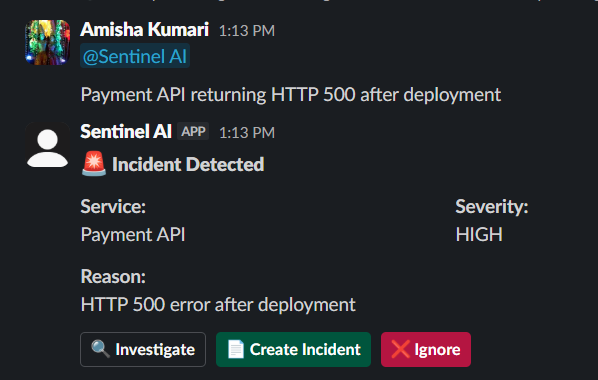
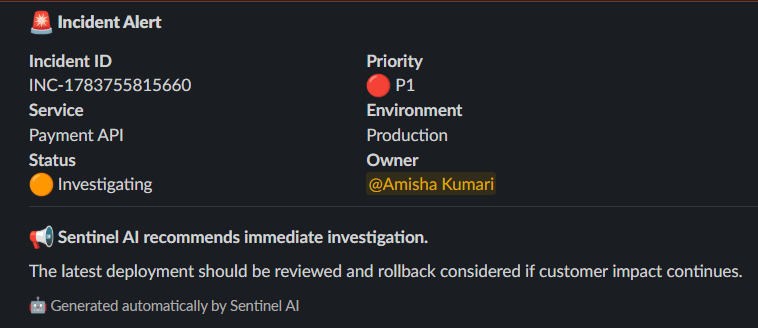
When a user reports an issue by mentioning the bot, Sentinel AI uses a Large Language Model (Groq Llama 3.3 70B) to determine whether the message describes a production incident. If an incident is detected, it identifies the affected service, classifies its severity, and presents an interactive Slack workflow.
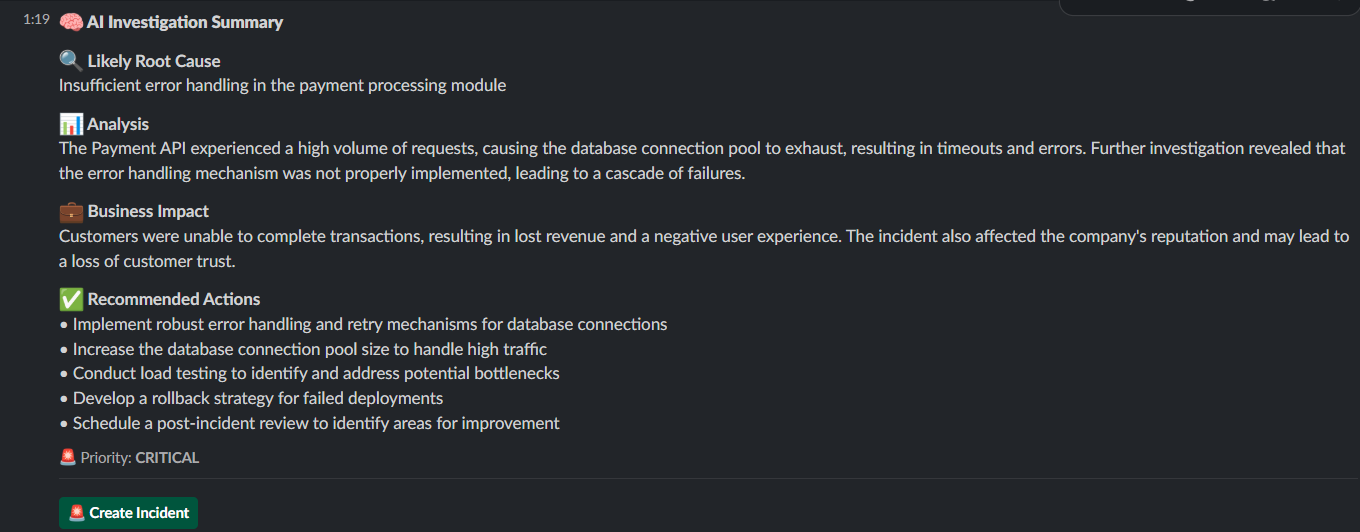
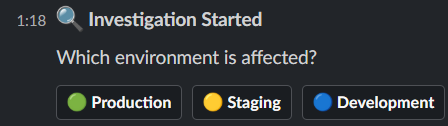
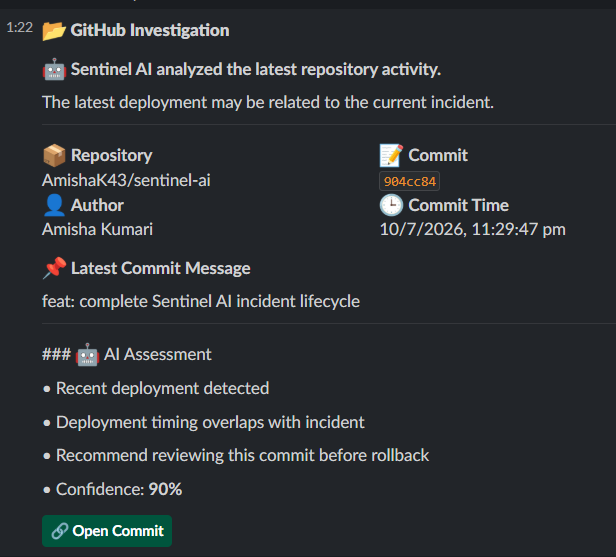
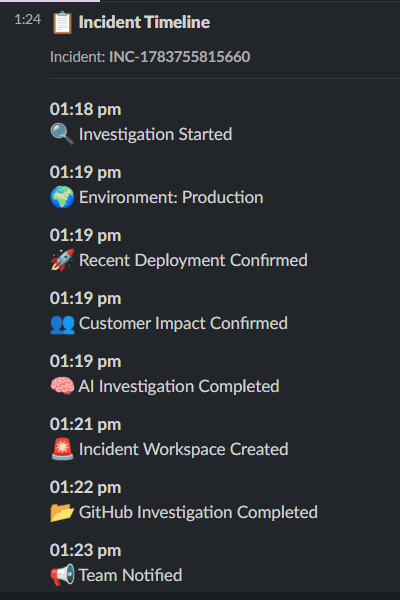
The agent guides responders through a structured investigation by collecting information about the affected environment, recent deployments, and customer impact. Throughout the investigation, Sentinel AI maintains an incident timeline and generates an AI-powered investigation summary.
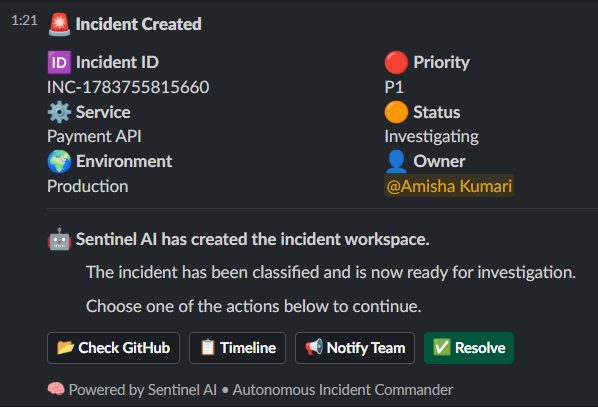
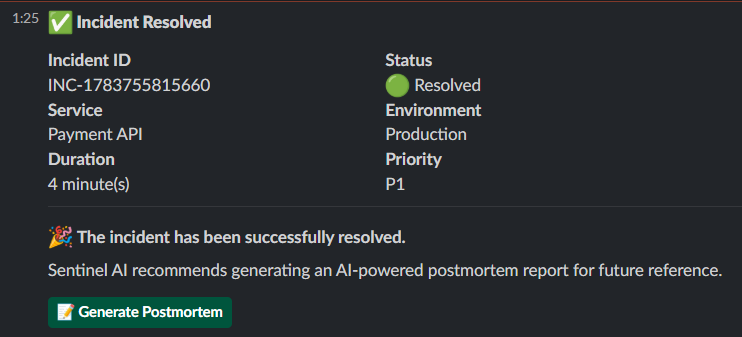
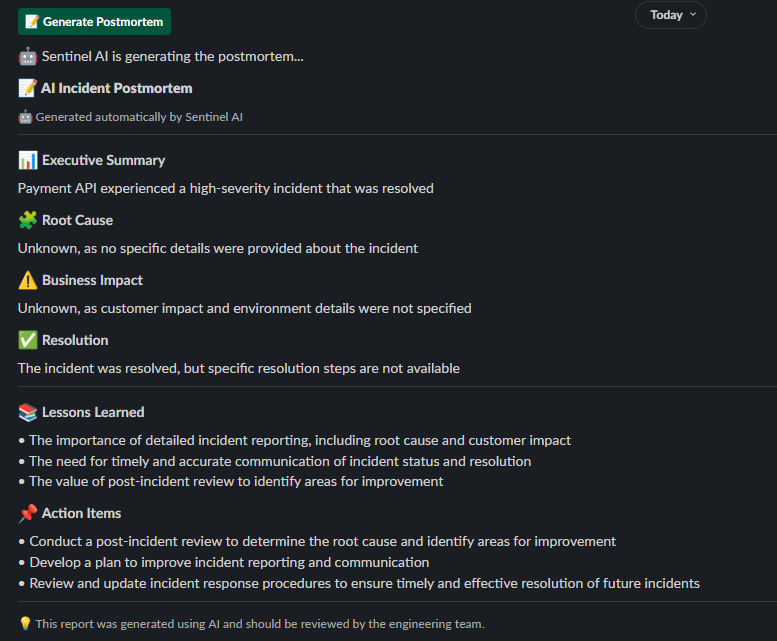
Once the investigation is complete, the incident can be resolved directly within Slack, after which Sentinel AI automatically generates a comprehensive postmortem including the executive summary, root cause analysis, business impact, lessons learned, and action items.
How we built it
Sentinel AI was built using:
- Node.js
- Slack Bolt SDK
- Slack Block Kit
- Groq API (Llama 3.3 70B)
- JavaScript
- Render for deployment
- GitHub for version control
The application listens for Slack Events, analyzes incident reports using AI, stores incident state in memory, and drives interactive workflows using Slack buttons and Block Kit components.
Challenges we ran into
Building Sentinel AI involved several technical challenges.
One of the biggest challenges was configuring Slack Events, Interactivity, OAuth permissions, and deploying the application correctly on Render. Ensuring Slack could communicate securely with our hosted application required careful configuration of request URLs, environment variables, and event subscriptions.
Designing reliable AI prompts for incident detection was another challenge. We refined the prompts to improve the consistency of incident classification while minimizing false positives.
We also designed a guided investigation workflow that feels natural inside Slack while maintaining the state of each incident across multiple user interactions.
What we learned
Throughout this project we gained hands-on experience with:
- Building production-ready Slack applications
- Slack Events API and interactive components
- AI prompt engineering
- Large Language Model integration using Groq
- Deploying Node.js applications on Render
- Designing conversational workflows
- Managing incident response processes
Most importantly, we learned how AI can streamline operational workflows and improve collaboration for engineering teams.
What's next for Sentinel AI
We plan to continue improving Sentinel AI by adding:
- Multi-workspace OAuth support
- GitHub deployment analysis
- PagerDuty integration
- Jira integration
- Grafana and Datadog integration
- Persistent database storage
- AI-powered root cause analysis
- Automated remediation suggestions
- Historical incident search using RAG
Our vision is to make Sentinel AI a complete AI-powered incident response platform for modern engineering organizations.
Built With
- ai
- block-kit
- devops
- github
- groq
- javascript
- llama
- llm
- node.js
- render
- restapi
- slack
- slackapi
- slackbolt
- sre


Log in or sign up for Devpost to join the conversation.