-
-
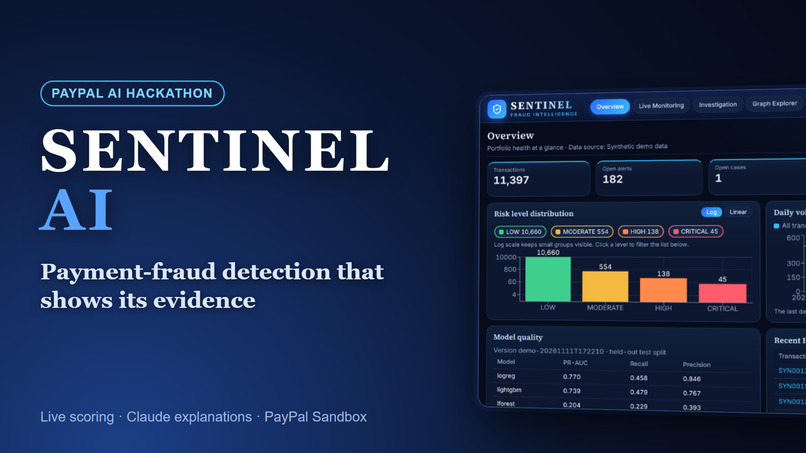
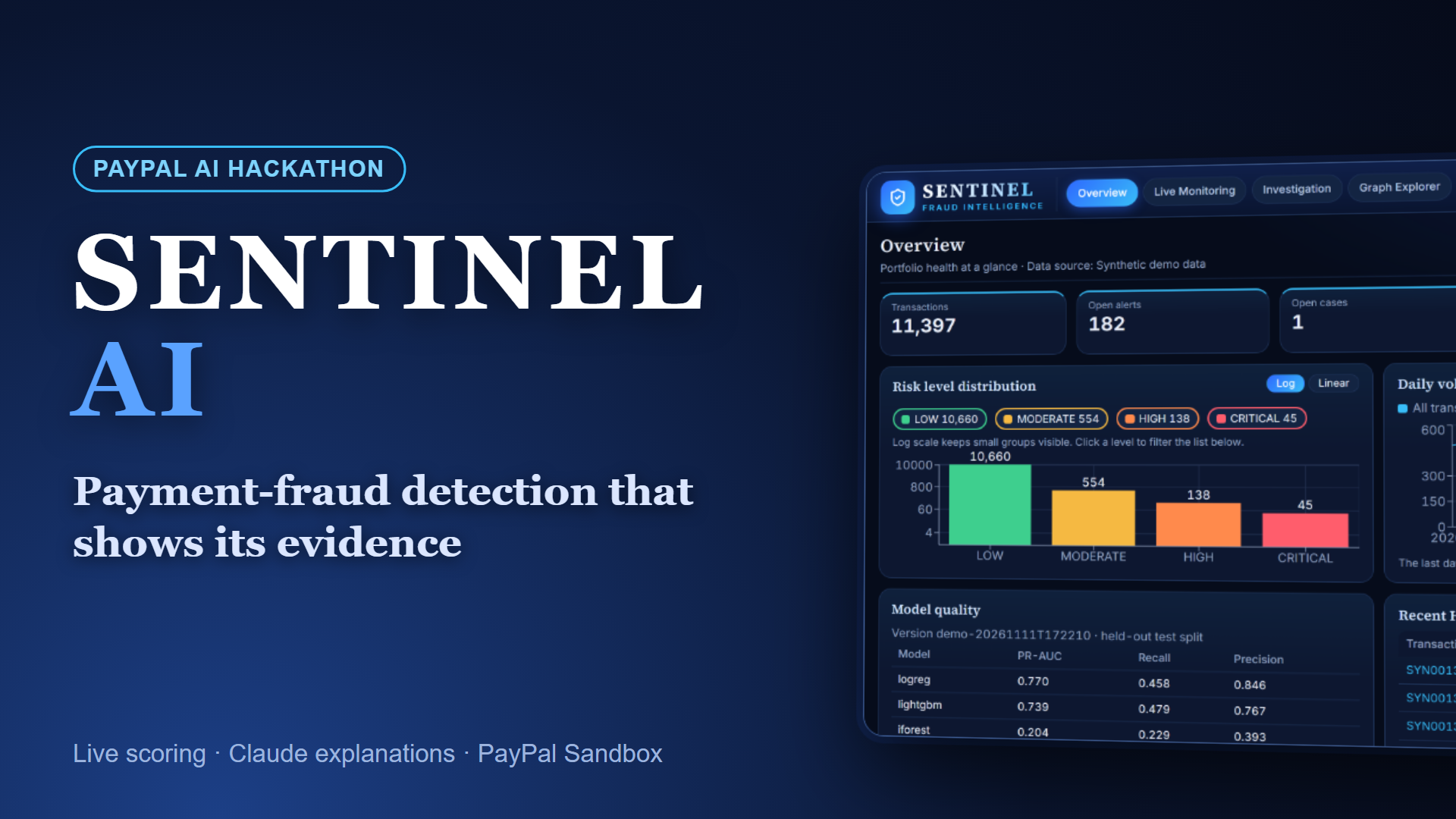
SENTINEL AI: payment-fraud detection that shows its evidence.
-
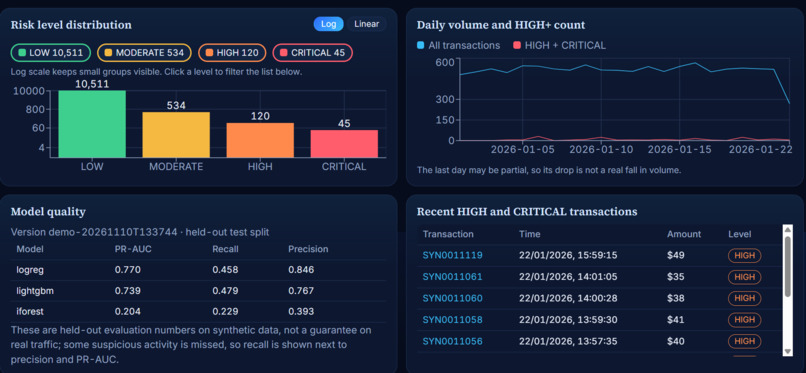
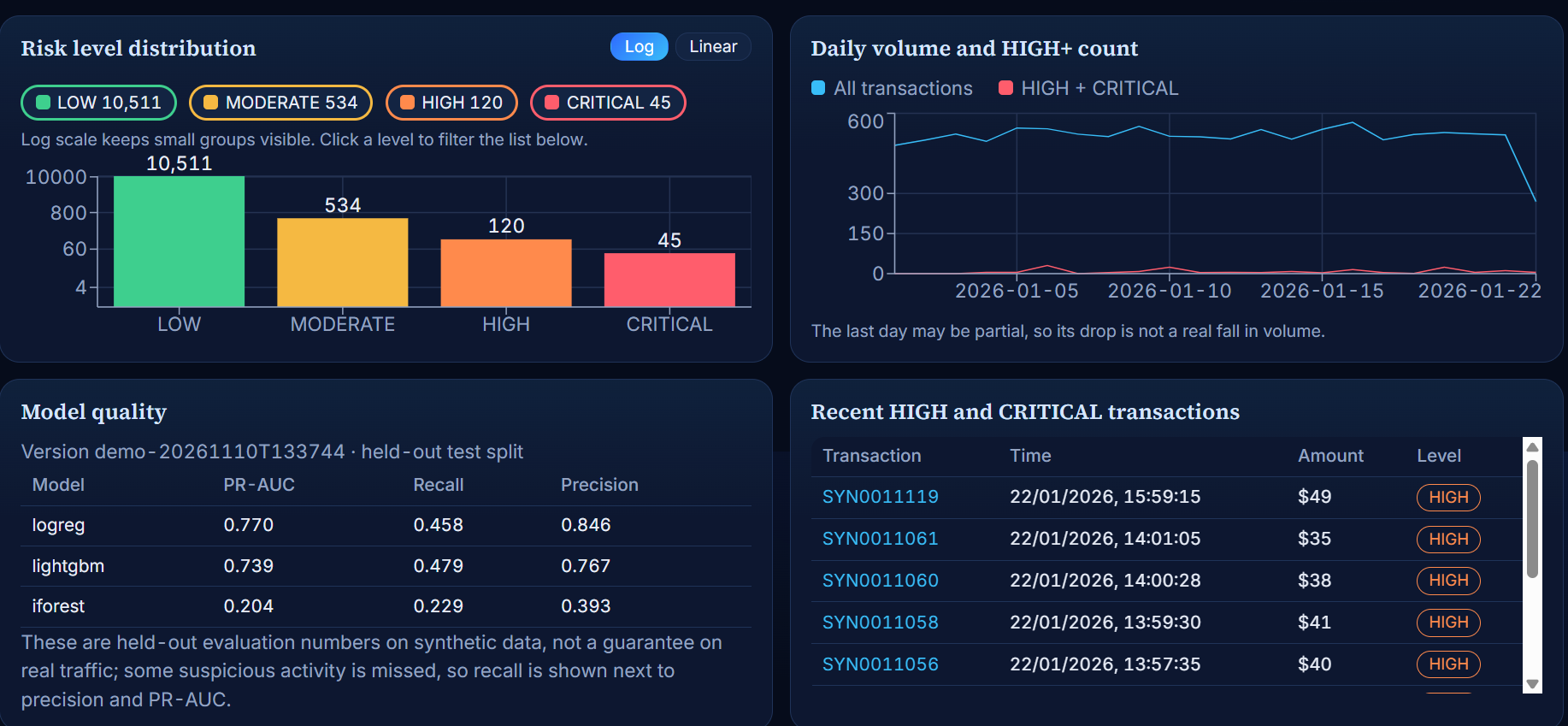
Overview with risk distribution and an honest model-quality table, including what it misses.
-
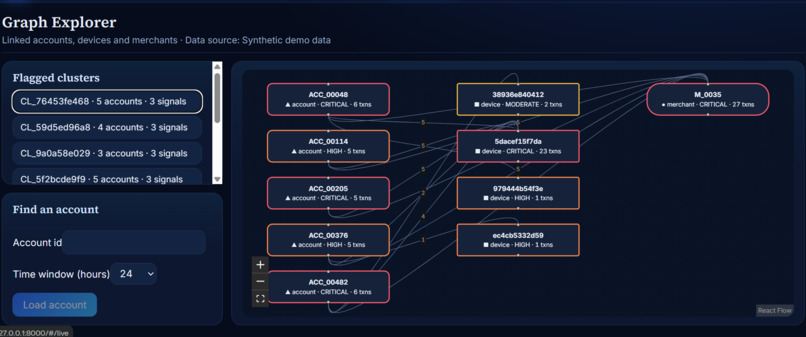
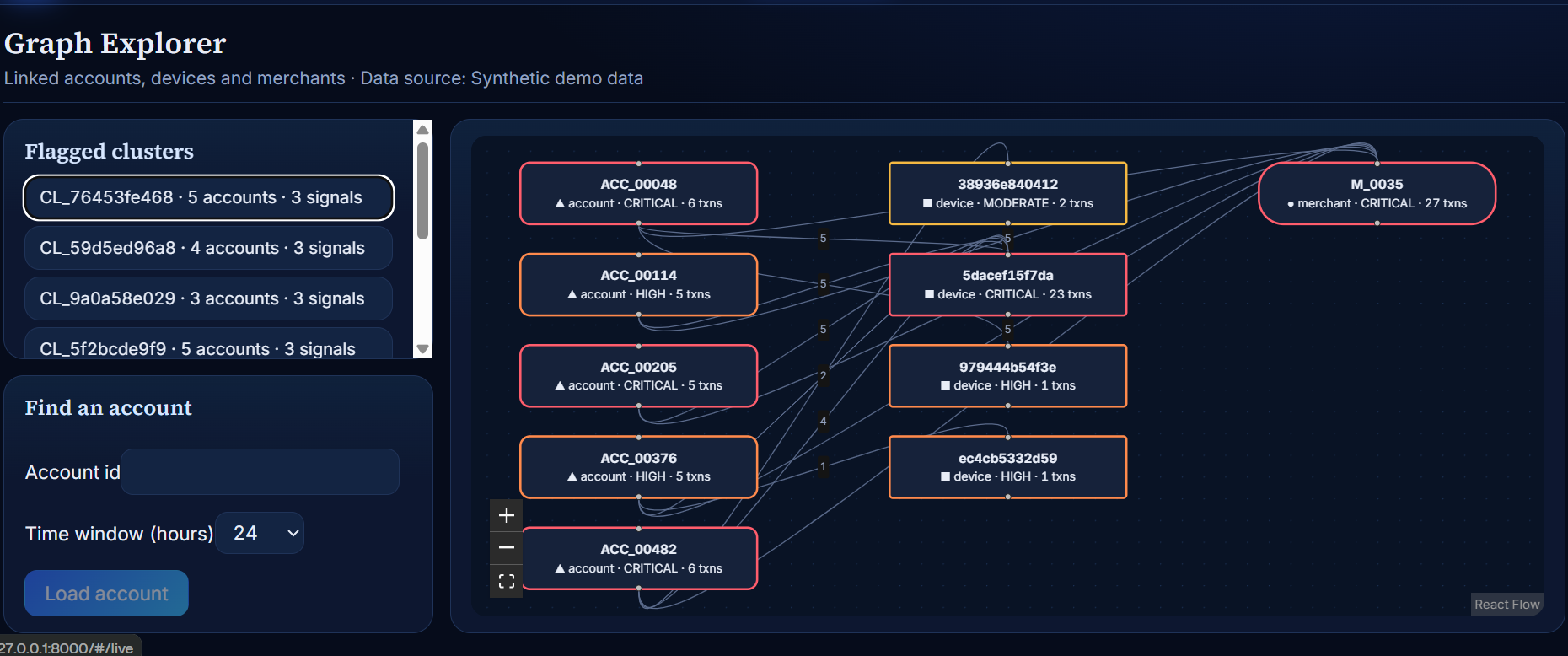
Graph view of the flagged cluster: accounts, devices and merchants linked by shared signals.
-
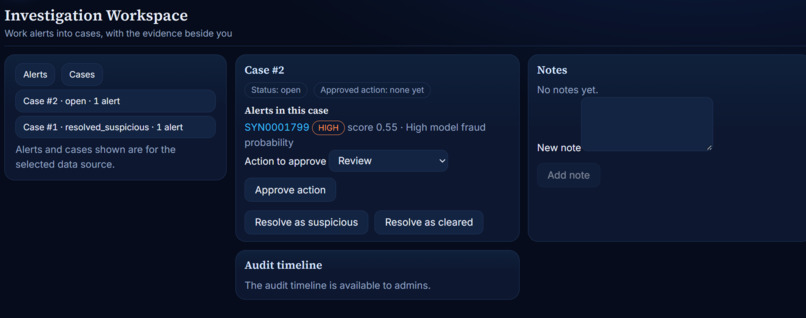
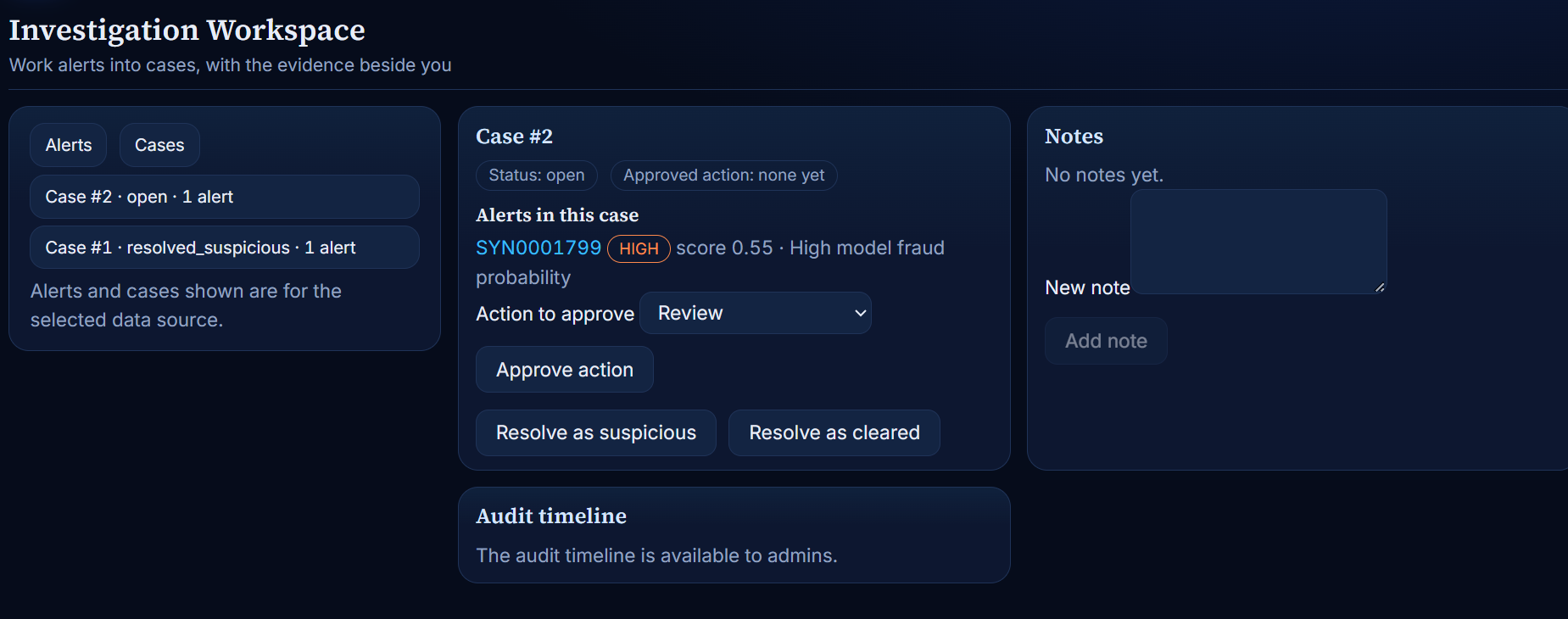
Case view with SHAP risk factors and a Claude report where every claim cites its evidence.
Inspiration
Fraud tools often fail in one of two ways. Some are a black box that blocks a customer and gives no reason. Others are a long pile of alerts that nobody can finish.
I wanted to build a small system that must show its reasoning at every step. I also wanted an AI helper that may only say what it can prove. So the idea was simple: a fraud tool you can audit.
What it does
SENTINEL AI scores each payment as it arrives and helps an analyst decide what to do.
- It gives every payment a risk score from seven signals.
- It finds rings of accounts that share a device and pay the same merchant within minutes.
- It explains each score with named risk factors and SHAP values.
- It takes real PayPal Sandbox payments by webhook and scores them live.
- It uses Claude to write case reports and answer questions. Every claim must cite an evidence id that a tool returned.
- It never blocks anything by itself. A person decides, and every action goes into an audit log.
The risk score is plain arithmetic, so the same input always gives the same answer:
$$ \text{risk} = \sum_{i=1}^{7} w_i \, s_i, \qquad \sum_{i=1}^{7} w_i = 1, \qquad 0 \le s_i \le 1 $$
Here $s_i$ is one signal (for example the model probability or the graph risk), and $w_i$ is its weight from a versioned policy file. A score of $0.20$ or more is MODERATE, $0.40$ or more is HIGH, and $0.65$ or more is CRITICAL.
How I built it
- Backend: Python 3.11, FastAPI, SQLAlchemy and SQLite.
- Models: logistic regression, LightGBM and Isolation Forest. I calibrated the probabilities and used SHAP for explanations.
- Graph: NetworkX with Louvain community detection to find account clusters.
- PayPal: OAuth, Orders v2, and
PAYMENT.CAPTURE.COMPLETEDwebhooks. Each webhook is checked with PayPal's signature verification API before I trust it. - AI: Claude calls ten read-only tools. Its answer is checked, and replies that state fraud as a fact are withheld.
- Frontend: React, TypeScript, Vite, Recharts and React Flow.
- AG Grid: the live feed and the alert triage list are AG Grid tables. Rows update by transaction id, so sorting and filters stay in place while new events stream in. I used only the free Community edition.
One feature extractor serves training, batch scoring and live scoring. Each feature uses only history from before the event, so the model never sees the future.
I built it test-first: 412 backend tests and 124 frontend tests. I also wrote a script that records the demo video from the real app.
Challenges I ran into
- Making the data hard enough. My first fake data was too easy, and the model scored a perfect $\text{PR-AUC} = 1.000$. That was a warning sign, not a win. I made fraud look like normal behaviour and added honest cases such as shared family devices and flash sales. The scores then dropped to realistic values: the LightGBM model reached $\text{PR-AUC} = 0.739$, with recall $0.479$ and precision $0.767$.
- Bugs that only real services showed.
- The first live Claude call failed because a tool schema used a rule the API rejects.
- The first real webhook showed that a PayPal capture has no payer identity. I score it as its own account instead of mixing it into someone else's history.
- Filming the demo showed that live-flagged clusters could not be opened in the graph view.
- Keeping the AI honest. Simple keyword filters for the word "fraud" were easy to get around. So I check claims sentence by sentence, in both reports and chat.
- A steady live table. Filters had to survive streaming rows. Keying each row by transaction id fixed it.
Accomplishments that I'm proud of
- A real PayPal Sandbox payment goes from a signed webhook to a live score on the dashboard.
- Claude's reports cite their evidence, and the system rejects answers that overclaim.
- All five planted fraud rings were flagged. On my synthetic data, $79\%$ of fraud reached HIGH or above, with $89\%$ precision at that level.
- Live scoring takes about $81$ ms at the median and $162$ ms at the 95th percentile.
- I tested everything and wrote down what I did not verify, so the README is honest about its limits.
What I learned
- Honest tests matter. A perfect score usually means the test is too easy.
- Real integrations find real bugs. Mocks passed, but the live services showed problems I had not seen.
- Explainable beats clever. A plain weighted sum is easier to trust, test and explain than a hidden rule.
- AI needs rails. Claude is useful when it can only read, must cite its evidence, and cannot take action.
- Look at both numbers. Precision and recall tell different stories:
$$ \text{precision} = \frac{TP}{TP + FP}, \qquad \text{recall} = \frac{TP}{TP + FN} $$
A tool that misses fraud can still look good on one number alone.
I want to be clear about the limits. About a fifth of planted fraud is missed. The data is synthetic. PayPal is Sandbox only, and I never ran refunds. This is a hackathon prototype, not a production system.
What's next for Sentinel AI
- An approved-case refund flow through PayPal.
- Testing on a public fraud dataset.
- Rate limiting, and Postgres instead of SQLite.
Built With
- ag-grid
- anthropic
- claude
- fastapi
- lightgbm
- networkx
- paypal
- python
- react
- scikit-learn
- shap
- typescript
