-
-
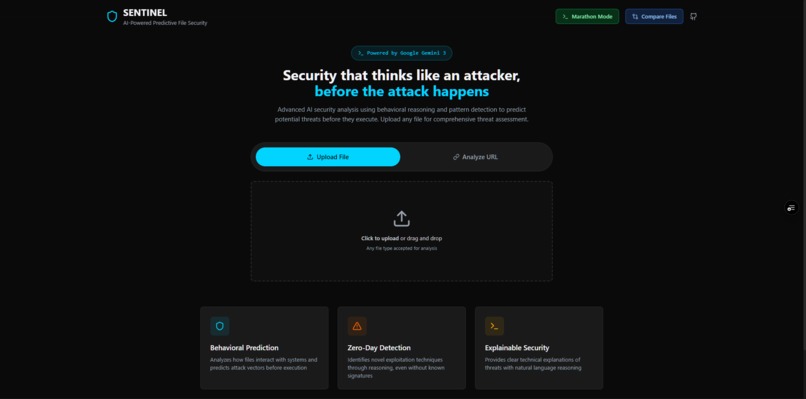
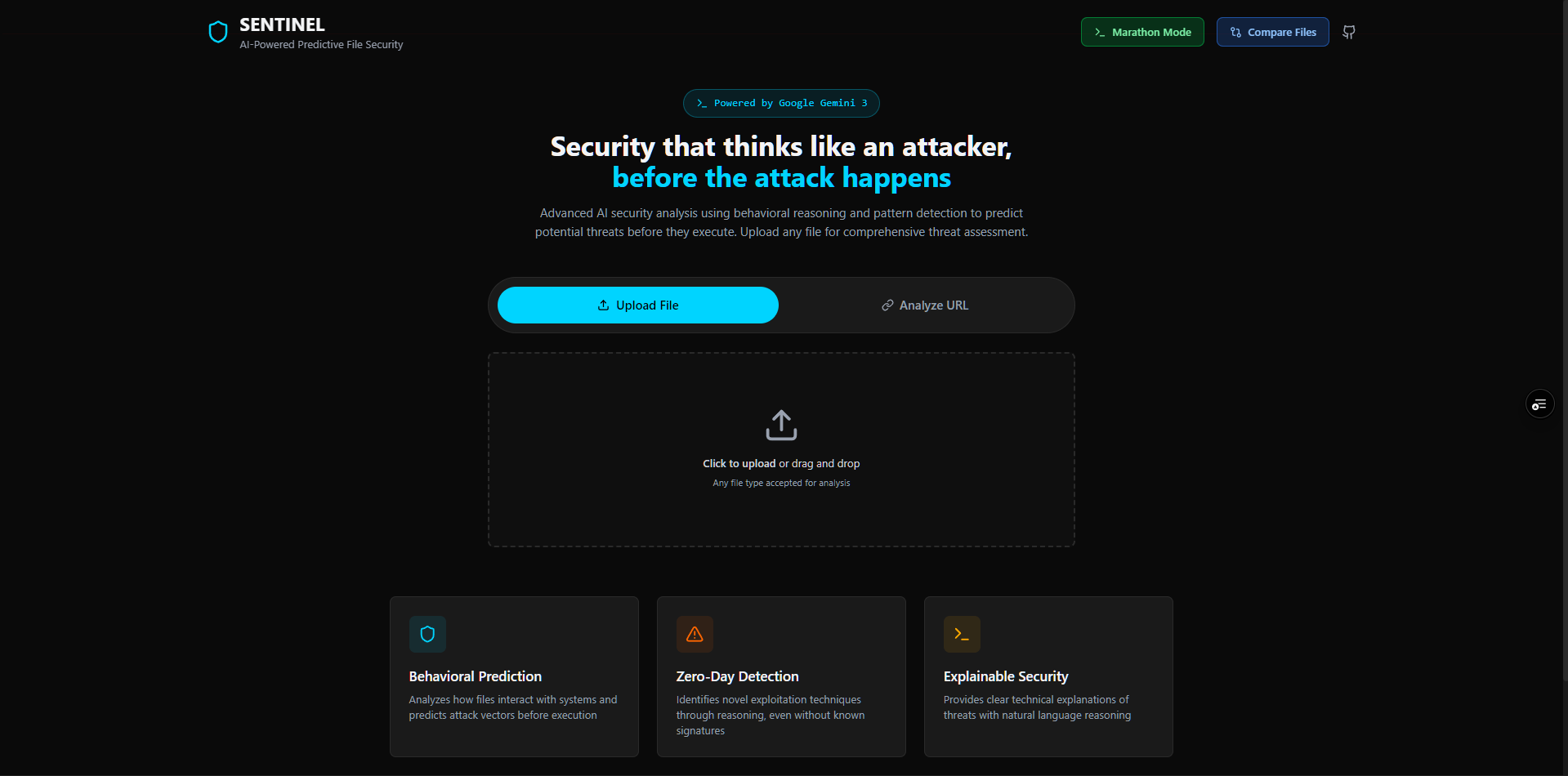
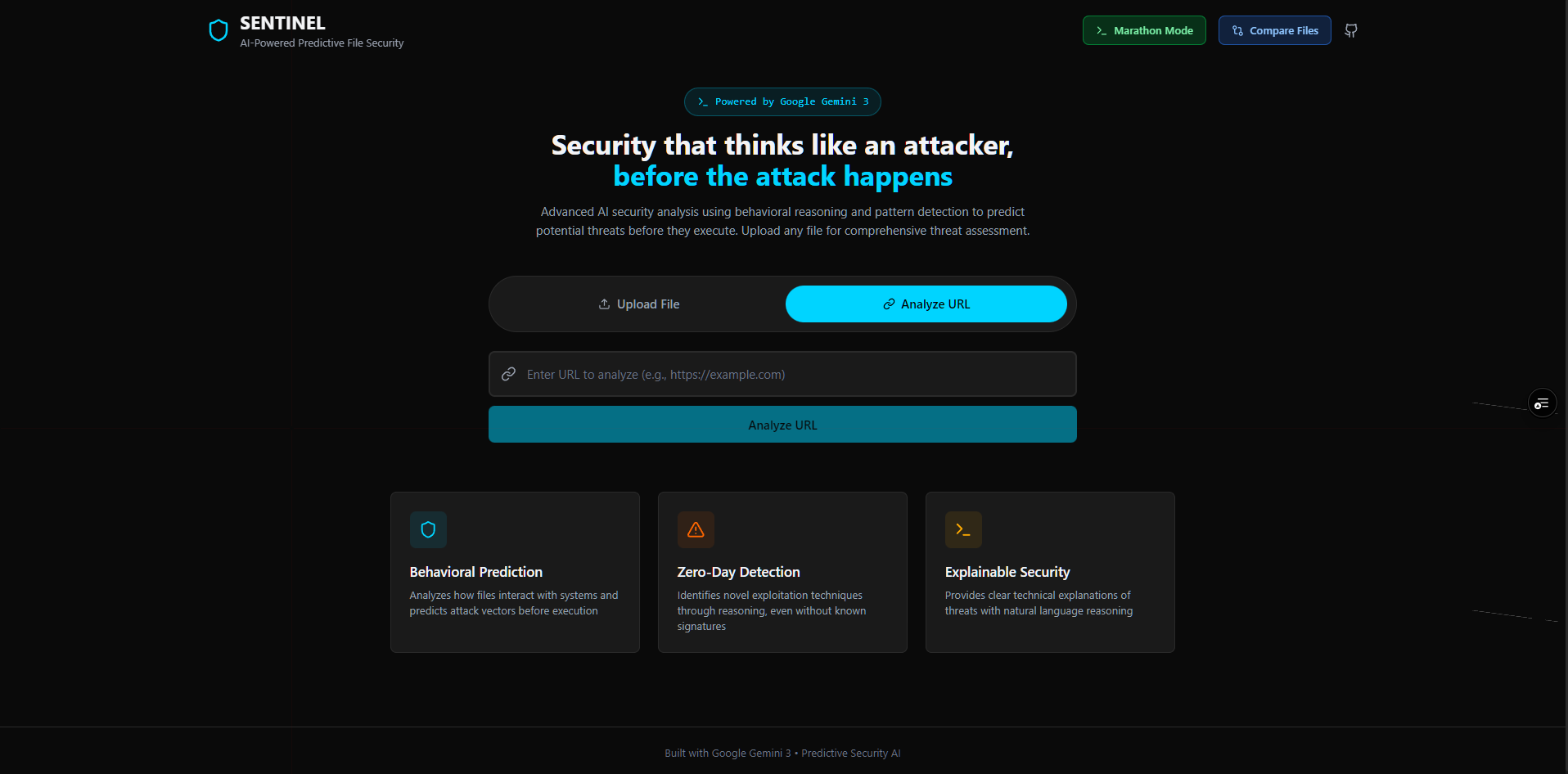
Sentinel AI Homepage
-
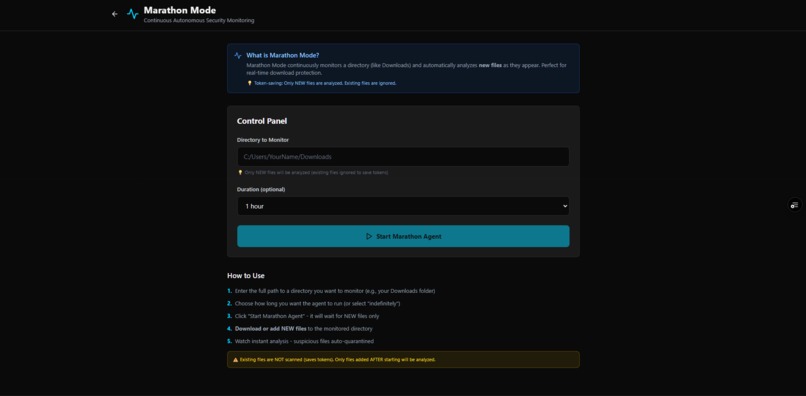
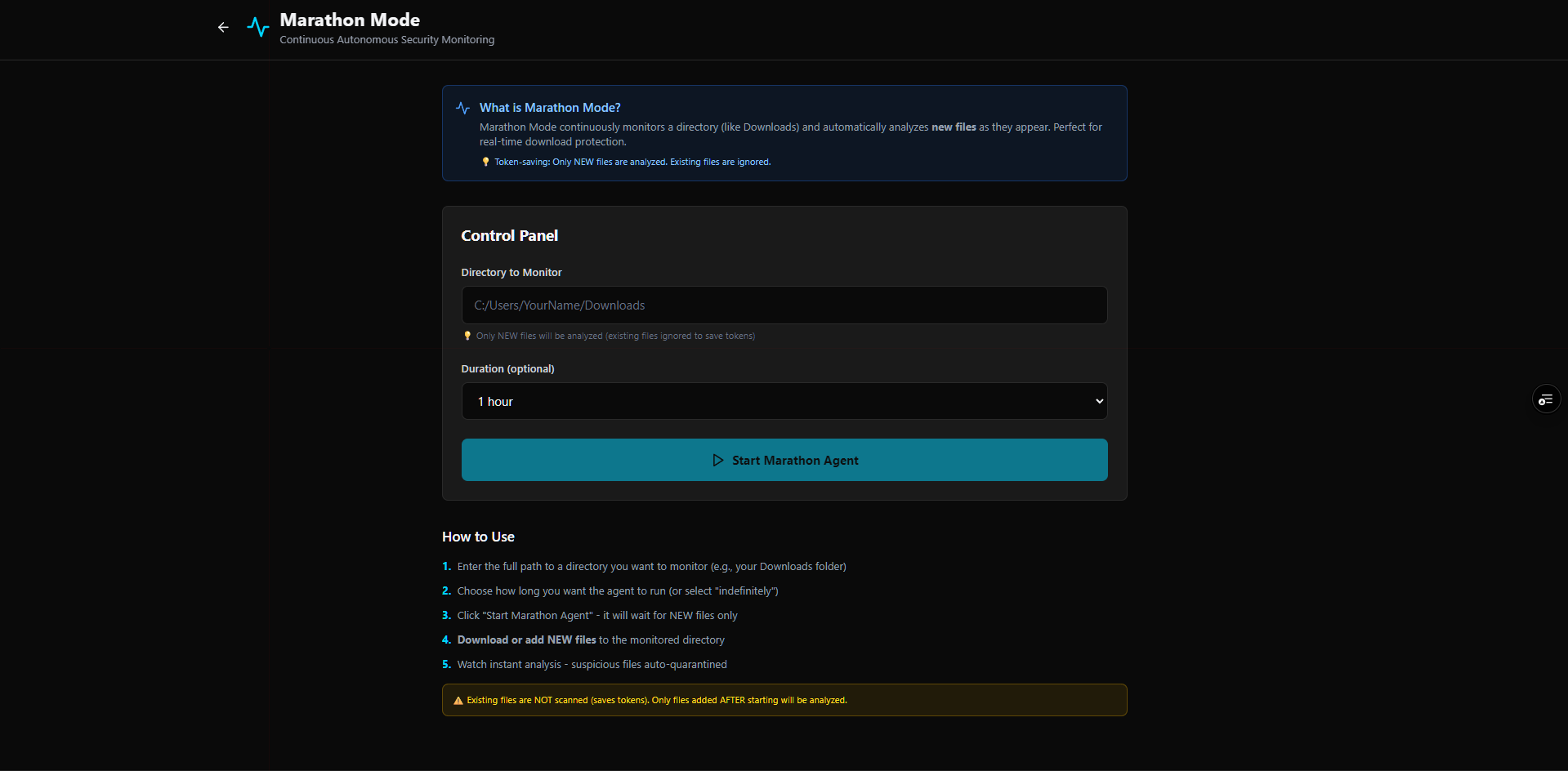
Sentinel Marathon mode
-
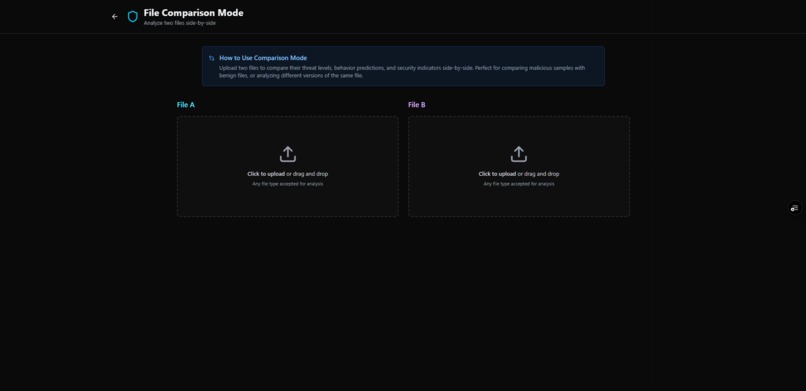
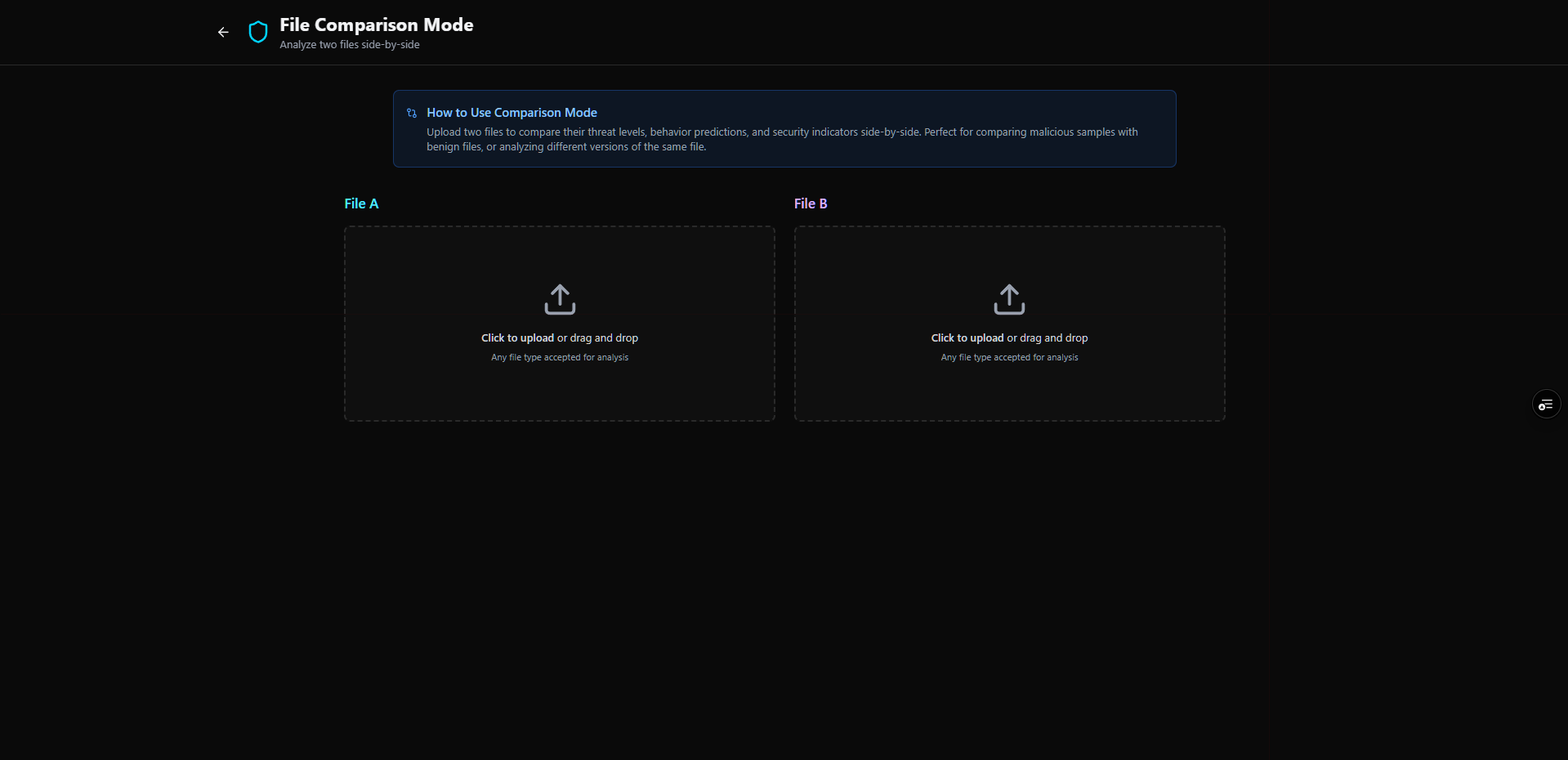
Sentinel Comparison
-
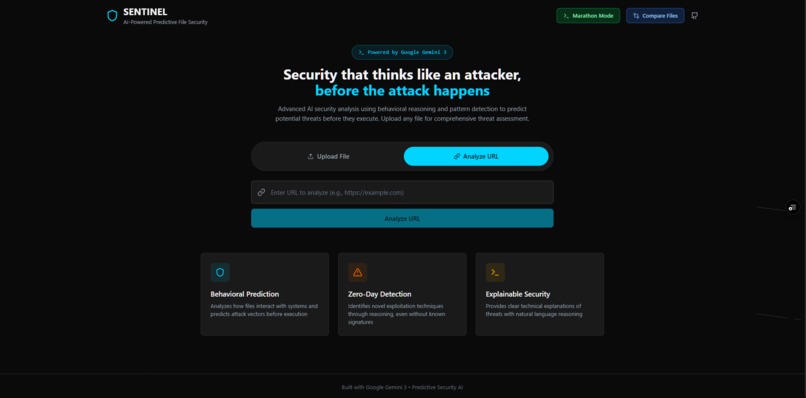
Sentinel URL Analyser
-
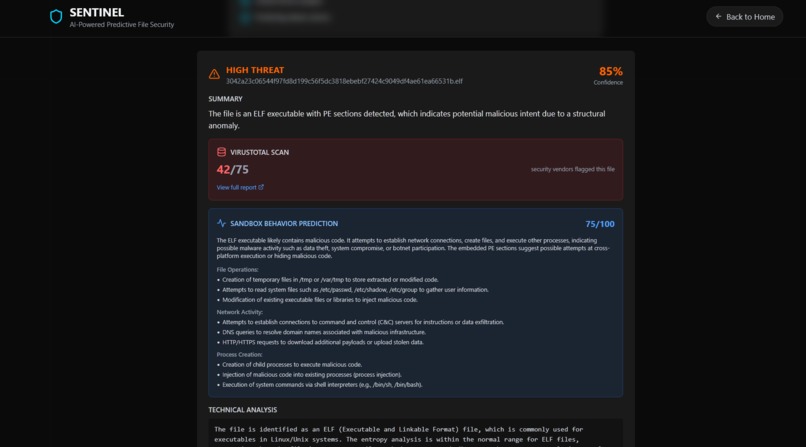
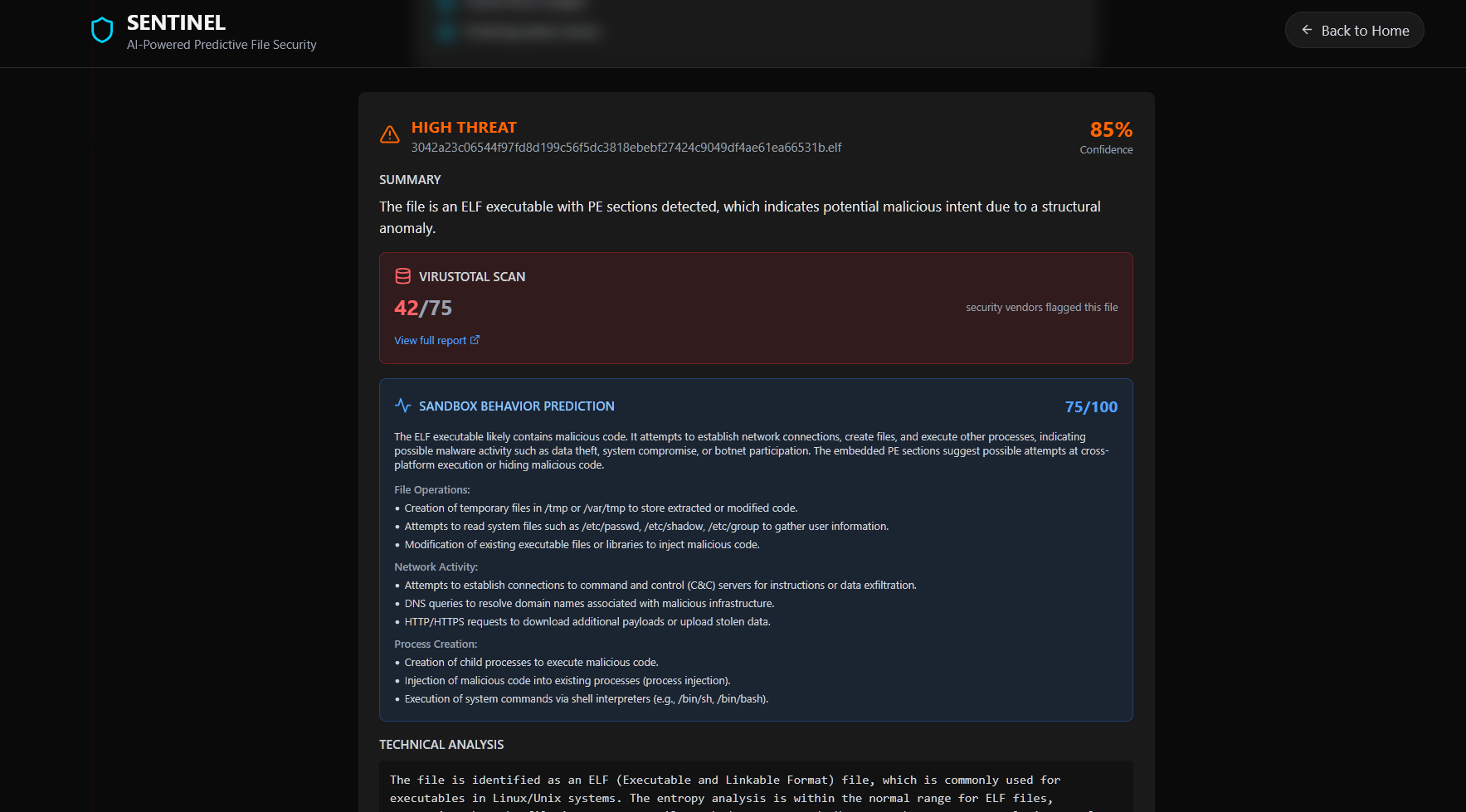
Analysis results
About Sentinel AI
My Journey Building a Marathon Security Agent for the Gemini 3 Hackathon
💡 What Inspired Me
The Background: From SEAL to Sentinel
I've been working on SEAL (Self-Encrypting Autonomous Layer), a file format that embeds post-breach security directly into files themselves. SEAL files are autonomous — they can detect unauthorized database breaches and self-destruct to prevent data leaks. It's a radical approach to security: instead of protecting the perimeter, protect the data itself.
But while building SEAL, I kept coming back to the same frustrating realization: we're always fighting threats after they've already gotten in.
Post-breach security is fundamentally reactive. By the time SEAL detects unauthorized access, the attacker is already inside your system. What if we could predict threats before they execute? What if AI could reason about file behavior and catch malware before it runs?
That question became Sentinel.
The Gemini 3 "Action Era" Spark
When Google announced the Gemini 3 Hackathon with its focus on the "Action Era" — autonomous agents that run for hours or days with self-correction — something clicked.
Traditional security tools are one-shot analyzers:
- Scan file
- Report result
- Done
But real threats evolve. Attackers iterate. False positives pile up. Security needs continuous reasoning, not just instant verdicts.
I realized I could extend Sentinel from a one-shot analyzer into a Marathon Agent — a system that never stops, learns from mistakes, and improves its threat detection over time through autonomous operation.
That's when Sentinel AI was born.
🎓 What I Learned
1. The False Positive Crisis
Early versions of Sentinel had a catastrophic problem: every HEIC image from my iPhone was flagged as a CRITICAL threat.
At first, I thought it was a bug. But when I dug deeper, I realized it was a fundamental design flaw in how I was thinking about threat detection.
The Problem:
- HEIC files have 7.2-7.99 Shannon entropy (extremely high, looks like encrypted malware)
- The magic bytes are at offset 4, not offset 0 (my validator missed them entirely)
- My system automatically labeled unknown formats as "SUSPICIOUS"
- I was measuring entropy without understanding what "normal" means for each format
The Lesson: Raw metrics mean nothing without context. A JPEG with 7.5 entropy is perfectly normal — it's compressed image data. A Word document with 7.5 entropy is malware — documents shouldn't be that random.
I rebuilt the entire validation system with:
- Offset-aware magic byte detection (checking bytes at arbitrary positions)
- Format-specific entropy baselines (HEIC: 7.2-7.99 is normal, PE: >7.0 is suspicious)
- ISOBMFF container parsing to properly identify modern image formats
This taught me that context matters more than raw numbers. Security isn't about thresholds — it's about understanding what's normal for each file type.
2. AI Reasoning ≠ AI Summarization
My initial Gemini integration was embarrassingly naive. I was using AI as a glorified template engine:
"Here's the analysis: entropy=7.8, unknown format, suspicious APIs.
Please summarize this as a threat report."
The hackathon feedback was brutal but accurate: "Gemini is just window dressing here. It's not reasoning, it's summarizing. 5.6/10."
They were absolutely right.
The Fix: I completely restructured how I use Gemini. Instead of feeding it conclusions to rewrite, I give it evidence and ask it to reason:
"Given this file's structure, entropy, and detected patterns,
what would happen if it were executed?

Predict:
- File operations (what would it create/modify?)
- Network activity (what would it connect to?)
- Registry changes (what persistence mechanisms?)

Reason through the attack vector."
Now Gemini analyzes behavior instead of rephrasing my analysis. That's the difference between AI innovation and AI window dressing.
Key Insight: Don't ask AI to make your results sound smart. Ask AI to solve problems you can't solve statically.
3. Multi-Stage Pipelines Beat Monolithic Analysis
From my SEAL project, I learned that security needs specialized layers. You can't just write one checkForMalware() function and call it a day.
Sentinel has two implementations:
Current Production (JavaScript - 6 core stages):
- Magic byte detection (offset-aware, 30+ formats)
- Metadata extraction (SHA-256, size, timestamps)
- Entropy analysis (Shannon entropy 0-8 scale, context-aware)
- Pattern detection (shellcode, Base64 executables, suspicious APIs)
- Weighted threat scoring (evidence-based 0-100 scale)
- AI threat reasoning with Gemini 3.0 Flash (behavioral prediction, not summarization)
Advanced TypeScript Implementation (11 stages): Includes the above 6 stages PLUS:
- Steganography detection (LSB analysis, PNG chunks)
- Polyglot detection (files valid as multiple formats)
- Payload hunting (embedded executables, high-entropy regions)
- VirusTotal validation (70+ AV engines)
- Sandbox behavior prediction (file/network/registry operations)
Each stage is independent and testable. If the VirusTotal API goes down, the other 10 stages still work. If Gemini times out, I still have static analysis results.
Lesson: Modularity isn't just good software engineering — it's critical for reliability in security tools.
4. URL Analysis is Harder Than File Analysis
Adding URL scanning seemed simple: "just fetch the HTML and analyze it."
I was spectacularly wrong.
Real-world URLs are chaos:
- Redirect chains: Shortened links → CDN → final destination (I spent hours debugging infinite redirect loops)
- Dynamic JavaScript: Malicious code that loads after the page renders
- Timeouts and failures: Sites go down, firewalls block you, DNS fails
- Malformed HTML: Parsing broken HTML without crashing is an art form
I spent more time debugging URL edge cases than I did building the entire file analysis pipeline.
Lesson: Files are deterministic. URLs are not. Never assume network operations will behave predictably.
5. Speed vs Thoroughness Tradeoff
I originally built a 3-agent debate system (Prosecutor → Defense → Judge) to showcase Gemini's reasoning. It was architecturally elegant and technically impressive.
It also took 10-15 seconds per file.
Users don't care about architectural cleverness if it's too slow to use. I simplified to a single AI call with structured reasoning: 3-5 seconds, same accuracy.
Lesson: Shipping beats sophistication. The best architecture is the one users will actually use.
6. Marathon Mode ≠ Serverless
The biggest technical revelation came when designing Marathon Mode for the "Action Era" track.
My Assumption: I can deploy everything to Vercel because it's free, fast, and scales automatically.
Reality Check:
- Serverless functions have time limits (Vercel: 10-900 seconds depending on plan)
- Marathon Mode needs to run for hours or days
- Serverless filesystems are ephemeral — files disappear between invocations
- My learning baselines stored in
Map()structures get wiped every request chokidarfile watchers can't run persistent background processes
The Solution: Hybrid architecture:
- Web UI on Vercel (serverless) — Perfect for one-shot file uploads
- Marathon Mode on VPS (traditional server) — Needed for continuous operation
Lesson: Not everything belongs in serverless. Some problems require persistent state, long-running processes, and traditional server architectures. Choose the right tool for the job, not the trendy tool.
🛠️ How I Built It
Phase 1: Core File Analysis (Week 1)
Current Implementation Status:
Built two versions of Sentinel:
Production JavaScript Server (
backend/server.js)- ES modules (required by package.json "type": "module")
- 6 core analysis stages
- Gemini 3.0 Flash Exp for AI reasoning
- Multer for file uploads
- CORS configured for Vercel + local development
- Real-time threat analysis with behavioral prediction
Advanced TypeScript Implementation (
backend/src/)- Full 11-stage pipeline with all advanced features
- Magic Byte Detection (
magic-bytes.ts)- Comprehensive signature database (30+ formats)
- Offset-aware matching (HEIC at offset 4)
- Confidence scoring per match
- Container Parsing (
isobmff-parser.ts)- ISOBMFF parser for HEIC/AVIF/HEIF
- Extracted
ftypboxes to identify brands - Structure integrity validation
- Entropy Analysis (
format-baselines.ts)- Shannon entropy (0-8 scale)
- Format-specific baselines (HEIC: 7.2-7.99, JPEG: 6.8-7.8, PE: <7.0)
- Abnormal entropy flagging
Phase 2: Advanced Threat Detection (Week 2)
TypeScript-Only Advanced Modules (backend/src/analyzers/):
Steganography Detector (
steganography-detector.ts)- JPEG DCT coefficient LSB analysis
- PNG ancillary chunk extraction (
tEXt,zTXt,iTXt) - Appended data detection after EOI/IEND markers
Polyglot Detector (
polyglot-detector.ts)- Detected files valid as multiple formats simultaneously
- Flagged dangerous combinations (PDF+JavaScript, JPEG+PE)
- Calculated security risk level
Payload Hunter (
payload-hunter.ts)- Shellcode pattern detection (x86/x64 opcodes)
- Base64 blob detection and decoding
- Embedded PE header scanning
- High-entropy region analysis
Note: The production JavaScript server includes basic pattern detection for shellcode and Base64 executables, but the TypeScript version has more sophisticated analysis.
Phase 3: External Integrations (Week 3)
AI Integration (Both Versions):
All versions now use Gemini 3.0 Flash Exp for behavioral threat analysis:
- JavaScript version: Direct integration with behavioral prediction
- TypeScript version: Enhanced with multi-agent debate system (optional)
TypeScript-Only External Services:
VirusTotal Integration (
virustotal-client.ts)- SHA-256 hash checking against 70+ AV engines
- Detections count and engine breakdown
- Respects API rate limits (4 requests/minute on free tier)
Sandbox Predictor (
sandbox-predictor.ts)- Uses Gemini to predict execution behavior without running code
- Predicts: file operations, network activity, registry changes, process creation
- Risk score 0-100 with behavior summary
URL Analysis (Both Versions):
- JavaScript: Basic URL threat analysis using Gemini
- TypeScript: Enhanced with redirect tracking and HTML parsing
Phase 4: Marathon Mode (Week 4)
The big architectural shift:
Marathon Agent (
marathon-agent.ts)- Built 6-stage autonomous investigation loop:
- Initial quick scan
- Suspicion detection (threshold: MEDIUM+)
- Deep investigation (multi-iteration self-correction)
- Learning application (adjust baselines)
- Final decision (multi-factor reasoning)
- Autonomous action (quarantine if needed)
- Built 6-stage autonomous investigation loop:
Continuous Learning System
- Threat baselines stored in
Map<fileType, baseline> - Entropy ranges adjust with each new sample
- Confidence increases over time (up to 100%)
- Threat baselines stored in
File Watcher Integration
- Uses
chokidarfor directory monitoring - Only watches NEW files (ignoreInitial: true) to save API tokens
- Automatic quarantine to
.quarantine/directory
- Uses
Phase 5: Frontend & Polish (Week 5)
Built the user interface:
React Frontend (TypeScript + Tailwind CSS)
- File upload with drag-drop
- URL input with validation
- Real-time analysis pipeline visualization
- Threat card with detailed results
- Analysis side panel with technical details
- Comparison mode for side-by-side analysis
Integration Testing
- Tested with EICAR test file
- Validated HEIC false positive fix
- Tested polyglot detection with crafted samples
- URL analysis with real phishing sites (in VM)
🚧 Challenges I Faced
Challenge 1: HEIC Detection at Offset 4
Problem: HEIC/HEIF/AVIF files have their magic bytes at offset 4, not offset 0. My validator only checked offset 0, so all iPhone photos were classified as "unknown format" and flagged as suspicious.
Solution:
const SIGNATURES = [
  { ext: 'heic', magic: [0x66, 0x74, 0x79, 0x70], offset: 4 }, // 'ftyp'
  { ext: 'jpeg', magic: [0xFF, 0xD8, 0xFF], offset: 0 },
  // ...
];
Then built an ISOBMFF parser to extract the ftyp brand and validate container structure.
Challenge 2: TypeScript Buffer Configuration
Problem: Node.js buffers didn't work in TypeScript without proper configuration. Got constant errors:
Property 'from' does not exist on type 'Buffer'
Solution:
Added to tsconfig.json:
{
  "compilerOptions": {
    "types": ["node"],
    "lib": ["ES2022"]
  }
}
Challenge 3: Context-Aware Pattern Matching
Problem: Searching for suspicious strings like "CreateProcess" flagged every PDF because PDF metadata often contains those strings as plain text.
Solution: Built context-aware detection:
- Executables: Flag suspicious API calls in code sections
- PDFs: Ignore text content, only flag embedded executables
- Images: Flag appended executables or embedded scripts
The same string means different things depending on file type and location.
Challenge 4: Balancing Speed and Thoroughness
Problem: Initial multi-agent AI debate system (Prosecutor → Defense → Judge) was thorough but took 10-15 seconds per file.
Solution: Simplified to single AI call with structured reasoning. Still provides transparent explanations, but 3x faster (3-5 seconds).
Tradeoff: Less "impressive" architecture, but way more usable. Users care about results, not implementation elegance.
Challenge 5: Marathon Mode Architecture for Serverless
Problem: Designed Marathon Mode with continuous file watching, learning baselines, and multi-day operation. Naively assumed I could deploy everything to Vercel.
Reality:
// This doesn't work on Vercel
this.watcher = chokidar.watch(watchPath, { persistent: true }); // Killed after 900s
this.threatBaselines = new Map(); // Wiped between requests
maxRuntime: 30 * 60 * 1000; // 30 minutes (Vercel max: 15 min)
Serverless platforms:
- Kill functions after 10-900 seconds
- Have ephemeral filesystems
- Don't support background processes
- Reset memory between invocations
Solution: Hybrid deployment:
- Web UI + single-file API → Vercel (perfect for one-shot analysis)
- Marathon Mode → VPS/traditional server (needed for persistent operation)
Lesson: Design with deployment constraints from the start, not as an afterthought, So my solution to test marathon is to download the github dir and run the project locally.
Challenge 6: Gemini API Rate Limits and Costs
Problem: During development, I was making 100+ API calls per testing session. Costs added up quickly, and rate limits hit during peak testing.
Solution:
- Implemented aggressive caching for repeated file analyses
- Added
ignoreInitial: trueto file watcher (only analyze NEW files) - Created mock responses for unit testing
- Added environment variable to skip Gemini in tests
Lesson: Always design with API costs in mind. Every call costs money and counts against rate limits.
🏆 Why This Project Matters
Sentinel AI represents a shift in how we think about security:
Traditional Approach:
- Wait for malware to appear
- Analyze signatures
- Update signature database
- Repeat
Problem: Always reactive. Zero-days slip through.
Sentinel's Approach:
- Reason about file structure and behavior
- Predict what would happen if executed
- Learn from false positives over time
- Continuously improve without human intervention
Advantage: Proactive prediction, not reactive matching.
Marathon Agent Possible Capabilities:
- Runs for days/weeks without stopping
- Self-corrects when evidence is contradictory
- Learns baselines for each file type automatically
- Autonomous decisions (quarantine without human approval)
- Temporal context (knows what's normal based on history)
This aligns perfectly with Google's "Action Era" vision: autonomous systems that maintain continuity across multi-step tool calls without human supervision.
🚀 Current Status & What's Next
✅ Completed:
- Dual Implementation Strategy
- Production JavaScript server (6 core stages) - Fast, lightweight, ready for deployment
- Advanced TypeScript implementation (11 stages) - Full feature set for power users
- CORS Configuration - Fixed for Vercel deployment
- Environment Configuration - Proper .env setup for both local and production
- Gemini 3.0 Flash Integration - Latest model with behavioral reasoning
- File Upload Pipeline - Working end-to-end analysis
Immediate Post-Hackathon:
- Merge TypeScript features into production JavaScript server selectively
- Add rate limiting to prevent API abuse
- Implement caching for repeated file analysis
- Persistent storage for threat baselines (save to JSON/database)
- Web dashboard for live Marathon Mode metrics
- Historical analysis to show learning improvements over time
Future Vision:
- Chrome Extension - Analyze downloads before they hit disk
- Email Integration - Scan attachments inline in Gmail/Outlook
- YARA Rule Support - Custom pattern matching for security teams
- ML Model Training - Train on malware corpus for pattern recognition
🙏 Acknowledgments
- Google Gemini Team - For building an API that can actually reason about security threats, not just generate text
- VirusTotal - For the free API tier that made external validation possible
- Security Research Community - For openly sharing detection techniques and malware analysis methodologies
📝 Final Reflection
Building Sentinel taught me that security isn't about perfect detection — it's about continuous improvement.
Traditional security tools try to be right 100% of the time on day 1. They fail because threats evolve faster than signatures can be updated.
Sentinel embraces imperfection. It makes mistakes (HEIC false positives), learns from them (format-specific baselines), and gets better over time (confidence scoring). That's what makes it a Marathon Agent instead of a one-shot analyzer.
The "Action Era" isn't about building systems that never fail. It's about building systems that learn from failure and keep improving autonomously.
That's the future of security. That's Sentinel AI.
Built by Legend Testimony for the Gemini 3 Global Hackathon


Log in or sign up for Devpost to join the conversation.